Sunday, September 17, 2006

Photos: Sister Leonella Sgorbati

May she rest in peace and may she be blessed with the palm of martyrdom.


The body of late nun Leonella (only first name available) in the hospital, Sunday, Sept 17, 2006. An Italian nun was shot dead at a mothers' and children's hospital by unidentified Somali gunmen, doctors said Sunday. Hospital doctor Mohamed Yusuf said the nun was shot in the back. The nun's bodyguard was also killed, doctors told The Associated Press. The nun, who has not been identified, was shot at the entrance to the hospital in northern Mogadishu by two gunmen armed with pistols, Dr. Yusuf said . (AP Photo/Mohamed Sheikh Nor)

The body of an Italian nun, sister Leonella Sgorbati, is carried to an ambulance in Mogadishu, September 17, 2006. Gunmen killed the nun at a children's hospital in Mogadishu on Sunday in an attack that drew immediate speculation of links to Muslim anger over the Pope's recent remarks on Islam. The Catholic nun's guard also died from pistol shots in the latest attack on foreign personnel in volatile Somalia. REUTERS/Shabelle Media (SOMALIA)

Fellow Italian nuns of slain Catholic sister Leonella Sgorbati line up to board the plane carrying her body as all the nuns working at the SOS hospital were evacuated from Mogadishu September 17, 2006. REUTERS/Shabelle Media

This undated photo provided Sunday, Sept. 17, 2006 by the family of Sister Leonella, shows Italian nun Sister Leonella, right, sitting with an unidentified aunt in Rezzanello di Gazzola, near Piacenza, Italy. Gunmen killed Sister Leonella and her bodyguard Sunday at the entrance of the hospital where she worked in Mogadishu, Somalia, officials said _ an attack some feared could be linked to Muslim anger toward Pope Benedict XVI. (AP Photo/Courtesy of family, ho)

Khatami at Harvard


short article at the Harvard University Gazette

The former president of Iran was in town last Sunday to give a lecture at the Kennedy School of Government. There were protests outside; what did the average Cambridge citizen think of it all?

His lecture has not yet been archived yet. (I don't know what the reason for the delay is. Perhaps they don't have enough people working on the website.)

Mohammad Khatami profile
His website
KSG
"Dialogue Among Civilizations"

Even though human beings inevitably inhabit a certain historical horizon, we could still aim at meta-historical discourse. Indeed, a meta-historical discussion of eternal human questions ? such as the ultimate meaning of life and death or goodness and evil ? ought to substantiate and enlighten any dialogue on political and social issues. Without a discussion of fundamentals, and by simply confining attention to superficial issues, dialogue would not get us far from where we currently stand. When superficial issues masquerade as real, urgent and essential, and where no agreement, or at least mutual understanding, obtains among parties to dialogue concerning what is truly fundamental, in all likelihood misunderstanding and confusion will proliferate instead of any sense of empathy and compassion.

The movement of ideas and cultural interaction and interpenetration recur in human history as naturally and persistently as the emigration of birds in nature. Translation and interpretation have always proved to be one of the prime venues for the movement of ideas. The subtlety lies in cases where the language under translation or interpretation sounds the same as the one we use today, whereas the world, or universe of discourse to which the two languages belong, has changed over time. Particular difficulty arises when one of the parties to the dialogue attempts to communicate with another by employing a basically secularist language in an essentially sacred and spiritual discourse. By secularism here I mean the general rejection of any intuitive spiritual experience and any faith in the unseen. The true essence of humanity is more inclusive than language, and this more encompassing nature of the existential essence of humanity makes it meaningful to hope for fruitful dialogue.


So what fundamentals does Khatami adhere to? And what interpretation of Islam? And does his interpretation of Islam admit of true dialogue and agreement with other traditions?

Assorted photos. I must admit that I like his clothing.
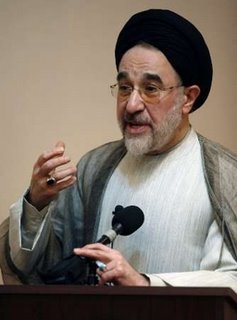
Former Iranian President Mohammad Khatami speaks at the Bait ul Ilm Islamic center in Streamwood, Illinois September 2, 2006. Reuters/John Gress (UNITED STATES)
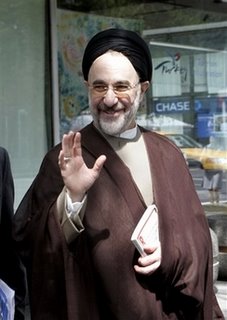
Former Iranian President Mohammed Khatami leaves a meeting with the United Nations Alliance of Civilizations at the offices of the Turkish Mission to United Nations in New York, Wednesday, Sept. 6, 2006. Khatami is taking part in a United Nations conference Tuesday and Wednesday. (AP Photo/David Karp)
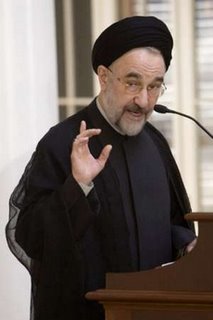
Former Iranian President Mohammad Khatami addresses an invitation-only audience in the Dome Room of the Rotunda on the Grounds of the University of Virginia in Charlottesville, Virginia, September 7, 2006. Khatami's visit was sponsored by the University's Institute for Advanced Studies in Culture. FOR EDITORIAL USE ONLY NO SALES NO ARCHIVE REUTERS/Dan Addison/U.Va. News/Handout (UNITED STATES)
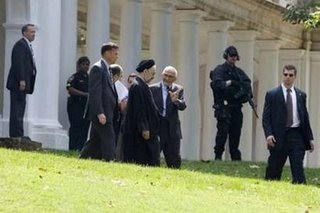
Former Iranian President Mohammad Khatami (C) and Professor of Religious Studies Abdulaziz Sachedina (3rd R) leave the Dome Room of the Rotunda after delivering an address at the University of Virginia in Charlottesville, Virginia, September 7, 2006. Khatami's visit was sponsored by the University's Institute for Advanced Studies in Culture. FOR EDITORIAL USE ONLY NO SALES NO ARCHIVE REUTERS/Eric Kelley/University of Virginia/Handout (UNITED STATES)
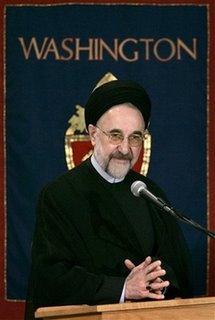
Former Iranian President Mohammad Khatami speaks during a press conference at Washington National Cathedral Thursday, Sept. 7, 2006. Khatami is the most senior Iranian to travel outside New York in the United States since Islamic fundamentalists seized the U.S. Embassy in Tehran in 1979 and held Americans hostage for 444 days. (AP Photo/Charles Dharapak)
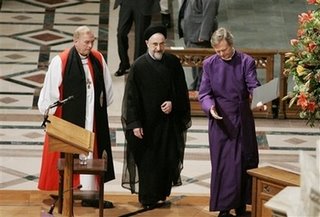
Former Iranian President Mohammad Khatami, center, is escorted by Rev. Samuel T. Lloyd III, Dean of Washington National Cathedral, right, and Rev. John Bryson Chane, Bishop of Washington, left, before Khatami spoke at Washington National Cathedral Thursday, Sept. 7, 2006 in Washington. (AP Photo/Charles Dharapak)
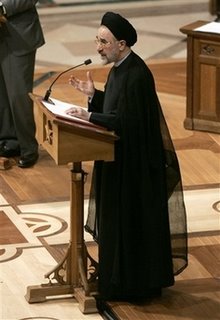
Former Iranian President Mohammad Khatami speaks at Washington National Cathedral Thursday, Sept. 7, 2006 in Washington. (AP Photo/Charles Dharapak)
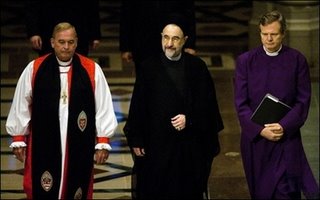
Reverend John Bryson Chane (L) and Reverend Samuel Lloyd III (R) walk with former Iranian president Mohammad Khatami before a speech at the National Cathedral in Washington, DC. Khatami, the most senior Iranian to visit the United States in 25 years, said dialogue between top Iranian and US officials will only happen when both sides stop verbally assaulting each other.(AFP/Brendan Smialowski)
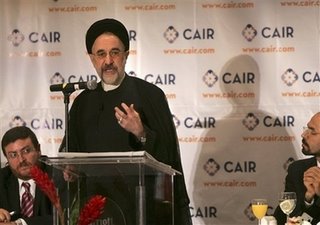
Former Iranian President Mohammad Khatami makes remarks at the Council for American Islamic Relations dinner, Friday, Sept. 7, 2006, in Arlington, Va.(AP Photo/Lawrence Jackson)
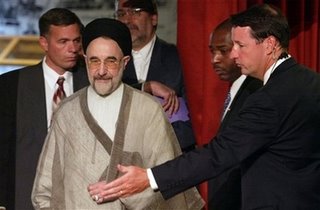
Former Iranian President Mohammad Khatami, left, arrives at Harvard University's John F. Kennedy School of Government, Sunday, Sept. 10, 2006, in Cambridge, Mass. Khatami discussed 'Ethics of Tolerance in the Age of Violence.' (AP Photo/Bizuayehu Tesfaye)
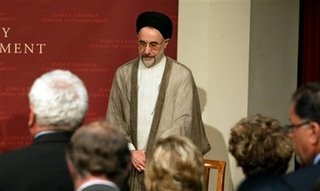
Former Iranian President Mohammad Khatami observes a moment of silence at Harvard University's John F. Kennedy School of Government, Sunday, Sept. 10, 2006 in Cambridge, Mass., for victims of the Sept. 11, 2001 terrorist attacks. (AP Photo/Bizuayehu Tesfaye)
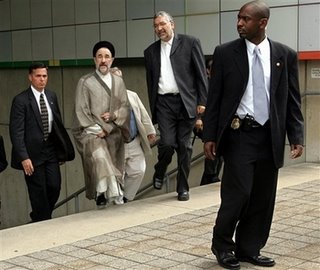
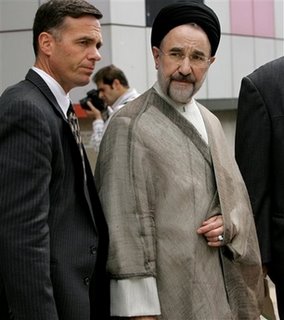
Former Iranian President Mohammed Khatami, right, is escorted by security as he departs the Media Laboratory on the campus of Massachusetts Institute of Technology, in Cambridge, Mass., Monday, Sept. 11, 2006. In a speech at Harvard University, in Cambridge, Sunday, Sept. 10, 2006, Khatami condemned Osama bin Laden for committing crimes in the name of Islam. (AP Photo/Steven Senne)
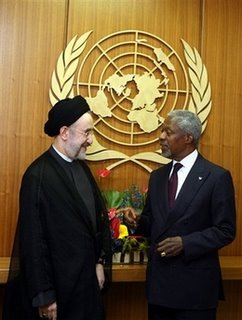
United Nations Secretary-General Kofi Annan, right, meets with former Iranian President Mohammed Khatami at the U.N. headquarters, Tuesday, Sept. 12, 2006. (AP Photo/Mary Altaffer)
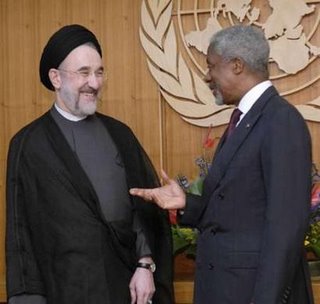
REUTERS/Chip East
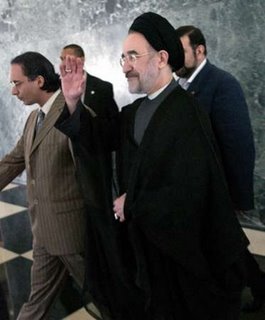
Former Iranian President Mohammed Khatami waves as he leaves after a meeting with U.N. Secretary-General Kofi Annan at the United Nations in New York September 12, 2006. REUTERS/Chip East (UNITED STATES)

New trailer for Curse of the Golden Flower

at Apple

Will this be better than Zhang Yimou's House of Flying Daggers?

Reviews for The Banquet have not been so good; while it is pretty, critics have lambasted the plot and the acting. At the rate at which these fantasy epics are failing, I think I might have to watch historical dramas produced in the Mainland instead...

Bishop Giampaolo Crepaldi on Christianity and globalization

Christianity and Globalization

Vatican Official Offers Guidelines

ROME, SEPT. 16, 2006 (Zenit.org).- A book published this summer offers a summary of the Church's view on globalization. In just over 100 pages Bishop Giampaolo Crepaldi, secretary of the Pontifical Council for Justice and Peace, brings together some of the main points made by Popes John Paul II and Benedict XVI on this complex theme, as well elements taken from other Church documents.

The book, published in Italian by Edizione Cantagalli, is entitled "Globalizzazione: Una prospettiva cristiana" (Globalization: A Christian Perspective). The text starts by noting that the Church has so far not published a systematic treatment of globalization. Instead, there are numerous speeches and documents that touch on the issue.

The lack of a Church document exclusively devoted to globalization does not mean, however, that the Church has neglected the subject. In the past the social encyclicals dealt with universal social principles regarding economic activity. In recent times the first explicit treatment of globalization is contained in John Paul II's 1991 encyclical, "Centesimus Annus."

Globalization affects our daily lives, but at the same time its dynamics often remain difficult to understand, comments Bishop Crepaldi in the book's opening chapter. For example, are economic inequalities between various countries and regions caused by globalization, or are they due to the poorer nations not entering sufficiently into the globalized world?

An understanding of globalization is rendered difficult in part because of our being caught up in a process that is still developing, and whose outcome is unclear. But a more serious underlying problem is that of deficiencies in our capacity to govern, due to a lack of an ethical vision to guide governments.

It is precisely this ethical perspective that the Church offers as its contribution to society. John Paul II commented that globalization in itself is neither good nor bad, but that its impact will depend on decisions made by us. Therefore, governing globalization calls for wisdom, not just empirical data, noted John Paul II.

A common ethical foundation to guide globalization would be based on our universal human nature. The anthropological foundation is important to recognize in order to avoid the error of cultural relativism regarding values. In the face of globalization the Church reminds the world of the globality of human nature and of the need for a universal solidarity between all peoples.

3 mistakes

Bishop Crepaldi then dedicates a chapter looking at three mistakes made in analyzing globalization. The first of these, a sort of economic determinism, consists in considering globalization as a sort of undeniable process that leaves us with no room to maneuver. We can feel impotent in the face of changes that come about far removed from our control. For this reason it is necessary that international organizations and the more powerful nations not impose on the poorer and weaker countries economic changes that do not take into account local needs and problems.

The Church also asks for respect for local traditions and cultures and not to impose a globalization based only on economic criteria. It is vital also that the human person be the main protagonist in the process of development. This requires full respect for human liberty and not reducing people to mere economic instruments.

In this way globalization is seen not as a technical question, but as a process to be guided by people. Economic and technical processes may well bring us closer, but not necessarily more united. And if they are made absolutes, they risk dividing, not uniting, humanity.

A second mistake is a reductionism that simply blames all problems and social changes on globalization without an adequate analysis of each situation. The impact of globalization on many aspects of our lives cannot be denied, admits Bishop Crepaldi, but it is wrong to simply blame all the world's ills as stemming from it.

Many countries have benefited from globalization and it is not necessarily the case that the economic advances of one nation result from impoverishing another. The problems of underdeveloped countries often stem from a complex series of factors, not all of them economic.

The third mistake is similar to the second, and consists in thinking that by now all is globalized. There are, nevertheless, sectors of economic activity that are not integrated globally. In addition, hand in hand with globalization there has been an increased emphasis on local and regional identities.

A new culture

To avoid these and other mistakes globalization requires a new culture that can orient the changes. This "new culture" was called for by John Paul II who explained that this consists both in discerning the positive cultural elements already in existence, and in proposing new cultural elements.

Discernment is needed in order to avoid accepting a vision of globalization that sees itself as part of a postmodern process in which liberty is given an absolute value and a place for tradition and religion is denied. For its part the Church proposes a culture based on a Christian anthropological vision that has as its objective the construction of a new humanity.

Globalization has also brought with it an increased attention to the fundamental principles of the Church's social teaching developed in past decades. Concepts such as the universal destiny of earthly goods and the common good have now acquired a new relevance and urgency in the face of debates regarding globalization.

The Church also proposes the concept of moral authority in dealing with globalization. The changes at a global level have brought to the forefront questions regarding progress and goods on a universal scale that need to be somehow reconciled according to a hierarchy of values. This in turn requires a correct understanding of human dignity and rights that is not possible, however, if we accept a system based on ethical relativism.

The universal moral principles derive from our common nature. Discerning the content of these principles is not an easy process. But if globalization is not guided by moral principles, then it will result in all sorts of injustices.

Solidarity

Another essential aspect of the Church's teaching on globalization is the promotion of solidarity. A global solidarity that will ensure all peoples can benefit from the economic changes taking place. Christian solidarity consists in making ourselves responsible for the welfare of others. It is more than compassion or sentiments, as it calls for a full reciprocity in human relationships.

The unity of humanity is evident from the moment of creation, when we read in Genesis that God created man and we thus have a common point of origin. Our common destiny is also evident in the incarnation, when Christ becomes man to save humanity.

Christ's message not only makes evident the unity between all people, but also our common brotherhood. In the final analysis human unity is founded on the Trinitarian unity. Seen in this perspective the increased interdependence resulting from globalization acquires a new dimension, which saves it from a merely technical or economic reductionism.

Along with solidarity the Church also teaches the importance of subsidiarity. This means avoiding an excessive concentration of power at higher levels, allowing institutions such as the family, local communities and ethnic groups sufficient autonomy to carry out their functions.

Globalization, therefore, needs to be a process guided by respect for human liberty. A globalization thus oriented by Christian principles will result in a harmonious unity of the human family.

Rorate Caeli on B16's clarification

Here

"These in fact were a quotation from a medieval text, which do not in any way express my personal thought."

Oh really?

The New Catholic also includes this update:
Update 3: Sister Leonella (Rosa) Sgorbati, a 65-year-old Italian nun, of the Consolata Missionaries, who worked in a hospital in Mogadishu, Somalia, was martyred today by Muslim forces (picture provided and hosted by Corriere della Sera). She was also one of four nuns who cared for approximately 400 children in the main orphanage of the city.
The press statement by Fr. Federico Lombardi, S.J.:

Vatican Statement on Pope's Words About Islam

"A Clear and Radical Rejection of the Religious Motivation for Violence"

VATICAN CITY, SEPT. 15, 2006 (Zenit.org).- Here is the press statement released Thursday by Jesuit Father Federico Lombardi concerning the interpretation of certain passages of the Holy Father's address at the University of Regensburg.

* * *

Concerning the reaction of Muslim leaders to certain passages of the Holy Father's address at the University of Regensburg, it should be noted that what the Holy Father has at heart -- and which emerges from an attentive reading of the text -- is a clear and radical rejection of the religious motivation for violence.

It was certainly not the intention of the Holy Father to undertake a comprehensive study of the jihad and of Muslim ideas on the subject, still less to offend the sensibilities of Muslim faithful.

Quite the contrary, what emerges clearly from the Holy Father's discourses is a warning, addressed to Western culture, to avoid "the contempt for God and the cynicism that considers mockery of the sacred to be an exercise of freedom" (homily, Sept. 10). A just consideration of the religious dimension is, in fact, an essential premise for fruitful dialogue with the great cultures and religions of the world.

And indeed, in concluding his address in Regensburg, Benedict XVI affirmed how "the world's profoundly religious cultures see this exclusion of the divine from the universality of reason as an attack on their most profound convictions. A reason which is deaf to the divine and which relegates religion to the realm of subcultures is incapable of entering into the dialogue of cultures."

What is clear then, is the Holy Father's desire to cultivate an attitude of respect and dialogue toward other religions and cultures, including, of course, Islam.

[Original text: Italian; translation issued by the Holy See]

Review of Our Happy Time

A Superior Weepie About the Meaning of Compassion

The film “Our Happy Time,” which went on general release on Thursday, tells a doomed love story between a woman who longs for death and a man who is being forced to face it against his will. The movie has all the typical elements of a melodrama, and the simple plot makes it easy to predict what the two have been doing and will be doing next -- and that is just what happens. What makes the movie special is the undeniable charm of the two young stars and the director’s ability to express nuances. The film is an excellent choice for those who are looking for a weepie this fall.

Lee Na-young and Kang Dong-won pose for a photo during a press conference for the film ‘Our Happy Time’ on Tuesday.

After failing to kill herself for the third time, Lee Na-young’s character comes to visit Kang Dong-won’s character, a prisoner sentenced to death. Imprisoned for murdering three people, his initial response to her is cold, but soon the walls between them break down and they tell each other of their painful past. Lee and Kang, whose strength lies in expressing the weaknesses of human beings, are ideally cast in a film about understanding and love between those with an excruciating pain in their heart.

A poster for “Our Happy Time”

Lee proves that she is fully capable of taking the lead in a film. She confesses a past that she has been hiding in sentences broken by the difficulty of doing so. That is what makes it so moving. Where “queen of tears” Jeon Do-yeon expresses her characters’ pain by weeping copiously, Lee desperately tries to fight her tears. Kang also acquits himself more than honorably by perfectly inhabiting a character where audiences can focus on his acting rather than his pretty face. Since ambition is the first step to becoming a great actor, Kang’s future in the craft looks bright.

Song Hae-seong, who directed “Failan,” again showcases his uncanny ability to understand when he should make his audiences cry or wipe their tears away. His skill in showing changes in the character’s view of life with seemingly trivial actions adds vitality to the well-worn story. This melodrama is less about love than about compassion: both rich and poor, killers and suicides are entitled to our compassion. While it cannot save the dying, it can be a warm blanket that helps them withstand the sense of futility in life. But wait: isn’t compassion the very thing that lies at the heart of love?

(englishnews@chosun.com )


Korean-American Skater Brings Comeback Tour to Seoul


Scotch toast: Torquhil Ian Campbell, left, the 13th Duke of Argyll in the United Kingdom and hereditary master of the royal household in Scotland, toasts VIP customers with Royal Salute whiskey in the courtyard of the British Embassy in Seoul, Wednesday. /Courtesy of Jinro Ballantine’s 09-14-2006 14:28


New BMW coupe: Models, including actress Lim So-young, showcase BMW’s Z4 Coupe, a premium sports car, at the Convention & Exhibition Center in Samsong-dong, southern Seoul, Thursday. /Courtesy of BMW Korea 09-14-2006 20:04

Business - September. 15, 2006

BMW’s new two-seater sports car Z4 3.0si unveiled at COEX in Samseong-dong, Seoul on Thursday./Yonhap


Michelle Wie of Honolulu watches an errant tee shot Thursday on the 13th hole during the first round of the 84 Lumber Classic golf tournament at Mystic Rock Golf course in Farmington, Pa. / AP-Yonhap


Korean submarine: Sailors line up on the Navy's 1,200-ton submarine the SS 066 Lee Jong Mu anchored at the port of Chinhae, South Kyongsang Province, Thursday. The submarine built in 1996 has posted an all time record for the Navy of 10 years without any accidents at sea. /Yonhap 09-14-2006 20:10

Culture - September. 15, 2006

Students of Bongrae Elementary School in Malli-dong, Seoul read in the schoolyard on Thursday morning.

Photos: Italian and Spanish soldiers in Lebanon


An Italian soldier, part of the U.N. peacekeeping forces, stands at a checkpoint in Ras al-Ain village near the port city of Tyre (Soure) in southern Lebanon September 14, 2006. REUTERS/Ali Hashisho (LEBANON)

Italian soldiers from the U.N. Interim Force receive communion from military chaplain Marco Galante during their first Catholic mass at a military base near the village of Maraka in southern Lebanon September 10, 2006. REUTERS/Peter Andrews (LEBANON)

An Italian soldier from the U.N. Interim Force carries a cross after their first Catholic mass at a military base near the village of Maraka in southern Lebanon September 10, 2006. REUTERS/Peter Andrews (LEBANON)

An Italian soldier of the United Nations Interim Force patrols a road near the village of Srifa in southern Lebanon September 10, 2006. REUTERS/Alessandro Bianchi (LEBANON)

An Italian U.N. soldier walks with an espresso coffee kettle in their U.N. camp in Kalaway, in southern Lebanon,Tuesday, Sept. 5, 2006. More than 800 Italian troops had reached Lebanon by Monday, the first large wave of international peacekeepers, bringing the total number of U.N. forces in Lebanon to 3,250, including the 2,000 troops who had been there before the fighting and 250 French troops who arrived last week. (AP Photo/Karel Prinsloo)

Italian soldiers embark on a plane at Pisa military airport before flying to Lebanon. More Italian troops have been deployed in Lebanon as part of the first major reinforcement in nearly 30 years of the UN mission monitoring a truce between Israel and the Shiite militant group Hezbollah.(AFP/Nico Casamassima)

Italian U.N. soldiers arrive at Beirut's airport September 3, 2006, on their way to their United Nations mission in southern Lebanon. REUTERS/Reinhard Krause (LEBANON)

An Italian U.N. soldier guides a truck into position, Sunday, Sept. 3, 2006 in the southern Lebanese town of Naqoura. Italian troops, trucks and armored personnel carriers landed Sunday in Lebanon as the arrival of the first large contingent of international peacekeepers entered its second day after being delayed by rough seas south of the capital. (AP Photo/Karel Prinsloo)

An Italian U.N. soldier mans machine guns as a landing craft prepares to come ashore, Sunday, Sept. 3, 2006 in the southern Lebanese town of Naqoura. Italian troops, trucks and armored personnel carriers landed Sunday in Lebanon as the arrival of the first large contingent of international peacekeepers entered its second day after being delayed by rough seas south of the capital.(AP Photo/Karel Prinsloo)

(AP Photo/Karel Prinsloo)


Spanish soldiers, joining a U.N. peacekeeping force being expanded to patrol the south alongside the Lebanese army, patrol next to the their base at the village of Aadchit el Qoussair in southern Lebanon September 16, 2006. REUTERS/Alessandro Bianchi (LEBANON)

A UNIFIL Spanish soldier holding a M60 machine gun stands guard near navy divers as Lebanese boy looks on, during an assessment patrol at the Rest House Hotel beach in the southern Lebanese city of Tyre, Thursday, Sept. 14, 2006. Around 570 Spanish soldiers should be landing Friday in Tyre. Spain's contribution to the UN Interim Force in Lebanon (UNIFIL) is the third largest by a European Union state. (AP Photo/Francois Mori)


(AP Photo/Francois Mori)

UNIFIL Spanish navy divers walk out of the water as Lebanese girl Zainab looks on, during an assessment patrol at the Rest House Hotel beach in the southern Lebanese city of Tyre, Thursday, Sept. 14, 2006. Around 570 Spanish soldiers should be landing Friday in Tyre. Spain's contribution to the UN Interim Force in Lebanon (UNIFIL) is the third largest by a European Union state. (AP Photo/Francois Mori)

Neon Genesis Evangelion


One of the most popular anime series of the 90s, it was even aired in the Bay Area on KTEH 54 for a while. Pete Takeshi has a love-hate relationship with the anime, hate like many other fans because of how it ended. I never got into the show because of its take on religion. Pete Takeshi once gave a name for its stance, but I've forgotten it. Learn more about the anime through wiki or the Guide-to NGE.

More resources:
Neon Genesis Evangelion | Anime.com Anime Shrines
Eva Monkey, The Ultimate Evangelion Resource Site
Neon Genesis Evangelion
Google Directory - Arts > Animation > Anime > Titles > N > Neon ...
Neon Genesis Evangelion - Mahalo

Galleries:
Images from Usenet
AnimeGalleries.net
Neon Genesis Evangelion Images
Anime Cubed 3.0
Neon Genesis Evangelion Gallery - page 1
Anime Project Alliance Gallery - Neon Genesis Evangelion
FerriCorp v5 - Neon Genesis Evangelion Gallery
Jeff's Neon Genesis Evangelion Gallery
Evabeast.com
Neon Genesis Evangelion: Image Galleries

Edit:
for the live-action adaptation: Weta Workshop // Neon Genesis Evangelion - Gallery
Digik Gallery - Gallery: Neon Genesis Evangelion 2008 Calendar

YouTube - Fanime 1999 - #27 Ayanami Rei Neon Genesis ...

Anime Resources:
anipike
anime archive
Novastorm