Our One-Track Mind by John Thomas
Settling by Scott Croft
Bowing to Convenience by Krishana Kraft
The easy access and comforts of our culture have seeped from retail stores and fast-food restaurants and become a way of life.
Perfect Happy Bubble by Candice Watters
Many of the answers to your questions are highly unrealistic. How are we, as young adults, to realistically put what you advise into practice?
Saturday, July 05, 2008

Rorate Caeli: All hail the Holy Constable!
From Tradition in Action: Blessed Nuno Alvares Pereira, Nun'Alvares Pereira, Plinio Correa ...

NY Times: Tablet Ignites Debate on Messiah and Resurrection
via NOR
Of course there are the academics who, with the tablet as evidence (of what, it is not yet clear), speculate about its contents in such a way as to contradict the divine origin of Christ and the Gospel. Richard Dawkins has a link. Could there be one or several oral traditions regarding the coming of the Messiah, one separate from expectations of a political savior? Could not such traditions (even if they were misunderstood because the words were understood incorrectly -- Israel referring to the nation instead of the 'new' people of God, the Church, and so on) be a preparation for the coming of Christ?
Edit: photo here

Dominic Buettner for The New York Times
When David Jeselsohn bought an ancient tablet, above, he was unaware of its significance.
Department of Archaeology - Prof. Yuval Goren
An Alternative Interpretation of the Stone Tablet with Ancient ...
Professor Daniel Boyarin, University of California, Berkeley, Near ...
Israel Knohl (wiki)
evangelicalinerrancy.com: BCE tablet: Messiah to rise in three days!
Free Internet Press :: Tablet Ignites Debate On Messiah, Resurrection
via NOR
Of course there are the academics who, with the tablet as evidence (of what, it is not yet clear), speculate about its contents in such a way as to contradict the divine origin of Christ and the Gospel. Richard Dawkins has a link. Could there be one or several oral traditions regarding the coming of the Messiah, one separate from expectations of a political savior? Could not such traditions (even if they were misunderstood because the words were understood incorrectly -- Israel referring to the nation instead of the 'new' people of God, the Church, and so on) be a preparation for the coming of Christ?
Edit: photo here
Dominic Buettner for The New York Times
When David Jeselsohn bought an ancient tablet, above, he was unaware of its significance.
Department of Archaeology - Prof. Yuval Goren
An Alternative Interpretation of the Stone Tablet with Ancient ...
Professor Daniel Boyarin, University of California, Berkeley, Near ...
Israel Knohl (wiki)
evangelicalinerrancy.com: BCE tablet: Messiah to rise in three days!
Free Internet Press :: Tablet Ignites Debate On Messiah, Resurrection
Scouse!
First learned of it in reference to actor David Morrissey. (Not sure if he is speaking with the accent in Sense and Sensibility.) Tom Baker and Paul McGann are also mentioned as being Scouse actors.
WHAT IS SCOUSE?
Paul McGann Estrogen Brigade
The eighth Doctor Who - Paul McGann
Paul McGann Page
gallery for the TV movie
First learned of it in reference to actor David Morrissey. (Not sure if he is speaking with the accent in Sense and Sensibility.) Tom Baker and Paul McGann are also mentioned as being Scouse actors.
WHAT IS SCOUSE?
Paul McGann Estrogen Brigade
The eighth Doctor Who - Paul McGann
Paul McGann Page
gallery for the TV movie

Culture in Macross Frontier


How will music save the human fleet in Macross Frontier? Music is the embodiment of culture (and also of emotion and love) in the Macross universe. Intelligent (or rational) creatures aren't the only ones who appreciate or are affected by it, as Macross Zero shows--there's a very strong connection between music and the spirit, what animates or gives life in all its forms (spiritia energy!).
The warrior races, the Zentrans and Meltrans, are converted through their exposure to music, having known only war-making prior to their contact with the humans. In a sense the Zentraedi are like the Spartans, priding themselves on their excellence in war (and missing out on everything important), while the humans are the Athenians, in so far as they have an appreciation for the fine arts. It must be remarked, though, that there is not much philosophizing in the Macross universe, and no religion. This is another story in which humans were created not by God, but by an alien intelligence.
One would prefer to think of culture as a tool and transmitter of intelligence, but how rational can culture in the Macross universe be when the warring Zentrans and Meltrans are turned into lovesick idol fans? (To witness Meltrans becoming giddy fans like high school teens, see the "Fleet of the Strongest Women" and the results of Basara Nekki's work.) Hence, their conversion is more an emotional one than a spiritual one; it is the suppression of their appetite for violence through the use of other emotions, rather than through reason and the will. Those who have a strong appetite for violence come to acquire other strong desires, particularly lust. (As we see in the original Macross series, with Quamzin Kravshera [Khyron]). But what sci-fi story these days does not reduce reason to feeling, human nature to a competition between different emotions?
The Vajra are apparently some sort of bio-weapon--whether they were created by the humans or by the Protoculture or developed on their own has not yet been revealed, though there is a hint that the humans had a hand in some sort of experimentation upon them. The drones are said to have no intelligence of their own, being directed by something else. Would this be the queen, or some other entity? Are they sentient? It is difficult to see how they could not be, if they are able to construct ships.
Fans have been pointing out how the scene with the Vajra queen recalls Aliens. The struggle between the humans and the Vajra is similar to the Starship Troopers movie (and cartoon), Starcraft, and a host of other science-fiction stories and games.
Are the Vajra lifeforms native to foldspace? Have they been genetically engineered or manipulated? By whom? Can there be harmony between sentient beings? This seems to be a sci-fi version of the Fall: subrational creatures turning against their creators, usually because they have a legitimate grude--being mistreated by their creators and masters, and so on. Does this part of the plot serve as a warning against genetic manipulation and the abuse of technology through human pride? Are the humans following the footsteps of Protoculture, whose creations also turned against it?
Will music once again transform enemies by re-establishing the harmony that should exist between all living things? Is Macross more consonant with a Buddhist worldview than one proper to Western sci-fi? Perhaps these questions will be answered in time, along with the following:
What is the connection between Ranka, the purple crystals, and the strange aura that glows in her abdominal region?
What did Grace mean in episode 13, "The hate grows." She is fostering hate between whom? All factions involved? The humans and the Zentraedi?
Macross Zero: Arkan
Macross Mecha Manual
Mecha Profiles
Macross 7 | Nekki Basara | Mylene Jenius | Fire Bomber | Spiritia
Macross 7 - Wikipedia, the free encyclopedia
Zenit: Sacred Music that Serves the Word of God (Part 1)
Sacred Music that Serves the Word of God (Part 1)
Father Samuel Weber on Sacred Music Institute
By Annamarie Adkins
ST. LOUIS, Missouri, JULY 4, 2008 (Zenit.org). Parish music directors -- and congregations -- in the Archdiocese of St. Louis soon will benefit from Archbishop Raymond Burke’s recent initiative: The Institute for Sacred Music.
Archbishop Burke, who has since been named to head the Apostolic Signature, the Church's supreme court, appointed Benedictine Father Samuel Weber as the first director of the new institute earlier this year.
Father Weber is a professor in the divinity school of Wake Forest University in North Carolina and also a monk of the St. Meinrad Archabbey in Indiana.
In Part 1 of this interview with ZENIT, Father Weber discusses how the Institute for Sacred Music will try to restore Gregorian chant’s “pride of place” in the liturgy.
Part 2 of this interview will appear Sunday.
Q: Why did Archbishop Burke found the Institute for Sacred Music? What is its mission?
Father Weber: As Archbishop Burke explained, he established the institute to help him to cultivate more fully sacred music in the celebration of the complete Roman Rite.
The Institute will have many activities. First, it will form programs of sacred music, especially Gregorian chant, for parish musicians, musicians of other archdiocesan institutions and interested individuals.
Second, it will assist parishes with the singing of the Mass in English, for example, the entrance antiphon, the responsorial psalm and the Communion antiphon. Third, it hopes to foster the singing the Liturgy of the Hours.
A fourth activity of the institute is assisting parishes that wish to develop a "schola cantorum" for singing Gregorian chant; a fifth goal is aiding the full implementation of the English translation of the Roman Missal in the archdiocese.
Lastly, the institute aims to give particular assistance to the programs of sacred music at the Cathedral Basilica of St. Louis and at Kenrick-Glennon Seminary.
Q: Is there a difference between sacred music and religious music?
Father Weber: Although the two terms are often used interchangeably, we can make a distinction.
Sacred music, properly speaking, is music that is united to a sacred text -- especially psalms and other scriptural texts and texts of the Mass, such as the Introit, Gloria, Sanctus, Agnus Dei, etc., and it includes certain traditional hymns that are -- or have been -- part of the official liturgical books.
The authority of the Church must confirm all the liturgical texts; these sacred words are not to be altered in setting them to music.
All sacred music is “religious music,” obviously. But religious music would encompass everything from classic hymns to contemporary songs with a religious theme in a wide variety of styles and varying quality. Not all religious music is suitable for sacred worship, certainly.
Ultimately, it is the responsibility of competent authority -- i.e., the bishop or the Holy See -- to determine the suitability of all religious music for sacred worship, even though parish musicians will usually choose the music for a parish Mass and other liturgical celebrations.
All Church musicians need to be able to make truly informed choices about appropriate music for use in the liturgy, based on authentic Church teaching. This is not always easy, nor is the choice simply a matter of taste.
Q: Many complain about popular or secular forms of music creeping into the liturgy, but this has been a perennial problem for the Church. What causes this recurring problem, and how have the great renaissances in sacred music such as those fostered by Palestrina and Pope St. Pius X turned the tide?
Father Weber: Yes, you could say that the concern about secular -- or frankly anti-Christian -- musical styles supplanting sacred music in worship is perennial -- though it may manifest itself differently in different cultures and historical periods.
For example, in early centuries, all music other than chanting was strictly forbidden by Church authorities, because use of musical instruments had strongly pagan associations.
In the 19th century, the style of opera had so greatly influenced Church music that Pope St. Pius X warned strongly against this “profane” music, and forbade composing music imitating operatic styles. He initiated the 20th Century Liturgical Movement by his 1903 document, “Tra le Sollecitudini.”
In particular he encouraged Gregorian chant, which he said in the third paragraph of the document, “has always been regarded as the supreme model for sacred music,” thus “it is fully legitimate to lay down the following rule: The more closely a composition for Church approaches in its movement, inspiration and savor the Gregorian form, the more sacred and liturgical it becomes; and the more out of harmony it is with that supreme model, the less worthy it is of the temple.”
It was Pope Pius X, also, who coined the phrase “active participation” of the people. And he also said in paragraph five of the document that “modern music is also admitted to the Church, since it, too, furnishes compositions of such excellence, sobriety and gravity, that they are in no way unworthy of the liturgical functions.”
After the Second Vatican Council it was the pop and folk style music of the late 1960s and 1970s that dominated newly composed music for worship -- Catholic and Protestant. Despite the Constitution on the Liturgy’s emphasis on the “pride of place” for Gregorian chant in the liturgy, the council’s teaching was ignored, and chant virtually disappeared.
The reasons for this are many and complex. But one major element was plain confusion and misunderstanding. The liturgical reform following the Council was astoundingly rapid, and serious upheavals in the secular world of those times also affected the anti-authoritarian mood within the Church.
This was played out dramatically in the liturgy. Changes were made precipitously with too little consultation with the bishops.
During the papacy of Pope John Paul II, we began to see a sober reassessment of the post-conciliar liturgical changes, culminating in his last encyclical, “Ecclesia de Eucharistia.”
The present “renaissance” in liturgical music we are now seeing is in large part due to Pope Benedict XVI and his many scholarly works on the subject even before he became pope.
The historic heritage of sacred music, then, always serves as an indispensable teacher and model of what best serves the celebration of sacred worship, and leads worshipers to greater holiness.
Rod Dreher on the Aristotelianism of Wall-E
"Wall-E": Aristotelian, crunchy con
the movie's official site
At first I wasn't sure if I wanted to pay the price of a theater ticket to watch the movie (and what man wants to be watching the movie alone, in a movie full of children?); then I discovered that it is also being distributed by Disney. (Did the nieces enjoyed Disneyland?) So I will probably wait until it's out on DVD.
the movie's official site
At first I wasn't sure if I wanted to pay the price of a theater ticket to watch the movie (and what man wants to be watching the movie alone, in a movie full of children?); then I discovered that it is also being distributed by Disney. (Did the nieces enjoyed Disneyland?) So I will probably wait until it's out on DVD.
Rosalind Creasy, More food, less lawn - save money with an edible landscaping plan
I’ve seen it happen time and time again. People who are on a tight budget think they cannot afford to spend a lot of money on the landscaping; so they go to the nursery, buy a package of grass seed, and turn most of their yard into a large lawn. There are few things you can do, particularly in the West, that will cost you more over the long run.
original
original
Rhonda Vincent at Clinchfest 2008
Rhonda Vincent and the Rage play Clinchfest 08. (song 1)
Rhonda Vincent and the Rage play Clinchfest 08. (song 2)
Clinch Mountain Music Festival - June 13-15, 2008
Rhonda Vincent and the Rage play Clinchfest 08. (song 2)
Clinch Mountain Music Festival - June 13-15, 2008
AT&T Blue Room: Rhonda Vincent interview (part 1 of 4)
Rhonda, Rage and Rounder Artists Round up at 2008 SPBGMA awards
Rhonda Vincent ~ I Gotta Start Somewhere
Edit: Via the Bluegrass Blog--Rhonda live online--her performance and interviews on Unplugged at Studio 330.
Rhonda, Rage and Rounder Artists Round up at 2008 SPBGMA awards
Rhonda Vincent ~ I Gotta Start Somewhere
Edit: Via the Bluegrass Blog--Rhonda live online--her performance and interviews on Unplugged at Studio 330.
'Daddy' vs 'Papa'
I prefer the latter for myself (because of its presence in Latin and other Romance languages, and its link to pater), though it would appear that in Latin there is a similar-sounding diminutive for the former-- from Wiki: tata, tatae (m) -- but first declension! I have heard da in movies about the Irish, but I did not know that dad is Welsh.
Father is one of those words that has clear cognates in other Indo-European languages. (The replacement of p with f for the word appears to be common to all Germanic languages?)
(Concise Oxford Dictionary of English Etymology)
Wiki for PIE and Indo-European languages
Proto-Indo-European Language Demonstration and Exploration Website
PROTO INDO-EUROPEAN
Indo-European and the Comparative Method
Indo-European Documentation Center: What is (Proto-)Indo-European?
Indo-European Language Family Tree
Lynch, Indo-European Language Family Tree
Indo-European Home Page
Indo-European Etymological Dictionary (IEED)
Wordgumbo: Comparative Indo-European
Indo-European Language Resources
UCLA Program in Indo-European Studies
Proto-Indo-European verbs conjugation
Journal of Indo-European Studies
Characterization of the Germanic Language Family
Fricatives!
Father is one of those words that has clear cognates in other Indo-European languages. (The replacement of p with f for the word appears to be common to all Germanic languages?)
(Concise Oxford Dictionary of English Etymology)
Wiki for PIE and Indo-European languages
Proto-Indo-European Language Demonstration and Exploration Website
PROTO INDO-EUROPEAN
Indo-European and the Comparative Method
Indo-European Documentation Center: What is (Proto-)Indo-European?
Indo-European Language Family Tree
Lynch, Indo-European Language Family Tree
Indo-European Home Page
Indo-European Etymological Dictionary (IEED)
Wordgumbo: Comparative Indo-European
Indo-European Language Resources
UCLA Program in Indo-European Studies
Proto-Indo-European verbs conjugation
Journal of Indo-European Studies
Characterization of the Germanic Language Family
Fricatives!
Kow Yokoyama, Maschinen Krieger
For Pete Takeshi:

Kow Yokoyama has done models and pictures of armored suits and such.


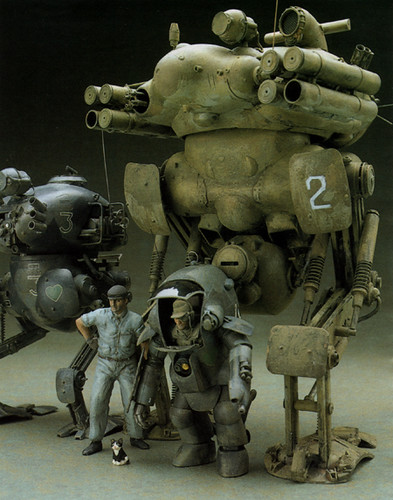
Jason Eaton:
Kow Yokoyama
Kow Yokoyama
roboterkampf's photostream
Maschinen Krieger ZbV 3000 - Wikipedia, the free encyclopedia
2008年
Kow Yokoyama
Maschinen Krieger
Ma.K In Action
Mecha Art and Design
toybot studios: Maschinen Krieger: The Art of Kow Yokoyama ...
Krueger's Krieger SF3D/MaK Zbv3000 Models and Tips
ZbV3000 Ma.K. Maschinen Krieger
3D WIP of two of Sensei KOW YOKOYAMA's design - ConceptArt.org Forums
Mecha Modeling Websites
Maschinenkrieger.com - powered by vBulletin
Kow Yokoyama's Sketch
ESP Visuals: Ma.K Update

Books: KOW Yokoyama
Very Cool Things: Kow Yokoyama Ma.K. Sketchbook (Maschinen Krieger ...
Mecha Art and Design
Kow Yokoyama - Ma.K. Sketch Book Vol.01 (Dai Nippon Kaiga ...
Ma.K. Modeling Book


Kinokuniya SF has at least 3 of his books on sale. In case you come out to CA for a visit, PT.
Kow Yokoyama has done models and pictures of armored suits and such.
Jason Eaton:
Kow Yokoyama
Kow Yokoyama
roboterkampf's photostream
Maschinen Krieger ZbV 3000 - Wikipedia, the free encyclopedia
2008年
Kow Yokoyama
Maschinen Krieger
Ma.K In Action
Mecha Art and Design
toybot studios: Maschinen Krieger: The Art of Kow Yokoyama ...
Krueger's Krieger SF3D/MaK Zbv3000 Models and Tips
ZbV3000 Ma.K. Maschinen Krieger
3D WIP of two of Sensei KOW YOKOYAMA's design - ConceptArt.org Forums
Mecha Modeling Websites
Maschinenkrieger.com - powered by vBulletin
Kow Yokoyama's Sketch
ESP Visuals: Ma.K Update
Books: KOW Yokoyama
Very Cool Things: Kow Yokoyama Ma.K. Sketchbook (Maschinen Krieger ...
Mecha Art and Design
Kow Yokoyama - Ma.K. Sketch Book Vol.01 (Dai Nippon Kaiga ...
Ma.K. Modeling Book
Kinokuniya SF has at least 3 of his books on sale. In case you come out to CA for a visit, PT.
More Trish Thuy Trang
Trish Thuy Trang - Stay Awhile
Trish Thuy Trang - The day you went away
Trish Thuy Trang - Big Big World
Trish Thuy Trang - Too Little Too Late
Trish Thuy Trang - Up and Down
Trish Thuy Trang-Like No Other
Trish Thuy Trang-Lie To Me [MV]
Trish Thuy Trang - The day you went away
Trish Thuy Trang - Big Big World
Trish Thuy Trang - Too Little Too Late
Trish Thuy Trang - Up and Down
Trish Thuy Trang-Like No Other
Trish Thuy Trang-Lie To Me [MV]
Friday, July 04, 2008
"Freedom!"

I don't think I imagined this while I was half-asleep, but this afternoon Sean Hannity mentioned on the radio that the last line uttered by William Wallace in Mel Gibon's Braveheart was the cry of "Freedom!" And then he proceeded to relate this to a "libertarian" conception of freedom, what one might associate with license, but the individual right to determine one's actions for one's self and choose accordingly. But the freedom that the fictional Wallace was striving for in the movie [and the real historical person as well] was "political freedom" -- liberation from a occupying power (or a tyrannical government). Political liberty as opposed to differing notions of individual liberty; there isn't a necessary connection between the two, unless one rejects both subjection from without and from within (as being unjust). More on this in a bit.
BBC - History - Scottish History
Wallace: A Biography - Google Books Result
Braveheart @ MacBraveHeart - Homepage
One friend liked the movie to an extent, which was a surprise when I first heard him talking about it since he usually avoids movies. But he wished that instead of "Freedom," Gibson's Wallace had shouted instead something like "Scotland!" Catholic traditionalists and reactionaries tend to mistrust any talk about liberty, since it is often tied up with some form of liberalism or bad conceptions of freedom, authority, and community. But is talk of liberty always necessarily tainted or wrong? Can there be a proper Catholic understanding of political liberty?
Traditionally, it has been taught that if the ruler is ruling justly, for the sake of the common good, then his rule is legitimate and should be obeyed. So one question is what is to be done if his rule or his laws are unjust. The other question is whether those conditions are enough. It has also been traditionally taught that those who obtain rule through conquest may have their rule legitimated with time, provided that they meet the other conditions for just rule. If, despite the way they came into power, they rule justly, one cannot disobey their laws or start a rebellion.
Still, we would do well to question whether there is a divine mandate for one world government. I can see how the desire for self-rule in the medieval republics (and autonomy on the part of kings in their states) would lead to discussions about the various claims to authority (especially by the Holy Roman Empire) and reactions by some to attempts by others to gain power over them. Other than a claim to having inherited some imperial authority from the past, what legitimate claim did the Holy Roman Emperor have over others?
If communities should be of an appropriate size (in accordance with natural limits), then most attempts to gain control over them by larger entities would probably be not only wrong-headed but unjust as well. Only in extreme cases should such authority be assumed (for example, if a community is incapable of self-rule, realizes it, and asks for outside help--but is that likely to happen?), and ideally authority should be returned to that community as soon as it is possible. (Once it becomes capable of self-rule, and this is a goal that the outside power should seek to bring about, if it is truly 'benevolent'.)
I could envision someone using Aquinas' argument concerning the best form of government to press for a unified world government over all, but I think this is too much to ask for, in a world marred by sin. And, it would go again reason. (Once again, the question of limits -- size and being able to understand local circumstances -- and the proper political participation of the citizens.)
Quentin Skinner has written about republican government and conceptions of liberty during the middle ages and afterwards. He has traced various understandings of political liberty through European history, focusing on the classical notion as being the best(?). According to the classical notion of [political] liberty, only those who participate in self-rule are free; those who are subject to the authority of another are not really free.
Even if we accept that there is a "classical" conception of political liberty to be found in Republican Rome and in the Greek poleis, is it necessarily always the best? Or do we follow Aristotle, who differentiates between the different good constitutions? Aristotle maintains that polity (or 'rule by the many') is not the best constitution for all societies. Is a right violated if one does not participate in rule? Or is this only when one is qualified to rule? What are the qualifications for rule? 'Civic humanism' or republicanism does not always involve the egalitarian assumption that one is qualified to rule merely in virtue of being a(n) [adult] member of a community. But is the many's possession of the requisite virtue for a polity sufficient to entail that taking political participation away from them is unjust and a violation of their liberty? One need not to accept this to avoid such an action--the prudential judgment that the taking away of political power from them will cause resentment and other adverse effects on the common good would be enough.
This sort of political liberty is not opposed to, or does not do away with, the virtue of obedience, since self-rule is attributed to the whole and not to each member of the community taken individually. There is no place in authentic republicanism for an exaggerated notion of freedom -- that I be able to do what I want, and not have to follow the commands of others, since this would be destructive to the common good. The question is whether others outside of the community can claim to have authority over me. God and the Church, yes. But what of another human temporal authority, in which we do not participate?
Just as one cannot licitly disobey an usurper if he is ruling in accordance with the common good, so political liberty cannot be the highest good within the political order--the common good (and by extension obedience to the law) take precedence. (Which isn't to say that one shouldn't strive to regain or strengthen self-rule, so long as it the intended outcome is likely and it does not destroy the common good, respect for the law, and so on.)
I should try to skim through Professor Skinner's Liberty Before Liberalism and Hobbes and Republican Liberty; they are probably worth getting. I've read through his The Foundations of Modern Political Thought; while it is informative I'm not entirely convinced by the narrative that he puts forth. I do think that links between republicanism of the middle ages and of the classical period need to be explored further and judged in accordance with something normative, even if medieval rhetoric appealed to liberty and republicanism to justify certain political actions. ("Following the example of our ancestors" would not be enough?)
Google Books: The Foundations of Modern Political Thought
As for "American independence," and whether it really was a case of secession or rebellion--I have yet to study the constitutional case of the loyalists. Was it a case of tyrannical rule being rejected? Or the violation of a contract between sovereign communities and a higher authority being violated? Hence, my present ambivalence about celebrating the 4th of July.
I'm surprised none of the networks is broadcasting The Patriot tonight. Is it being shown on cable?


Yahoo Movies; Rotten Tomatoes
Extended version
More on Quentin Skinner
wiki

Quentin Skinner on concepts of liberty (mp3)
A summary: Cambridge historian lectures on concepts of liberty - Podcast ...
Content-TV: Quentin Skinner - Three Concepts of Liberty - video
LRB · Quentin Skinner: A Third Concept of Liberty
Rethinking Political Liberty -- Skinner 61 (1): 156 -- History ...
Quentin Skinner - Rethinking Political Liberty - History Workshop ...
Google Books: Equal Freedom: Selected Tanner Lectures on Human Values
The Social Affairs Unit - Web Review: David Womersley
The place of history in public life, by Quentin Skinner
Quentin Skinner on civic humanism
Professor Quentin Skinner on Hobbes | The Early Modern Intelligencer
DSpace at Cambridge: Interview of Quentin Skinner
INTERVIEW WITH QUENTIN SKINNER (pdf)
On Encountering the Past – Interview with Quentin Skinner (pdf)
Philosophy Bites interview with Quentin Skinner (mp3, transcript)
Related:
Cambridge University Press: Rethinking the Foundations of Modern Political Thought - Cambridge
Republicanism - vol. 1, 2; Visions of Politics - vol. 1, 2, 3
States and Citizens
An Approach to Political Philosophy
P. Pettit, KEEPING REPUBLICAN FREEDOM SIMPLE On a Difference with Quentin Skinner (pdf)
Samuel Moyn - Intellectual History and Democracy: An Interview ...
Traditional uniforms for cross-Strait flights (Xinhua)
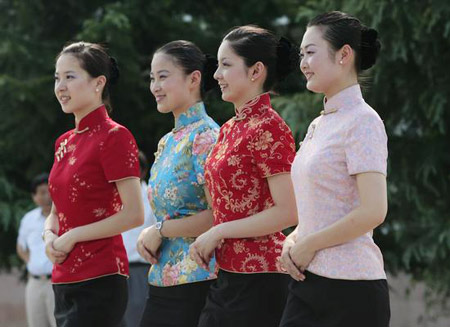
Four flight attendants from China Eastern Airlines model new colorful uniforms, which were unveiled Tuesday. The uniform, made from a traditional southern Chinese silk called yunjin, cost about 10,000 yuan each. This traditional uniform will be worn for charter flights from the Chinese mainland to Taipei, which begin on July 4.



China Daily showbiz gallery
Four flight attendants from China Eastern Airlines model new colorful uniforms, which were unveiled Tuesday. The uniform, made from a traditional southern Chinese silk called yunjin, cost about 10,000 yuan each. This traditional uniform will be worn for charter flights from the Chinese mainland to Taipei, which begin on July 4.
China Daily showbiz gallery
Leon Lai-2005北京演唱會@最後的戀愛、甜蜜蜜
Leon Lai-2005中華小姐表演嘉賓
07年國際中華小姐競選Part1
2008國際中華小姐內地決賽泳裝項目
2008中華小姐季軍徐萌
2008中華小姐冠軍朱璇
2008中華小姐吳佳穎
Miss Chinese International 2008 國際中華小姐競選
2007 年度中華小姐競選OP
see sryaxiius and TVBFrance and cantonril
Miss China Tiffany Ning Lei Interview part 1, 2, 3
2008国际旅游小姐中国总决赛定摄影
2008国际旅游小姐中国总决Miss Tourism Queen China 2008 Xitang Beijing
2008滑铁卢春节晚会(university of waterloo) 7
2008纽约华裔小姐选美专访(9) [Duowei]
2008纽约华裔小姐选美专访(1)
Leon Lai-2005中華小姐表演嘉賓
07年國際中華小姐競選Part1
2008國際中華小姐內地決賽泳裝項目
2008中華小姐季軍徐萌
2008中華小姐冠軍朱璇
2008中華小姐吳佳穎
Miss Chinese International 2008 國際中華小姐競選
2007 年度中華小姐競選OP
see sryaxiius and TVBFrance and cantonril
Miss China Tiffany Ning Lei Interview part 1, 2, 3
2008国际旅游小姐中国总决赛定摄影
2008国际旅游小姐中国总决Miss Tourism Queen China 2008 Xitang Beijing
2008滑铁卢春节晚会(university of waterloo) 7
2008纽约华裔小姐选美专访(9) [Duowei]
2008纽约华裔小姐选美专访(1)
William F. Jasper, Shooting the Messenger
Another article on Sibel Edmonds (wiki).
Links:
Google Video: Sibel Edmonds-Lost in Translation-'State Secrets' and 9/11
Dave Lindorff: A Real 9/11 Cover-Up?
American Conservative: Found in Translation
For sale: West’s deadly nuclear secrets - Times Online
Let Sibel Edmonds Speak
Complete 911 Timeline: Sibel Edmonds and Related Scandals
Kill the Messenger: Sibel Edmonds: Interview: Sibel Edmonds Manifesto
An Interview with Sibel Edmonds - by Christopher Deliso
The BRAD BLOG : EXCLUSIVE: FBI Whistleblower Sibel Edmonds Will ...
Sibel Edmonds - SourceWatch
Another article on Sibel Edmonds (wiki).
Links:
Google Video: Sibel Edmonds-Lost in Translation-'State Secrets' and 9/11
Dave Lindorff: A Real 9/11 Cover-Up?
American Conservative: Found in Translation
For sale: West’s deadly nuclear secrets - Times Online
Let Sibel Edmonds Speak
Complete 911 Timeline: Sibel Edmonds and Related Scandals
Kill the Messenger: Sibel Edmonds: Interview: Sibel Edmonds Manifesto
An Interview with Sibel Edmonds - by Christopher Deliso
The BRAD BLOG : EXCLUSIVE: FBI Whistleblower Sibel Edmonds Will ...
Sibel Edmonds - SourceWatch
In the decades since The Closing of the American Mind became a bestseller, many critics have joined Allan Bloom in arguing that the changes in higher education since the sixties have been mostly for the worse. Anthony Kronman adds his voice to the lament for the humanities in his recent title Education’s End: Why Our Colleges and Universities Have Given Up on the Meaning of Life. While offering a trenchant critique of the academy’s too often dogmatic adherence to the articles of multiculturalism, tolerance, and constructivism, Kronman notes both the moral worth of such commitments as well as the ways in which their contemporary iterations fall short of the ideal of a truly humane liberal education. . .
More from Psallentes
Gregorian Chant (Advocatam) Llibre Vermell de Montserrat
Advocatam II (Gregorian Chant) Chant Group Psallentes in the context of Llibre Vermell ...
Ave Maria I (Gregorian Chant) Chant group Psallentes in the context of the ...
Ave Maria II (Gregorian Chant) Chant Group Psallentes in the
Benedicamus Domino
Caritas pater est (Plainchant by Chant Group Psallentes)
Caritas pater est II (Gregorian Chant group Psallentes)
Caritas pater est III (Gregorian Chant group Psallentes)
Caritas pater est IV
Caritas pater est V (Gregorian Chant - Chant group Psallentes)
Caritas pater est VI (Gregorian Chant - Chant group Psallentes)
Caritas pater est VII (Gregorian Chant Group Psallentes)
Caritas pater est VIII (Gregorian Chant - Chant group Psallentes)
Gregorian Chant (Mater Patris) in the context of Llibre Vermell de Montserrat
O lux (Gregorian Chant by Chant group Psallentes)
The group's website.
Advocatam II (Gregorian Chant) Chant Group Psallentes in the context of Llibre Vermell ...
Ave Maria I (Gregorian Chant) Chant group Psallentes in the context of the ...
Ave Maria II (Gregorian Chant) Chant Group Psallentes in the
Benedicamus Domino
Caritas pater est (Plainchant by Chant Group Psallentes)
Caritas pater est II (Gregorian Chant group Psallentes)
Caritas pater est III (Gregorian Chant group Psallentes)
Caritas pater est IV
Caritas pater est V (Gregorian Chant - Chant group Psallentes)
Caritas pater est VI (Gregorian Chant - Chant group Psallentes)
Caritas pater est VII (Gregorian Chant Group Psallentes)
Caritas pater est VIII (Gregorian Chant - Chant group Psallentes)
Gregorian Chant (Mater Patris) in the context of Llibre Vermell de Montserrat
O lux (Gregorian Chant by Chant group Psallentes)
The group's website.
Macross Frontier, ep 13
I've missed episodes 11 and 12--13 is a bit of a shocker, from what I've gleaned from the forums. Next episode is supposed to feature another big battle. Veoh.
Macross Frontier - 13 | Random Curiosity
Star Crossed Anime Blog :: Macross Frontier - 13 :: July :: 2008
Celestial Kistune
Macross Frontier - 12 | Random Curiosity

Star Crossed Anime Blog :: Macross Frontier - 12 :: June :: 2008
Macross Frontier Episode 12 | Atarashii Prelude
Macross Frontier Episode 12 | Animation Online | Animation World
Yukan Blog! » Blog Archive » Macross Frontier - 12: Panic at the ...
Sea Slugs Episode 12
Macross Frontier - 13 | Random Curiosity
Star Crossed Anime Blog :: Macross Frontier - 13 :: July :: 2008
Celestial Kistune
Macross Frontier - 12 | Random Curiosity
Star Crossed Anime Blog :: Macross Frontier - 12 :: June :: 2008
Macross Frontier Episode 12 | Atarashii Prelude
Macross Frontier Episode 12 | Animation Online | Animation World
Yukan Blog! » Blog Archive » Macross Frontier - 12: Panic at the ...
Sea Slugs Episode 12
Thomas DiLorenzo, Happy Secession Day!
That's what Thomas Jefferson would be celebrating today. Unlike so many Americans, he would not be celebrating the American empire, with its "unitary executive," swarms of tax-collecting bureaucrats, its militarization of society, protectionism, economic fascism, suspension of habeas corpus, domestic spying, etc., etc. The Hamiltonian republic that we now live under, which is celebrated by the liberal/left and neocons alike, is the opposite of Jefferson's dream of an "empire of liberty."
Another recording of "If Ye Love Me," sung at the Sacred Music Colloquium: It's Not Only All About Latin. Also from NLM: Interview with Abbot of Heiligenkreuz - "We do this in Benedictine serenity".
Joseph R. Stromberg, On Not Celebrating the Government’s Birthday
An oldie from Joseph Stromberg--On Not Celebrating the Government’s Birthday
Blessed Pier Giorgio Frassati


www.piergiorgiofrassati.org
3op.org
bettnet.com
Papal Homily: Pier Giorgio Frassati Beatification
Dominican History : Blessed Pier Giorgio Frassati (1901-1925)
Blessed Pier Giorgio Frassati
Pier Giorgio Frassati (1901-1925)
Blessed Pier Giorgio Frassati, An Ordinary Christian, by Maria Di ...
FrassatiUSA, Inc. - Nashville, TN
Nashville Dominicans
A Man of the Beatitudes: Pier Giorgio Frassati - Google Books Result
Blessed Pier Giorgio Frassati Confraternity
The Frassati Society
The Frassati Society of Young Adult Catholics
MONIALES OP ~ Dominican Nuns: BL. PIER GIORGIO FRASSATI, Dominican ...
Adoro te Devote: Novena to Blessed Pier Giorgio Frassati
Blessed Pier Giorgio Frassati
alt
Thursday, July 03, 2008
A translation of Fr. Lang's article in the L'Osservatore Romano on the pallium can be found on this page of the Papa Ratzinger Forum.
Looks like those vigilant Japanese companies have done their work again, and all the links for this post are gone.
Internet connection temporarily restored.
Internet connection temporarily restored.
Scott Richert, Church and Nation: A Credal Nation, Part 3
Clyde N. Wilson, A Modest Proposal for Peace and Reconciliation
Clyde N. Wilson, A Modest Proposal for Peace and Reconciliation
Fr. Z translates Andrea Tornielli's post on Pius XII: In support and better understanding of Pius XII
podcast of Pope Benedict XVI's homily for the Feasts of Saints Peter and Paul
podcast of Pope Benedict XVI's homily for the Feasts of Saints Peter and Paul
Via EB:
Lessons from amateur radio
New book from John Michael Greer: The Long DescentAlso, his latest blog entry:
John Michael Greer, New Society (book publishers)
The Long Descent
A User's Guide to the End of the Industrial Age
By John Michael Greer
Americans are expressing deep concern about US dependence on petroleum, rising energy prices and the threat of climate change. Unlike the energy crisis of the 1970s, however, there is a lurking fear that, now, the times are different and the crisis may not easily be resolved.
The Long Descent examines the basis of such fear through three core themes:
- Industrial society is following the same well-worn path that has led other civilizations into decline, a path involving a much slower and more complex transformation than the sudden catastrophes imagined by so many social critics today.
- The roots of the crisis lie in the cultural stories that shape the way we understand the world. Since problems cannot be solved with the same thinking that created thyem, these ways of thinking need to be replaced with others better suited to the needs of our time.
- It is too late for massive programs for top-down change; the change must come from individuals.
Hope exists in actions that range from taking up a handicraft or adopting an "obsolete" technology, through planting an organic vegetable garden, taking charge of your own health care or spirituality, and building community.
Focusing eloquently on constructive adaptation to massive change, this book will have wide appeal.
John Michael Greer is a certified Master Conserver, organic gardener and scholar of ecological history. The current Grand Archdruid of AODA, his widely-cited blog, The Archdruid Report (www.thearchdruidreport.blogspot.com) deals with peak oil, among other issues. He lives in Ashland, Oregon.
(2 July 2008)
The long-awaited book by a long-time writer for Energy Bulletin (list of articles).We hope to arrange to publish excerpts and reviews of the book. -BA
Lessons from amateur radio
Natalie MacMaster, Hayley Westenra - Ave Maria
Hayley Westenra -I believe
Hayley Westenra - 白い色は恋人の色(English Ver.)
Hayley Westenra - 花(Flower)
Hayley Westenra -I believe
Hayley Westenra - 白い色は恋人の色(English Ver.)
Hayley Westenra - 花(Flower)
Today I realized that the upside of having to move out is that I won't have to deal with ants any more. Ugh. Can't believe there were some in the room again. Need to find something to clean carpet stains--I didn't make them, but I didn't notice them until after the "room inspection" (there really wasn't one when I moved in--my fault, I should have remembered).
In other news... niece #2 knows how to say 'po po' and 'kau kau' now, but I haven't heard her actually say it. She said it to my mom, after my sister put her on the phone.
Last night my friend JY called from Australia--she was trying to find out about whether she could take custody of her children from her husband's parents. Apparently they are on the road to getting a divorce, but the problem is that the children along with the husband are now in the U.S.. If they had stayed in Taiwan, perhaps this would be an easier problem to solve, but the husband and the children usually visit his parents every Summer. Not a good situation--I don't know how much power she has under U.S. law.
Their marriage has been rocky from the beginning, though I blame the husband more than JY, and not just because she's a friend. He's a bit immature, and in the middle of a career change--he no longer wants to teach English, but wants to become a nurse. His parents had wanted them all to move to the US, and thought that she could find a good-paying job to support the family, while he goes to nursing school. She thinks that when they first met, he was running away from his mom (who is apparently rather domineering), but either has caved into her pressure to have the grandchildren close to her, or actually wants to live close to them. Well, he should have thought about where he was going to settle down before having sex with someone half-way around the world. What a mess.
The HS friend with the mental illness apparently will not be coming to the U.S., not this week at any rate. Her father decided that she should get better before she flies. Hrm... seems to me that her condition while she is in Taiwan is worse, but I don't know if that is really the case, and if it can be attributed to someone's actions (or lack of action).
In other news... niece #2 knows how to say 'po po' and 'kau kau' now, but I haven't heard her actually say it. She said it to my mom, after my sister put her on the phone.
Last night my friend JY called from Australia--she was trying to find out about whether she could take custody of her children from her husband's parents. Apparently they are on the road to getting a divorce, but the problem is that the children along with the husband are now in the U.S.. If they had stayed in Taiwan, perhaps this would be an easier problem to solve, but the husband and the children usually visit his parents every Summer. Not a good situation--I don't know how much power she has under U.S. law.
Their marriage has been rocky from the beginning, though I blame the husband more than JY, and not just because she's a friend. He's a bit immature, and in the middle of a career change--he no longer wants to teach English, but wants to become a nurse. His parents had wanted them all to move to the US, and thought that she could find a good-paying job to support the family, while he goes to nursing school. She thinks that when they first met, he was running away from his mom (who is apparently rather domineering), but either has caved into her pressure to have the grandchildren close to her, or actually wants to live close to them. Well, he should have thought about where he was going to settle down before having sex with someone half-way around the world. What a mess.
The HS friend with the mental illness apparently will not be coming to the U.S., not this week at any rate. Her father decided that she should get better before she flies. Hrm... seems to me that her condition while she is in Taiwan is worse, but I don't know if that is really the case, and if it can be attributed to someone's actions (or lack of action).
Papal Homily at Shrine of Mary "De Finibus Terrae"
"Mary Shines on the Sea of Life and History as a Star of Hope" [2008-07-02]
"Mary Shines on the Sea of Life and History as a Star of Hope" [2008-07-02]
Vietnamese videos
Trish Thuy Trang - Sukiyaki
Trish Thuy Trang - Crossing Over
Trish Thuy Trang - Joe Le Taxi
Joe Le Taxi - Ngoc Lan
Trish Thuy Trang-Sway
[Asia 56] Trish Thuy Trang - Kimigasuki
[Asia 57] Trish Thuy Trang - Ice Queen
Asia 56: Yeu Doi & Yeu Nguoi
Asia 56 - Yeu Doi Yeu Nguoi - Part 2
Asia 56 - LK Chinese Top Hits
[Asia 56] Lam Thuy Van, Anh Minh, Le Nguyen-Chinese Top hits
[Asia 57] Anh Minh, Le Nguyen - Sayonara
[Asia 57] Thuy Huong - Money Money
Trish Thuy Trang - Crossing Over
Trish Thuy Trang - Joe Le Taxi
Joe Le Taxi - Ngoc Lan
Trish Thuy Trang-Sway
[Asia 56] Trish Thuy Trang - Kimigasuki
[Asia 57] Trish Thuy Trang - Ice Queen
Asia 56: Yeu Doi & Yeu Nguoi
Asia 56 - Yeu Doi Yeu Nguoi - Part 2
Asia 56 - LK Chinese Top Hits
[Asia 56] Lam Thuy Van, Anh Minh, Le Nguyen-Chinese Top hits
[Asia 57] Anh Minh, Le Nguyen - Sayonara
[Asia 57] Thuy Huong - Money Money
Wednesday, July 02, 2008
Sandro Magister, Pauline Year: The Ecumenical Dream of Pope Benedict
Together with the patriarch of Constantinople, the successor of Peter has proclaimed a special jubilee year dedicated to another great apostle, Paul. The stated objective: "to create the unity of the 'catholica', of the Church formed from Jews and pagans, of the Church of all peoples"
I've been reading through Kirkpatrick Sale's The Human Scale. It's a dense book and the statistics and numbers can be overwhelming, so it can be difficult to judge how sound his arguments are. But I would recommend it to those who are interested in the problem of size for the science of politics. So far I have not read anything that would support the characterization of Mr. Sale as a leftist. Does he support a local version of socialism or the welfare state? Is he a libertine with respect to "social issues?"
His contribution to the American Conservative's "What is Left? What is Right?" issue.
Kirkpatrick Sale / Leopold Kohr
Kirkpatrick Sale
John Robb: JOURNAL: Governance of the Wilderness
His contribution to the American Conservative's "What is Left? What is Right?" issue.
Kirkpatrick Sale / Leopold Kohr
Kirkpatrick Sale
John Robb: JOURNAL: Governance of the Wilderness
The breathtaking run-up in oil prices is linked to the crisis of world financial institutions. What the U.S. Government should not do.
China has encouraged rapid export-led economic growth as a way of putting off dealing with its internal political and social problems. Economic growth requires energy, and China's energy comes overwhelmingly from coal. The nation's short-term survival strategy thus centers on producing enormous quantities of coal today, and far more in the future. (Excerpts)
More Hikaru Nishida
wiki
Welcome to Hikaru Nishida Home Page
Hikaru Nishida - IT'S SO EASY
Linda Ronstadt - It's So Easy (LIVE)
Hikaru Nishida - MOON RIVER
Hikaru Nishida - KISSIN' ON THE PHONE
Hikaru Nishida - THE CIRCLE GAME
Agnes Chan - THE CIRCLE GAME
RAINDROPS KEEP FALLIN' ON MY HEAD
Kumiko - RAINDROPS KEEP FALLIN' ON MY HEAD
Hikaru Nishida - VACATION
Hikaru Nishida - GOTTA PULL MYSELF TOGETHER
one boy,西田ひかる
♪ ボーイ・ハント
Hikaru Nishida - WHERE THE BOYS ARE
伊東ゆかり ボーイハント "Where The Boys Are",
ジョニーエンジェル 伊東ゆかり
西田ひかる Nishida hikaru「人生変えちゃう夏かもね」
Nishida Hikaru - Till the end of time
Nishida Hikaru - Miracle
西田ひかる 月夜の人魚
Hikaru Nishida - Natsu no prism
Miracle Hikaru @ Japan Festa in Bangkok
Hikaru Nishida - PHYSICAL
Olivia Newton -John "Physical"
Olivia Newton-John - Physical on Sold Gold 1981
Hikaru Nishida - SUKIYAKI
Kyu Sakamoto 坂本 九 - Sukiyaki (Covers Slide)
西田ひかる - 私のNo.1 ~You're the only one ~
西田ひかる
西田ひかる 涙 止まらない
西田ひかる Making of NH
Nishida Hikaru - Truth
Welcome to Hikaru Nishida Home Page
Hikaru Nishida - IT'S SO EASY
Linda Ronstadt - It's So Easy (LIVE)
Hikaru Nishida - MOON RIVER
Hikaru Nishida - KISSIN' ON THE PHONE
Hikaru Nishida - THE CIRCLE GAME
Agnes Chan - THE CIRCLE GAME
RAINDROPS KEEP FALLIN' ON MY HEAD
Kumiko - RAINDROPS KEEP FALLIN' ON MY HEAD
Hikaru Nishida - VACATION
Hikaru Nishida - GOTTA PULL MYSELF TOGETHER
one boy,西田ひかる
♪ ボーイ・ハント
Hikaru Nishida - WHERE THE BOYS ARE
伊東ゆかり ボーイハント "Where The Boys Are",
ジョニーエンジェル 伊東ゆかり
西田ひかる Nishida hikaru「人生変えちゃう夏かもね」
Nishida Hikaru - Till the end of time
Nishida Hikaru - Miracle
西田ひかる 月夜の人魚
Hikaru Nishida - Natsu no prism
Miracle Hikaru @ Japan Festa in Bangkok
Hikaru Nishida - PHYSICAL
Olivia Newton -John "Physical"
Olivia Newton-John - Physical on Sold Gold 1981
Hikaru Nishida - SUKIYAKI
Kyu Sakamoto 坂本 九 - Sukiyaki (Covers Slide)
西田ひかる - 私のNo.1 ~You're the only one ~
西田ひかる
西田ひかる 涙 止まらない
西田ひかる Making of NH
Nishida Hikaru - Truth
Tuesday, July 01, 2008
via Francis Beckwith, at WWWTW: Obama Supports Same-Sex Marriage, and If You Disagree You're a Bigot
Obama keeps reminding us why he is not really the herald of change (from the status quo) that he claims to be.
Srdja Trifkovic, Obama the “Patriot”
Thomas Fleming, One Nation Under Obama
Obama keeps reminding us why he is not really the herald of change (from the status quo) that he claims to be.
Srdja Trifkovic, Obama the “Patriot”
Thomas Fleming, One Nation Under Obama
Gene Logsdon, Pasture: the foundation of garden farm success
Pasture: the foundation of garden farm success
A sure way to tell the direction you should take in garden farming is to watch the trend in commercial farming and then do the opposite. Commercial farming has de-emphasized — and all but ignored in the corn belt — pasture and tree crop farming because these types of agriculture lack the ability to return quick and high-gross profits.
archived Jul 1 2008
original
original
NLM: Chant Release Date in US is Today
So... does Cistercian chant as it is sung now faithfully represent how chant was done in the Middle Ages?
So... does Cistercian chant as it is sung now faithfully represent how chant was done in the Middle Ages?
Subscribe to:
Posts (Atom)