At B&N there were several copies of the
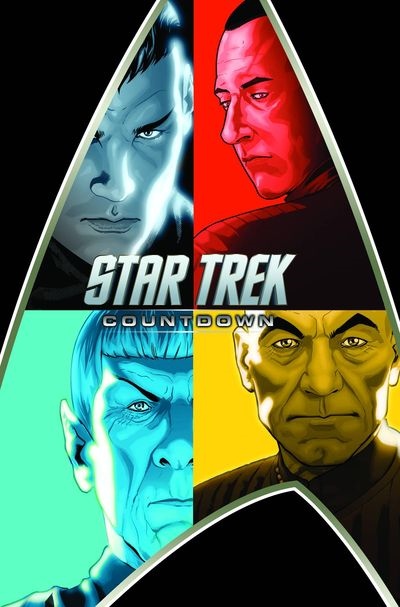
Star Trek Countdown trade paperback book, the comic book prequel to the upcoming
Star Trek movie, so I was able to read through it on Tuesday night. Would I buy the book? Probably not. The artwork is fine and the dialogue didn't bother me as much as it did some
Star Trek fans, but the story was unsatisfying. I found it a bit forced--after all, the creators were trying to give a backstory to the movie, explaining the relationship between Nero and Spock, and the reasons behind Nero's actions.
I thought there weren't enough political machinations, details about Vulcan-Romulan relations, or contrasts between the two cultures. We do see some "normal" Romulans: Nero and his crew, and his wife. There are some hints at what had transpired between
Nemesis and Countdown, but probably not enough to satisfy devoted fans. I find the details given by the developers of
Star Trek Online about what has happened to the Romulan Empire since
Nemesis to be more interesting, even if the game is non-canonical. (You can find out more at
TrekMovie.)
Some of the same problems affected the TNG episode
"Unification," which featured the return of Federation Ambassador Spock to TV. It was discovered that Spock was hiding on Romulus, aiding and teaching the underground movement. While I enjoyed the return of Spock, the episode suffered from a lack of scale. Budget problems, I know. Not enough money to dress the sets. Still, the episode could have been executed much better, and why compress the story to only two episodes, when it could have easily been drawn out to 3 (even 4?).
Part of the weakness of
Countdown is due to the limitations of the format. There is only so much that can be done in 4 comic book issues. A novel would probably have done greater justice to the story. (However, while I haven't read any Star Trek novels lately, from what I remember, they rarely describe alien cultures in detail; too much is left to the imagination.) But some of
Countdown's shortcomings are also due to the story itself. I don't have any problem with the life trajectories of Data (becoming the captain of the Enterprise after his neural nets/memories are grafted onto B-4), Worf (now a general in the Klingon Empire), Geordi LaForge (going off into the private sector and creating his own ships and new technology), or Picard (appointed the Federation Ambassador to Vulcan), but it is rather convenient that only Spock is able to figure out that the supernova threatens the whole galaxy. (Although this is later confirmed by the Romulans and Vulcans, but it is too late.)
Not only that, but the Vulcans are so suspicious of (or hostile to?) the Romulans that they do not take decisive action right away and hand the technology over to Nero, under Spock's supervision. If there was a possibility that the supernova did have the destructive capability Spock claimed, would it not be more logical to forestall any danger, than to delay? Haven't they evolved since the time of Jonathan Archer and
Enterprise?
Then there is the science-
fiction of the plot: the use of "red matter" to create a singularity, or a black hole... (Red matter is generated from some other material that needs to be mined, Decalithium... I suppose it is no sillier than "
dilithium.") The only way to stop the expansion of the
supernova and to dissipate its energy is to create a black hole at its center. However, haven't other ways to create black holes been discovered in the Star Trek universe? Instead, we need to rely upon the injection of a rare, exotic material. And how does a
supernova get stronger by devouring planets and other celestial bodies? [Some have questioned if the supernova is somehow able to travel faster than light, since this seems to be the case in the comic book. The distance between the Hobus star and Romulus is not mentioned in the story, as far as I know. We can't let inconvenient numbers and facts get in the way of story-telling, even if it is a science-fiction story.] And what if there is already a black hole at the center of a supernova?
It turns out that the only people who possess the technology and know-how to create the blackhole are the Vulcans. Naturally, the Romulans are very reluctant to seek their help. How were the Vulcans able to make such a discovery? Was it part of some top secret project, aimed at creating a weapon? If it was a normal discovery, wouldn't the Vulcans, supposed heralds of scientific progress, have made it known to everyone else?
The Federation is ready to undertake a covert operation to collapse the supernova. The Romulans, realizing that impending disaster, contemplate using military force to take the technology away from the Vulcans. Why wouldn't they have considered this option beforehand? If there is a possible danger to the Empire, I do not think it would be characteristic of the Romulans to take a slow course of action, while they try to confirm Spock's findings. Is the Hobus star valuable to them? Would its destruction or containment have any bad consequences? And don't tell me that in the Star Trek universe, ways haven't been devised of destroying stars before they explode. The Romulan government and military have been willing to kill innocent people in order to bring about some advantage to the Empire. Why not a star, especially one that serves no useful function?
The destruction of Romulus is the motivator for Nero's actions -- he blames it first of all on the Vulcans for refusing to give the technology needed to prevent this [tragic] event from happening, and he seeks to exact his revenge upon them. As someone who can be a Star Trek fan from time to time, I don't like the permanent changes that have been made to the prime timeline. Even if the comic book is non-canonical, the movie itself establishes that Romulus has been destroyed. What's left of the
Romulan Star Empire? Some colonies? Part of the Romulan fleet? It's no longer the star power that it once was. (Was Remus destroyed as well?)
Spock signs off at the end of the comic book, knowing that he has left the galaxy in good hands. It may be a better ending for the character than the death of Captain Kirk, but I think much more could have been done with the Romulus-Vulcan story. (Spock being martyred? Spock's pacificist movement leading to a more violent reaction among Romulans? etc. etc.)
Maybe I'm just looking for reasons to criticize the comic book (and the upcoming movie). After all, I don't have that much invested in the Star Trek universe, do I? Heh. Many Star Trek fans have been pleased with the book. Those who are not fans may enjoy the story. But I think
Countdown was meant primarily for the fans, especially those concerned with canon and continuity, and I don't think it measures up to fan's expectations. Those who have the money and creative control can do what they wish with the Star Trek universe and tell whatever stories they want, but I find these new products disappointing. So many wasted potential.
[Why does Nero decide to go after the Federation as well? Because they are the enemies of the Romulans? And why single out James T. Kirk?]
Memory-Alpha:
Star Trek: CountdownAnd now, for some comments about the clothing of the Romulans and the Vulcans...In
Countdown, the Romulan senators are still wearing robes similar to East Asian clothing, the same sort of clothing
they were wearing in
ST Nemesis. (The closet analogue seems to be the Japanese kimono for men, except that the robes are rather wide at the bottom. I can't tell if the senators are wearing pants under their robes are not. If they are, then it would be similar to what Sung Chinese wore?)
The Vulcans in
Star Trek: First Contact seemed to be wearing East Asian-inspired clothing. But this has changed over time? (Recall the Vulcan clothing Spock wore in
TMP and
Undiscovered Country. You can find pictures over at
TrekCore.) What were the influences on the designers of Vulcan clothing for the movies and all of the post-TOS series?
In American culture, the wearing of a robe implies a certain amount of leisure. At the moment I can't recall if a distinction was made in the structure of the clothing in China -- certainly distinctions were made with the material and color. Are Asian robes restrictive of movement, preventing a more active lifestyle? I'd have to look through the history of Chinese fashion -- I believe soldiers did wear pants and a shorter robe. But I don't know if pre-Qing nobles wore shorter robes when they went hunting.
Memory Alpha:
Romulan uniform and
Vulcan uniformRare Photos