Saturday, August 29, 2009

Friday, August 28, 2009
[T]he present healthcare system is unsustainable for two sets of (interconnected) reasons, fiscal and ecological. The fiscal side receives attention in the current debate, but most discussion underestimates the problems and proposes solutions that provide little more than temporary band-aids... Our collective understanding of the ecological dimension is abysmal, especially its connection to the economy, and if grasped would lead to the abandonment of politics and business as usual in medicine and throughout society.
Thursday, August 27, 2009
“It should be obvious from simple arithmetic that population growth is on a direct collision course with increasingly scarce resources.” - Jeremy Grantham
The notion of peak water probably sounds crazy to most people. The earth is 70% covered by water. The water cycle replenishes water on a continuous basis. The global warming enthusiasts tell us that glaciers are melting and oceans are rising. This should make water more plentiful. But, as they say in the real estate business – Location, Location, Location. Freshwater shortages in the wrong places could have calamitous consequences to those regions, worldwide commodity prices, the economic future of nations with water shortages and possible war. Regional water scarcity means water usage exceeds the annual natural replenishment from the water cycle. The impact of water scarcity can be far reaching. It can lead to food shortages, famine, and starvation. Many nations, regions and states have mismanaged their water resources, and they will have to suffer the long-term consequences.
(via LRC)

The character of American development is influenced by another factor, which dovetails with many of the discrete trends that comprise the cycle of suburban expansion and collapse. Americans have come to possess a dessicated and abstract conception of property, according to which property is no longer understood, or at best decreasingly understood, to be associated with place and its ties, or with productivity, or the stability of a family, but as a speculative instrument in which one happens to dwell. The concern of Americans for the rights of property is increasingly, as revealed in the fact of the real-estate bubble itself, with the exchange value of property, the opportunity to realize speculative returns on the anticipated or projected appreciation of the property conceived of as an asset. This is not the right of property invoked by the plaintiffs in Kelo, which was the right of simple possession, with the implication that their property ought not be taken and ceded to others; this is a position more nearly analogous to that of the wealthy interests to whom the Kelo plaintiffs' property was given: greater exchange value can be realized in this manner, and this fact is the paramount consideration both as between competing rights-claims, and between competing conceptions of the good. In the case of the Wal-Mart, and any adjacent property owners who might suffer a loss of exchange value were the preservationists to triumph, the claim is that a claim-right to this greater exchange value would be infringed were the development to be foreclosed. There is no consideration of property owners being stripped of the possession of their tracts, merely the contemplation of actions which will either prevent certain sales, or exclude certain uses, thus, possibly, lowering the value of the properties as speculative vehicles. And these two conceptions of property must not be treated as equivalents, either in thought or in law (and yes, law is often quite independent of thought, hence the formulation), for such speculative gains are at once inherently uncertain, depending upon both zoning and other decisions, and economic trends which cannot be foreseen, and less secure than the goods of actual possession. A property owner may whinge that a zoning restriction constitutes a "taking" because it deprives him of some hoped-for future return, but the eventual reality of such a return, if it is ever to materialize, is dependent upon broader economic trends - the sustainability of the economics of growth and consumerist expansion - that are not in evidence and cannot be regarded as certain. Moreover, it is grotesquely invidious to maintain that this expectation of future gains of exchange value be made the paramount objective of public authority, that it is mandatory, de facto for a government entity, in the course of its efforts to balance competing goods with a view to the common good - goods including the historic and aesthetic character of a region, or the quality of life afforded by not having interminable sprawl - to take care that hypothetical future exchange values are not infringed by efforts to maintain other goods, goods less amenable to quantification. It is, however, the belief in a right to 'cash out' a property held speculatively, taking advantage of the aforementioned cycles of development, that both mandates this privileging and perpetuates the wasteful utilization of a finite resource.
My subject today is the grotesque wealth & income inequality that exists in the United States. I have dubbed our times the new Gilded Age, which was Mark Twain’s name for the post-Civil War period when “the rich wore diamonds and many others wore rags.” I could also have called it the “last” Gilded Age because our slowly disappearing Middle Class will never exist again as it once did.
So there’s nothing new under the sun. Farming begins with small holdings and then slowly graduates to larger and larger units until it falls apart. Or starts with large holdings and breaks up into small ones and then repeats the cycle over and over again. Every generation must have its “back to the land” movement.
(original)
A blog: Open Carry California!
OpenCarry.org forums -- Stories from California
Wednesday, August 26, 2009
The second law of thermodynamics is the gold standard of physics, the law you can count on when all else fails. Why, then, does so much of the contemporary conversation on the future of energy ignore it? The answer is profoundly human -- and profoundly troubling.
(original)
Tuesday, August 25, 2009
Patrick Deneen on the Anti-Federalists
Links:
Anti-Federalist Papers
The Western Confucian, The Way and Virtue of Anti-Federalism
Google Books: The antifederalists: men of great faith and forbearance by David J. Siemers
Google Books: The Promise of American Life
As some have written online, part of the problem with American public education lies with the schools of education and education/child psychologists.
Monday, August 24, 2009

From Fr. Finigan, "Beauty for Truth's Sake". He tells us of a so-entitlted new book on education by Stratford Caldecott.
Likely to lead to an overreaction? Or is it an accurate portrayal of reality? 2500 students. A rather limited sample? We'll have to take a look at statistics, and the reasoning that follows from its use, at another time. With the lack of supervision and discipline at colleges, and the lack of moral formation, many students are bound to get into trouble. Does college life continue and exacerbate the morally loose culture of casual hookups and immature dating that begins in high school (and earlier)? What do you think?
See also:
- Wasted Youth: The Partying Never Stops
- Wasted Youth: Girls Gone Wild
- Wasted Youth: Freshmen Girls Beware
- Is Your Teen Starting College? You Must See This!
The real cowboy has somehow been lost in all the reckless rhetoric that uses his name in vain. It may be too late to save his reputation from the sneers of the pundits and politicians, but let us at least try to present some of the truth about who he is and what he does.
To begin with, he is a working man, having much in common with millions employed in other occupations, but different in the specifics of his profession. As writer John Erickson has observed, the cowboy is defined by the work he does. That work has to do with domestic animals, specifically cattle, though a good hand with horses and sheep may also qualify for the title.
To call a man a cowboy tells you what he does for a living, but it does not tell you about him as a person. He may be gentle, or he may be rough. He may have a college degree, or he may have trouble reading a newspaper. He may be in church every Sunday, or he may spend the Sabbath getting past a hangover. A cowboy is an individual—tall, short, thin, heavy, loud, quiet, or none of the above.
His job developed out of the vaquero tradition that migrated north from Mexico in the early 1700’s. Working methods and tools of the trade evolved from those favored by Mexican herders on horseback. In South Texas today, the terms “cowboy” and “vaquero” are often used interchangeably, though the true vaquero is Hispanic. In the mountain states of the West, the word is “buckaroo,” an Anglo corruption of “vaquero.”
But cowboying is no regular profession, like bricklaying or accounting. The cowboy is an integral part of the American myth, a symbol of self-reliance and rugged individualism, a descendant of Sir Walter Scott’s knights of old. Of course, this image of a wild but selfless defender of righteousness and justice is just as inaccurate as more-negative depictions. It began with penny-dreadful pulp magazines of the late 1800’s and was augmented by Hollywood western action films, beginning with The Great Train Robbery (1903) and continuing through the spaghetti western invasion of the sixties and seventies. In most of these he tended to be seven feet tall and quick on the trigger.
By contrast, the first western novel widely accepted as literature, Owen Wister’s The Virginian (1904), depicted the cowboy as quiet and contemplative, slow to take action and regretful about it afterward. A boisterous group in town for a spree immediately settles down upon learning that they are disturbing a sick woman. The hero meets the villain in the street only when honor leaves him no other option. Wister’s cowboy lived by an unwritten but widely accepted code of conduct that, in general, has guided real cowboys through the generations.
An interesting bit later, from the author's own family history:
My brothers and I were witnesses to what some have called the last generation of full-time horseback cowboys, still working cattle in ways much like those of their grandfathers. The McElroy Ranch had a couple of very large pastures that at roundup time had to be worked in segments, much as in the days of the open range. We often rode out long before daylight and traveled for miles before we reached the pasture where we were to work. Later on, Dad streamlined this operation by building crude but efficient trailers so we could haul the horses. Often this enabled us to work one pasture in the morning and another in the afternoon, doubling our productivity. With Dad, efficiency always trumped tradition.
Would we have a need for horses and cowboys if we returned to a more simpler way of life?
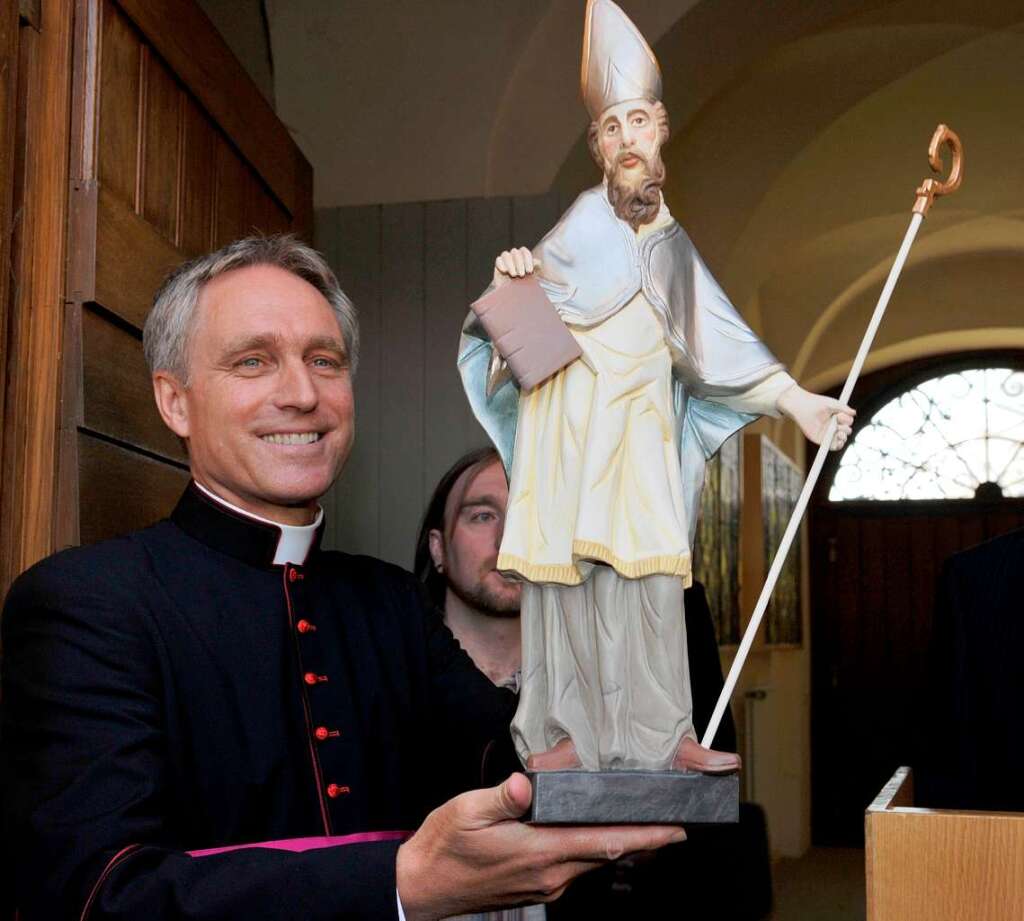
Papstsekretär Georg Gänswein hält in Riedern eine holzgeschnitzte Heiligenfigur in den Händen, die ihm die Kirchengemeinde geschenkt hat. | Foto: dpa
From NCR Online:
In general, church-watchers say that policy is intended to defend the theology of apostolic succession, in which decision-making power in the church is believed to flow through the sacrament of holy orders. Although religious brothers take vows and are generally seen as equals within their communities, under the church's canon law they are considered laity.I can understand why apostolic succession is important for the exercise of authority within the local Church and the universal Church -- but why is it necessary for religious orders or other associations that are a part of a Church?
A trip among the new generation of Israeli settlers. Anarchical and visionary, they are defying the prohibitions of their government and the hostility, not only of the Arabs, but of the world. "We are the people of the Bible. We have come back home." A major on-site investigation
We shouldn't be surprised that Zionism is alive and well among the young.
Rhonda Vincent at Podunk
til they come home
Heartbreaker's Alibi
A couple more at senortocino's channel.
Kentucky
Sunday, August 23, 2009
Social Credit
Social Credit by Major Clifford Hugh Douglas
Douglas Social Credit
C.H. Douglas: Pioneer of Monetary Reform by Richard C. Cook
An Exchange Between C.H. Douglas and John Maynard Keynes
Wiki: C. H. Douglas, href="http://en.wikipedia.org/wiki/Social_Credit">Social Credit
The Alberta Social Credit Party
Social Credit Asterisks
From The University Concourse:
The unfeasibility of the Social Credit solution
Social Credit is no alternative
Major C.H. Douglas on "Causes of War" - part 1
Major C.H. Douglas on "The Causes of War" - part 2

Gourmet tea stores
I should take a look and see what is available at Daiso.
Unschooling
unschooling.com
Family Unschoolers Network
Radical Unschooling
Unschool Radical
Unschooling -- Delight-driven Learning
A new chapter in education: unschooling
I just started looking into unschooling last month, even though I had been aware of the unschooling fanpage at Facebook for a while. Despite some qualms I have with Holt's political beliefs (see my previous post on John Holt), I haven't read anything I find objectionable so far, when it comes to teaching children. From Pat Farenga's introduction to unschooling:
What Is Unschooling?
This is also known as interest driven, child-led, natural, organic, eclectic, or self-directed learning. Lately, the term "unschooling" has come to be associated with the type of homeschooling that doesn't use a fixed curriculum. When pressed, I define unschooling as allowing children as much freedom to learn in the world, as their parents can comfortably bear. The advantage of this method is that it doesn't require you, the parent, to become someone else, i.e. a professional teacher pouring knowledge into child-vessels on a planned basis. Instead you live and learn together, pursuing questions and interests as they arise and using conventional schooling on an "on demand" basis, if at all. This is the way we learn before going to school and the way we learn when we leave school and enter the world of work. So, for instance, a young child's interest in hot rods can lead him to a study of how the engine works (science), how and when the car was built (history and business), who built and designed the car (biography), etc. Certainly these interests can lead to reading texts, taking courses, or doing projects, but the important difference is that these activities were chosen and engaged in freely by the learner. They were not dictated to the learner through curricular mandate to be done at a specific time and place, though parents with a more hands-on approach to unschooling certainly can influence and guide their children's choices.
Unschooling, for lack of a better term (until people start to accept living as part and parcel of learning), is the natural way to learn. However, this does not mean unschoolers do not take traditional classes or use curricular materials when the student, or parents and children together, decide that this is how they want to do it. Learning to read or do quadratic equations are not "natural" processes, but unschoolers nonetheless learn them when it makes sense to them to do so, not because they have reached a certain age or are compelled to do so by arbitrary authority. Therefore it isn't unusual to find unschoolers who are barely eight-years-old studying astronomy or who are ten-years-old and just learning to read.
Natalie MacMaster at Podunk Bluegrass Festival
Natalie MacMaster at Podunk Bluegrass Festival #7
Natalie MacMaster at Podunk Bluegrass Festival #9
Natalie MacMaster at Podunk Bluegrass Festival #11
Natalie MacMaster at Podunk Bluegrass Festival #13
Natalie MacMaster at Podunk Bluegrass Festival #15
Natalie MacMaster at Podunk Bluegrass Festival #19
Natalie MacMaster at Podunk Bluegrass Festival #21 - Medley
Natalie MacMaster at Podunk Bluegrass Festival 2009 - Final Song
Podunk Bluegrass Music Festival
It reminds me of You Walk Wrong by Adam Sternbergh.