NLM: Superior General of Society of St. Pius X Interviewed on Canadian Catholic Television
Tuesday, June 23, 2009

Primum non nocere
Reading through The Underground History of American Education, I cannot help but think that the precept, "First, do not harm" is applicable not only to physicians but to all who seek to serve God and neighbor, or to make a living at least. I do not seem suited to mass education at the primary level by temperament; but it may be that mass education at the primary level, as it is practiced in public schools in the United States (and perhaps in private schools as well) is not suitable for children either. It is in accord with this precept that I would want to avoid participating in the sham known as higher education in this country as well. (There are a few exceptions, but even those should be scrutinizing the product being offered to the students, and seeking an honest cost-benefit analysis.)
Perhaps it is not easy for us who are looking for a way to follow to be able to evaluate the impact of our actions on others. But shouldn't we be concerned as to whether we are cooperating formally or materially with evil in choosing to go along with the status quo and accepting the practices of social institutions without critical examination?
wiki: Primum non nocere, Hippocratic Oath
"First, do no harm": Not in the Hippocratic Oath
NOVA | Doctors' Diaries | The Hippocratic Oath: Classical Version; Modern Version
The Internet Classics Archive
Perhaps it is not easy for us who are looking for a way to follow to be able to evaluate the impact of our actions on others. But shouldn't we be concerned as to whether we are cooperating formally or materially with evil in choosing to go along with the status quo and accepting the practices of social institutions without critical examination?
wiki: Primum non nocere, Hippocratic Oath
"First, do no harm": Not in the Hippocratic Oath
NOVA | Doctors' Diaries | The Hippocratic Oath: Classical Version; Modern Version
The Internet Classics Archive
Asia News: CHINA
Clashes between police and people who can’t take it any more become daily occurrence
In Hubei some 10,000 people resist attempts by police to remove the body of a young man who died in mysterious circumstances. They fear the authorities might cremate it and eliminate the evidence of a crime. In Guangdong residents seize government officials and clash with police sent to free them.
CHINA
Many democrats arrested on the anniversary of June 4th, still in jail
Police have released many pro-rights activists who were arrested just before June 4th, but others are still detained. Signatories of Charter 08, the document for Democracy which has aroused great interest in the country, are the most affected.
Clashes between police and people who can’t take it any more become daily occurrence
In Hubei some 10,000 people resist attempts by police to remove the body of a young man who died in mysterious circumstances. They fear the authorities might cremate it and eliminate the evidence of a crime. In Guangdong residents seize government officials and clash with police sent to free them.
CHINA
Many democrats arrested on the anniversary of June 4th, still in jail
Police have released many pro-rights activists who were arrested just before June 4th, but others are still detained. Signatories of Charter 08, the document for Democracy which has aroused great interest in the country, are the most affected.
More fiddling
Erin Loughran plays two Ed Reavy tunes on Fiddle
Erin McGeown on Fiddle with some Irish Reels
New York trio of fiddle players playing Irish hornpipes
No fiddles in the following...
Tara Finn and Sinéad Farrell with an Irish Jig
Links:
Comhaltas channel.
Comhaltas.ie
Comhaltas Ceoltóirí Éireann North America
Comhaltas Ceoltóirí Éireann Boston
Comhaltas Ceoltóirí Éireann - West Region - Welcome
Erin McGeown on Fiddle with some Irish Reels
New York trio of fiddle players playing Irish hornpipes
No fiddles in the following...
Tara Finn and Sinéad Farrell with an Irish Jig
Links:
Comhaltas channel.
Comhaltas.ie
Comhaltas Ceoltóirí Éireann North America
Comhaltas Ceoltóirí Éireann Boston
Comhaltas Ceoltóirí Éireann - West Region - Welcome
Stephanie Cadman


Her website.
AMA | Artists | Celtic Blaze featuring Stephanie Cadman
Stephanie Cadman - Celtic Blaze - Breakfast TV - CITY TV - Apr. 30 2009
Demo Reel
Another album from CDBaby
Lisa Meyer, Voices Hushed and Still
Southern songs and rare gems from the Civil War Period.
(via the Confederate Colonel)
So there's an April Verch cd at CDBaby I'm interested in... what else... Stephanie Cadman.
Related links:
The United Daughters of the Confederacy
Southern songs and rare gems from the Civil War Period.
(via the Confederate Colonel)
So there's an April Verch cd at CDBaby I'm interested in... what else... Stephanie Cadman.
Related links:
The United Daughters of the Confederacy
Monday, June 22, 2009
Gene Edward Veith, Christian Education in the New Dark Age
Review of Mark A. Noll and James Turner, The Future of Christian Learning: An Evangelical and Catholic Dialogue,
Review of Mark A. Noll and James Turner, The Future of Christian Learning: An Evangelical and Catholic Dialogue,
 ,
,While it is true that there are a number of Catholic research universities and a very few aspiring evangelical research institutions, there are over 1000 liberal arts colleges in America. Some 200 are self-consciously “Catholic,” and about that many are “evangelical.” Perhaps a majority of the rest are “church-related” in one way or another.
True, most of these liberal arts institutions are trying to emulate the research universities with their specialized majors and even the “publish or perish” mentality for their professors. Most of them have forgotten what the liberal arts are, replacing the integrated breadth and depth of a liberal education with a small menu of general education electives.
But some of these Catholic and evangelical schools are keeping the kind of education that gave us the Western intellectual heritage alive. At evangelical schools like my own Patrick Henry College and New St. Andrews, and at Catholic schools like Thomas Aquinas and Christendom College, students are reading Plato, Aristotle, Augustine, Aquinas, and other seminal texts. They are taught the arts of grammar, logic, and rhetoric. They learn to think deeply, to write persuasively, to be creative. In terms of the history of education, these students are being given an education liberalis—that is, the education designed to form free citizens—as opposed to an education servilis, the specialized job training that was given to slaves.
Both Catholic education and Protestant education are grounded historically in the liberal arts. The liberal arts tradition is secular, not Christian as such, but its openness to truth, goodness, and beauty was found to be profoundly compatible with Christian revelation. The liberal arts were broad enough to contain many different emphases. This tradition made up the curriculum of the Medieval university—which stressed the art of logic, thus leading to scholastic philosophy—and of the Renaissance university, which stressed rhetoric. This latter was the model for the Reformation-era universities and lower schools, as implemented by Melanchthon, and would bear fruit in eloquent preaching and the close study of classical texts, including the Bible. Higher education by means of the liberal arts was put into practice by Anglicans at Oxford and Cambridge, and by American Puritans at Harvard and Princeton.
The liberal arts curriculum as informed by Christianity, whether Catholic or Protestant, provided the intellectual foundation for Western civilization in all of its intellectual variety, shaping jurists, artists, statesmen, scientists, and citizens in every vocation.
The true change came in the late 19th century, with the introduction of the Prussian university model, a creation of the scientific Enlightenment and the authoritarian state. Its highest aim was progress, not tradition. Its only allowable methodology was scientific. It rejected the broad learning of the liberal arts in favor of technical specialization. The Prussian university model broke faculties into departments, forced students to choose “majors,” and made research—not teaching—the purpose of the university.
Universities built on the Prussian model, by their very institutional structure, are going to cut against the grain of both the liberal arts and Christianity. Designed as factories for the manufacture of new knowledge, they will tend to minimize old knowledge. Designed to be specialized and compartmentalized, they will find it difficult to make connections, either between disciplines or with the moral and spiritual dimensions of life.
Patrick Deneen, Robert Nisbet's Quest
As naturally “political” or “social” creatures, we long for thick and rich set of constitutive bonds that necessarily shape a fully-formed human being. Shorn of the deepest ties to (extended) family, place, community, region, religion, and culture - and deeply shaped to believe that these forms of association are limits upon our autonomy - we seek membership and belonging, and a form of extended self-definition, through the only legitimate form of organization available to liberal man - the State. Nisbet saw the modern rise of Fascism and Communism as the predictable consequence of the early-modern liberal attack upon smaller associations and communities - shorn of those memberships, modern liberal man sought belonging through distant and abstract State entities. In turn, those political entities offered a new form of belonging by adopting the evocations and imagery of those memberships that they had displaced, above all by offering a new form of quasi-religious belonging, now in the Church of the State itself. Our “community” was now to be a membership of countless fellow humans who held in common an abstract allegiance to a political entity that would assuage all of our loneliness, alienation and isolation. It would provide for our wants and ; all that was asked in return was sole allegiance to the State and partial and incomplete allegiance to any other intermediary entity. To provide for a mass public, more power to the central authority was asked and granted. Thus Nisbet concludes - following a basic insight of Alexis de Tocqueville: ”It is impossible to understand the massive concentrations of political power in the twentieth-century, appearing so paradoxically, or it has seemed, right after a century and a half of individualism in economics and morals, unless we see the close relationship that prevailed all through the nineteenth century between individualism and State power and between both of these together and the general weakening of the area of association that lies intermediate to man and the State.”
Nisbet understood that a radical disjuncture had been introduced by modern theories of “social belonging” that seemed to resemble some aspects of older Aristotelianism, but which in fact were fundamentally distinct. Aristotle, and Aristotelians like Aquinas, insisted that such any conception of a good and flourishing human community required a basis in familiarity with a particular people and one that had continuity over time. Theirs was an argument about human scale: our ability to comprehend a common good, and our willingness to act on its behalf - to feel a sense of obligation and indebtedness to our inheritance from the past and a sense of duty born of gratitude toward the future - requires a fairly intimate, on in which we can have some sensory connection of our actions upon others and theirs upon us, and a setting in which memory plays a large role. Such a community has an enlarged sense of humanity’s temporal dimension, one that expands beyond merely one lifetime instead to include a strong sense of generational gratitude and obligation. Only in such a setting can we intuitively understand that without our forbears, we would not have achieved our own humanity, and thus that we are obligated to give as good as possible to future generations.
An excerpt from Adam Webb's A Path of Our Own: An Andean Village and Tomorrow's Economy of Values. The book is now available from ISI.
Caleb Stegall, Searching for a Usable Past
To the extent America has developed an institutional culture, it has done so in keeping with its founding, as a wholly voluntaristic venture premised less on external social bonds than on rational individual choice.
Michael Oakeshott wrote that the man of pure rational choice must have a “deep distrust of time” stemming from “an impatient hunger for eternity.” Likewise, his mind has no home, “no atmosphere, no changes of season and temperature.” According to the dominant American mythos of the fresh start, Oakeshott’s rationalist is the ideal American: a man unbound by time or place, restrained only by the scope of his own imagination and will. “He strives to live each day as if it were his first, and he believes that to form a habit is to fail.”
These ideals of new beginnings and a fresh start have imprinted themselves forcefully on the American soul, giving us everything from the frontier spirit and entrepreneurial innovation to the rugged individual and rags-to-riches fairytales. Americans still view themselves as liberated from Old World limitations: the dead weight of ancient blood-and-soil loyalties; the stultifying expectations of parochial locales; and the suffocating blanket of the-way-it’s-always-been.
Photos: The new Secretary of Congregation for Eastern Churches, Cyril Vasil, S.J. raised to the dignity of archbishop. (See also Santa Maria Maggiore - Ordinazione episcopale di P. Cyril Vasil')
h/t: Byzantine, Texas, NLM, Rorate Caeli
NLM:Solemn Pontifical Mass and Other Important Liturgical Events in New York
The Society of St. Hugh of Cluny: Pontifical Mass at St. Jean Baptiste with Bishop Rifan
And some stuff for the CRNJ: Anniversary Mass of the Canons Regular of the New Jerusalem
More on the CRNJ Anniversary Mass
One Final Video from CRNJ Mass at St. Michael's Abbey
(1 of 4? parts)
Just wanted to put down this link:
Usus Antiquior News from Poland (more photos)
h/t: Byzantine, Texas, NLM, Rorate Caeli
NLM:Solemn Pontifical Mass and Other Important Liturgical Events in New York
The Society of St. Hugh of Cluny: Pontifical Mass at St. Jean Baptiste with Bishop Rifan
More on the CRNJ Anniversary Mass
One Final Video from CRNJ Mass at St. Michael's Abbey
(1 of 4? parts)
Just wanted to put down this link:
Usus Antiquior News from Poland (more photos)
Grant Havers, Paleos vs. Protestants
I fail to see, however, any wisdom in conservative efforts to scapegoat Protestantism as the main source of all that ails the present age. While not all paleos have been as extreme as Voegelin in claiming that Lutheran and Calvinist “gnosticism” is a dress rehearsal for Hitler and Stalin, I have yet to encounter more than a handful of paleos who believe that the Reformation was a good thing. It is far more common in my experience to find paleos who wish that the American founding had been a little more Catholic, or who support John Courtney Murray’s contention that America would be far better off if the Founders had read more Aquinas and less Locke. (For the record, I’ll take church-state separation over the ancien regime any day.) It is one thing to bash Protestants for failing to defend their own traditions; it is quite another thing to bash those traditions as unworthy of defense in the first place.The ancien regime was not the model of Church-state relations; even during the medieval period the ideal was often ignored or violated. Has the question of whether the pope is the ultimate temporal ruler been resolved? Even if he is the final authority in temporal matters (or with respect to the temporal common good of the whole human race), it does not imply he should micromanage. Is church-state separation an essential component of the Anglo-American tradition? Looking at the history of the United Kingdom and of the 13 colonies, it would seem not. Can we say that there was church-state separation in the Lutheran and Protestant polities of continental Europe? So how does church-state separation become a product of Protestantism, rather than, say, a reaction against the religious wars of the 17th century, or of liberals? Does liberalism have its source in Protestantism? I would like to avoid that conclusion, even though some Catholics have argued for it. The revolt against the authority of the Church may be have been a condition for the development of liberalism. But even if Protestantism and liberalism share certain tenents or attitudes in common, did the progenitors of liberalism receive them from a religious source? (In this case it may be possible to claim that non-believing liberals imbibed particular theses from a Protestant culture, but I'd like to see the evidence for this.)
It is also a very strange thing to call oneself a conservative if one is uncomfortable with the conservatism (that is, the older Protestantism) of one’s nation. What exactly, then, is one trying to conserve in America?One can believe that the older political order is worth conserving when compared to the statist, centralizing new order and also that the Protestant revolt was wrong and the source of many errors that affected not only "religion" but political theory. Does one have to work for the preservation of Protestantism in order to conserve the Federal order and state sovereignty, or Anglo-American culture in general? No. If there were still state-established churches the question would be different. In that situation a Catholic would be wrong to actively promote Protestantism by promoting the state church, but he could tolerate its existence. Would he be a traitor to work for the conversion of non-Catholics? No. (Does that answer hinge on the "Catholik religion' being the right one, that is the one given to us by God? Perhaps.)
by Kevin R. C. Gutzman on June 22, 2009I lamented here that the Supreme Court’s decision in District of Columbia v. Heller, __ U.S. __, 128 S. Ct. 2783, 171 L. Ed. 2d 637 (2008), seemed about to be “incorporated” into the Fourteenth Amendment’s Due Process Clause—that is, enforced against the states. Since then, however, comes news that a New Jersey appellate court has now found the Second Circuit’s decision not to “incorporate” more persuasive. Mayhap sanity will reign.
Maybe, on the other hand, the Supreme Court will have to take up the issue. It generally dislikes conflict among circuits, as has now developed between the Second and Ninth. That would give some enterprising originalist an opportunity to level a blast at the Incorporation Doctrine generally. (It would also provide phony “originalist” Antonin Scalia an opportunity to explain that he doesn’t want to refight the incorporation battle.)
From his previous post:
James Madison endeavored in the First Congress to include in Congress’s proposed bill of rights an amendment providing for federal judicial oversight of states’ behavior in respect to certain rights. His effort was unavailing. Thus, when “originalist” Antonin Scalia announced that the First Amendment establishes a right to burn a flag enforceable by federal courts against state authorities, he showed exactly how “originalist” he really is.
From John Taylor Gotto:
I think Mr. Gotto would endorse some system of phonics, He even seems to believe reading in English can be largely self-taught, as children, once they learn the alphabet and its corresponding sounds, can work out pronouncing words for themselves!
Name Sounds, Not Things
So how was the murder of American reading ability pulled off? I’ll tell you in a second, but come back first to classical Greece where the stupendous invention of the alphabet by Phoenicians was initially understood. The Phoenicians had an alphabetic language used to keep accounts, but the Greeks were the first to guess correctly that revolutionary power could be unleashed by transcending mere lists, using written language for the permanent storage of analysis, exhortation, visions, and other things. After a period of experiment the Greeks came up with a series of letters to represent sounds of their language. Like the Phoenicians, they recognized the value of naming each letter in a way distinct from its sound value—as every human being has a name distinct from his or her personality, as numbers have names for reference.
Naming sounds rather than things was the breakthrough! While the number of things to be pictured is impossibly large, the number of sounds is strictly limited. In English, for example, most people recognize only forty-four.1
The problem, which American families once largely solved for themselves, is this: in English, a Latin alphabet has been imposed on a Germanic language with multiple non-Germanic borrowings, and it doesn’t quite fit. Our 44 sounds are spelled 400+ different ways. That sounds horrible, but in reality in the hands of even a mediocre teacher, it’s only annoying; in the hands of a good one, a thrilling challenge. Actually, 85 percent of the vast word stock of English can be read with knowledge of only 70 of the phonograms. A large number of the remaining irregularities seldom occur and can be remastered on an as-needed basis. Meanwhile a whole armory of mnemonic tricks like "If a ‘c’ I chance to spy, place the ‘e’ before the ‘i"’ exists to get new readers over the common humps. Inexpensive dictionaries, spell-check typewriters, computers, and other technology are readily available these days to silently coach the fearful, but in my experience, that "fear" is neither warranted nor natural. Instead, it is engendered. Call it good business practice.
Also, communicating abstractions in picture language is a subtlety requiring more time and training to master than is available for most of us. Greeks now could organize ambitious concepts abstractly in written language, communicating accurately with each other over space and time much more readily than their competitors.
According to Mitford Mathews:2
The secret of their phenomenal advance was in their conception of the nature of a word. They reasoned that words were sounds or combinations of ascertainable sounds, and they held inexorably to the basic proposition that writing, properly executed, was a guide to sound. reading. A number of other good treatments are available for the newcomer.
Learning sound-sight correspondences comes first in an alphabetic language. Competence with the entire package of sounds corresponding to alphabet symbols comes quickly. After that anything can be read and its meaning inquired after. The substantial speaking vocabulary kids bring to school (6,000—10,000 words) can now be read at once, and understood.
When the Romans got the alphabet through the Etruscans they lost the old letter names so they invented new ones making them closer to the letter sounds. That was a significant mistake which causes confusion in novice readers even today. Through conquest the Latin alphabet spread to the languages of Europe; Rome’s later mutation into the Universal Christian Church caused Latin, the language of church liturgy, to flow into every nook and cranny of the former empire.
The Latin alphabet was applied to the English language by Christian missionaries in the seventh century. While it fused with spoken English this was far from a perfect fit. There were no single letters to stand for certain sounds. Scribes had to scramble to combine letters to approximate sounds that had no companion letter. This matching process was complicated over centuries by repeated borrowings from other languages and by certain massive sound shifts which still occupy scholars in trying to explain. [Alas, they didn't have the International Phonetic Alphabet.]
Before the spread of printing in the sixteenth century, not being able to read wasn’t much of a big deal. There wasn’t much to read. The principal volume available was the Bible, from which appropriate bits were read aloud by religious authorities during worship and on ceremonial occasions. Available texts were in Latin or Greek, but persistent attempts to provide translations was a practice thought to contain much potential for schism. An official English Bible, the Authorized King James Version, appeared in 1611, preempting all competitors in a bold stroke which changed popular destiny.
Instantly, the Bible became a universal textbook, offering insights both delicate and powerful, a vibrant cast of characters, brilliant verbal pyrotechnics and more to the humblest rascal who could read. Talk about a revolutionary awakening for ordinary people! The Bible was it, thanks to the dazzling range of models it provided in the areas of exegesis, drama, politics, psychology, characterization, plus the formidable reading skills it took to grapple with the Bible. A little more than three decades after this translation, the English king was deposed and beheaded. The connection was direct. Nothing would ever be the same again because too many good readers had acquired the proclivity of thinking for themselves.
The magnificent enlargement of imagination and voice that the Bible’s exceptional catalogue of language and ideas made available awakened in ordinary people a powerful desire to read in order to read the Holy Book without a priest’s mediation. Strenuous efforts were made to discourage this, but the Puritan Revolution and Cromwell’s interregnum sent literacy surging. Nowhere was it so accelerated as in the British colonies in North America, a place already far removed from the royal voice.
Printing technology emerged. Like the computer in our own day, it was quickly incorporated into every corner of daily life. But there were still frequent jailings, whippings, and confiscations for seditious reading as people of substance came to realize how dangerous literacy could be.
Reading offered many delights. Cravings to satisfy curiosity about this Shakespeare fellow or to dabble in the musings of Lord Bacon or John Locke were now not difficult to satisfy. Spelling and layout were made consistent. Before long, prices of books dropped. All this activity intensified pressure on illiterate individuals to become literate. The net result of printing (and Protestantism, which urged communicants to go directly to the Word, eliminating the priestly middleman), stimulated the spread of roving teachers and small proprietary and church schools. A profession arose to satisfy demand for a popular way to understand what uses to make of books, and from this a demand to understand many things.
1The "problem" with English phonics has been wildly exaggerated, sometimes by sincere people but most often by those who make a living as guides through the supposed perils of learning to read. These latter constitute a vast commercial empire with linkages among state education departments, foundations, publishers, authors of school readers, press, magazines, education journals, university departments of education, professional organizations, teachers, reading specialists, local administrators, local school boards, various politicians who facilitate the process and the U.S. offices of education, defense and labor.
2Mitford Mathews, Teaching to Read Historically Considered (1966). A brief, intelligent history of reading. A number of other good treatments are available for the newcomer.
I think Mr. Gotto would endorse some system of phonics, He even seems to believe reading in English can be largely self-taught, as children, once they learn the alphabet and its corresponding sounds, can work out pronouncing words for themselves!


Pope Benedict XVI leads a mass during a visit to Padre Pio at Santa Maria delle Grazie in San Giovanni Rotondo, southern Italy June 21, 2009. Padre Pio is one of the Catholic Church's most popular saints and during his lifetime the monk was said to have the stigmata, the wounds of Jesus' crucifixion on his hands and feet. (Reuters/Daylife)

Pope Benedict XVI (R) celebrates mass at the Renzo Piano church dedicated to Padre Pio in San Giovanni Rotondo during his visit to the crypt of Padre Pio in the southern Italian Apulia region on June 21, 2009. Born Francisco Forgione, at age 23 the friar was said to have permanent sores on his hands similar to the stigmata, or the wounds of Jesus Christ's crucifixion, according to Christian belief. Padre Pio has become a cult figure for millions around the world and the subject of controversy in Italy. (Getty/Daylife)

(Reuters/Daylife)

Pope Benedict XVI celebrates the Holy Mass, next to Domenico D'Ambrosio, archbishop of San Giovanni Rotondo during a visit at the Padre Pio's shrine in San Giovanni Rotondo, southern Italy, Sunday, June 21, 2009. In the background is a portrait of Padre Pio, one of the Catholic Church's most revered saints. (AP/Daylife)

Pope Benedict XVI prays in front of the body of Padre Pio as he is displayed for the veneration of the faithful in a part-glass coffin in the crypt of the old Church of St. Mary of Grace, in San Giovanni Rotondo, southern Italy, Sunday, June 21, 2009. (AP/Daylife)

Pope Benedict XVI prays in front of the exhumed body of the mystic saint Padre Pio in the crypt of Santa Maria delle Grazie in San Giovanni Rotondo, southern Italy, June 21, 2009. Padre Pio is one of the Catholic Church's most popular saints and during his lifetime the monk was said to have the stigmata, the wounds of Jesus' crucifixion on his hands and feet. (Reuters/Daylife)

Pope Benedict XVI looks at the relics of the mystic saint Padre Pio in the crypt of Santa Maria delle Grazie in San Giovanni Rotondo, southern Italy, June 21, 2009. Padre Pio is one of the Catholic Church's most popular saints and during his lifetime the monk was said to have the stigmata, the wounds of Jesus' crucifixion on his hands and feet. (Reuters/Daylife)

Pope Benedict XVI waves during a meeting with the youth at Santa Maria delle Grazie in San Giovanni Rotondo, southern Italy, after paying his respect to the tomb of Padre Pio June 21, 2009. Padre Pio is one of the Catholic Church's most popular saints and during his lifetime the monk was said to have the stigmata, the wounds of Jesus' crucifixion on his hands and feet. (Reuters/Daylife)

Pope Benedict XVI blesses the faithful during his meeting at Renzo Piano church, dedicated to Padre Pio, in San Giovanni Rotondo, southern Italy on June 21, 2009. Born Francisco Forgione, at age 23 the friar was said to have permanent sores on his hands similar to the stigmata, or the wounds of Jesus Christ's crucifixion, according to Christian belief. Padre Pio has become a cult figure for millions around the world and the subject of controversy in Italy. (Getty/Daylife)

Pope Benedict XVI blesses the faithful during his meeting at Renzo Piano church, dedicated to Padre Pio, in San Giovanni Rotondo, southern Italy on June 21, 2009. Born Francisco Forgione, at age 23 the friar was said to have permanent sores on his hands similar to the stigmata, or the wounds of Jesus Christ's crucifixion, according to Christian belief. Padre Pio has become a cult figure for millions around the world and the subject of controversy in Italy. (Getty/Daylife)

Pope Benedict XVI (L) receives a gift during his meeting with priests, religious and youth, at Renzo Piano church dedicated to Padre Pio in San Giovanni Rotondo, in southern Italy in the Apulia region, on June 21, 2009. Born Francisco Forgione, at age 23 the friar was said to have permanent sores on his hands similar to the stigmata, or the wounds of Jesus Christ's crucifixion, according to Christian belief. Padre Pio has become a cult figure for millions around the world and the subject of controversy in Italy. (Getty/Daylife)
I can't say I like the architecture of the church.
Transition communities gear up for society's collapse with a shovel and a smile
Alastair Bland, North Bay Bohemian
Localized efforts have sprouted from the ground up in Santa Cruz, Cotati, Sebastopol, San Francisco and many other towns worldwide, where residents and neighbors are putting their heads together and collaborating on ways to relocalize themselves, bolster self-sufficiency and build the resilience that communities will need to absorb the shock of peak oil.
Localized efforts have sprouted from the ground up in Santa Cruz, Cotati, Sebastopol, San Francisco and many other towns worldwide, where residents and neighbors are putting their heads together and collaborating on ways to relocalize themselves, bolster self-sufficiency and build the resilience that communities will need to absorb the shock of peak oil.
More choices at garden farm markets
Gene Logsdon, Organic To Be, Dave Smith
Shoppers just now discovering the allure of open air fresh food markets in towns and cities should be aware of new developments. Not only is there an increasing number of different fruits and vegetables being offered, but also meats, dairy products, even fresh fish— all from small garden farms.
(original)
Obama's (Latest) Surrender to Wall Street By MICHAEL HUDSON
How the Financial Reform Plan Protects the Status Quo
How the Financial Reform Plan Protects the Status Quo
American Papist: "Badethics": Obama Plans to Replace Bush’s Bioethics Panel
The President's Council on Bioethics -- so who will be appointed to the "new and improved" version? And if concensus is what is important, will the appointments be stacked in certain directions? What a joke. At least there was discussion on the Bush council, that ended up being published in the proceedings. Can the same be said for anything the Obama council produces (other than perhaps some minor quibbling)?
The Great Beyond: President's bioethics council disbanded
Obama Plans to Replace Bush's Bioethics Panel
Members of President's Bioethics Council Voice Objections
The President's Council on Bioethics -- so who will be appointed to the "new and improved" version? And if concensus is what is important, will the appointments be stacked in certain directions? What a joke. At least there was discussion on the Bush council, that ended up being published in the proceedings. Can the same be said for anything the Obama council produces (other than perhaps some minor quibbling)?
The Great Beyond: President's bioethics council disbanded
Obama Plans to Replace Bush's Bioethics Panel
Members of President's Bioethics Council Voice Objections
Sunday, June 21, 2009
Catholic Church Conservation: New and important interview with Bishop Fellay in Austrian press
SSPX: "We are the black sheep in any case"
Sissy's Song
I usually like Alan Jackson's slow songs, and the melody for this one is nice, but I can't get into the lyrics for this one -- the presumption of certain forms of American Protestantism. (Not that Catholics these days aren't infected with presumption as well.)
A Woman's Love
Remember When
Small Town Southern Man
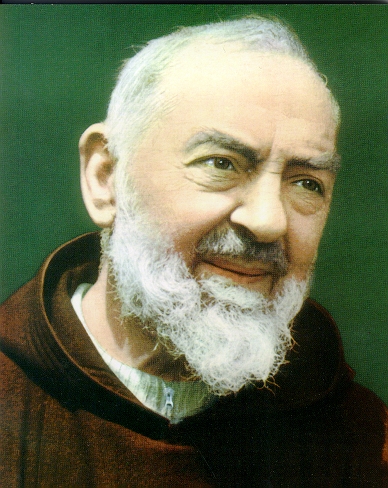
Zenit: On Padre Pio's Devotion to Mary
"With a Mother's Hand She Will Guide You to the Heavenly Homeland" [2009-06-21]
Pontiff's Homily at St. Pio of Pietrelcina Church
"God Never Annuls That Which Is Human, but He Transforms It" [2009-06-21]
Benedict XVI's Words at the Padre Pio Hospital
"In Hospitals One Touches the Preciousness of Our Existence" [2009-06-21]
Papal Words to Priests, Youth at Padre Pio Church
"Love for Christ Is Inevitably Linked to Love for His Church" [2009-06-21]
Subscribe to:
Posts (Atom)