Thursday, August 27, 2009

Wednesday, August 26, 2009
Entropy gets no respect
John Michael Greer, The Archdruid Report
The second law of thermodynamics is the gold standard of physics, the law you can count on when all else fails. Why, then, does so much of the contemporary conversation on the future of energy ignore it? The answer is profoundly human -- and profoundly troubling.
(original)
Tuesday, August 25, 2009
Patrick Deneen on the Anti-Federalists
Constitution as Regime
Links:
Anti-Federalist Papers
The Western Confucian, The Way and Virtue of Anti-Federalism
Google Books: The antifederalists: men of great faith and forbearance by David J. Siemers
See also the discussion of Lincoln in the comments to Crolier Than Thou. (Lincoln defender Brian Brown's Extended Republic or Centralized Nation-State? Herbert Croly, Progressivism, and the Decline of Civic Engagement.)
Google Books: The Promise of American Life
Links:
Anti-Federalist Papers
The Western Confucian, The Way and Virtue of Anti-Federalism
Google Books: The antifederalists: men of great faith and forbearance by David J. Siemers
Google Books: The Promise of American Life
Jay Mathews, They Messed With the Wrong Blogger (via Steve Sailer)
As some have written online, part of the problem with American public education lies with the schools of education and education/child psychologists.
As some have written online, part of the problem with American public education lies with the schools of education and education/child psychologists.
Monday, August 24, 2009

From Fr. Finigan, "Beauty for Truth's Sake". He tells us of a so-entitlted new book on education by Stratford Caldecott.
Wasted Youth: College Freshmen Gone Wild (via WWTW)
Likely to lead to an overreaction? Or is it an accurate portrayal of reality? 2500 students. A rather limited sample? We'll have to take a look at statistics, and the reasoning that follows from its use, at another time. With the lack of supervision and discipline at colleges, and the lack of moral formation, many students are bound to get into trouble. Does college life continue and exacerbate the morally loose culture of casual hookups and immature dating that begins in high school (and earlier)? What do you think?
See also:
- Wasted Youth: The Partying Never Stops
- Wasted Youth: Girls Gone Wild
- Wasted Youth: Freshmen Girls Beware
- Is Your Teen Starting College? You Must See This!
Rod Dreher links to an interesting piece in his post Who cares about cowboys anymore?: True Grit, by Elmer Kelton.
An interesting bit later, from the author's own family history:
Would we have a need for horses and cowboys if we returned to a more simpler way of life?
The real cowboy has somehow been lost in all the reckless rhetoric that uses his name in vain. It may be too late to save his reputation from the sneers of the pundits and politicians, but let us at least try to present some of the truth about who he is and what he does.
To begin with, he is a working man, having much in common with millions employed in other occupations, but different in the specifics of his profession. As writer John Erickson has observed, the cowboy is defined by the work he does. That work has to do with domestic animals, specifically cattle, though a good hand with horses and sheep may also qualify for the title.
To call a man a cowboy tells you what he does for a living, but it does not tell you about him as a person. He may be gentle, or he may be rough. He may have a college degree, or he may have trouble reading a newspaper. He may be in church every Sunday, or he may spend the Sabbath getting past a hangover. A cowboy is an individual—tall, short, thin, heavy, loud, quiet, or none of the above.
His job developed out of the vaquero tradition that migrated north from Mexico in the early 1700’s. Working methods and tools of the trade evolved from those favored by Mexican herders on horseback. In South Texas today, the terms “cowboy” and “vaquero” are often used interchangeably, though the true vaquero is Hispanic. In the mountain states of the West, the word is “buckaroo,” an Anglo corruption of “vaquero.”
But cowboying is no regular profession, like bricklaying or accounting. The cowboy is an integral part of the American myth, a symbol of self-reliance and rugged individualism, a descendant of Sir Walter Scott’s knights of old. Of course, this image of a wild but selfless defender of righteousness and justice is just as inaccurate as more-negative depictions. It began with penny-dreadful pulp magazines of the late 1800’s and was augmented by Hollywood western action films, beginning with The Great Train Robbery (1903) and continuing through the spaghetti western invasion of the sixties and seventies. In most of these he tended to be seven feet tall and quick on the trigger.
By contrast, the first western novel widely accepted as literature, Owen Wister’s The Virginian (1904), depicted the cowboy as quiet and contemplative, slow to take action and regretful about it afterward. A boisterous group in town for a spree immediately settles down upon learning that they are disturbing a sick woman. The hero meets the villain in the street only when honor leaves him no other option. Wister’s cowboy lived by an unwritten but widely accepted code of conduct that, in general, has guided real cowboys through the generations.
An interesting bit later, from the author's own family history:
My brothers and I were witnesses to what some have called the last generation of full-time horseback cowboys, still working cattle in ways much like those of their grandfathers. The McElroy Ranch had a couple of very large pastures that at roundup time had to be worked in segments, much as in the days of the open range. We often rode out long before daylight and traveled for miles before we reached the pasture where we were to work. Later on, Dad streamlined this operation by building crude but efficient trailers so we could haul the horses. Often this enabled us to work one pasture in the morning and another in the afternoon, doubling our productivity. With Dad, efficiency always trumped tradition.
Would we have a need for horses and cowboys if we returned to a more simpler way of life?
Two from Dr. Peter Chojnowski: The Dollar's Demise: The Coming American Default and from 2008, Interview on the Crash of 2008.
Georg Gänswein feiert Priesterjubiläum in Riedern am Wald
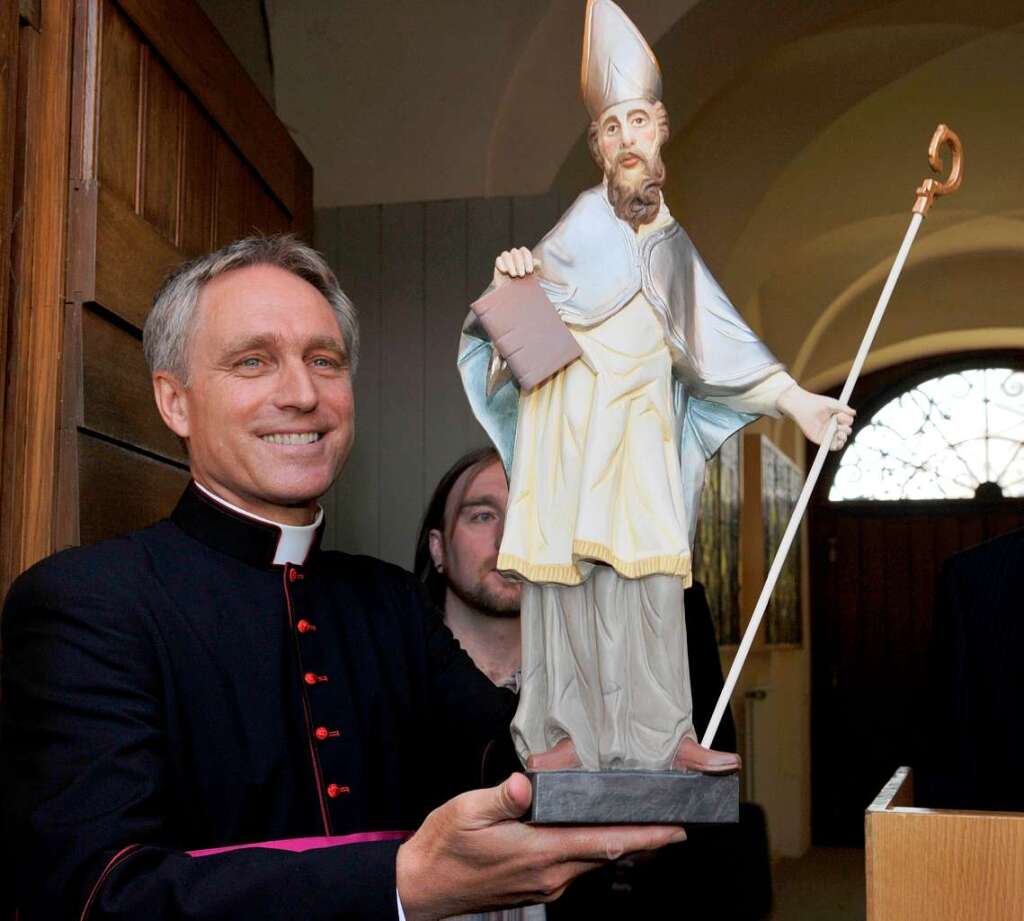
Papstsekretär Georg Gänswein hält in Riedern eine holzgeschnitzte Heiligenfigur in den Händen, die ihm die Kirchengemeinde geschenkt hat. | Foto: dpa
Papstsekretär Georg Gänswein hält in Riedern eine holzgeschnitzte Heiligenfigur in den Händen, die ihm die Kirchengemeinde geschenkt hat. | Foto: dpa
Catholic Church Conservation: Roman veto
From NCR Online:
From NCR Online:
In general, church-watchers say that policy is intended to defend the theology of apostolic succession, in which decision-making power in the church is believed to flow through the sacrament of holy orders. Although religious brothers take vows and are generally seen as equals within their communities, under the church's canon law they are considered laity.I can understand why apostolic succession is important for the exercise of authority within the local Church and the universal Church -- but why is it necessary for religious orders or other associations that are a part of a Church?
Sandro Magister, Hilltop Youth. Report from Judea and Samaria
A trip among the new generation of Israeli settlers. Anarchical and visionary, they are defying the prohibitions of their government and the hostility, not only of the Arabs, but of the world. "We are the people of the Bible. We have come back home." A major on-site investigation
We shouldn't be surprised that Zionism is alive and well among the young.
Rhonda Vincent at Podunk
Rhonda Vincent at Podunk Homecoming day
til they come home
Heartbreaker's Alibi
A couple more at senortocino's channel.
Kentucky
til they come home
Heartbreaker's Alibi
A couple more at senortocino's channel.
Kentucky
Sunday, August 23, 2009
Apparently the UK Not With a Bang But a Whimper is different from the US collection of Dalrymple essays with the same title: Not With A Bang But A Whimper (UK).
Social Credit
Some have mentioned social credit in threads dealing with the current economic crisis on other blogs. I should look into it. Some links for future reference:
Social Credit by Major Clifford Hugh Douglas
Douglas Social Credit
C.H. Douglas: Pioneer of Monetary Reform by Richard C. Cook
An Exchange Between C.H. Douglas and John Maynard Keynes
Wiki: C. H. Douglas, href="http://en.wikipedia.org/wiki/Social_Credit">Social Credit
The Alberta Social Credit Party
Social Credit Asterisks
From The University Concourse:
The unfeasibility of the Social Credit solution
Social Credit is no alternative
Major C.H. Douglas on "Causes of War" - part 1
Major C.H. Douglas on "The Causes of War" - part 2

Gourmet tea stores
When I took the MD to Valley Fair a couple of weekends ago, I walked by Teavana, with which I was already familiar, since I first visited one at the Prudential Center while I was living in Boston. I was shocked to see another gourmet tea store at the mall though: Lucipia Fresh Tea. Can both stay in business during this economic crisis? I really doubt it. The teas, teapots, cups and accessories also seem to me to be overpriced. If I wanted to pay for a fancy tea set I'd go to a store in Japantown SF or shop online. (There's not much in Japantown SJ.) Indeed, my friend HCK remarked, gourmet tea seemed to be the next thing after frozen yogurt, but he wasn't going to pay that kind of money for tea that he could get for cheaper prices from Taiwan.
I should take a look and see what is available at Daiso.
I should take a look and see what is available at Daiso.
Unschooling
Some more links to the unschooling movement:
unschooling.com
Family Unschoolers Network
Radical Unschooling
Unschool Radical
Unschooling -- Delight-driven Learning
A new chapter in education: unschooling
I just started looking into unschooling last month, even though I had been aware of the unschooling fanpage at Facebook for a while. Despite some qualms I have with Holt's political beliefs (see my previous post on John Holt), I haven't read anything I find objectionable so far, when it comes to teaching children. From Pat Farenga's introduction to unschooling:
What Is Unschooling?
This is also known as interest driven, child-led, natural, organic, eclectic, or self-directed learning. Lately, the term "unschooling" has come to be associated with the type of homeschooling that doesn't use a fixed curriculum. When pressed, I define unschooling as allowing children as much freedom to learn in the world, as their parents can comfortably bear. The advantage of this method is that it doesn't require you, the parent, to become someone else, i.e. a professional teacher pouring knowledge into child-vessels on a planned basis. Instead you live and learn together, pursuing questions and interests as they arise and using conventional schooling on an "on demand" basis, if at all. This is the way we learn before going to school and the way we learn when we leave school and enter the world of work. So, for instance, a young child's interest in hot rods can lead him to a study of how the engine works (science), how and when the car was built (history and business), who built and designed the car (biography), etc. Certainly these interests can lead to reading texts, taking courses, or doing projects, but the important difference is that these activities were chosen and engaged in freely by the learner. They were not dictated to the learner through curricular mandate to be done at a specific time and place, though parents with a more hands-on approach to unschooling certainly can influence and guide their children's choices.
Unschooling, for lack of a better term (until people start to accept living as part and parcel of learning), is the natural way to learn. However, this does not mean unschoolers do not take traditional classes or use curricular materials when the student, or parents and children together, decide that this is how they want to do it. Learning to read or do quadratic equations are not "natural" processes, but unschoolers nonetheless learn them when it makes sense to them to do so, not because they have reached a certain age or are compelled to do so by arbitrary authority. Therefore it isn't unusual to find unschoolers who are barely eight-years-old studying astronomy or who are ten-years-old and just learning to read.
Natalie MacMaster at Podunk Bluegrass Festival
Natalie MacMaster at Podunk Bluegrass Festival #7
Natalie MacMaster at Podunk Bluegrass Festival #9
Natalie MacMaster at Podunk Bluegrass Festival #11
Natalie MacMaster at Podunk Bluegrass Festival #13
Natalie MacMaster at Podunk Bluegrass Festival #15
Natalie MacMaster at Podunk Bluegrass Festival #19
Natalie MacMaster at Podunk Bluegrass Festival #21 - Medley
Natalie MacMaster at Podunk Bluegrass Festival 2009 - Final Song
Podunk Bluegrass Music Festival
Sarge sent a link to this video to me: Hot Summer Gear: Vibram FiveFingers
It reminds me of You Walk Wrong by Adam Sternbergh.
It reminds me of You Walk Wrong by Adam Sternbergh.
Subscribe to:
Posts (Atom)