Friday, July 28, 2006

Singer Bada in Bid to Boost Birthrate

Singer Bada in Bid to Boost Birthrate

Eight years after her debut, the pop singer Bada is preparing to market her first solo concert, “Showman aLive,” with a novel twist. The concert will be held at Samseong-dong's COEX convention center in Seoul on July 29, and the singer and her management plan to do their bit for the nation’s paltry birthrate by encouraging people to have children under the slogan "the happiness of manwon." Concertgoers who have more than two children will be given a "manwon" or W10,000 note (US$1=W954), according to Network Live, the organizer of the concert. (englishnews@chosun.com )


She is Catholic.

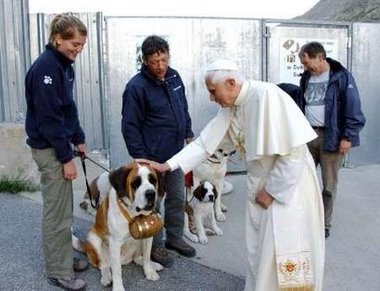
The Pope with Saint Bernards


Pope Benedict XVI (C) plays with Saint Bernard dogs at the Maison of Saint Bernard in Martigny, in the Swiss part of the Gran San Bernardo mountain in Switzerland July 19, 2006. REUTERS/Osservatore Romano/Pool (SWITZERLAND)

Those are rather big heads!

"Borrowed Empire"

Borrowed Empire

The dollar won’t necessarily collapse if oil is billed in euros—but our crushing trade deficits might do the trick.

By Paul Craig Roberts

188 Japanese martyrs to be beatified in Nagasaki

188 Japanese martyrs to be beatified in Nagasaki

This was decided by the Standing Committee of the Catholic Bishops' Conference of Japan, to “draw near to Japan’s great tragedies”. A nationwide appeal for funds was launched to cover the expenses of the ceremony that should be held next May.

Tokyo (AsiaNews/JCW) – The Standing Committee of the Catholic Bishops' Conference of Japan decided at their monthly meeting to celebrate the beatification ceremony of Fr Petro Kibe and his 187 companions in Nagasaki “thus drawing near to the great tragedies of the Japanese people”.

The commission also appointed four bishops – Mgr Ryoji Miyahara (Oita), Osamu Mizobe (Takamatsu), Mgr Yoshinao Otsuka (Kyoto) and Mgr Mitsuaki Takami (Nagasaki) – to undertake the preparations.

The bishops launched a fund-raising appeal that will start on 1 August, with the aim of raising 30 million yen to cover the expenses. An appeal for donations by the bishops’ conference was sent to dioceses, religious orders and Catholic institutions in Japan.

Fr Fernando Rojo – promoter of the canonization cause – said the ceremony will not take place before May: the historical and theological commissions of the Vatican Congregation have issued opinions in favour, but the final decision lies with the pope.

The 188 Japanese martyrs killed in the seventeenth century for their faith include priests, religious and lay people: their cause is referred to as the “beatification of Fr Petro Kassui Kibe and his 187 companions”.

Fr Petro Kassui Kibe, a Jesuit priest, was a convert to Christianity. At first, he managed to escape persecution and went to Rome, where he joined the Society of Jesus and was ordained to the priesthood. He returned to Japan to minister to other oppressed Christians, but was captured, tortured and martyred in Tokyo in 1639.

Thursday, July 27, 2006

"Ancient apartheid leaves imprint"

On the Germanicization of Britain.

Thanks to the Western Confucian.

Change in uniforms coming?

Where are their priorities?

Another Wendell Berry interview

Source
January/February 2006

INTERVIEW

How can a family ‘live at the center of its own attention?’
Wendell Berry’s thoughts on the good life

BY HOLLY M. BROCKMAN

If you profess to embrace family values and you shop at Wal-Mart, think again. The global economy, powered by big corporations such as Wal-Mart, destroys families with low prices made possible by low wages.

Such are the teachings of Wendell Berry, 71, a lifelong advocate of family values, sustainable agriculture and environmental stewardship. Berry’s writings promote local economies as a healthier, more eco-friendly way of life. He has authored more than 40 books and is among 35 Kentucky writers whose work is featured in a new anthology on the devastation that mountaintop removal mining has wrought in Southern Appalachia.


Berry lives, writes and farms at Lane’s Landing near Port Royal, Ky.


Holly M. Brockman: I've heard you use the term "useful" in some of your talks, and it certainly permeates all your essays and other writing. What does usefulness mean? Who is somebody who is useful and why?

Wendell Berry: There’s a kind of language that obscures its subject. Such language makes it harder to see and to think. By the word usefulness I mean language or work that enables seeing, makes clarity. Wes Jackson’s work and language have been wonderfully useful to me in that way. Harry Caudill too, by his books and his conversation, helped me to see and think and make the radical criticism. Gary Snyder and I agree on a lot of things, but his point of view is different from mine and it has been immensely useful to me. Some differences make for binocular vision.

HB: And what does it mean in the context of human daily living and beyond? Let's say into the corporate world?

WB: Usefulness stands in opposition to the frivolous. John Synge wrote about the Aran Islands where the people were poor and yet all the useful things in their life were beautiful. The issue of usefulness has a kind of cleansing force. If you ask, "Is it useful?" probably you’re going to have fewer things you don’t need. You are useful to your family if you’re bringing home the things they need. Beyond that, maybe you are useful to other people by your work. The corporate world is much inclined to obscure this usefulness by making and selling a lot of things that people don’t need. For instance, a lively and important question is how much light we use at night and what we use it for and need it for. I’m old enough to remember when the whole countryside was dark at night except for the lights inside the houses, and now the countryside at night is just strewn with these so-called security lights. How much of this do we need? How much of it is useful? We have a marketplace that is full of useless or unnecessary commodities. I don’t want to be too much of a crank, but there are many things that people own to no real benefit, such as computer games and sometimes even computers.

HB: How does your notion of usefulness differ from the old Protestant work ethic?

WB: The Protestant work ethic has never been very discriminating about kinds or qualities of work or even the usefulness of work. To raise the issue of usefulness is to call for some means or standard of discrimination. The Protestant work ethic doesn’t worry about the possibility of doing harmful work or useless work.

HB: In order to be better stewards of our own lives and therefore those resources around us—land, soil, each other— how do we work toward a more sustainable, community-oriented life?

WB: I think you have to begin with an honest assessment of the value or the possibility of personal independence. What is the limit of individualism or personal autonomy? Once you confess to yourself that you need other people, then you’re in a position to look around your neighborhood and see how neighborly it is, starting with how neighborly you are yourself. The question of stewardship naturally follows. How careful is your neighborhood of the natural gifts such as the topsoil on which it depends.

HB: Large chunks of what used to be taken care of by family members—caring for children, the elderly and education—has been outsourced to corporations in the form of daycare, preschool and corporate sponsorship of education initiatives. You've written extensively about this and that these are signs of familial breakdown. Why is it a breakdown and what impact does it have on a family?

WB: The issue here is the extent to which a family is like a community in its need to live at the center of its own attention. A family necessarily begins to come apart if it gives its children entirely to the care of the school or the police, and its old people entirely to the care of the health industry. Nobody can deny the value of good care even away from home to people who have become helplessly ill or crippled, or, in our present circumstances, the value of good daytime care for the children of single parents who have to work. Nevertheless, it is the purpose of the family to stay together. And like a community, a family doesn’t stay together just out of sentiment. It is certainly more pat to stay together if the various members need one another or are in some practical way dependent on one another. It’s probably worth the risk to say that families need to have useful work for their children and old people, little jobs that the other members are glad to have done.

HB: What are some things we can do—small things, perhaps—until we actually make a commitment on a broader scale, to initiate husbandry (whose trajectory will be felt globally) to ourselves, our families and our communities?

WB: I think this starts with an attempt at criticism of one’s own economy, which may be the same thing as good accounting. What are the things that one buys? How necessary or useful are they? What is their quality? Are they well grown or well made? What is their real cost to their producers and to the ecosystems in which they were produced? Almost inevitably when one asks these questions, one discovers that they are extremely difficult and sometimes impossible to answer. That frequently is because the things we buy have been produced so far away as to make impossible any stewardly interest on the part of the consumer. And this recognition leads to an even better question: How can these mysterious products brought here from so far away be replaced by products that have been produced near home? And that question, of course, leads to all manner of thoughts and questions about the possibility of a better, more self-sufficient local economy. What can we neighbors do for one another and for our place? What can our place do for us without damage to us or to it?

HB: Is it possible to reshape our thinking in baby steps or must we make sweeping changes?

WB: Oh, let’s be against sweeping changes and in favor of doing things in small steps. Let’s not discourage ourselves by trying for too much or subject ourselves to the tyranny of somebody else’s big idea.

HB: If everything is left to the individual and the community, how can each avoid being so overburdened that no one has much time for activism and intellectual pursuit?

WB: In other words, how can you have a livable life and do everything? Everything ought not to be left to individuals and communities. Government exists to do for people what they can’t do for themselves. Farmers individually or in their communities, for instance, can’t enact effective programs for price supports with production control so a government can do that, and at one time our federal government did do that. Maybe I’d better say at this point that I am an unabashed admirer of the tobacco programs of The New Deal.

HB: Many progressives live transitive lives (you included having spent time in New York, California and abroad) having fled small towns for the more intellectually stimulating environment or a college town. How do we close that gap and encourage progressives and intellectuals to find safety and comfort outside an academic setting?

WB: The geographer Carl Sauer said, "If I should move to the center of the mass I should feel that the germinal potential was out there on the periphery.” I think there should always be some kind of conversation between the center and the periphery. So you need people in the periphery who can talk back to the people in the center.

HB: What encouraged you to settle back in your hometown of Port Royal, Ky., after finding rewarding intellectual and academic success?

WB: It was clear I’d be thinking about this place (Port Royal) the rest of my life, and so you could argue that I might as well have come back so as to know it. But that’s only a supposition. The reason I came back was because I wanted to. Tanya and I wanted to. We hadn’t been homesick but when we started down the New Jersey turnpike with the New York skyline behind us, it was exhilarating.

HB: How do we encourage progressives to settle down and where should they stay? Would you see possibility in them forming communities among themselves or would you see them successful in joining already established rural communities where they might not feel initially welcomed?

WB: Well, people do form intentional communities. I have visited a few that seemed pleasant enough. But I’ve never lived in one, and so I don’t really know about them. I’m not willing to say, as general advice, that urban people should move to the country. I’ve never advised anybody to give up a well-paying city job and try to farm for a living.

HB: Rural, community-based living has the thinking, stereotyped perhaps, that there is an innate distrust of outsiders. Do you see truth in this thinking? What can be done to re-shape this thinking?

WB: There’s truth in it, but it’s also true that distrust is a major disease of our time, wherever you live. I don’t have any idea what can be done about that. The only way to stop somebody from distrusting you is to be trustworthy and to prove it over a longish period of time.

HB: Do you believe community-based living has historically bred conservative rather than progressive ideas?

WB: That depends entirely on the community you’re in. Communities of coal miners have supported the union movement. Small farmers have in this part of the country supported the tobacco program. On the other hand, I suppose that if you live in a community that is thriving, providing good work for its members and unthreatened by internal violence, you would probably try to conserve it. I suppose that Amish communities have tried to be conservative that way. If you live in an enclave of wealth and privilege, probably you tend to be conservative in a more familiar way. And, in my opinion, that is the wrong kind of conservatism.

HB: Many people grow up in small towns and find great comfort in their natural and familial surroundings, but their thinking and ambitions aren't rewarded there either by lack of jobs or lack of embracement of ideas—certainly, a misuse of the community's resources. How can youngsters and young adults be encouraged to stay home and still be fulfilled?

WB: This question depends on what you mean by intellectual stimulation and whether or not you can get it from the available resources. It’s perfectly possible to live happily in a rural community with people who aren’t intellectual at all (as we use the term). It is possible to subscribe to newspapers and magazines that are intellectually challenging, to read books, to correspond with like-minded people in other places, to visit and be visited by people you admire for their intellectual and artistic attainments. It’s possible to be married to a spouse whose thoughts interest you. It’s possible to have intellectually stimulating conversations with your children. But I’ve had in my own life a lot of friends who were not literary or intellectual at all who were nevertheless intelligent, mentally alive and alert, full of wonderful stories, and whose company and conversation have been indispensable to me. I’ve spent many days in tobacco barns where I did not yearn for the conversation of the college faculty.

HB: Farmers markets and coops where people buy a share of a farmer's harvest and pick it up weekly or bi-weekly have gained in popularity. So have weekly, predictable roadside stands. Why is this so important to a community?

WB: Well, the obvious reason is that a good local economy feeds the local community. But markets of the right kind and scale also fulfill an important social function. They are places where neighbors, producers and consumers meet and talk. People come to the farmer’s market to shop and might stand around and talk half a day. Country stores have fulfilled the same functions. People feel free to sit up at the Hawkins Farm Center in Port Royal. It’s a great generosity on the part of the Hawkins family, and a great blessing to the community.

HB: Why is providing food to a local community so important in sustaining it?

WB: Because the most secure, freshest and the best-tasting food supply is local food produced by local farmers who like their work, like their products and like having them appreciated by people they know. A local food system, moreover, is subject to the influence of its consumers and the dangers and vulnerabilities of a large, high-centralized, highly chemicalized, industrialized food system held together by long distance transportation. A locally adapted local food economy is the most secure against forms of political violence, epidemics and other threats.


Freelance writer Holly M. Brockman teaches and lives in Louisville, Ky.

Fiddler's Hearth

Well my sister KK is definitely the party thrower, a better one than Dr. Caroll? Haha

On Tuesday night I went with New Scot to The Fiddler's Hearth, an "Irish" pub, right next to The Oyster Bar, where we had gone a couple of nights before. The Fiddler's Hearth is a nice place, plenty of light (not like Burp Castle), not so many Irish people though the night we went there. Too bad! I heard there is live Irish music on Thursday night--perhaps the New Scot is going there again tonight. I, on the other hand, have come back to Boston, and am stuck in a hot room.

The New Scot was having a conversation with another patron of the pub, when the topic of religion came up. Evidently the patron is an Unitarian and believes that it suffices for one to be morally good (i.e. treat others justly and well) in order to be fulfilled or perhaps even 'saved.' While it is easier for us to come to know what the demands of justice are, how we should act with respect to ourselves is not as easy, and relatively unimportant for liberals, progressives, and others. What difference does it make if I am unchaste, so long as "I treat others well"?

The other problem, of course, is how God figures into all of this, and for this guy, He wasn't a part of the picture at all. Culpable ignorance, or not? Hard to say... perhaps it is possible for someone to proclaim the importance of behaving well towards others without pride sneaking in. Then again, is God really so silent in their lives?

website

Oh, here's the Trinity website.

Wednesday, July 26, 2006

T. Hibbs' review of A. MacIntyre's book on Edith Stein

source


Books in Review
The Beginning of the Journey
Copyright (c) 2006
First Things 163 (May 2006): 49-52.

Edith Stein: A Philosophical Prologue 1913-1922 by Alisdair MacIntyre. Rowan & Littlefield. 224 pp. $25.95.

Reviewed by Thomas S. Hibbs

IN THE SUMMER OF 1921, while visiting friends, Edith Stein chanced upon the
autobiography of St. Teresa of Avila. Reading through the night, she completed
an important stage in her own intellectual and religious development. She decided to become a Catholic and to follow the path of St. Teresa into the Carmelites.

Now, with Edith Stein: A Philosophical Prologue 1913-1922, Alasdair MacIntyre has written a remarkable intellectual biography of Stein that ends, rather than begins, with her conversion. The author of such influential books as Marxism and Christianity, After Virtue, and Dependent Rational Animals, MacIntyre is not writing hagiography but a “philosophical prologue” to a conversion—though that carefully chosen word prologue invites thoughts about the life that Stein would lead after her conversion.

Edith Stein has much to say about reason and faith, the nature of conversion, the
relation of phenomenology to Thomism, and the understanding of philosophy as a
way of life. In Stein, MacIntyre detects an exemplary philosophical life, not so
much in the conclusions reached but in the questions formulated and the integration of thought and life. MacIntyre opens with a reference to the ancient genre of “Lives of the Philosophers,” and MacIntyre’s account of Stein’s life is a contribution to that venerable genre: a counter to the trivializing relegation of philosophy to the professionalized and specialized world of academia, which too often reduces the life of a philosopher to salacious gossip.

MacIntyre’s book is at once an example of, and yet transcends, the contemporary
philosophical impulse to recover what philosophers call the “situatedness of thought.” He does indeed locate Stein—a female, Jewish philosopher who was
killed at Auschwitz and canonized as a Catholic saint—in the context of her Jewish upbringing, her philosophical apprenticeship under Edmund Husserl, and her growing awareness of German nationalism and its attendant anti-Semitism.
But the book is not finally about the background history of Edith Stein’s
intellectual development. Instead, it defends a thesis about the unity of thought and life and about Stein’s own life as an embodiment of a certain form of philosophical life.

MUCH CONTEMPORARY philosophical biography involves unmasking scandal. Among modern philosophers, Martin Heidegger is the most widely mentioned case—and the comparison of Heidegger with Stein illustrates the centrality of truthfulness in the attempt to think clearly about how thought and life might be integrated. At various points, MacIntyre offers tantalizing comparisons of Stein and Heidegger, whose lives have intersecting but opposed trajectories. Heidegger began as a Catholic, studied with Husserl, abandoned Husserl to embark on a radical deconstruction of traditional metaphysics, and ended up an ally of the Third Reich.

Edith Stein began as a practicing Jew, turned to atheism, studied with Husserl, struggled to move beyond the limitations she detected in Husserl’s phenomenology, became a Catholic, moved toward traditional metaphysics, and was executed by the Nazis at Auschwitz.

But MacIntyre’s Edith Stein also concerns the history of modern Thomism, to
which MacIntyre has since the early 1980s himself been a contributor. In his 1990 book Three Rival Versions of Moral Enquiry, MacIntyre argued that, by making epistemology into first philosophy, certain strains of Thomism inevitably dissolved into a number of competing schools. Of course, MacIntyre does not think that Thomism can simply seal itself off from modernity. Instead, what is needed is a way of engaging modern philosophy without succumbing to its epistemological assumptions.

One possible way to address this problem is through the kind of phenomenology that Edmund Husserl began. MacIntyre does a nice job of introducing the reader to the central philosophical issues in phenomenology and its development out of the history of modern philosophy. While many modern thinkers lined up in defense of the two lines of modern thought that were developed from David Hume and Immanuel Kant, Husserl objected to what Hume and Kant shared: an atomistic and punctual account of experience as consisting of easily isolated sense impressions.

HUME, FOR INSTANCE, inventoried sense impressions and declared that he could detect no clear impression corresponding to such common philosophical notions such as substance or cause and effect. We perceive, Hume famously asserted, only contiguity in time and place: We never have a sense impression of some thing causing another thing, just of one thing happening after, and adjacent to, another event.

To Husserl, this looked less like an accurate description of experience and more like the result of a peculiar sort of analysis. To counter Hume’s reductionist analysis, Husserl offered a meticulous descriptive account of experience, sensitive to the complex ways in which objects are given to us as actual or potential wholes—and as
inextricably intertwined, especially in their actions, with other objects. We do not experience fire, paper, and then ashes; we experience fire actively consuming paper and reducing it to ashes.

What attracted so many young scholars to the Husserl of the Logical Investigations (1900) was the sense that he had rescued philosophy from an impasse into which the lines of David Hume and Immanuel Kant had driven it. Instead of Kant’s insistence that we know only appearances, that things in themselves remain hidden to us, the shibboleth of phenomenology was, “To the things themselves.”

YET WHEN HUSSERL released his later book Ideas (1913), he seemed to have retreated from things themselves to ideas and to have lapsed from realism back into idealism. As Edith Stein wrote, “All of us had the same question on our minds. The Logical Investigations had caused a sensation primarily because it appeared to be a radical departure from critical idealism which had a Kantian and neo-Kantian stamp. Knowledge again appeared as reception, deriving its laws from objects not, as criticism has it, from determination which imposes laws on the objects. All the young
phenomenologists were confirmed realists. However, the Ideas included some expressions which sounded as though the Master wished to return to idealism.”

In his penchant for depicting reality as utterly mind-dependent or intentional, Husserl created notorious problems for himself, concerning (a) the role of the human body in our acts of knowing and (b) our awareness of, and communication with, other persons—the famous problem of intersubjectivity. As MacIntyre sees it, Husserl’s thought embodies two distinct and incompatible philosophical positions.

MACINTYRE DOES A marvelous job of reconstructing all this historical context for Stein’s philosophical journey. He takes up, for example, the little-known Adolph Reinach, a student of Husserl’s and one of Stein’s teachers. Reinach shared Stein’s worries about latent idealism in Husserl, and, ahead of Stein, he saw the import of the social conditions of certain types of acts of knowing: those involved in making promises, for instance.

Among Stein’s own philosophical contributions to phenomenology, her work on empathy stands out, particularly for the problems concerning embodiment and inter-subjectivity. Stein’s graduate thesis, “On the Problem of Empathy,” bears all the marks of an early, incomplete work, where the questions and suggestions for further research are in many ways more significant than the conclusions established.
Still, her focus on empathy brings to the fore precisely those constituting conditions of human experience and knowledge that Husserl was always in danger of suppressing or at least pushing to the margins: the way in which first-person accounts of experience can be changed by alternate third-person accounts, the way in which our sense of ourselves and of others as embodied persons is crucial to the experience of empathy, and the way our self-understanding is frequently mediated by third-person recognition.

MacIntyre detects the overlap of Stein’s life and thought as her philosophical interests in empathy and the social conditions of knowledge, on the one hand, match her desire to participate in the right sort of community, on the other. Stein concerned herself with such fundamental practical questions as: To what sort of community do I owe allegiance? And with what sort of others should I be in dialogue?

It is not surprising that her decision to become a Catholic was nearly indistinguishable from her decision to join a religious order. MacIntyre rightly sees that Stein’s conversion is a disruption of philosophy. Indeed, given the limitations in her philosophical resources and her lingering disagreements with Husserl, it is not clear how she could have proceeded philosophically.

But MacIntyre also suggests that her conversion provided the seeds for future progress on precisely the lingering questions that Stein was unable to resolve from within Husserlian phenomenology. From Stein herself, MacIntyre derives the observation that large-scale changes in belief are less a matter of organic evelopment of latent possibilities than of an “otherworldly” influence that could not be predicted or compelled.

MACINTYRE COMPARES Edith Stein’s conversion to that of a number of her contemporaries (Reinach’s conversion to Protestantism, Rosenzweig’s to Judaism, and Lukacs’ to Marxism) to show that the gap between Stein’s philosophical prelude and her religious conversion does not imply that the meaning of “conversion” is
reducible simply to “the adoption of beliefs beyond reason.” One can undergo a
conversion from one set of rationally held beliefs to another set, or from irrationality to faith in reason. Moreover, the most dramatically compelling conversions are those that enable individuals to understand, if only retrospectively, what they could not before.

One of the matters on which Stein had clearly made some progress before her conversion was in her thought about German nationalism. MacIntyre makes a convincing case that Stein moved beyond a crude patriotism in the German Volk to a more democratic conception of government, even as she became gradually aware of the rising currents of anti-Semitism in her country. Her analysis of the way what she calls “contagion” can sweep over the masses and render a people susceptible to irrational social currents looks remarkably prescient.

HERE, TOO, MACINTYRE makes a case for Stein’s exemplary integration of thought and life, with her ability not so much to come to peremptory conclusions but to think through questions, both theoretical and practical, and to adopt a corresponding way of living. And this returns us to the comparison of Stein with Heidegger. MacIntyre puts the question, to which Stein’s life is the answer, thus: “What would it have been in that period of German history in which Heidegger grew up, served his philosophical apprenticeship, and became the most influential of
twentieth-century German philosophers to have lived quite otherwise as a
philosopher, to have consistently taken seriously both the implications for one’s life outside philosophy of one’s philosophical enquiries and the implications for one’s philosophy of one’s other activities?”

Edith Stein is a splendid philosophical book, whose significance over time may come to rival that of After Virtue. That it should also constitute a compelling prelude to
theology, indeed, to hagiography, goes some measure toward confirming Thomas
Aquinas’ paradoxical claim that philosophy can both have its own integrity and
function as a handmaiden of theology.

Thomas S. Hibbs is distinguished professor of ethics and dean of the honors college at Baylor University. His books include Virtue's Splendor and Shows About Nothing: Nihilism in Popular Culture from The Exorcist to Seinfeld.

Monday, July 24, 2006

Venezuela

Tonight at the 'unofficial' party one of the participants told us what is going on in Venezuela. Once the neo-Cons and members have the administration have lost credibility and our trust, it is difficult to accept what they say as true. In the case of Venezuela, one is tempted to dismiss any criticism of Chavez as war-mongering or a charade masking America's need for oil. However, we were told tonight that over the past 7 years over 40,000 people have been killed. Incredible? Perhaps. One does not hear numbers like this in the American MSM. We were also told about the march/protest about 4 years ago? in which many protestors were killed by snipers and such; in fact, Chavez had decided that the military should suppress the protest through violence, but all except one general disobeyed the order, and they pressured the only obedient one to not carry it out. This general eventually became the minister of defense. Unbelievable. Certainly this deserves a more thorough investigation, and I will try to learn more if I get a chance. Our witness believes that is a concerted attack upon the Church (conspiracy) in many Latin American countries, as well as Europe. Secret societies? Communists? One wonders.

Sunday, July 23, 2006

Report from Notre Dame

Things are going well here, I am planning on getting several participants to sign their books for me. I arrived yesterday and was picked up by my sister KK, her boyfriend and the New Scott. We headed to Famous Dave's BBQ for lunch (no wonder the name sounded familiar, there are franchises in AZ). Then we returned back to Notre Dame so I could check into the dormitory where I am staying during the Institute. Then we went to the bookstore so I could pick up the big M[a]c's autobiography and so other items, with a discount thanks to my sister's TA discount card. Afterwards, I hung out with the New Scot on campus, and checked out some of the sites while we took a walk. I got a chance to ride his bike; I'll post some pikes of his book with the old-fashioned handlebar when I get back to Boston. He went to a baseball game and dropped me off at the house of my sister's bf, where we had dinner. The sausage burgers were good, but I must admit that I am getting a bit tired of sausage, having eaten so much of it in the past week. We caught part of the Miami Vice special on NBC--while some of it was ok, a lot was really outdated. It's too bad Robbery Homicide Division didn't last longer on CBS.

Friday, July 21, 2006

Photos for the Day


Traffic cops: North Korean traffic police walk in their summer uniforms. To be a traffic police officer is an occupation of envy among women in the North. /Yonhap 07-19-2006 21:17


Food to fight the heat: People queue up in front of a “samgyetang” (chicken stew) restaurant in central Seoul, Thursday, the day of “chobok.” Chobok refers to one of the hottest periods in summer between June and July in the lunar calendar, followed by “chungbok” and “malbok.” On these days, Koreans eat highly nutritious food like samgyetang to stay healthy and fight off the heat. /Korea Times Photo by Lee Ho-jae
07-20-2006 17:25


Beauties in class: Candidates for this year’s Miss Korea Contest join a learning session on manufacturing semiconductors at the Samsung Electronics complex in Kihung, Kyonggi Province, Thursday. A total of 61 participants will compete in beauty and intelligence in the main event at the Sejong Center for the Performing Arts on Aug. 3. The contest is being hosted by The Korea Times and The Hankook Ilbo.
/ Korea Times 07-20-2006 19:29


Miss Germany Natalie Ackermann, front, and Miss Korea Kim Joo-hee take naps backstage while waiting to introduce themselves in their national costumes before the opening number for the 2006 Miss Universe Competition on Thursday at the Shrine Auditorium in Los Angeles./AP-Yonhap


Lee Hyo-lee Becomes Muscle Mag’s First Cover Girl

Thomistic Institute

Leaving tomorrow for Notre Dame, be back on the 27th. If I have any free time I will catch up on correspondence.

Schedule for the 2006 Summer Thomistic Institute:

Saturday 22 July

Arrival

Sunday 23 July

7:30 Morning Prayer and Mass in Dorm Chapel
8:30 Breakfast
9:45 Opening Remarks: Ralph McInerny
10:15 Morning Seminar: John O’Callaghan (Intro, and Chpts. 1 & 2)
11:15 Coffee Break
11:30 Resume Morning Seminar
12:30 Lunch
2:30 Chair for the Day: Steven Baldner
Lecture 1: David Twetten: “The Essence of Aquinas: Nominalist or Realist?”
3:30 Break
3:45 Lecture 2: William Carroll
4:45 Evening Prayer
5:00 Dinner
7:30 Lecture 3: Josh Hochschild: "Mental Language in Aquinas?"

Monday 24 July

7:30 Morning Prayer and Mass in Dorm
8:30 Breakfast
10:00 Morning Seminar: John O’Callaghan (Chpts.3&4)
11:00 Coffee Break
11:15 Resume Morning Seminar
12:30 Lunch
2:30 Chair for the Day: Melanie Barrett
Lecture 1: Fergus Kermr, O.P.: “Other minds: Augustine, Thomas and Wittgenstein”
3:30 Break
3:45 Lecture 2: Fr. Stephen Brock: How Metaphysical is Human Nature? Cajetan on Who Studies Soul”
4:45 Evening Prayer
5:00 Dinner

Tuesday 25 July

8:00 Morning Prayer and Mass in Dorm
9:00 Breakfast
10:00 Morning Seminar: John O’Callaghan (Chpt.5&6)
11:00 Coffee Break
11:15 Resume Morning Seminar
12:30 Lunch
2:30 Chair for the Day: Douglas Flippen
Lecture 1: Michael Sherwin, O.P. : ““Aquinas at the Well-house: Language acquisition and moral development, the case of Helen Keller.”
3:30 Break
3:45 Lecture 2: Cyrille Michon
4:45 Evening Prayer
5:00 Dinner
7:30 Lecture 3: Kevin Flannery, S.J.
8:30 Party in the Dorm

Wednesday 26 July

8:00 Morning Prayer and Mass in Dorm
9:00 Breakfast
10:00 Morning Seminar: John O’Callaghan (Chpts.7&8, and 9)
11:00 Coffee Break
11:15 Resume Morning Seminar
12:15 Lunch
2:30 Chair for the Day: Joshua Stuchlik
Lecture 1: Alfred Freddoso: “Christ: unum vel duo?”
3:30 Break
3:45 Lecture 2: Roger Pouivet: “Aquinas on Knowledge and Virtue Epistemology”
4:45 Evening Prayer
6:30 Banquet Dinner

Thursday 27 July

Morning Prayer and Mass TBA on Campus
8:30 Breakfast
Departure


Saint Thomas Aquinas and the Third Millenium
Leonard E. Boyle Chair

Thursday, July 20, 2006

Children of Men trailer

at Apple; movie stars Clive Owen and is directed by Alfonso Cuaron.

It's an apocalyptic movie, though I am a bit surprised that those who have hope are relying upon the Human Project and scientists to figure out the solution to their problems. I prefer the perspective of The 12 Monkeys. If anything, it would be scientists unrestrained by traditional morality who would accelerate the destruction of civilization, not save it.

Ah yes, looks like there is no religious aspect to this movie--God is absent.

Some Resources on 4GW

Some tools for understanding what's going on in Lebanon and 4GW in general:

By Martin van Creveld:
"The State: Its Rise and Decline"
"The Fate of the State"

An interview by Sonshi.com
See also his Transformation of War, The Rise and Decline of the State

By William S. Lind
"Understanding Fourth Generation War" (pdf)
"The Four Generations of Modern War"
"The Canon"
"The Canon, continued"
"How to Fight a 4th Generation War"
His "On War" archive
FMFM 1-A draft
Review of Neither Shall the Sword by Chet Richards

Others:
"10 Best books on Fourth Generation Warfare," by Anthony Lukin
including Sun Tzu, The Art of War

"Conflict in the Years Ahead," by Chet Richards
Prof. Juan Cole's blog, "Informed Comment"

Commentary on Israel and Lebanon

William Lind, "The Summer of 1914," added: "Why Hezbollah is Winning... So Far"
Paul Craig Roberts, "Attention Deficit Americans are Being Misled to War," "America is Being Set Up," "The Neocons' Next Victims"
Pat Buchanan, "Where are the Christians"

Wednesday, July 19, 2006

MFA

This afternoon I went to the MFA with Fujian Gal, since BC students have free admission (although we need to pay $8 weekdays for special exhibitions, full price on weekends, in case any of you BC students are wondering). We couldn't go to the Japanese garden, because I couldn't find the way to it, but then we found out it had already closed. We passed through the Laura McPhee exhibition, and Fujian Gal wants to visit Idaho now. Br. B is from Idaho. I said she should settle down there. Then again maybe I should visit Idaho, in case I need a place to flee to. We were thinking of going to the "Americans in Paris" exhibition but decided to be cheap instead...

We also saw the Chinese section, the Egyptian section, and the Greek/Roman sections, plus some of the Near Eastern stuff... We didn't get to see everything, so we or I will have to visit again some time... there are plenty of seats there, not enough drinking fountains perhaps. I suppose if I were at Northeastern I could do some work there, or some reading. There was a sketching class being held near the entrance to the Chinese furniture exhibit; two women were doing various poses (more like gymnastic poses, for one of them), and the class (mostly older women) was busy doing some sketches. How 'nice.'

Well, another museum experience... I wouldn't mind owning some of the pieces, but spending more than a minute to scrutinize every detail? I don't have the attention span or interest to do that... a beautiful thing perhaps, but in the end, just a thing.

As Fujian Gal was interested in watching Superman Returns, we went to AMC Fenway tonight to catch the movie, since there isn't much else that is out. What can be said about the movie... Fujian Gal liked it, though during and after the movie she was questioning whether certain parts made any sense. Such as--if Lois Lane figured out the 'secret,' shouldn't she be asking how it happened? But we don't get any of that. I think Bryan Singer wrote the script--evidently it doesn't make as much sense as he thought it did. Of course we have to suspend our disbelief when no one can figure out Clark Kent is Superman. It is a comic book story after all... We do get a lot of secular humanism, no religion... Jor-El talks about how human beings can be good, if they are properly inspired. As for Christian resonances, how about Messianic expectations instead?

Superman does quite a lot of lifting in this movie... but it stops being impressive after a while... may be it's because it's not realistic and I can't get into the mindset that would appreciate it. I think I'd rather see a movie about realistic virtue... I don't think I will be seing any other superhero movies, and moreover I fear that they are trying to pack too much into Spiderman 3.

As for Mr. Butterworth's critique of the movie, I'd have to think about it more... are Jane Austen heroes insecure or do they have doubts and jealousies? They do have doubts and jealousies, but do they dwell on their feelings? At least Superman isn't crippled by his insecurities. Is Superman Returns a movie for women or is it supposed to be for everyone? A strong but sensitive guy, but who can't be with Lois because his responsibilities to the world are too great. Perhaps it is fine that Lois end up with Richard and for him to raise her son.

Huh... just realized Dr. Laura's teachings on sexual morality aren't quite consonant with those of the Church. Ah well... that's too bad.

I think I figured out what is wrong with the kielbasa I purchased this week--it's the lean kielbasa, with 50%(?) less fat. The sausage meat lacks cohesion, and tastes like poorly mixed ground chicken. Ah well, no more of that.

"David Jones and the Holy Mass"

Josephinum Journal of Theology

Homepage

Cardinal Dulles, "Justification: The Joint Declaration"
Daniel G. Van Sylke, "Lex orandi lex credendi: Liturgy as Locus Theologicus in the Fifth Century?"

Orthodox Theologian Speaks on Modern Deserts

Code: ZE06071818

Date: 2006-07-18

Orthodox Theologian Speaks on Modern Deserts

Interview With John Chryssavgis

BOSTON, JULY 18, 2006 (Zenit.org).- We can only appreciate the mystical dimension of our world and our soul if we go through the stage of the desert, says Orthodox theologian, John Chriyssavgis.

"I would say that the secret of the desert is learning to lose," he says.

Author of several books, husband and father of two, Doctor Chryssavgis has recently released "In the Heart of the Desert. The Spirituality of the Desert Fathers and Mothers."

Q: Seeking God through silence and prayer like the 4th and 5th century Christian ascetics still has much to teach us now?

Chryssavgis: It is so easy today to consider silence and prayer as something historically outdated or merely as spiritual virtues. In fact, for the life of the early desert fathers and mothers in the fourth and fifth centuries, silence was a way of breathing, a way of going deep.

In a world, such as ours, where so much is determined by the immediate and the superficial, the desert elders teach us the importance of slowing down, the need to pay attention and to look more deeply.

Silence is letting the world and yourself be what they are. And in that respect, silence is profoundly connected to the living God, "who is who he is."

Silence and prayer mean creating space for those moments in our life where integrity and beauty and justice and righteousness reign.

Of course, all this requires toil and tears, labor and love. It is the art of living simply, instead of simply living. It resembles the skill of gardening: you cannot plant unless, first, you cultivate. You cannot expect to sow unless you dig deep. And you certainly cannot expect fruit unless you wait.

The search, then, is for what lies beneath the surface. Only in taking time and looking carefully can we realize just how much more there is to our world, our neighbor, and even ourselves than at first we notice or than we could ever imagine.

Q: Is there a secret to live a rich and healthy spiritual life?

Chryssavgis: In some ways, the secret to living a rich and healthy spiritual life may well be the fact that there is no secret.

One of the problems along the spiritual way is that most of us seek -- or resort to -- magical solutions to profound issues.

Reading the texts of the early ascetics, I have come to realize that perhaps the most essential lesson learned in life is the lesson of surrender, of letting go.

It is a hard lesson, and one that is only reluctantly embraced by most of us. But I am convinced that this life is given to us in order to learn how to lose.

We think that the purpose of a good spiritual life is to acquire virtues, or perhaps to lead a solid, productive, dignified, admirable, and even influential lifestyle.

In fact, every detail -- whether seemingly important or insignificant, whether painful or joyful -- in the life of each one of us has but a single purpose, namely to prepare us for the ultimate act of sharing and sacrifice.

I would say that the secret of the desert is learning to lose. When you know how to lose, you also know how to love! In some ways, every moment in our life is a gradual refinement so that we are prepared to encounter death, which is the ultimate loss.

Q: What unifies the desert fathers and mothers?

Chryssavgis: If there is one element that unites the desert fathers and mothers, in my mind it is their realism.

The unpretentious dimension of their life and experience, of their practice as well as their preaching, is something they share with one another and with all the communion of saints through the centuries.

And precisely because they are truthful and down-to-earth, the desert fathers and mothers are not afraid to be who they are. They do not endeavor to present a false image; and they do not accept any picture of themselves that does not reflect who they really are.

"Stay in your cell," they advise us. Because so often we are tempted to move outside, to stray away from who and what we are.

Learning to face who and what we are -- without any facade, without any make-up, without any false expectations -- is one of the hardest and at the same time, one of the finest lessons of the desert. Putting up with ourselves is the first and necessary step of learning to put up with others. And it is the basis for recognizing how all of us -- each of us and the entire world alike -- are unconditionally embraced and loved by God.

Q: Is there another kind of "desert" nowadays?

Chryssavgis: In our day, the desert is not necessarily to be found in the natural wilderness, although it may certainly be located there for some. The institutional church and the institutional parish have their place; and the natural desert has its place.

But there is more to the spiritual life than these could ever provide alone. Alongside the institutional, there must be room for inspiration. The two are not necessarily opposed, but they must work together integrally if the Body of Christ is to function in all its fullness.

We need to discern the mystery in life. And we can only appreciate the mystical dimension of our world and our soul if we go through the stage of the desert, if we experience that contemplative dimension of life.

Yet the desert today is found in the marginal places of the world and the church, where the prophetic and critical word is spoken in response to the cry of suffering in human beings and in the natural environment.

Those who put themselves on the edge of the conventional church or society in order to see clearly what is happening in our world are contemporary desert fathers and mothers.

Tuesday, July 18, 2006

Methodists to Join Declaration on Justification

Methodists to Join Declaration on Justification

Hrm.

Today's Entertainment News

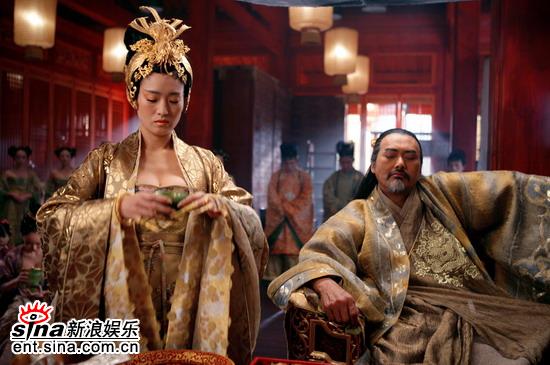
Two pictures from The Curse of the Golden Flower, starring Chow Yun-Fat and Gong Li.


Sony Pictures Classics has picked up distribution rights for the movie; The Banquet has not yet found a North American distributor. I think visually The Banquet looks better, but we will see which has a better story. I hope CYF has found a movie worth acting for. I don't plan on watching Pirates 3.

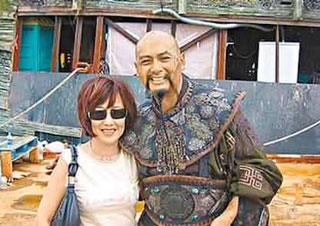
A picture of Mr. Chow with his wife, I believe, from the filming of Pirates 3.

News and links to photos thanks to Monkey Peaches.

Full House's Song, Hye-kyo sets foot in Japan
Song, Hye-kyo finally sets foot in Japan.

The popular Korean actress, who starred with renowned Korean Wave star Rain in the drama Full House, will be launching in Japan her photo books shot in Paris,
Amsterdam, and New York.

Furthermore, her debut film, My Girl and I, is also scheduled to open in Japan in August, for which Song will visit Japan and run a series of major promotional events.

Although there is yet to be a final schedule for her promotional tour, it is believed that Song will hold a press conference and meet her fans in Tokyo and Fukuoka.

Having become one of the leading Korean Syndrome luminaries with her performances in All In and Autumn Fairy Tale (also known as Autumn in My Heart), this is the actress's first time to be on a promotion campaign, thus attracting much interest from local audiences and officials.

With Song entry into Japan, everyone's wondering if the actress would finally emerge as the best Korean Wave star.
More Korean entertainment news.

Review of Miami Vice by David Poland. I hope it's another hit for Michael Mann.

XM-8

The Heckler and Koch XM-8.


Some more photos: 1, 2, 3, 4, 5, 6, 7, 8, 9, 10, 11 (G36), 12, 13, airsoft replicas of various rifles, another airsoft catalog

Images from answers.com and wikipedia:


with grenade launcher:


Some closeups here.

Col. Hackworth had high hopes for this weapon, great M-16-hater that he was.


The hot contender currently being tested by the Army to replace these lemons is
the XM-8, a revolutionary smart-weapon being put through its paces by
professionals who, so far, give it two thumbs up. It's a different kind of
rifle, lighter and less expensive, yet it offers additional features and
performance not available in any other assault rifle in the world.
He ends his column, "With the upgraded XM-8, our warriors will finally have a weapon that will do as good a job punching holes in enemy soldiers in the 21st century as the M-1 and Browning Automatic Rifles did in the 20th. " (source)

Alas, the project has been cancelled. The Pentagon is re-evaluating what exactly the army needs in the future. As if rifles were not an important tool, but perhaps this is the 'technology will replace manpower' mindset at work. Will the XM-8 be revived in the future? Who knows...

Other related news : 1, 2, 3
HK used to have a page for the XM-8, but it has been taken down. The army website appears to be dead as well. Military.com coverage.


The Tavor. FN SCAR.
StrategyPage info on the SCAR. Another site.

"Megadeath in Mexico"

article here

Charles Taylor Resources

It's supposed to feel over 100 today, with actual temps in the mid-90s plus high humidity. I'm waiting at O'Neill for the CTRC to open (not until 3 P.M.), so I should be reading, but I'll finish some drafts for posts instead.

Charles Taylor is the author of Ethics of Authenticity, and Sources of the Self: The Making of the Modern Identity. He is known as a communitarian, and his works do address the questions of individualism versus corporatism as well as altruism versus egoism. I have not really read either, though Ethics of Authenticity was used in several sections of Philosophy of the Person.
Is there such a thing as modernity, traceable to certain philosophical and ideological roots? Or are we just seeing the results of Original Sin? More and more I am leaning towards the latter. Ideas have consequences, but original sin + lack of proper legislation by the government can also have the same consequences, with a proper ideological foundation not being necessary to explain what is going on in a particular society or its development (or more appropriately, its decline).

Charles Taylor resources
Bibliography
wikipedia entry
"The Multifaceted Charles Taylor"
Faculty page at McGill University

I suppose his books are on my reading list, but not a priority. I'd prefer to read a more Aristotelian analysis.

It will be interesting to see the kind of papers that will be presented at the Center for Ethics and Culture conference in November, though I am not sure I will be in attendance.