A pic of KK's poor posture.

The photo of the ensemble founder (posted earlier) is rather old--he is not so young, and he is... a typical artist/musician in appearance and demeanor. Pleasant French accent, and short--shorter than me! But a good flautist.
I am not sure if the group was attempting a recreation, or if dance troupes in the 16th and 17th centuries would actually put on performances like the one we watched tonight for others to observe. I would be somewhat surprised if such was the case--I imagine that dances were held so that everyone could participate, and that the development of dance as an 'art' for the enjoyment of spectators is more recent. I suppose royalty and other nobles might abstain from dancing and choose to watch the couples of dance, but that would still be different--the dance would be for a social/festive purpose and not an 'artistic' one.
As far as I could tell, the technical part of the performances was very good. The costumes for the dancers were appropriate--Renaissance period. Unfortunately the male dancer does not compare to Christian Bale in The New World:
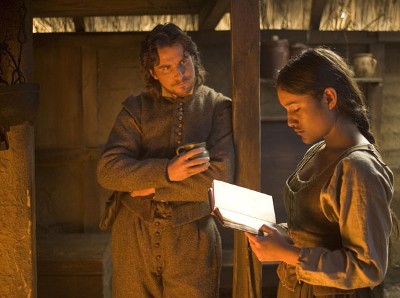

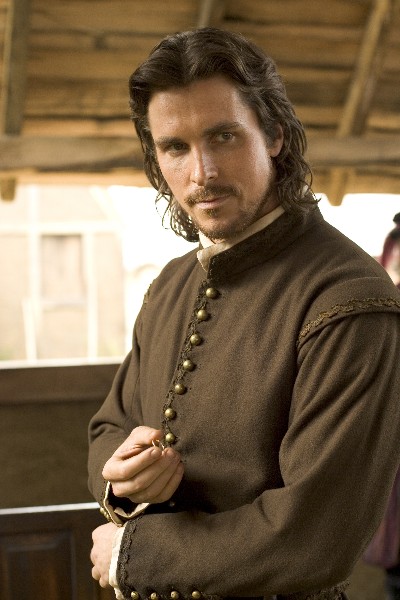
(The New World is definitely worth watching at least once--let's see if a director's cut becomes available on DVD.)
A lot of the dance steps were recognizable from ballet? After all, isn't ballet derived from earlier dances? I don't know if a single couple would be the center of attention--tonight there was only one couple dancing, everyone else was a musician, plus the soprano. I would like to see a recreation of a typical court ball, with at least four couples--just to see if there is any dancing by the group, as opposed to couples dancing separately from one another. That communal aspect is one reason why I like English country dancing; there is a group here in Boston that teaches people how to do English dance.
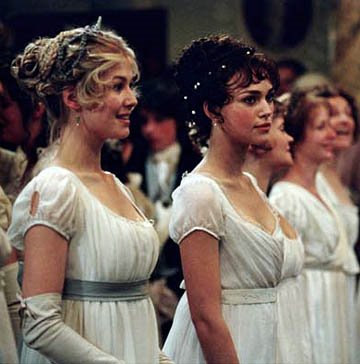
Much of the music performed in the Boston Early Music Festival is divorced from the original social setting in which it was performed. Even the sacred works of Bach, which would have reached a wider audience, were peformed in church for a religious purpose. Ditto for polyphony. Who else could support musicians but the nobility, or rich merchant families? Do the social elites still congregate at contemporary opera performances? If one were to judge by clothes alone, one would think the people attracted to the BEMF come from a variety of backgrounds. I suppose these are people who at least appreciate early music, and do not attend simply because they think they are expected to give patronage to the fine arts.
On the other hand, I think changing the purpose and social context of this kind of music, so that it becomes merely beautiful music to be listened to within an appropriate acoustic setting and another piece of art for art's sake, is not a step forward in cultural progress, but a step backward. The art of fine social dance has been lost, except perhaps as it is practiced by the few in Cambridge--though one wonders if they are more Austen fans than anything else. In the photos of the sessions, the people appear to be dressed casually, in what passes for American casual. Not exactly the ideal. Then again, it is a gathering of country dance or Austen enthusiasts, and not of peers from the same social circle, celebrating as a community through a traditional custom. What we have lost through urbanization, industralization, and mass culture... is the BEMF just another choice for consumers? Does it reinforce our consumerist understanding of culture? Or does it serve a vital role in preserving the cultural heritage of Europe?
One final picture of Keira in P&P:


No comments:
Post a Comment