Wednesday, August 02, 2006

Preliminary Review of Sympathy for Lady Vengeance

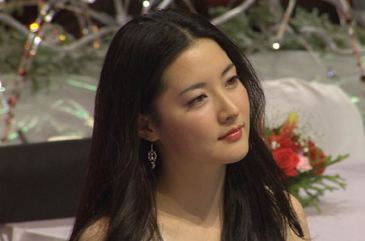
I'll have to admit that the reason why I watched this movie was not because I am a fan of Park Chan-wook's movies (I'm not sure if he is that great a director) nor because I had seen the other two movies in the Vengeance trilogy (I haven't), but because of Lee Young Ae. I skimmed through the movie while I was home in CA back in early June.


I thought I had read in a review somewhere about her refusing communion, but iirc there is no such scene in the movie. There is, however, a scene of her refusing to eat the cake she made for her daughter. Maybe it's just a visual representation of 'you can't eat your cake and have it too.' Certainly it is tied to the question of whether someone can pursue vengeance and still find redemption.

The visual styles and the way the story is told might be considered innovative; I didn't get lost though it did require a lot of attention. As for showing realistically how vicious life could be in a women's prison... that could always be toned down a bit.

Is Geum-ja an innocent angel? Or a witch? The movie flips back and forth between these two images. On the one hand, while she is innocent of the murder of the young boy to which she confesses, she does commit murder while she is in prison, in order to help her fellow prisoners escape from certain tyrants. Naive and innocent, cold and deadly... is it psychologically possible to have this sort of split? I would think not... unless one were to make the case that the murder was really self-defense, but it is not clear to me that killing the prison tyrant is the only solution.
(Unlike a later scene in the movie... where some measure of self-defense is required, but perhaps again, she goes too far... an exercise in extreme brutality, as it were.)

If it is motherhood that saves her, and her willingness to be apart from her daughter because she believes that is best (and also because she is undeserving to be a mother), what (or who)condemns her? I believe that at the end, the audience is left sympathetic to her character, but one is not sure how she can find peace. An unconscious appeal to a transcendent source of justice?

I suppose I'll have to re-watch the movie and see if I can make better sense of it.

movie posters (warning large files): 1, 2,
Korean website. Koreanfilm.org; review and gallery

wallpaper; old pic (almost looks fake?)

More pictures of Lee Young Ae:


Photos from the 2006 LG Pan Asian Family Festival:


More photos from that occasion.


(I think that's by Andre Kim.)

Self-absorbed adults

Domenico Bettinelli has two posts highlighting contemporary attitudes towards children:
Nanny 911
Children, Out of Sight!

The article which inspired the latter:
A Glass of Wine and a Pacifier, Please

New York City is pretty much an adult playground; one wonders how it compares to Las Vegas in that respect. While there are some children-friendly places there (parks, libraries, museums, and such), for the most part, those who are attracted to the city usually cite its nightlife, pop culture venues (including musicals), and the things young single adults are usually attracted to (bars, shopping... did I mention its nightlife?). Perhaps only Vegas is more hedonistic in its purpose for existence. Without the casinos and everything attached to them, how big would Vegas be?

To be "free" and to live the high life in the city, free from all concerns, responsibilities, and attachments... what need have we for a chastisement? Our sin is our punishment.

In his post "Hyperparenting," Mr. Bettinelli comments on the article "A Nation of Wimps." Are some parents creating soft, pampered individuals? "I don't doubt it."

Bumper sticker theology

On the way home after dropping off Fujian Gal at the airport, I saw a mini-van with the bumper sticker, "The Bible says: The Jews own Israel."

Not quite.

Certain Catholics who pride themselves on being 'in tune' with Vatican II and Nostra Aetate and (mis-use ) the statements of recent pontiffs claim that the Old Covenant has not been superceded or abrogated. Some have even caricaturized supercessionism:
... Christianity has replaced Judaism. The theological term for this, supercessionism, has been repudiated as untrue by any number of leading Protestant and Catholic theologians, as well as by Pope John Paul II!

Others make a distinction between the covenant made with Abraham and the covenant made with Moses. Why is this an important question? Because it deals with the economy of grace. Are we saved through Christ alone? And through grace? And by what ways is grace conveyed? Can we say that the sacraments, as the ordinary means of sanctification, are intended by God as such? Do works alone save? We can add the necessary qualifications to explain how a non-Christian is saved, but simply asserting that as long as "someone is good," he will go to heaven is misleading and potentially wrong.

Many Catholics have appealed to God's promise to Moses as a justification of the modern state of Israel. While the sovereignty of its government has been recognized (legitimized by time, if not anything else), this does not mean that everything the government does is necessarily just. Moreover, even if it has a right to defend the country, it does not get a green light to use whatever means it sees as appropriate.

Given the controversy surrounding Israel's response to the attacks by Hezbollah, it is not surprising that some have become angry with some reason. (Putting aside the moral questions, those who fail to understand 4GW do not see that Israel's response is woefully inadequate.) Is this what happened to Mel Gibson, in part? There are also rumors that he was depressed to the point of suicide.

Mel Gibson's second apology (Thanks to Amy Welborn.):

There is no excuse, nor should there be any tolerance, for anyone who thinks or expresses any kind of anti-Semitic remark. I want to apologize specifically to everyone in the Jewish community for the vitriolic and harmful words that I said to a law enforcement officer the night I was arrested on a DUI charge.

I am a public person, and when I say something, either articulated and thought out, or blurted out in a moment of insanity, my words carry weight in the public arena. As a result, I must assume personal responsibility for my words and apologize directly to those who have been hurt and offended by those words.

The tenets of what I profess to believe necessitate that I exercise
charity and tolerance as a way of life. Every human being is God's child, and if I wish to honor my God I have to honor his children. But please know from my heart that I am not an anti-Semite. I am not a bigot. Hatred of any kind goes against my faith.

I'm not just asking for forgiveness. I would like to take it one step further, and meet with leaders in the Jewish community, with whom I can have a one on one discussion to discern the appropriate path for healing.

I have begun an ongoing program of recovery and what I am now realizing is that I cannot do it alone. I am in the process of understanding where those vicious words came from during that drunken display, and I am asking the Jewish community, whom I have personally offended, to help me on my journey through
recovery. Again, I am reaching out to the Jewish community for its help. I know there will be many in that community who will want nothing to do with me, and that would be understandable. But I pray that that door is not forever closed.

This is not about a film. Nor is it about artistic license. This is
about real life and recognizing the consequences hurtful words can have. Its about existing in harmony in a world that seems to have gone mad.

His first apology can be found here.

Whatever financial and professional consequences there may be, we should be more concerned with his health and salvation. And we should be praying for peace in the Middle East.

Today it's supposed to get to 110 degrees. Or at least feel like it. I'm hiding out on campus again...

(I did take the Ted Williams tunnel on the way back from the airport; one lane was closed, so I'm guessing that's the reason why there were no tolls. The tunnel to I-90/Mass Pike was still closed--this is where the accident happened several weeks ago, I believe, when a 3-ton concrete panel fell on a car and killed a woman.)

Tuesday, August 01, 2006

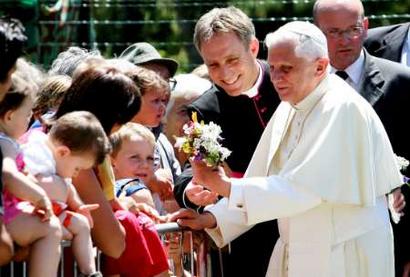
Msgr. George Gaenswein turned 50 on Sunday

I am guessing that very few men in Germany can compare to him.

News and reactions here. An interview posted on that thread:
He who stands behind the Pope

Mons. Gaenswein, you live and work side by side with the Pope. What can you tell us of your daily routine? Which decisions does he leave up to you, and which ones mst in any case need to be further considered?
The Pope's daily routine is, in general, known, but of course, there are elements that are not publicized.

In brief: Holy Mass together at 7 a.m.; breviary prayers; meditation; a pause before the Lord. Breakfast together. Then my work day begins by preparing the correspondence, looking through the oficial mail which is voluminous daily. Then I discuss things with the Holy Father, after which as a rule, I accompany him at noon to the audiences held in the Second Loggia of the Apostolic Palace.

Afterwards, we have lunch together, then a brief walk, and then we have a midday pause. Second halftime, afternoons: I go through newly arrived mail so I can bring the most important things to the Holy Father - for signature, for study, for approval.

Of course, there's a whole range of things that come to the Holy Father that he will not necessarily all see. There are things which are of second, third, fourth priority. One must shield him from a monstrous mass of mail, documents, etc. so that he can do what he really needs to do with necessary calm.

As the Pope's private secretary, you hold the most confidential position possible in the Catholic Church. What does your key position mean for you?
First, it is, of course, for me a sign of the Holy Father's trust in me, and so I try in everything that I do, say or do not say, to be worthy of this trust. And I try to do everything asked of me in such a way that I can answer my conscience clearly. After a year and three months, also, our togetherness has grown.

What influence did your parental upbringing have on your career?
My roots are with my parents, and my earliest upbringing, my first experiences of the faith, the daily example - not so much of words, but rather the simple day-to-day example of living that they set, was for me a great help, which I still have before my eyes even today, and for which I am very very thankful.

Which memories of your youth became particularly important in your later life and may have possibly shaped you?
I grew up in a little village in the southern Black Forest - it's like any other small village. We were a very lively family. I had many comrades, friends. Of course, we played sports - football was my favorite; I was also in a choir and I played the clarinet. We did many things together...So I have lots of memories of a sometimes rascally childhood which always bring me much joy.

Which character traits have been decisive for your career so far?
I'll start with the negative: I am someone who, unfortunately, does not have much patience. I need to make an effort to be patient, to force myself to be patient. But what I would consider positive are my determination, dependability, sincerity and directness. These are traits which go together, woven together like a fabric, that have given my life its inner direction.

You have been working with one of the greatest theologians in the world and have known him for 11 years. What is the difference between the Prefect for the Doctrine of the Faith and the Pope?
Even in hindsight, I don't see a difference in the personality of the Cardinal Prefect and Benedict XVI. Obviously, the position can affect a person in many ways, but his personality, his kindness, his charisma [he uses the word Ausstrahlung, whose primary meaning is 'radiance'] is just as it was before.

Don't you sometimes feel something like stage fright when you are standing before the Holy Father?
Obviously, I do, on occasion. But it is also true that our daily meetings, our daily working together, has made possible a
familiaritas. But there are always situations in which I find my heart pounding more strongly!

When you look back at the first year of Benedict XVI's Pontificate, what stands out?
Certainly, the fact that the Holy Father in his words and in his actions, in his whole being, wishes to demonstrate that faith brings joy to life and for life, that joy is its most important sign, and so this runs like a thread through everything that he does, that he says, everything that one perceives in him, that one draws from him; and he wants this joy in faith to be infectious!

Were you surprised by the theme of love that he chose for his first encyclical?
Not particularly. That first encyclical has found a very very great resonance everywhere. Whoever knew Pope Benedict as a theologian, I think, was not really surprised that he chose this theme and expressed and treated it the way he did in the encyclical.

Mons. Gaenswein, I am sure you are aware that in the eyes of the public you are "beautiful Georg." How do you react to this?
Actually, the Italian press started to write about me in this flattering manner. At the beginning, I was surprised, and even a bit irritated. I couldn't decide - should I just ignore it? Should I take note? Should I react? So I simply ignored it, and over time, I have become used to it. Meanwhile, I think, they are now looking not only at the shell but also a little at what's really inside.

They say that when you were a student, the girls were all drawn to you. Was it also the other way around?
Oh yes, I had healthy senses, and if you have healthy senses, you use them. I never had any problems with the so-called weaker sex, and always had, even to this day, a very relaxed and very natural relationship with women. Of course, in my youth, there were some girls that I preferred to see.

As pious as he is well-educated - that's one of the things that has been said about you. Is that why the Pope chose you to work with him?
Piety and education, piety and theology - these things go together, that's a fact that has a great tradition. I'm glad if I am characterized as pious and educated. I would hope that both the piety and the education remain, that they last, and that they may be nourished well.

Fairness, intelligence, bravery, moderation - which of these cardinal virtues would you say best described your character?
It is always difficult to choose one from the four virtues you name, but if you must make me choose now, then I would say moderation.

With your narrowly restricted freedom now, what is it that you would not give up?
What I missed doing for over a year, to exercise myself, to do some sport, but that I have now resumed. Even if to a lesser degree than before. That I would most like to maintain. Once in a while, I go to the mountains. That I would not like to give up.

Closest collaborator of the Pope; the man who accompanies him every hour, every day, on trips; top manager at the Vatican; but also, and not the least, a priest. What do you think is a priest's most important task today?
Today, yesterday, tomorrow - the main thing is that he does what he is obliged by his ordination. Being a priest means to celebrate the Eurcharist, to administer the Sacraments, and to live as a priest should. In hindsight, there are many ways of realizing one's priestly vocation, and one of them is what I am doing, which I try with my whole heart and with all my strength to do.

You live in the center of the Church. How often do you ask yourself, what would Jesus say?
In my daily examination of conscience, I also try at night to go through all the things that I have encountered during the day. Sometimes, even for the simplest decisions, I ask myself: Did I do right? Would that have been the right thing in the eyes of the Lord? Or should I correct myself here? Of course, all this eventually gets straightened out during regular Confession.
----------------------------------------------------------------

P.S. For a really novel animated greeting (with lots of photos) for Giorgio's 50th birthday, check out Nessuna's emerald heart on *this website*
I haven't figured out if such presentations are 'copy-able' as I can't seem to raise any 'Properties' to copy from!


[Modificato da TERESA BENEDETTA 01/08/2006 2.40]


Pope Benedict XVI's personal aide Rev. Georg Gaenswein, right, hands the pontiff a sheet of paper as he delivers his message during his Sunday Angelus prayer at his summer residence of Castel Gandolfo, on the outskirts of Rome, Sunday, July 30, 2006. The pontiff appealed in the name of God for an immediate cease-fire in the Middle East, hours after the deadliest attack yet in nearly three weeks of fighting between Israel and Hezbollah guerrillas. (AP Photo/Plinio Lepri) AP - Jul 30 5:50 AM


Pope Benedict XVI and his personal secretary Georg Gaenswein leave the Pope's summer residence in Les Combes, Valle d'Aosta, northern Italy July 28, 2006. The Pope arrived in Valle d'Aosta on July 11 for a holiday in a mountain chalet in the shadow of Mont Blanc. REUTERS/Daniele La Monaca (ITALY)


Pope Benedict XVI , followed by his personal aide Georg Gaenswein, smiles as he leaves Les Combes d'Introd, in the Aosta Valley region, Italy, Friday, July 28, 2006. The pontiff left his vacation retreat in the italian Alps on Friday, heading to the papal residence in Castel Gandolfo in the Alban Hills, south of Rome. (AP Photo/Antonio Calanni)
AP - Jul 28 9:48 AM


In this picture made available Wednesday, July 19, 2006, by the Vatican newspaper L'Osservatore Romano, Pope Benedict XVI, left, strolls with his personal secretary Georg Gaenswein in Martigny, Switzerland, Tuesday, July 18, 2006. Pope Benedict XVI made an unannounced visit to Switzerland, strolling across the Italian-Swiss border during his Italian Alpine holiday to visit a monastery and a kennel of St. Bernard dogs. Benedict arrived in the mountains a week earlier and his holiday ends July 28. (AP Photo/L'Osservatore Romano, Arturo Mari)


Pope Benedict XVI (R) and his personal secretary Georg Gaenswein receive a bunch of flowers from the faithful as he arrives at his summer residence in Les Combes, Valle d'Aosta, July 11, 2006. The Pope arrived in Valle d'Aosta on Tuesday for a holiday in a mountain chalet in the shadow of Mont Blanc. REUTERS/Daniele La Monaca (ITALY)

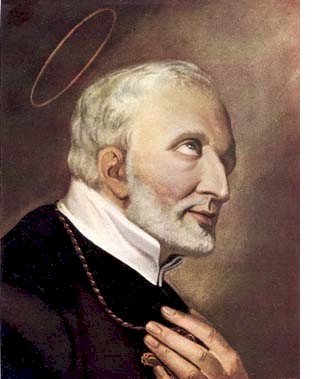
Feast of St. Alphonsus Liguori, August 1

Doctor of the Church, moral theologian, founder of the Redemptorists, and patron of moralists and theologians

source

His statue in St. Peter's Basilica:


Liguori Publications bio; Brief Life of St ALPHONSUS LIGUORI; CE entry

an icon; some more pictures: 1, 2, 3, 4, 5

Official website for the Redemptorists
Alfonsian Academy


Moral Choices:The Moral Theology of St. Alphonsus Liguori
by Theodule Rey-Mermet, C.Ss.R.; Translated by Paul Laverdure
(I have no idea if this book is any good.)

I would like to read his work in moral theology, coming as it did during the time of casuistry, paying attention to his explanation of why certain actions are wrong.

Catholic Moral Teaching by Joseph Mausbach
"Law or Liberty" by Fr. Hugh Barbour. Fr. Barbour gives a brief summary of the three theories, probabiliorism, aequiprobablism, and probablism. The critique of casuistry by Fr. Pinckaers and Fr. Barbour is that the casuist mindset (that is so rule-focused) supplanted but could not replace the cultivation of the virtue of prudence.

Hrm... www.rectaratio.blogspot.com
"Robert Wendland and the 'Safer' Course"
Fr. John Hardon's Moral Theology

Interview with Fr. Kolvenbach

Code: ZE06073023

Date: 2006-07-30

On the Future of the Jesuits

Interview With Superior General Father Kolvenbach

ROME, JULY 30, 2006 (Zenit.org).- Last February, Father Peter Hans Kolvenbach, father general of the Society of Jesus, convoked a general congregation for January 2008, to elect his successor.

It was an unexpected announcement, as the office is for life, but the superior general has his reasons.

In this interview with ZENIT, Father Kolvenbach explains why he called the meeting, and what other important issues the representatives of the world's close to 20,000 Jesuits will also address.

Q: What symptoms prove that the moment has come to call a general congregation?

Father Kolvenbach: St. Ignatius did not favor the idea of general congregations being called at a fixed period. He thought that the preparations necessary to convoke a general congregation and to call a large number of Jesuits worldwide to Rome might affect the apostolic work in which they were engaged.

Therefore, he prescribed that only "for reason of great importance," when the issues were of such magnitude that they went beyond the capacity of the Society's ordinary government to address, should a general congregation be convoked. In fact there have only been 34 general congregations in the 465-year history of the Society.

The Church and present-day society are facing problems that require careful and creative examination.

Globalization, emigration, massive displacements, relativism, secularization and so many others are challenges that to one or another degree affect all countries and impose important changes on our apostolic planning. The general congregation is the instrument available to the Society to find, with God's grace, the way to serve the Church and the world.

To this very important reason is added another of a personal nature: the many years I have had at the head of the government of the Society and the suitability of electing my successor.

St. Ignatius saw valid reasons to prescribe that the office of superior general be for life. And, of course, it cannot be denied that it entails certain advantages.

However, that decision of St. Ignatius was made in the 16th century when life expectancy was much shorter than now. Ignatius died at 65, a rather advanced age for the time, after having been superior general for 15 years. His two immediate successors died respectively at 53 and 62 years of age, after a generalate that in both cases was reduced to seven years.

Compared to them, my period as superior general is already longer than 22 years, and if God so wills, in 2008 I will be about to celebrate 80 years of age and 25 as superior general. These are circumstances which question legitimately the appropriateness of putting an end to such a long period.

Q: There have been ups and downs in the relationship between the Society and the Pope. Why?

Father Kolvenbach: In the framework of a special relationship between the Pope and the Society of Jesus -- desired and professed by both parties -- it is understandable and human that historical circumstances influence the tenor of this relationship.

On the other hand, as Pope Paul VI said so affectionately, in an address in which points of attention were not lacking in regard to certain tendencies he observed in the Society. The Jesuits have always been in the trenches, at the crossroads where problems have been debated that did not always have a clear answer.

It is not strange that, in the service of the Church, some abandoned the security of the trenches to launch themselves defenseless beyond the orthodox demarcations in search of new answers to new problems.

The case of Father Mateo Ricci is enlightening. Profoundly knowledgeable of the Chinese culture and mentality, he made the effort to show that reverence to ancestors was not an idolatrous worship as was said in the West, but a social and family custom which did not contradict the Christian faith or justify the denial of baptism to those who remembered their ancestors in that way.

This position made him the target of criticisms by other religious and, finally, of Rome's condemnation. There is no doubt that this closed the door to many possible converts. Only in the 20th century was Ricci recognized as ahead of his age in the proclamation of the Gospel and as a precursor of inculturation in the missionary endeavor.

Not all the Jesuits who have been called to Rome can attribute to themselves Ricci's preparation and nobility of intentions, but neither have those who have served the Church with faithfulness and dedication been few, who were not recognized until a long time after. Father Teilhard de Chardin is, perhaps, one of the most representative cases.

Q: The spiritual life of Jesuits is, of course, one of your concerns as superior general. Will it be a topic to address at the general congregation and, if so, in what terms?

Father Kolvenbach: On examining the state of the Society at the meeting of all the major superiors, which we had in Loyola in December 2005, we came to the conclusion that the spiritual health of Jesuits was good. The instrument to measure Jesuits' spiritual health has always been and continues to be, unconditional consecration to the mission.

Today as yesterday it is profound personal identification with the Lord, the one sent by the Father, which characterizes and defines the way to proceed in the Society. However, it will in any case be a topic that the general congregation will address because it is proper to the Jesuits not to be satisfied with what they have achieved.

We must serve the Lord in a society in which trivial thought reigns supreme and tends to undermine a profound love of Jesus Christ and an unconditional commitment to the mission. That is why it is a topic of constant timeliness which undoubtedly the general congregation will want to put on the table, though it is still too early to venture into speculation on the congregation's agenda.

Q: There are many institutions of the world, especially universities in the United States, called Jesuit, but in which the presence of Jesuits is very reduced. Have you thought of some solution?

Father Kolvenbach: This situation has not arisen now. We have already addressed it before and we agreed to accept that this situation of a reduced presence of Jesuits has led us to discover new avenues: the incorporation of lay men and women in our works in consonance with the splendid rise of the apostolic awareness of the people of God, a "sign of authentic hope" as Benedict XVI called it recently.

We believe the desire of the laity to take an active part in the mission of the Church to proclaim the kingdom is a grace of our time, inspired by the Spirit. The last general congregation exhorted Jesuits to be "men for others and men with others."

It is true that the decline of vocations to religious life -- and also to the Society -- has been a stimulus to bring about that cooperation with the laity which the general congregation of 1965 had already urged. But it is not about alleviating a shortage, but about opening ourselves to a latent apostolic reality in the Church.

The "solution" which you refer to is to cooperate in our works with lay men and women who act under Ignatian inspiration. In fact, there is already a number of Jesuit institutions in which positions of responsibility are entrusted to lay men and women. The number of Jesuits physically present in these institutions is not decisive if we have men and women imbued with the Ignatian spirit to serve the Church.

Q: Will some juridical formula be studied, during the next congregation, to integrate lay men and women in the Society of Jesus?

Father Kolvenbach: The last general congregation gave it a green light so that for a decade, on an experimental basis, the provinces were able to establish groups of men and women associates united with a contractual agreement without that implying integration in the body of the Society.

In this way their lay vocation is safeguarded even when they take part in the Jesuits' apostolic work. The experience of these last years will be subjected, without a doubt, to discernment by the general congregation.

Q: The Xaverian and Ignatian Year is being celebrated. What do you expect from these celebrations?

Father Kolvenbach: The obvious desire is that on remembering the three first companions -- the memory of Blessed Peter Faber, next to Ignatius and Xavier, must not be forgotten -- the Jesuits will revive in their lives and in their apostolate the three charisms that they embodied: to encounter God and unite oneself to him through the work to lead everything to its fulfillment, as Ignatius did; to proclaim passionately the Gospel as Xavier; and to deepen one's spiritual life as Faber.

Q: The preferential option for the poor, social justice, interreligious dialogue, refugees, the realm of culture and education, are only some of the Society's priorities. Is there a new field in which the Jesuits want to be involved?

Father Kolvenbach: The Pope reminded us recently -- on April 22 on the occasion of the commemoration of the 2006 Jubilee of the Jesuits -- what the Church expects from the Society with special emphasis on the field of philosophy and theology traditionally cultivated by the Jesuits.

As geographic preferences we feel called to contribute in a special way to the evangelization of Africa and China. But it will be material for reflection on the part of the future general congregation to discern if some of the situations of today's world, such as globalization, the cultural dialogue or relativism, for example, require an adjustment of our apostolic commitment.


A dreamer? Pollyanna? Who should embody Jesuit spirituality? Jesuits or lay people? American Jesuit colleges and universities have, like other Catholic schools, adopted the curriculum and thinking of their secular counterparts. Faith no longer guides reason for the most part, because very few know how to use reason, opting instead for easy harmonizations that may have just a tiny foundation in reality. The great medieval project is dead, for the most part--it is time to return to the "catacombs". (It would be more accurate to say domestic churches.)

An article by Magister on Cardinal Kasper and Fr. Kolvenbach.

Monday, July 31, 2006

Monday wrap-up

Virginia on Hell's Kitchen reminded me of one of the contestants on Ming Tsai's Cooking Under Fire because of her pseudo-meekness. I thought she was gone for good once Chef Ramsey said she was no longer safe, but he decided to keep his word and leave the decision up to her. Keith's major fumble was his attempt to cook the undercooked pasta. If he has any other flaws, then I don't think any of the three really should have their own restaurant, even though Heather did well tonight with her meats.

Earlier this morning Barbara Walters proclaimed that she would never watch another of Mel Gibon's movies due to the remarks he purpotedly made when he was pulled over for possibly DUI. She and Joy Behar were both annoying in their indignation--as if hey don't have their own moral foibles. And that's the problem with their show--it's not merely just 4 (or 5) women conversing with another--it's another powerful opinion-shaper that potentially leads people to stupid, non-reflective prejudgments.

Later, two members of the cast of Descent were on the show to speak of their film. The discussion briefly became a forum for "gender politics," as they asked whether there are real biological differences between men and women in how they handle personal relationships and anger. Plenty of radical (gender) deconstructionism floating around on that show.

The cave dwellers of Descent (Trollogs? Crawlers? I didn't catch their nickname) remind me of Gollum. Supposedly they evolved from human beings, but don't have much hair, snarl, and have rather pointed ears. I suppose they also look like certain movie vampires. The movie opens next weekend--my bet is that Sarge will go see it.

Descent is directed by the same man who did Dog Soldiers. Descent trailer

The Protector trailer (I think that's the American title for Tom Yum Goon); I still haven't seen Tony Jaa's (Panom Yeerum) first movie, Ong-Bak. (An interview with Mr. Jaa.)

The one-sheet for the upcoming Star Trek movie:

Blue and Gold: so will it really focus on Spock (blue) and Kirk (gold)? Or is there another reason for the color choice?

ABC's latest adultlescent reality show, One Beach View, is on tonight--apparently ABC is staffed by execs who don't learn their lessons. The pathetic culture of young adults who don't grow up really isn't entertaining.

It's supposed to hit the 100s later this week. I still haven't figured out how to take care of lunch if I do end up going to campus to type.

A City of Violence

'Violence' is freak-out for hardcore action film geeks

With no stuntmen and no wire action, Korean real action heroes in "The City of Violence" are no high-flying over-the-top heroes. Instead, the hardcore action film starring Jung Doo-hong and Ryu Seung-wan (who is also the director of the movie) as two old hometown buddies on a revenge spree, is loyal to the reality of street fighting, not overly refined but super real. There are no spurting severed limbs in the
film as in Quentin Tarantino's two "Kill Bill" movies (which are good for popcorn eaters), but the skillful and witty filmmaking of Ryu and
no-holds-barred fighting action of Jung makes the film an action masterpiece.

Tae-soo (Jung), a police detective in Seoul, visits his hometown for the first time in 10 years, upon hearing the news that his old friend Wang-jae was murdered by a gang of teenagers. Guided by his detective's instinct, he attempts to uncover the hidden connections in the death of his former gang boss friend. He reluctantly teams up with hot-tempered Seok-hwan (Ryu). The rest of the film is an action-packed account of how another old buddy Pil-ho (Lee Beom-soo) has turned into a cold-blooded villain, and how the two fight against the criminal
kingpin of the city, for the sole purpose of avenging the death of Wang-jae. If "Kill Bill" pays tribute to Tarantino's beloved Chinese and Japanese martial arts films, "Violence," simply put, is a homage to the entire history of Korean action films, which have never been in the mainstream. In this sense, the film pays homage to all the Korean actors devoting themselves to the genre, including Jung who is far better known as an action director than an actor. With the show-stopping action film, their long struggles with pain and hunger seem to be paid off a little. In an interview, Jung recollected the day when he had to jump off a running vehicle, not onto a soft mattress but piled cardboard boxes. The climatic carnage at a Japanese restaurant, in which the two eradicate Pil-ho's subordinates one after another, is the distillation of the universe of Korean action films. The scene might seem to be under strong "Kill Bill" influences, probably reminding many of the mayhem of O-Ren Ishi (Lucy Liu) and her school
girl bodyguard Go Go Yubari (Chiaki Kuriyama). Yet considering that such a scene from "Kill Bill" is also a patchwork of a wide variety of Asian martial art films, a debate on its similarity is almost pointless. Ryu Seung-wan, however, seems to share much with Tarantino, especially his brilliant dark humor. For one thing, all the key characters of the film speak in thick a Chungcheong Province
accent, slow and unenthusiastic, which probably is the last kind of accent one would expect to hear from a merciless gang member. The screenplay of the film also shows his best, not far behind that of Tarantino's. His acting is fine but "Violence" seems to be his last film as an actor, as the older brother of film star Ryu Seung-bum said in a recent interview that he would concentrate on filmmaking. For the film, the biggest plus from its cast will be Lee Beom-soo, star of "Superstar Mr. Gam" (2004) and "Oh! Brothers" (2003), whose roles had always been of a warm-hearted, super nice guy until this one. In the film, though, his Pil-ho is so perfectly villainous that it makes him look almost like a different actor. "Violence" is a freak-out for hardcore action film geeks, which combines exhilarating filmmaking skills and real action. The film screens in theaters from today. By Lee Yong-sung http://www.koreaherald.co.kr/


Official site
KFCCinema thread
KRMDB page

An oldie: What Makes Korea a Four-Eyed Nation?

What Makes Korea a Four-Eyed Nation?

Beauty, again

I still think that when a mother singing to her child she is at her most beautiful...

That is one moment, I've added another.

When a woman is praying.

How about praying in a chapel veil or mantilla? (Still in use in the Philippines and South Korea, and traditionalist chapels everywhere.)


Catholics pray during an Easter mass at Myeongdong Cathedral in Seoul on Sunday./Yonhap April 17, 2006

Then again, why stop at a chapel veil when one can go for a full veil? Monica Belluci with Maia Morgenstern in The Passion of the Christ:

Miss Korea Contest to Open Thursday

Miss Korea Contest to Open Thursday

BoA Sole Non-Sports Star in Nike Commercial

Foreign Backdrop Makes Song Hye-gyo Even Hotter


Song Hye Gyo's official website

Sunday, July 30, 2006

The Banquet trailer

here, thanks to kfccinema; official website

Another picture from Curse of the Golden Flower:

Sgt. David Hierholzer, RIP

One of Sarge's friends, Sgt. David Hierholzer was killed in Afghanistan. Please keep him and the members of our armed forces in your prayers.

"(AP) Lewisburg soldier killed in Afghanistan"
"Lewisburg native dies in battle in Afghanistan"

Secret Societies

CE entry on the Freemasons, CE entry on the Illuminati and Adam Weishaupt, CE entry on Secret Societies

Are secret societies as powerful as governments and the organs of government, especially those given intelligence-gathering and police powers? But do they need to be if their members have infiltrated government? And if they still exist and are operating, what connection do they have with global financial institutions, systems, and practices? Is there a coherent plan and goal behind all of the difficult-to-understand decisions that are made concerning money?

What is the relationship between the rise of centralized banking and the development of nation-states? The transition from monarchy to oligarchy? (For now I will refuse to concede the name of 'democracy' to the constitutions of the various modern nation-states.)

"Freemasons" by Sebastian R. Fama

An instance of someone interpreting major historical events as being the result of the machinations of secret societies. Incredible? At first reading one is inclined not to believe it, for how can such a numerical minority be able to accomplish all of this? If it can be shown that current financial arrangements work against any small group being able to accumulate mass wealth, then certain theories would have to be revised. On the other hand, if they are instead aiming for is destabilization so that a strong man can arise and unite the world... that is something else indeed.

60 Minutes on Skull and Bones (which gained some notoriety in the last presidential election).

Then there are the Protestants who argue that secret societies are the creation of Rome. A favorite target is the Jesuits, the pope's secret organization. I wonder if Opus Dei has replaced the Jesuits in the popular imagination of these conspiracy theorists. An example.

For them the Vatican is not Christian at all, and is interested only in gaining and holding on to power. Never mind the fact that it is because of the teaching authority of the pope and the bishops in communion with them that the canon of Scripture was determined, and basic "nicene Christianity" beliefs were handed on.

It's Sarge's Birthday

Happy Birthday!

Cynthia Olavarría:


Contestants take part in candlelight memorial
Amrita Thapar, Miss India Universe 2005; Cynthia Olavarria, Miss Puerto Rico Universe 2005; Ad?le Basson, Miss Namibia Universe 2005; Helene Traasavik, Miss Norway Universe 2005; Laura Elizondo, Miss Mexico Universe 2005; Yukari Kuzuya, Miss Japan Universe 2005; and Magalie Antoo, Miss Mauritius Universe 2005, participate in the Global Health Council's International Candlelight AIDS Memorial at the Westin Grande Sukhumvit hotel in Bangkok, Thailand on May 16, 2005. The 54th annual Miss Universe competition will take place in Bangkok, Thailand on May 31 EPA/Darren Decker/MISS UNIVERSE


with Nadine Chandrawinata


original source
Now for a diversion


alternate source


missology page
For Range

Grotius, continued

JB, you should list the books you are reading in comments; not sure if anyone else would be interested but I certainly am.

I am using books by Brian Tierney and Annabel Brett; Richard Tuck and Quentin Skinner have written on natural rights. I believe Ian Shapiro's book is written from a Straussian perspective. Tierney and Finnis are critical of Tuck's book, so I am not using it--I need to read the primary sources for myself. I have not had a chance to look through Skinner. His books were put on reserve for some courses.

I have not come across anything that provides complete medieval texts filled with the use of ius as subjective right--it is not clear to me how standard this usage was in canon or civil law.

From the Journal of International Human Rights:
Brian Tierney, "The Idea of Natural Rights--Origin and Persistence"
html, pdf
Michael Zuckert, "Natural Rights and Modern Constitutionalism"
html, pdf
Mary Ann Glendon, "The Rule of Law in the Universal Declaration of Human Rights " html, pdf

OLL section on 17th ce theorists

Michael Zuckert's faculty webpage
Christopher Wolfe reviews Michael Zuckert's The Natural Rights Republic
Page for his Natural Rights and the New Republicanism
Page for his Launching Liberalism: On Lockean Political Philosophy
"James Madison," "Thinkin' about Lincoln," "Natural Law Without God? Considering Russell Hittinger's The First Grace"
Audio files of his lecture on honor; info on Prof. Zuckert's Riley lecture
"Theorists Smith and Zuckert Argue Nature of Liberal Tradition"

Evidently both Prof. Zuckert and his wife were students of Strauss.
His stuff over at Claremont Institute: 1, 2

Vindicating the Founders website (author's page)

To be looked up:
"The ius commune and its demise"
"The Medieval Canon Law of Contract and Early Modern Treaty Law"