Friday, March 21, 2008

Tarek Saab
GUT CHECK by Tarek Saab - Home
Podcast Interviews
The Catholic Hack!: The Catholic Hack Episode No 26 –Tarek Saab
CS#43: Tarek Saab Shares About Gut Check And The Apprentice ...
The Catholic Hack!: The Catholic Hack! Episode No 44 - Gut Check ...
No. 45 Gut Check! Part 2
No. 46 Gut Check! Part 3
No. 47 Gut Check! Part 4
Apprentice Contestant Tarek Saab Launches New Clothing Line, Lionheart Apparel
Lionheart Apparel
CatholicMom.com Interview with Tarek Saab, Lionheart Apparel
wiki
Tarek Saab | Facebook

From his "A Report From Inside Your TV":

I think from the front, he has a passing resemblance to Orlando Bloom.

Thursday, March 20, 2008
Some stuff from First Principles
Russell Kirk (from IR 6:1-2, Winter 1969-70) - 03/20/08
Global Democracy and the American Tradition
Clyde Wilson (from IR 24:1, Fall 1988) - 03/19/08
Beauty as an Essential Characteristic of Civilized Culture
Kevin L. Cope (MA 49:4, Fall 2007) - 03/20/08


I was in a good mood this morning when I greeted the students--perhaps it was because I got plenty of sleep last night (and wasn't awoken at 4 in the morning). I tend to be irritable when I don't get enough sleep (is there anyone who isn't like that), though I don't think it carries over when dealing with students. It's more likely that I'm not fully awake during class and therefore not that alert, attentive, or responsive.Even the kids who misbehave didn't bother me too much today...
Maybe it was because the (cute) blonde school teacher and I exchanged greetings.
Or maybe I was just having and abnormal morning.
Her class and an upper-grade class had PE together today--mmm one of the tag derivatives, I can't remember the name right now. But the students line up on one side and then try to reach the other side without being tagged by the people in the middle... so she was out there in the middle, running around and trying to tag students. She seems to be rather athletic, or at least physically active. A definite plus for me and Sarge. Today she was wearing a white vest and khakis... plus a black shirt (with the school's mascot?). Thursdays are "Spirit Day" and so the class (for each grade) that has the highest percentage of students wearing a shirt with the name of the school and its mascot (a panda) gets to carry the spirit flag for a week.
"Whoopee," we adults may think. But it seems to work for the kids.
She does have a nice smile. Heh... crushes come and go... I'll wait and see how long this one lasts... probably a while until someone new shows up. My sister said I need to go to a different Mass at OLP to find a mantilla-wearing nubile woman, one in the morning. Maybe that is true, but those Masses are usually too full for my comfort level.
My class did have a short Easter party--one girl brought some Easter goodies to share with everyone. She even gave me a bag--a cookie and some candy. Unfortunately, she was the only one who brought goodies.
I did end up going to St. Thomas Aquinas tonight for Maundy Thursday Mass. There is a greater separation between pews at STA than at OLP--I like that. The St. Ann Choir was good, as usual. But even though the prayers were in Latin and there was Gregorian chant and polyphony... something felt "off." Maybe it was the versus populum orientation of the priest. Maybe it was the ordo itself--it was the ordinary form of the Roman rite, after all.
Boundlessline: Let's Talk About Dating, parts 5 and 6
by Denise Morris on Mar 19, 2008 at 1:30 PM
Let's Talk About Dating, Part 6: Managing Expectations by Suzanne Hadley
A friend once told me: "Expectations are stupid." I'm not sure I'd go that far.
Zenit: B16--On the Easter Triduum
On the Easter Triduum
"Love Is Stronger Than Hate, It Has Triumphed"
VATICAN CITY, MARCH 19, 2008 (Zenit.org).- Here is a translation of the greetings Benedict XVI gave today to students participating in the international UNIV congress who had gathered at St. Peter's Basilica, and the catechesis he gave afterward during his weekly general audience in Paul VI Hall.
* * *
[Pope's greeting to students in St. Peter's Basilica]
[In English, he said]
Dear Friends,
I offer a cordial welcome to all of you who have come to Rome from various countries and universities to celebrate Holy Week together, and to take part in the International UNIV Congress. In this way, you will be able to benefit from moments of common prayer, cultural enrichment and a helpful exchange of the experiences gained from your association with the centres and activities of Christian formation sponsored by the Prelature of Opus Dei in your respective cities and nations.
[In Spanish, he said]
You know that with a serious personal commitment, inspired by the Gospel values, it is possible to respond adequately to the great questions of our time.
The Christian knows that there is an inseparable link between the truth, ethics and responsibility. Every authentic cultural expression contributes to form the conscience and encourage the person to better himself with the end of bettering society. In this way one feels responsible before the truth, at the service of which one must put one's own personal liberty.
This certainly has to do with a mission requiring commitment, and to fulfill it the Christian is called to follow Jesus, cultivating an intense friendship with him through prayer and contemplation.
To be friends of Christ, and to give testimony of him wherever we are, demands, furthermore, the strength to go against the grain, remembering the words of the Lord: You are in the world but not of the world (cf. John 15:19)
Do not be afraid, then, to be nonconformists when it is necessary; at your university, school and in all places.
[In Italian, he said]
Dear young people of UNIV, be leaven of hope in the world that desires to meet Jesus, often without knowing it. To better the world, make an effort above all to change yourselves through an intense sacramental life, especially through approaching the sacrament of penance, and participating assiduously in the celebration of the Eucharist.
I commend each one of you and your families to Mary, who never stopped contemplating the face of her son Jesus. I invoke over each one of you the protection of Saint Josemaría and of all the saints of your lands, while I heartily wish you a happy Easter.
[Catechesis in Paul VI Hall]
Dear brothers and sisters
We have reached the eve of the Easter triduum. The next three days are commonly known as 'holy' because they allow us to relive the event central to our Redemption. They lead us to the nucleus of Christian faith: the passion, death and resurrection of Jesus Christ. These three days could be considered one single day. They make up the heart and are the key to both the liturgical year and the life of the Church. At the end of Lent we also enter that climate which Christ himself experienced back then in Jerusalem.
We want to rekindle in ourselves the living memory of the suffering which our Lord endured for us and to joyously prepare ourselves for next Sunday “"the true Passover, which the Blood of Christ has covered with glory, the Passover on which the Church celebrates the Feast that is the origin of all feasts” as stated in the preface for Easter in the Ambrosian rite.
Tomorrow, Holy Thursday, the Church remembers the Last Supper during which our Lord, on the eve of his own passion and death, institutes the sacrament of the Eucharist and that of ministerial priesthood. On that same evening, Jesus gave us a new commandment, "mandatum novum," the commandment of brotherly love.
Tomorrow morning, before entering the Easter triduum, but very closely tied to it, the "Messa Crismale" will take place in every diocese during which the bishop and priests of the diocese renew their promises made at ordination.
Also, the oils used to celebrate the sacraments are blessed: the oil for the catechumen, the oil for the sick and the holy chrism. It is one of the most important moments in the life of every Christian diocese, which, gathered around it's pastor, strengthens it's unity and faith in Christ, the supreme and eternal priest.
In the evening during the "Cena Domini" Mass, we remember the Last Supper when Christ gave himself to all of us as the food of salvation, as the drug of immortality and the mystery of the Eucharist -- source and pinnacle of Christian life.
Through this sacrament of salvation the Lord offered and realized for all those who believe in him, the most intimate union possible between our lives and his. With the humble and most expressive gesture of washing someone's feet, we are reminded how much Christ did for his Apostles.
Washing their feet was a concrete way of exclaiming the primacy of his love, a love that serves even to the point of giving oneself, anticipating as well the supreme sacrifice of giving his life, which he was to do the following day on Calvary. According to a beautiful tradition, the faithful close on Holy Thursday for a vigil of prayer and Eucharistic adoration enabling them to relive the agonies that Christ suffered at Gethsemane more vividly.
On Good Friday we remember the passion, crucifixion and death of Christ. On this day the Church does not celebrate mass, but the Christian community gathers to consider the mystery of sin and evil that oppress humanity. They revisit, in the light of the word of God, the sufferings of Christ that atone for this evil.
After they have listened to the retelling of the passion of Christ, the congregation prays for all the necessities of the Church and of the world, they pay homage to the cross and take the consecrated bread and wine kept from the "Cena Domini" mass of the previous day.
By way of further invitation to consider the passion and death of the Redeemer, to express their love and to enable the faithful to participate in the suffering of Christ, Christian tradition has created popular processions and holy representations which aim to impress ever more deeply on the souls of the faithful a sense of having truly participated in the redemptive sacrifice of Christ.
The Via Crucis stands out among these. Over the years it has been enriched with many spiritual and artistic expressions linked to the sensitivities of the various cultures.
In many countries, sanctuaries with the name “Calvary” have been born which are accessible after a steep climb. In recalling the painful climb of the passion, it allows the faithful to participate in Jesus' climb toward the mount of the Cross, the mount of love offered right up to the end.
Holy Saturday is marked by a deep silence. The Churches are left undecorated and there are no particular liturgies set aside for this day. While waiting for the Resurrection, the faithful persevere in the wait with Mary by praying and meditating. A day of silence is necessary to ponder the reality of human life, the forces of evil and the enormous power of good unleashed by the passion and resurrection of Christ.
Great importance is given during this time to participation in the sacrament of reconciliation, indispensable for the purification of the heart and to prepare for the celebration of Easter completely renewed. We need to undertake this inner purification and renewal of ourselves at least once a year.
This Saturday of silence, of meditation, of forgiveness, of reconciliation leads into the Easter Vigil, which introduces the most important Sunday in history, the Sunday that marks the Passover of Christ.
The Church holds vigil next to the newly blessed fire and meditates on the great promise contained in the Old and New Testaments, of the conclusive liberation from the ancient slavery to sin and death. In the darkness of the night, the Easter candle is lit from the new fire as a symbol of Christ who rises again in glory.
Christ, the light of humanity, dispels any shadows in the heart and the spirit and illuminates all men who come into the world. Together with the lighting of the Easter candle, the great Easter announcement reverberates throughout the Church: Christ has truly risen, death no longer has any power over him. With his death he defeats evil forever and makes man a gift of God's own life.
It is tradition that Christ's followers received the sacrament of baptism during the Easter Vigil. This was to underline the participation of Christians in the mystery of the death and resurrection of Christ. The joy, the light and the peace of Christ spread from the shining Easter night to fill the lives of the faithful in every Christian community and reaches into every area of space and time.
Dear brothers and sisters, during these special days let us guide our lives definitively toward a complete and decisive adherence to the designs of our celestial Father; let us renew our “yes” to the divine will as Jesus did with his sacrifice on the cross. The rites suggested for Holy Thursday and Good Friday, the rich silence of prayer of Holy Saturday and the solemn Easter vigil provide us with the opportunity to deepen the feelings and the values of our Christian vocation unleashed by the Paschal mystery and to strengthen it by faithfully following Christ in all circumstances, just as he did, even to the point of giving up our own existence to him.
Remembering the mysteries of Christ also means a willing and complete adherence to the history of today, convinced that when we celebrate, it is reality. Let us include in our prayers the terrible facts and situations that afflict our brothers across the world. We know that hate, division and violence never have the last word in historical events. These holy days reawaken a great hope in us: Christ was crucified, yet he rose again and conquered the world.
Love is stronger than hate, it has triumphed and we should affiliate ourselves with this victory of love. We should therefore start again from Christ and work together with him for a world founded on peace, justice and love.
In this commitment that involves all of us, let us allow ourselves to be guided by Mary, who accompanied her divine son on the road to his passion and cross, and who participated with the strength of her faith in the realization of his plan of salvation.
With these thoughts I send you my best wishes for a happy and holy Easter to you, your loved ones and your communities.
[Translation by Giustina Montaque]
[After his address, the Holy Father greeted the pilgrims in various languages. In English, he said:]
Dear Brothers and Sisters,
The Easter Triduum, which the Church now prepares to celebrate, invites us to share in the mystery of Christ’s suffering, death and resurrection. These days are the heart of the liturgical year. On Holy Thursday the Church recalls the Last Supper. At the Chrism Mass, the Bishop and his priests renew their priestly promises and the sacramental oils are blessed. The Mass of the Lord’s Supper commemorates Jesus’ institution of the sacrament of his Body and Blood and his commandment that we should love one another. On Good Friday, we ponder the mystery of sin as we listen to the account of the Lord’s passion and venerate the wood of his Cross. Holy Saturday, a day of silence and prayer, prepares for the joy of the Easter Vigil, when the light of Christ dispels all darkness, and the saving power of his Paschal Mystery is communicated in the sacrament of Baptism.
May our sharing in these solemn celebrations deepen our conversion to Christ, particularly through the sacrament of Reconciliation, and our communion, in the hope of the resurrection, with all our suffering brothers and sisters throughout the world.
I offer a cordial welcome to the English-speaking pilgrims and visitors present at today’s Audience, especially the pilgrims from Ireland, Canada and the United States. Upon you and your families I cordially invoke an abundance of joy and peace in the Lord!
[After his greetings, the Holy Father made the following appeal in Italian:]
I follow with deep unrest the news that in these days is coming from Tibet. My fatherly heart feels sadness and sorrow at the suffering of so many people. The mystery of the passion and death of Jesus, that we live again in this Holy Week, helps us to be particularly sensitive to their situation.
With violence, problems are not solved, only aggravated. I invite you to unite yourselves to my prayer, asking God all-powerful, source of light, to enlighten the minds of all and give to each one the courage to choose the path of dialogue and tolerance.
(c) Copyright 2008 -- Libreria Editrice Vaticana
How I'll probably spend the Triduum
TENEBRAE St. Ann ChapelThe schedule at St. Dominic's:
Wednesday evening, March 19, 8:00 p.m.
Matins and Lauds of Holy Thursday in Latin (anticipated the evening before).
Lamentations of Jeremiah by Victoria (lasts 1¾ hrs.)
HOLY THURSDAY St. Thomas Aquinas Church
Thursday evening, March 20, 5:30 p.m.
Evening Mass of the Lord's Supper, Washing of feet, and Procession of Blessed Sacrament. Music of Byrd, Tallis, Ciconia, and Dufay. (lasts 1½ hours)
GOOD FRIDAY St. Thomas Aquinas Church
Friday afternoon, March 21, 5:30 p.m.,
Solemn afternoon liturgy: Chanting of the St. John Passion, Adoration of the Cross, and Communion. Music of Victoria. (Lasts 1¾ hours)
EASTER VIGIL St. Thomas Aquinas Church
Saturday night, March 22, 11:00 p.m.
The Solemn Proclamation of Easter, the Prophecies, and Midnight Mass of the Resurrection. Music of Palestrina, Morales and Marenzio (lasts 2 hrs)
EASTER SUNDAY St. Thomas Aquinas Church
Sunday morning, March 23, 12:00 noon
Festive Sung Mass of Easter. Lasso, Missa Osculetur me for double ch. (lasts 1½ hours)
EASTER SUNDAY St. Ann Chapel
Sunday afternoon, March 23, vespers, 6:15 p.m.
Latin Vespers of Easter Sunday, sung in Gregorian Chant (lasts ¾ hour)
Thursday, March 20
6:30 AM - 9:00 AM
No Masses at 6:30 am or 8 am
7:30 AM - 8:30 AM
Tenebrae on Holy Thursday "Tenebrae" is the name given to the offices of Readings and Morning Prayer on Holy Thursday, Good Friday and Holy Saturday. The name means "darkness" and refers to the practice, during the middle Ages, of praying these portions of the Divine Office ...
5:30 PM - 6:30 PM
No Mass at 5:30 pm.
7:30 PM - 9:00 PM
Mass of the Lord's Supper The traditional Mass includes the presentation of the Holy Oils, blessed by the Archbishop; the Washing of Feet of twelve people; and, following communion, the Procession of the Sacrament to the Chapel of Reservation. Note that this will be the only...
Friday, March 21
6:30 AM - 9:00 AM
No Masses at 6:30 or 8 am.
7:30 AM - 8:30 AM
Tenebrae on Good Friday The morning office of Tenebrae includes the extinguishing of candles as each psalm is sung; thus leaving the church in darkness at the end. Breakfast follows in the Parish Hall.
12:15 PM - 1:00 PM
Stations of the Cross The traditional service of Stations of the Cross is celebrated at 12:15 pm on Good Friday
1:00 PM - 3:00 PM
Seven Last Words preaching The Seven Last Words of Jesus on the cross is celebrated with seven short sermons, given by a variety of people, both lay and religious. Eash sermon is followed by a piece of choral music to meditate upon and a period of silence.
5:30 PM - 6:30 PM
No Mass at 5:30 pm
7:30 PM - 9:00 PM
Celebration of The Lord's Passion The traditional Good Friday Liturgy includes the sung Passion Gospel; Veneration of the Cross and a Communion Service. The Solemn Mass Choir provides suitable choral music, including Palestrina's Stabat Mater.
Saturday, March 22
8:00 AM - 9:00 AM
No Mass at 8 am.
8:00 AM - 9:00 AM
Tenebrae on Holy Saturday The morning office of Tenebrae includes the extinguishing of candles as each psalm is sung; thus leaving the church in darkness at the end. Breakfast follows in the Parish Hall.
5:30 PM - 6:00 PM
No Mass at 5:30 pm
8:00 PM - 10:00 PM
Easter Vigil The traditional ceremonies of Lighting the New Paschal Candle; Singing the Exsultet; celebrating the Word of God; Initiation Rites (including baptism, confirmation and reception into the Church) and Easter Communion. Notes that there are no other Ma...
St. Dominic's is just too far, and I don't know what the music will be like for Holy Week, though it probably will be better than what one will hear at the typical parish down here in the South Bay. (With the exception of St. Thomas Aquinas, but isn't that considered to be a part of the peninsula?)
I don't know if I will be going to the vigil at STA, may be the latest one for the diocese. Good Friday at St. Dominic's might be nice, but I don't think I can spend a whole day in San Francisco. St. Elias is rather close to where I am living now; I'm too shy to go there for the first time, when the occasion is as important as this . From the monthly newsletter:
Wednesday 19 March—Great Wednesday: Repentance & Holy Oil, 7:30 pm
On this day, the Church offers us healing of soul and body. After prayers of repentance, there will be time for indi-vidual confession, then we will celebrate the Holy Mystery of Anointing with Holy Oil for healing.Thursday 20 March—Great Thursday: Service of Crucifixion of Christ, 7:30 pm
On this day, the Church remembers the Last Supper, when Jesus gave us the Holy Mystery of the Communion of His Body and Blood, and also His Passion, Trial, and Crucifixion. We celebrate Matins of Holy Friday, with the Pas-sion Gospels, the procession with the Cross, and the Nailing to the Cross.Friday 21 March—Great & Holy Friday: Ecumenical Way of the Cross, 12 Noon
In commemoration of the suffering and crucifixion of the Lord, the Alum Rock Ecumenical Association invites peo-ple to walk the Way of the Cross in Alum Rock Park, starting at 12 noon from the Rusticlands parking lot. At each station, there is a meditation and prayer. Enter the park from Penitencia Creek Road.Friday 21 March—Great & Holy Friday: Ginnaz al-Massih, 7:30 pm
In the evening of Good Friday, we celebrate Vespers for Holy Friday, the service of the taking down of Christ’s body from the Cross, followed by Matins for Holy Saturday, the service of the Funeral of Christ, with the singing of the Lamentations and the Procession with the Epitaphios, the ikon of Christ in the tomb. Coming back into the church, we pass under the Epitaphion, showing that we die and are resurrected with our Savior.Saturday 22 March—Great & Holy Pascha: New Fire, Hajmeh, Liturgy, 7:30 pm
After sundown on Saturday, we celebrate the first proclamation of the Resurrection—the New Fire, Procession of Triumph, Hajmeh, Paschal Orthros, Divine Liturgy, and blessing of eggs and bread. The church blazes with light and joy—“Christ is risen from the dead, and by His death He has trampled upon death and has given life to those who are in the tombs!” We sing “Christos Anesti! Al-Massih Qam! Christ is Risen!” again and again. At the end of the Liturgy, we break eggs, symbols of Christ breaking forth from the tomb.Note: This will be our only Easter Service this year. There will be no Liturgy on Easter Sunday morning, because attendance in the past has been very low and we have no singers or servers to help celebrate the service.
Wednesday, March 19, 2008
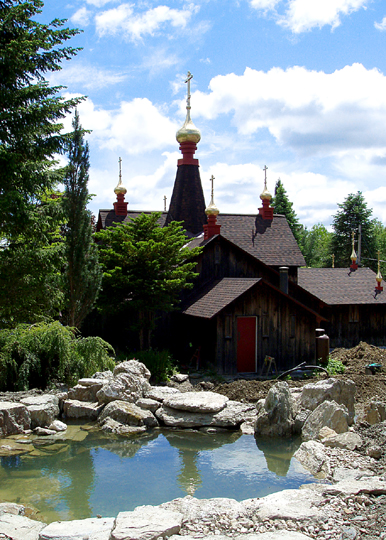

What are the principles of liturgical reform?
On altars:
From the period of St Pius X and the guiding principles of Dom Lambert Beauduin OSB onwards altars conforming to the liturgical decrees inevitably gained in simplicity and dignity. They came to achieve an unselfconscious beauty which was essential in the poorest altar set up in a wooden hut, or a room at St Louis, as in a great basilica.On Downside Abbey:
Many altars lose their beauty precisely because of their expensive embellishment. Many latter-day traditionalists confuse beauty with elaboration and that, I think, is evident in the St Louis oratory. The beauty of an altar depends upon its being designed, not for any subsidiary or non-liturgical purpose like the ornate exposition thrones of old, but for the one act round which the liturgy centres, the Sacrifice of the Mass.
But why should the appearance of the altar be of such supreme importance; why should it not only be correctly constructed for its purpose, but should also appear beautiful to the eye? The answer is that the Church has always regarded it as the representation of the Lord. She considers it to be the one likeness, the chief image of Him. But the altar does more than represent Our Lord, it interprets Him to the eye with an ordered variety denied by the most perfect statue of Him. This is reflected in the colours of the liturgical sequence, and the robing of the altar, as much as its proportions and innate dignity, has a vital significance and a universal appeal to the eye.
No pains, then, can be spared on the outward form of the altar; and no reverence it too great to guide our taste. The ornament we apply to the altar is such as we consider becoming to the person of Christ. This is the guiding principle for the choice of decoration and form of the altar. It is by this principle that such materials as lace (which mercifully does not appear on the St Louis altar) are judged to be suitable or frivolous. It is this principle which also decides whether simplicity or elaboration conveys the greatest honour.
The Church has pointed to the essential dignity of the altar, and laid down rules for achieving its outward effect. This can be assured only by obedience to the decrees of the Holy See which still apply to the use of the Roman Missal of 1962. Why go against them?
Dearmer's influence was non-existant at Downside, principally because medievalism in a fuller Catholic context was established before the Parson's Handbook was published and Comper had already designed vestments for the Abbey long before the St Dunstan's Society and Warham Guild had been started by Dearmer in 1911 or so.
With the completion of the altar in the Lady Chapel in 1913 it emerged fully-fledged, Then, in the same year, Dom Bede Camm arrived from Erdington and brought with him the needlework of the sisters at Southam which produced the distinctive dalmatics and tunicles. You could argue that there is more of a touch of Downside in Dearmer's endeavour than vice versa. In reality it was a feeble copying of Comper on a commercial basis.
Dom Edmund Fatt's achievement at Prinknash carried on the romantic medievalism of Caldey with a hefty chunk of indirect influence from Beuron. The Gothic vestments he produced were extremely good and a pleasure to wear, as I know from some in regular Jesuit use at the Sacred Heart, Wimbledon. They offered no encumbrence to liturgical actions. Comper's, on the other hand, sometimes needed to be turned back at the wrist to enable freedom of action. The vestments produced by the workroom at Downside largely followed Comper's patterns but, as time passed, used materials and braids infuenced by Beuron. You may, or may not, be persuaded by my evidence but I would advise you to forget Dearmer and go to safer principles.
Betjeman reference to fiddleback chasubles in mid-Lent pink certainly refers to Pusey House, Oxford, (even though Comper's work dates from after he went down) but his nostalgic poem, 'Anglo-Catholic Congresses' puts Travers at St Augustine's, Queens Gate, South Kensington, more prominently into focus. Comper was infinitely more serious as an architect and designer than him. He never embraced Folies Bergere liturgy which I notice is re-emerging with some force in certain quarters, but exemplified noble simplicity in the sense that Edmund Bishop meant it to be understood. Neither would be condemned by Mediator Dei, in the way that French and German monastic influence was. Nor were they part of the now largely forgotten breed of catacomb romantics. In Comper's case, his work became entirely accretive and was influenced by most styles and periods of the Christian centuries. In this way, and in his later planning, he points to the future as no other c20 church architect. His understanding of history, doctrine and liturgy was identical with Benedict XVI's.
I hope when the time comes for you to build your chapel you will use a good architect like Matthew Alderman or, in Britain, Warwick Pethers. Both know how Classic and Gothic architecture works without being superficial or pedantic. The majority of church architects these days have no idea. And I hope you will also consult Davis d'Ambly, in Philadelphis, for vestments and altar frontals. There is every reason for going for the best, even if it is an enemy of the good. And please put the altar beneath a ciborium magnum, gleaming in burnished gold.
Fr. Symondson is author of Sir Ninian Comper: An Introduction to His Life and Work, With Complete Gazetteer.
English Benedictine Congregation - Downside Abbey
CE
photo gallery
St. Louis Abbey
Percy Dearmer (wiki)
The Parson's Handbook by Percy Dearmer (1899)
REMEMBERING PERCY DEARMER
Biography and hymns of Pearcy Dearmer (1867-1936)
The Cathedral Church of Wells: A Description of Its Fabric and a ... - Google Books Result
Oxford University Press: The Oxford Book of Carols: Percy Dearmer
Percy Dearmer: An Authorized Biography - Donald Gray
Mama Mia trailer
Why so much face time for Pierce Brosnan (and none for the other two possible fathers--especially as one of them is Colin Firth)? Is that a spoiler for those who know nothing about the original musical's plot?
AT: Green challenge to China's mega-projects
China's fast pace of growth has come at huge cost in pollution and degradation of the countryside. Residents are now making their voice heard in protest against projects ranging from refineries to train lines. Assessment reports by the high-powered State Environmental Protection Administration will now play a key role - once it has some updated rules to follow. - Candy Zeng
Gummy on Love Letter, March 18, 2008
Gummy, T.O.P & Jeong-Eun(2/3) - Let Me Dance(Mar 18, 2008)
Gummy(3/3) - Don't Know Why(Mar 18, 2008)
Tuesday, March 18, 2008
PCR, The Collapse of American Power
The Collapse of American Power
By PAUL CRAIG ROBERTS
Also from Counterpunch:
The Coming Failure of the Social Safety Net
The Economic Crisis, Labor and the Left
By DAN LaBOTZ
The Damage Worsens Each Month
The Corrosive Consequences of the Trade Deficit
By PETER MORICI
Richard Heinberg, Making the most of a global depression
Richard Heinberg, HopeDance
The problem is not just financial mismanagement; there is a deeper instability: the global economy is based on a fundamentally unsustainable exploitation of depleting natural resources.
And from EB:
How shipping containers shortened the life span of petro-civilization
Alice Friedemann, Culture Change
Book Review:
Mark Levinson: The Box. How the Shipping Container Made the World Smaller and the World Economy Bigger. Princeton University Press, 2006.
Mark Levinson has written a book that shows how containers made global trade possible. In the preface of the paperback edition, he notes other aspects of containerization he became aware of later, such as the potential for containers to harbor atomic weapons, how they’ve become homes, and so on.
To me, what Levinson leaves out is how this global distribution system will make it very difficult to go back to local production as energy declines. He doesn’t mention that containerization was the fastest way yet for capitalism to loot the planet and strip Mother Earth down to her hard dry skin.
In 2005, roughly 18 million containers worldwide made over 200 million trips (wikipedia). Containers come in many sizes, an average one is 40 feet long, 8 feet wide, and 8 feet high, the size of three 10 by 10 foot bedrooms. There are 1,300 foot-long ships now that can carry 7,250 of them.
It’s mind boggling to think about how different the world is now. My grandparents ate what was in season, an orange was a precious Christmas gift. Today, the Japanese are eating Wyoming beef and we’re driving Japanese cars.
Before containers were used to move cargo, port cities had long piers where boxes and bales were moved by sweat and muscle onto ships. Longshoremen lived within two miles of the docks in cheap housing. Now the piers are gone and the only sweat comes from yuppies on treadmills in luxury apartments.
The cost of moving products by any means, whether truck, train, or ship, was often so high most goods were made locally. Factories were often located near ports to shorten the distance of getting products to ships.
(23 February 2008)
Oró sé do bheatha bhaile
Sarge, I'm sure you wish they had the masks off...
Darach Ó Catháin
Clancy Brothers and Tommy Makem Oro Se do Bheatha Bhaile
I guess this is my St. Patrick's Day post for this year, though it is one day late.

Fr. Luke Dingman Icons
wiki entry for the song
Oró Sé Do Bheatha 'Bhaile
Óró 'Sé do bheatha 'bhaile,
Óró 'Sé do bheatha 'bhaile,
Óró 'Sé do bheatha 'bhaile,
Anois ar theacht an tsamhraidh!
Óró 'Sé do bheatha 'bhaile,
Óró 'Sé do bheatha 'bhaile,
Óró 'Sé do bheatha 'bhaile,
Anois ar theacht an tsamhraidh!
'Sé do bheatha a bhean ba léanmhar,
B' é ár gcreach tú bheith i ngéibhinn,
Do dhúiche bhreá i seilibh meirleach...
Is tú díolta leis na Gallaibh!
Tá Gráinne Mhaol ag teacht thar sáile,
Óglaigh armtha léi mar gharda,
Gaeil iad féin is ní Gaill ná Spáinnigh...
Is cuirfidh siad ruaig ar Ghallaibh!
A bhuí le Rí na bhFeart go bhfeiceann,
Muna mbíonn beo ina dhiaidh ach seachtain,
Gráinne Mhaol is míle gaiscíoch...
Ag fógairt fáin ar Ghallaibh!
--//--
Óró! You are welcome home!
Óró! You are welcome home!
Óró! You are welcome home!
Now that summer is coming
Welcome Oh woman who was so afflicted,
It was our ruin that you were in bondage,
Our fine land in the possesion of theives,
And sold to the foreigners
Grainne Mhaol is coming over the sea,
Armed warriors along with her as guard,
They are Irishmen, not English or Spanish,
And they will rout the foreigners
May it please the God of Miracles that we may see,
Although we only live a week after it,
Grainne Mhaol and a thousand warriors,
Dispersing the foreigners
ORÓ, SÉ DO BHEATHA 'BHAILE (ORIGINAL LYRICS, JACOBITE VERSION ...
Traditional - Oró, Sé Do Bheatha 'Bhaile (original lyrics .
Steven L. Nock
Oxford University Press: Marriage in Men's Lives: Steven L. Nock
Nock-Marriage in Men's Lives
Rutgers University Press: Covenant Marriage: Steven L. Nock, Laura ...
Covenant Marriage In Comparative Perspective - Google Books Result
Steven L. Nock - Marriage in a Culture of Divorce (review ...
Steven L. Nock - Marriage as a Public Issue - The Future of ...
Steven L. Nock - The Future of Public Laws for Private Marriages ...
Steven L. Nock
What’sLoveGot ToDo With It? Equality,Equity,Commitment and Women’s ... (pdf)
William Bradford Wilcox and Steven L. Nock - What's Love Got To Do ...
What wives want Study finds commitment to marriage, emotional ...
SSRN-The Division of Labor, the New Marriage, and Marital ...
Happiest Wives website
The top predictors of women’s marital happiness, in order of importance:
- A husband’s emotional engagement.
Women who are married to men who make an effort to listen to them, who express affection and appreciation on a regular basis, and who share quality time with them on a regular basis (date nights, frequent conversations focusing on mutual interests and one another) are much happier in their marriages than women who do not have emotionally-engaged husbands.- Fairness.
Women who think that housework (and other family responsibilities) are divided fairly are significantly happier than women who think that their husband does not do his fair share. Note, however, that most wives do not equate fairness with a 50-50 model of equality. Only 30% of wives in this study think their marriage is unfair, even though the vast majority of wives do the bulk of childcare and housework. Why is this? In the average marriage, husbands devote significantly more hours to paid labor than do wives—especially when children come along. So, in the average marriage, husbands and wives devote about the same amount of total hours to the paid and unpaid work associated with caring for a family.- A breadwinning husband.
American wives, even wives who hold more feminist views about working women and the division of household tasks, are typically happier when their husband earns 68% or more of the household income. Husbands who are successful breadwinners probably give their wives the opportunity to make choices about work and family—e.g., working part-time, staying home, or pursuing a meaningful but not particularly remunerative job—that allow them to best respond to their own needs, and the needs of their children.- A commitment to marriage.
Wives who share a strong commitment to the norm of lifelong marriage with their husband—e.g., who both believe that even unhappily married couples should stay together for the sake of their children—are more likely to have a happy marriage than couples who do not share this commitment to marriage. Shared commitment seems to generate a sense of trust, emotional security, and a willingness to sacrifice for one’s spouse—all of which lead to happier marriages for women. This shared commitment also provides women with a long-term view of their marriage that helps them negotiate the inevitable difficulties that confront any marriage.- Staying at home.
Wives who stay at home tend to be happier in their marriages than wives who work outside the home. This is particularly true for women who have children in the home. Women often find it difficult to juggle kids, a career, and a marriage all at the same time. In fact, the study finds that working women are less likely to spend quality time with their husbands. They are also more likely to report that the division of housework is unfair. So time pressures and role overload help to explain why working wives are typically less happy in their marriages.- Shared religious attendance.
Wives who attend church or some other worship service with their husbands tend to be happier than wives who do not share religious attendance with their husbands. Religious attendance may give wives a sense that God is present in their marriage, a sense that their husband seeks to please them by attending church with them, and/or access to other married couples who value marriage and can provide them with guidance and moral support for their marriages.- Traditional gender attitudes.
Wives who hold more traditional gender attitudes—e.g., who believe that wives should focus more on nurturing/homemaking and husbands should focus more on breadwinning—are happier than wives who hold more feminist attitudes. One reason this may be the case is that traditional-minded wives probably have lower expectations of what their husbands can and should do for them emotionally and practically. We also find that more traditional-minded wives spend more quality time with their husbands, perhaps because they are less likely to argue with their husbands about housework and childcare.