Thursday, February 08, 2007

Photos: Protege premiere


Hong Kong actor Andy Lau and actress Anita Yuen pose before the premiere of their movie 'Protege' in Hong Kong February 8, 2007. HONG KONG OUT REUTERS/Stringer

Actor Daniel Wu poses before the premiere of his movie 'Protege' in Hong Kong February 8, 2007. HONG KONG OUT REUTERS/Stringer (HONG KONG)

(From L) Hong Kong actors Daniel Wu, Andy Lau and Louis Koo pose before the premiere of their movie 'Protege' in Hong Kong February 8, 2007. HONG KONG OUT REUTERS/Stringer

(From L) Hong Kong director Derek Yee, actors Louis Koo, Daniel Wu, Anita Yuen, Andy Lau and producer Peter Chan pose before the premiere of their movie 'Protege' in Hong Kong February 8, 2007. HONG KONG OUT REUTERS/Stringer

More photos from the DJG musical


The leading actress and actor of musical 'Dae Jang-geum' or 'Jewel in the Palace' pose at a news conference in Seoul in this February 5, 2007 file picture. The syrupy South Korean TV drama that was a hit through Asia about a cook for the royal family will be heavy on the romance when it hits the stage as a musical in May, producers said on February 8, 2007. Picture taken February 5, 2007. REUTERS/PMC Production/Handout/Files

Marian Crowe on Chesterton and Austen

G.K. Chesterton and the orthodox romance of Pride and Prejudice

Playdates for Into Great Silence

!!! It was playing at Harvard last night and I missed it because I didn't know about it. Blah!

Zeitgeist Films is the distributor here in the U.S.

Lumiere Theatre
San Francisco, CA
Starts March 16


E Street Cinema
Washington, DC
Starts March 23

Kendall Square
Cambridge, MA
Starts March 16


According to Zeitgeist, a (US) DVD will be released in 2007--I guess I won't buy the Canadian version. I've signed up on the mailing list to be notified of a release date.

Zeitgeist Films trailer

The website for the film.

How China woke up to a religious resurgence

Via NOR

How China woke up to a religious resurgence

By Richard Spencer in Beijing
Last Updated: 1:34am GMT 08/02/2007

The dramatic religious revival in China has been acknowledged by Beijing for the first time with a survey suggesting the number of adherents is three times the official figure.

Beijing also accepts by implication that there are tens of millions of Christians who do not worship in state-registered churches, a significant admission as negotiations with the Vatican over a resumption of diplomatic relations appear to have stalled.

International groups have also been active in trying to draw attention to the persecution of the growing number of underground Christian churches in the country.
advertisement
Telegraph - Menswear/Shoes

The survey, published in the China Daily newspaper, the international mouthpiece of the Communist Party, said that 31 per cent of the adult population – defined as over 16 – described themselves as religious, which works out at around 300 million people.

Official figures say there are 100 million religious adherents, a number which the paper noted without comment "has remained largely unchanged for years". It described the new number as "startling".

Beijing has changed tack on religion dramatically in recent years, despite remaining officially atheist and demanding that party members do not belong to a religion, an instruction widely ignored.

Partly in recognition of the churches, mosques and temples springing up in villages and suburbs all over the country, leaders now say religion can play a part in building a "harmonious society".

Most of the adherents found by the survey, around 200 million, followed Buddhism, Taoism, or local deities such as the Dragon King.

It said that 40 million were Protestants, more than double the official figure for the state church of 16 million. It gave no figure for Catholicism, but there are six million members of the state catholic church, which does not recognise the authority of the Pope, and at least the same number again, if not more, underground Roman Catholics who do.


"------- Commies." Of course "religion can play a part in building a 'harmonious society,' so long as they cooperate with the Party and accept its leadership. If things get worse in China, the people will need more religion, not less, and the Communists, with their militant atheism, will have nothing to offer except the use of force to respond to discontent.

Cardinal Schoenborn speaks on Dover

Via NOR.

It might have been better if he had not said anything--this will undoubtedly be used as evidence of meddling by foreign fundamentalists who don't understand what "true" science is. The truth is, secondary schools (and dare we say it, colleges and universities) are very poorly equipped (lack the right people) to teach reasoning skills to their students (not even the presuppositions of the "scientific method").

Catholic cardinal says scientists, US schools stifling debate on faith and evolution

Professor outrages Jews with book claim

Hrm. Not sure what to make of this. It's like the other book about Christ in the Talmud--if the claims are validated, how much of current "understandings" of historical Jewish-Christian relations in Europe will have to be reconsidered?

Via NOR.

Professor outrages Jews with book claim
By Andrew Rosemarine
Last Updated: 9:25am GMT 08/02/2007

A Jewish academic has shocked Italy by stating that Jews murdered Christians during the Middle Ages so that their blood could be used in ritualistic ceremonies.

The details were revealed in yesterday's Corriere Della Sera newspaper which published extracts of the book by Professor Ariel Toaff, Easter of Blood. European Jews and ritual homicides.

Last night his claims were denied by leading Jewish figures including his father Elio, once chief rabbi of Rome.

In the book, Prof Toaff describes the multilation and crucification of a two-year-old boy to recreate Christ's execution at Pesach, the Jewish Easter. The festival marks the fleeing of the Jews from Egypt and Prof Toaff says Christian blood was used for "magic and therapeutic practices."

In some cases the blood was mixed with dough to make the azzimo, unleavened bread, eaten at Pesach.

He says the acts took place in northern Italy, around the city of Trento in German-speaking areas that border modern-day Austria.

Prof Toaff bases his book on confessions he says came from Jews captured and put on trial for the practice, which took place from 1100 and 1500.

He writes that several confessed to the crucifixion of Christian children and that they were executed.

However, the claims were condemned by Jewish leaders in Rome. Their declaration read: "There has never existed in the Jewish tradition any ritual involving human blood. It is improper to use the declarations extracted under torture hundreds of years ago to construct theories as original as they are aberrant.

"The only blood split in these stories was that of many innocent Jews killed for unjust accusations."

However, Prof Toaff, who teaches at the Bar Illan University near Tel Aviv, responded: "This declaration is a disgrace, before judging they should have read my book and then saved themselves the bother."

Candice Z. Watters, How to Get Clarity in your Relationship

How to Get Clarity in Your Relationship
by Candice Z. Watters

I'll never forget Paul. We'd been spending lots of time together and even, dare I say, flirting. I was dying to know what he thought of me and decided to ask him. I didn't want to put him on the spot, though, so I did the next best thing: I wrote him a note.

It was simple. I slipped it to him during class. All he had to do was check one of the boxes.

I like you
We're just friends
I'm not sure

I signed it with much bravado and some flair, "More-than-a-friend, I hope."

Not bad for a grade schooler.

Though I don't remember exactly how old I was, I do remember feeling nervous. And giddy with excitement waiting for him to return the note. But that evaporated with his disappointing answer. So much for being his date at the upcoming roller skating party.

Things didn't improve from there. Throughout my single years, Define The Relationship talks (DTRs) felt like a necessary evil. Necessary because I never wanted to spend too much time with one guy in a go-nowhere relationship. Evil because they always seemed to end badly. I'd say, "Is this something that could be more?" and he'd say, "No." Still my need for clarity outweighed my fear of losing yet another shot at marriage.

The Necessity of Knowing

You may be having fun with the guy you're dating, but if you're unsure of where you're headed as a couple, what's good today can undermine where you hope to be long term. Kelly and Mark were a great couple. They'd been together a long time and everyone assumed they'd eventually marry. So did she, hopeful that he would pop the question, soon. But he never did. By the time she got clarity about the relationship, she'd spent six years with him. Now she worries that she wasted her childbearing years on a relationship that was "fun but had no future."

When what has been a good thing drifts on for months and even years, the DTR can seem like an unwelcome threat to your relationship's equilibrium. But it's essential. For a relationship that has marriage potential, it can be a timely accelerator. For a relationship that has been more about convenience and consumption, it can be a timely course correction.

As hard as it is to hear "no" in the moment, if that's the inevitable outcome, it's better to hear it in year one than year six.

So what does this essential conversation look like? It can take several forms. For the bold, a straight up question has the benefit of efficiency. For others, a more subtle approach can cultivate clarity without an ultimatum. And for those of you with an involved dad or mentors, you can have someone ask the questions on your behalf.

Cultivate Clarity

There are surprisingly many opportunities to discuss your future, naturally, in the course of conversation. In "Dinner and a Movie" I wrote:

Dr. Scott Stanley, a lead marriage researcher at the University of Denver, says that since we no longer have societal norms and expectations for marriage in place, what a woman needs are some tests; ways she can discern where a relationship is headed without initiating the conversation-stopping DTR.

Her task is two-fold: find out if her man is interested in, and capable of, moving toward marriage and re-establish marriage as the purpose of dating.

One of the best ways to do that is to head to the movies.

Why movies? Because they create an opportunity to discuss things that might not otherwise come up till months into the relationship; things like parenthood, marriage, finances, faith amidst trial, commitment to work, moral certainty under pressure, and more.

If you choose your movies wisely — for more than sheer entertainment — looking for stories that have something useful to say about real life, you may just get the chance to ask some questions of your date that on their own would seem pushy, forced or simply out of place. A good movie puts these issues on the table.

In addition to movies are books, news stories, passages of Scripture, sermons, music lyrics, holiday traditions, family pictures; the list is endless. It's never shameful to want to know, in a dating relationship, where things have the potential of going. Of course you'll want to bring things up tactfully, being sensitive to your timeline (avoid the temptation to measure him for a tuxedo on your first date), but to avoid the subject altogether, in this culture, is foolish.

He needs to know that you only have so much capacity to give him the things he enjoys about your connection (within biblical parameters) while he determines if you're the one. It shouldn't go on indefinitely.

Enlist Help

In another day, a woman's father was responsible for finding out what a man's plans were for his daughter. And he typically asked at the beginning — not years into — the relationship. The question, "what are your intentions for my daughter?" and how a young man answered it, set expectations all around. There was very little doubt about where the relationship was headed.

That conversation between dad and boyfriend is virtually unheard of today. But what woman wouldn't relish having it asked of her boyfriend by someone? I wish I'd thought of this back when Steve and I were in relational limbo. I suspect if I'd thought to ask our mentors to sit down and have a heart-to-heart with Steve about our relationship, they would have. It would have saved me having to ask him myself a few weeks later.

Don't think you're the only one who can ask the hard questions. One of the best benefits of enlisting help from your pastor or mentors is that if the man does respond to their challenge by stepping up and taking the relationship to the next level, it preserves "your story." The less you have to do on your own behalf, the better the tale is when you tell your grandchildren. And that's no small thing. Who wants to feel like she made her relationship happen?

There's a fine line you should observe if you are the one to ask for clarity. On one side of the line, he's the leader. On the other, it's pretty tough to maintain your respect for him.

Ask Him Yourself

Still, as much as we women want a man to sweep us off our feet, there's nothing about the passage of time that is likely to change a man who's dragging his. But don't take that to mean it's OK to propose to him. Far from it. Women have the ability to motivate a man in ways that show they respect his leadership. It's one thing to ask him to marry you, quite another to ask him what he intends for the relationship and where he plans to lead it.

Appealing to the leader in a man has a profound way of influencing his behavior and decisions. That's how Abigail approached David, a man on a mission to kill her foolish husband, Nabal. She knew that such bloodshed would be devastating for David's calling and career. So she related to him as king, saying,

"When the Lord has done for my master every good thing he promised concerning him and has appointed him leader over Israel, my master will not have on his conscience the staggering burden of needless bloodshed or of having avenged himself. And when the Lord has brought my master success, remember your servant."

Her wisdom was greatly rewarded. Not only did David do an about face, God struck the wicked Nabal dead and Abigail became David's wife.

If you don't have the benefit of someone asking on your behalf, you can still appeal to your boyfriend like Abigail did with David. You can ask clarifying questions, rather than making relationship-defining statements. "Where do you see us headed in the next year?" is a lot more attractive than, "I think we need to decide if we're going to get married or not. And soon."

I asked Steve to define our relationship. "I really want to get married," I said. "And I hope it's to you. But if it's not, then we have to stop spending all this time together."

I knew it was an all-or-nothing proposition and that there was a good chance I'd walk away with nothing. But my desire really was marriage, and hanging out as buddies indefinitely wasn't going to get me any closer to that calling.

Thankfully, it turned out even better than I'd hoped. After spending that day apart praying (at Steve's suggestion), Steve stepped up and made his intentions known. "Let's call this what it is," he said. And six months later he stepped up again when he asked me to marry him.

S. Hadley, Confessions of a Relationship Consultant

Confessions of a Relationship Consultant
by Suzanne Hadley

We sat, just the two of us, at the cafeteria table. He produced a notebook and pen from his backpack as I pushed the pasta around on my plate. He tore out a sheet of paper and handed me the pen.

"OK," I said, removing the cap. "Here's what you need to do."

I was on a mission. My brother needed my help.

I'd been observing his blossoming friendship with my best friend Anna since he'd started his freshman year at my college. Throughout the fall, I'd benefited from his efforts to impress her. Late-night mocha deliveries at the journalism house (which he knew I'd brag about to Anna). Regular phone calls to check on how I was doing (or what I was doing and with whom). And the kicker: a bouquet of flowers when I was sick. My brother is nice, but not that nice.

I'd first noticed romantic interest on Anna's side during a group excursion to the Nutcracker Ballet (something I'm convinced men only do to see women dressed up). Anna laughed generously at Matt's jokes and spent the whole evening by his side.

By my brother's account, the all-school winter retreat in early January had sealed the deal as they flirted during endless games of mafia.

All that needed to be done, it seemed, was for Matt to profess his like and make his pursuit official. Tonight was the night. He'd invited her to coffee.

Enter my editorial skills. On a sheet of ruled paper, I constructed a detailed outline, complete with Roman numerals.

"First," I said, "You need to point out the specific things you admire about her."

It took a while for my brother to put this into words, as he seemed to have a fairly vague impression that she was the woman for him. To his credit, beyond "she's cute," he mustered: "She's kind. She loves her family. I enjoy spending time with her."

I wrote each statement below point No. I.

"After you've told her why you like her, you need to tell her what you have in mind," I said.

We talked through the possibilities. Given Matt's freshman status and fairly new relationship with Anna, we decided on, "I like you, and I am interested in getting to know you better."

I thought this sounded very mature and told him so.

As we plotted exactly what he would say, I watched my brother's excitement grow. He was catching the vision. He knew he was about to do something important.

What's the Point?

When I attended Bible college, "defining the relationship" (DTR) was a regular part of the vocabulary. As soon as two members of the opposite sex had been seen hanging out together, oh, say two or three times, the buzz would begin. A girl in the dorm would giddily declare, "Chad and I are having our DTR tonight." By the flurry of excitement that followed, you would have thought they were getting engaged — and often six months later they would.

A DTR became an expectation for men — the inevitable end to serial "hanging out" with one girl.

Once my friend Rob, who didn't attend Bible college, visited me on campus.

"What's a DTR?" he asked, when I casually dropped the term into conversation. I explained the concept, and he seemed somewhat mystified. That's when I first became aware that DTR was a Christian buzzword.

After being exposed to countless DTRs during my college career, I began to lose respect for the term. It became what seemed like a generic exercise characterized by a woman demanding to know the man's intentions, and a man dutifully carrying out the task.

Where's the mystery or excitement in that?

Song of Songs relates a beautiful story about a betrothed couple — in their own words. We don't get to witness their "DTR," but their conversation is marked by beautiful, descriptive language and intentionality that seem to feed their love and desire for one another.

I don't know that I'd be entirely flattered to have my nose compared to a tower or my hair to a flock of goats, but the point is the couple recognizes they have found something unique in the other person that is exhilarating and worth talking about.

I think my disillusionment with the DTR concept reveals my lack of faith in the value of such a transaction. But it helps to remember that the first talk, while perhaps not the euphoric experience described in Song of Songs, is a building block to something profound.

So profound that Song of Songs warns three times: "Do not arouse or awaken love until it so desires." Clarifying the nature of a relationship opens the door for love.

Surviving the Bad DTR

Sometimes when that door is opened, a woman will slam it shut. There are many reasons for this, but two main ones are: a. She was not expecting (or desiring) it; b. The man's delivery is flawed.

During college my friend Julie began getting to know Nate, a guy from one of her classes. When the class ended, Nate initiated a weekly meeting at the campus cafe to play games and talk. After a few months of this, Nate invited Julie out for dinner.

Suspecting the impending DTR, Julie was excited. But the day after, when I asked her how it went, tears filled her eyes.

Nate had taken her to one of her favorite restaurants. They talked and laughed easily, and it seemed to be the ideal evening. Then disaster.

"At the end of the meal, he pulled out this piece of paper," Julie said. "He had drawn a graph."

As Nate struggled to explain what he was feeling, he blurted, "I'm 97 percent sure I like you." Sensing Julie's dismay, he quickly clarified: "I mean, we could get married, or we may never talk to each other again."

While Nate, a computer whiz, was trying to express something important, his clumsy delivery left Julie devastated. She was so hurt, in fact, that she told me she didn't want to go out with him again.

As we talked, I reminded Julie that Nate was a logical thinker, and the fact that he was 97 percent sure of his feelings for her was probably a good sign. When Nate called her a few days later and requested a second conversation, she decided to give him a chance. A year later Nate proposed, using a beautiful acrostic poem that contained the words "Marry me, Julie" in code.

There is much to be said for a woman (or man) who does not make a snap decision in the face of an unexpected or disastrous DTR.

I remember hearing one woman's story of being caught off guard when a man she knew from church told her he wanted to pursue her for marriage. Although he was clearly a godly man, he was not what she had been looking for. Instead of saying "no," she chose to pray about it for a couple of weeks, even asking the Lord to "open her heart" to this man. The Lord answered her prayer, and the couple has been happily married for 10 years.

Walk the Talk

My brother's implementation of my outline wasn't perfect. He certainly didn't deliver it in the poetic style of Solomon. At one point, he awkwardly blurted out the words during a hush in the coffee shop. From Anna's perspective, they had only been flirting, so she was taken aback by his profession. That night she told him she was flattered but did not reciprocate his feelings.

Undeterred, Matt continued to spend time with the two of us, and Anna was soon asking me questions about him. By Valentine's Day — a month after their DTR — she was hooked. They married three years later, and the story of Matt and I devising that first DTR was printed in their wedding program.

Like many single adults, I have long since grown weary of Christian relationship lingo. That doesn't change the wisdom of such actions. My experiences as a DTR consultant have taught me that the first relationship conversation can be more than an exercise — it can be the beginning of true love.

M. Lawrence, Real Men Risk Rejection

Real Men Risk Rejection
by Michael Lawrence

My senior year in college, I met a girl that blew me away. She was beautiful. She shared my passion for ministry. She shared my theology and understanding of the local church. And I suspected we had a lot of other things in common as well. We had lunch to talk about some areas of ministry we were both involved in on campus. A few days later I saw her again at our campus prayer meeting. I told her how much I enjoyed our lunch, and that we should do it again.

And then it hit me. That cold, gnawing feeling in the pit of my stomach. A weakness in my limbs, a dryness in my mouth. You know what I'm talking about. Fear. Powerful, primal, inescapable, fear.

I saw her often — at prayer meeting, our IVCF meetings, around campus. But all I could muster at those chance encounters (and some not so chance encounters!) was an earnest "We should do lunch again some time," followed by awkward avoidance of actually setting it up.

Thankfully, she had mercy on me. She took the initiative and found an excuse to set up a meeting. I was in charge of small group Bible studies on campus and she was leading one. So she could pull it off without too much trouble. Once again we had a great time. Once again, at the end of the lunch, I suggested we should get together again. And once again, fear gripped me and I failed to act.

Unbeknownst to me, she had already confided in her friends that she liked me, but wasn't going to bail me out again. If anything was going to happen, I was going to have to step up to the plate, initiate, and define the relationship. In short, I was going to have to be a man and lead.

It took a while, and she began to think I'd never do it. But a month or so later, I managed to initiate a conversation at our annual fall beach retreat. When we got back to campus, we took a walk one evening. I told her many of the things I liked about her, how much I enjoyed being with her, and that I wanted us to date exclusively. I'm not sure what we called it back then, but in today's parlance, I had finally had the DTR — Define The Relationship

It wasn't the last difficult stage in our dating relationship, nor was it the last time I was nearly paralyzed with fear. But nearly 17 years of marriage later, I am so thankful that Adrienne found that excuse for a second lunch. Had she not, I'm not sure we ever would have made it to the DTR, or the altar!

A Small Talk That's Not Just Small Talk

So why is it that guys like me and you tend to wait so long to have the talk? After all, chances are, you've already talked quite a few times. You like talking to her. That's why you want to have the conversation. But this conversation isn't like all the others. Even if it's just the initials DTR, there's a whole lot more riding on the outcome than whether or not you start dating. Your entire self-image is on the line.

Basically it comes down to what the Bible calls the fear of man. It can take many different forms. Maybe we don't want to risk her rejection, because we've invested a lot of ourselves in what she thinks of us. Maybe we don't want to risk failure, because our self-image is wrapped up in success, including relational success. Maybe we don't want to risk the ridicule of the guys, who'll tease us for not landing someone "better." Maybe we don't want to risk commitment, because we fear being that exposed to another person.

Whatever form it takes, fear of man causes me to avoid doing anything that puts me at risk, and that includes the DTR. Instead, I either wait for a risk-free scenario (like pumping her friends for information to find out how she'll respond), or I manipulate her into taking the risk for me (which is basically what flirting is all about — can I lead her on just enough to get her to reveal her true feelings first?).

Trusting God with your Manhood

Many people think that for guys, being a Christian means giving up being a man. Nothing could be further from the truth. God created us as men to lead and take the initiative. And that means taking risks.

But there's no way I'll ever take a real risk as long as my sense of worth is tied up in what others think of me. And that includes a girlfriend, or even a wife. It's only as I put my trust in God and his unconditional acceptance of me through the atoning death of Jesus Christ that I can ever take up God's calling to be a leader. It's only when I'm confident of God's love for me that I can stop manipulating the woman I'm interested in, and instead love and honor her by shouldering the risks of the relationship myself.

And guys, while risk-taking leadership may begin with the DTR, it doesn't end there. From Genesis 2 to Matthew 1 (Joseph's concern for Mary), to Ephesians 5 (Christ's love for the church), the Bible consistently portrays the man's responsibility to initiate and lead in the marriage relationship.

Maybe the most often overlooked example of this is in the very first relationship, Adam and Eve. Genesis 2:22 tells us that after God made Eve, he brought her to Adam. Now what we might have expected next was for God to say something: explain the purpose of marriage, assure Adam that after all the disappointment of not finding a suitable helper (2:19-20), here she was, encourage him about her willingness to marry. But God doesn't do any of that. He simply brings her to Adam and says nothing. The silence is deafening. The next move is all up to him.

What does Adam do? He doesn't flirt with her. He doesn't ask her if she likes him. Instead, he shoulders the risk, steps up to the plate, and declares his intentions for the relationship. When Adam says in Genesis 2:23, "This at last is bone of my bones and flesh of my flesh," he's not just describing where she came from. And he's certainly not flirting, or putting out feelers. He's laying it on the line and declaring his intentions for marriage.

Guys, the woman you marry is going to depend on you to lead her. She's going to look to you to sacrifice your own comfort and convenience for the sake of the family. She's going to look to you to back her up when your teenage children, or the in-laws, come down on her. She's going to look to you set the pace spiritually. She's going to look to you for leadership when hard decisions about career, or parenting, or aging parents, or any of a host of other issues arise. She's going to look to you to set the example in admitting when you're wrong and asking for forgiveness.

In all of those situations, you're going to feel the fear again. The fear of making a wrong decision. The fear of being exposed. The fear of being rejected. And then, as with the DTR, the only way you'll be able to step up and lead as the man God made you to be, is if your trust is in God, not in the outcome of the conversation.

[Note to women: if the guy you're dating isn't leading well now, don't think that a ring on his finger is going to change anything. You should be extremely wary of prolonging that relationship in the hope that you'll be able to change him. At this point, humility, realism and the Scriptures are your best friends. Humility reminds you that you're not the Holy Spirit; you can't change another person's heart. Realism tells you that what you see is generally what you get. A poor leader may improve in his leadership skills incrementally over time, but he's unlikely to metamorphose into a great leader on your wedding night. And the Scriptures warn you that your heart does not have your best interests in mind (Jer. 17:9). It will betray you. Thus the repeated warning in Song of Solomon, "Daughters of Jerusalem, I charge you by the gazelles and by the does of the field: Do not arouse or awaken love until it so desires" (Song of Solomon 2:7, 3:5, 8:4). So if you want to be married to a man who will lead well, don't date a man that doesn't.]

Swallowing Our Pride, Not Our Words

Since marriage is all about self-risking leadership, it makes sense that that's where we need to start in dating. Guys, we need to swallow our pride, which is unwilling to risk failure or embarrassment, and then open our mouths and initiate the relationship.

What should the DTR look like? There's no one right formula, but it should at least include the following:

*

What do you like about her? What qualities and attributes have attracted you to her? What have you observed that makes you want to pursue this? Tell her! And don't just focus on the romantic things that are likely to produce an emotional response. Talk to her about the biblical qualities and virtues that you've observed that make you think marriage is worth considering.
*

What are your intentions? If you're serious about obeying 1 Timothy 5:2, "Treat ... younger women as sisters, with absolute purity," your intentions should not be recreational or experimental dating. You wouldn't want someone treating your sister as a means for a little fun, would you? So if you're not in a position to get married, you shouldn't be having this conversation or the relationship! If you are, you don't need to tell her that you want to marry her, but you should let her know that you want to start this relationship in order to find out.
*

What's next? Regular dates? Getting involved in ministry together? Meeting each other's close friends? Give her a sense of how you intend to go about this, so she's not left wondering the next day why you haven't called. This might even include a sense of how long you think it will take to decide if this is leading to marriage or not.

Some of you men are thinking at this point, "Wait a minute. Are you saying that all the risk is mine?" Yes I am. "Doesn't that mean that she can just tell me no and leave me twisting in the wind?" Yes is does. Welcome to leadership. Welcome to trusting God. Welcome to being a man. Your cards belong on the table. Your intentions and your feelings, to the extent that you can discern them and it is appropriate for you to share them, should be clear. Part of your role even at this early stage is to protect the woman of your interest from unnecessary risk and vulnerability by providing a safe context in which she can respond.

Twenty years ago, when I finally worked up the courage to have the DTR, I didn't do everything right. I wasn't clear enough on my intentions. I certainly didn't give her a sense of what was next. That led to problems along the way. And additional DTRs. But by God's grace, I did risk myself. And I learned that God can be trusted, with my love life, with my manhood, with everything.

All that, from just one small conversation.

Josef Pieper


Philosopher of Virtue | Josef Pieper (1904-1997)

Print-friendly version

Josef Pieper was born on May 4th, 1904, in the small Westphalian village of Elte, Germany. At that time not even a local train connected the isolated spot in the middle of the heath with other towns of Westphalia; whoever wanted to reach the next station had to cross a river in a small ferry-boat. Pieper's father was the only teacher at the only school of this village. Josef Pieper went to the Gymnasium Paulinum in Münster, one of the oldest German schools, which has existed for more than eleven hundred years. His son took up that tradition as a pupil of that old institution, the buildings of which, however, were completely destroyed during World War II.

A teacher at the Gymnasium Paulinum, a priest, convinced Pieper to read the works of Thomas Aquinas. "At that time," Pieper wrote, "I was foolishly fond of Kierkegaard, whom we used to devour, my friends and I, naturally without quite understanding him; and it was this paternal friend and teacher, who directed me – with a sort of violent, ironical, and humorous intensity – to St. Thomas' Commentary to the Prologue of St. John's Gospel. Being a youngster of eighteen, I set about reading this work and, in fact, finished it, of course, again without understanding it perfectly. But from that moment the work of St. Thomas has accompanied me through life." Years later he translated this Commentary to the Prologue of St. John's Gospel into German.



Pieper went to the University of Münster in 1923, and later on he went to Berlin. The plan of his first book – which he ultimately submitted to the university in order to obtain his doctorate in philosophy – was born during a lecture on Goethe and Thomas Aquinas, given by Msgr. Romano Guardini at the Jugendburg Rothenfels on the Main in 1924; the lecture was entitled "About Classical Spirit." Pieper's first book, Die Wirklichkeit und das Gute (Reality and the Good; contained in Living the Truth [Ignatius Press, 1989]) based on St. Thomas' works, tries to show that the good is nothing else but what is in accordance with the reality of things.

Pieper deviated from this path of "pure philosophy" for some time; social problems fascinated him so much that he applied himself to the study of law and sociology. He became an assistant at the Institute of Social Research at the University of Münster. When, in 1931 the papal encyclical Quadragesimo Anno was published, Pieper wrote a few booklets explaining the fundamental idea of the " Entproletarisierung." Pieper said he would have devoted himself entirely to the social sciences if National Socialism had not come into power. From 1934 on, it became impossible for a Christian author to speak in public about the problems of social life.

Fortunately, Pieper returned to his work in philosophy, attempting to build up from the elements of Western tradition – as it has been formed especially by St. Thomas Aquinas – a philosophical and ethical doctrine of man, which might be comprehensible to modern people. In 1934 he wrote a small book about the virtue of fortitude, Vom Sinn der Tapferkeit. "At first," wrote Pieper, "the manuscript was refused by all editors (later on, this fact proved to be a good example for explaining to my children, what a boomerang is) till at last one editor, Jacob Hegner (Leipzig), who made known in Germany the works of Claudel, Yeats, and Bernanos, accepted the book and at the same time asked me to treat in the same way all seven virtues."

Pieper next wrote about hope. The small book was published in 1935, being just in time for the day of his wedding. During the years preceding World War II, two other works were published: one about the first cardinal virtue, prudence (Traktatrüber die Klugheit) and the other about the fourth cardinal virtue, temperance (Zucht und Mass). "To write about justice was quite impossible then in Germany," explained Pieper, "yet, in any case, I had put aside this treatise until later, for it seems to me just as difficult as that about love and up to now I have not yet written it."

During the first year of World War II, he brought out only a little biography of his hero, St. Thomas Aquinas, titled Guide to Thomas Aquinas.

Pieper joined the army and during the time he was in service a volume of the Summa Theologica or the Quaestiones Disputatae always accompanied him, and in the course of these years he succeeded in putting together two breviary-like collections of short sentences, chosen from the whole work of the Angelic Doctor, but they were not published until the end of World War II. One of these "breviaries," the more philosophical one, was published both in England and the United States under the title, The Human Wisdom of St. Thomas.

His other scientific work, which he also finished during World War II, dealt with the idea of "veritas rerum" and its history. This work was of special use to Pieper after the war in procuring a professorship at the university, which, under the Nazi regime, had been impossible for him. In 1946, Pieper became lecturer of philosophy at the Pedagogical Institute of Essen (Ruhr), at the University of Münster, and later on professor.

The result of the experiences with afterwar university-life and of those first years of instruction found expression in two small books. The first one, Musse und Kult, develops two theses: first, that culture is founded on leisure, secondly, that leisure has its roots within the region of cult. The second book, Was heist philosophieren? draws the consequences of these theses for the study of philosophy. The primer for Christians, containing short essays on Catholic dogma and ethics as well as on the history of the Church, written in collaboration with Heinz G. Raskop, appeared in August 1951 under the title What Catholics Believe, with an introduction by Reverend Gerald B. Phelan, and in November of the same year, Leisure: The Basis of Culture, with a preface by T. S. Eliot. This is considered by many to be Pieper’s greatest work.

Another classic is Faith Hope Love, a collection of Pieper’s famous treatises on the three theological virtues. Each of these treatises was originally published as a separate work over a period of thirty-seven years, and have been brought together in English for the first time in the Ignatius Press edition.

The first of the three written, On Hope, was produced in 1934 in response to the general feeling of despair of those times. His "philosophical treatise" on Faith was derived from a series of lectures Pieper gave in the late 1950s and early 1960s. His most difficult work, one that he struggled with for years and nearly abandoned was On Love. Pieper felt that it is the most important book he has written. In it, he discusses not only the theological virtue of caritas-agape, but also of eros, sexuality, and even "love" of music and wine.

"St. Thomas is still my hero," wrote Pieper in the early 1950s. "I think his work is inexhaustible and his affirmative way of looking at the reality of the whole creation seems to me a necessary correction modern Christianity cannot do without. Yet my admiration of Plato is likewise growing continually. And one theme not expressly treated by St. Thomas and the whole scholastic school is becoming more important to me than ever: the philosophy of history." Pieper’s interest in this topic would eventually result in the publication of Über das Ende der Zeit (The End of Time: A Meditation on the Philosophy of History) and Hoffnung und Geschichte (Hope and History). He also wrote some books engaging the thought of Plato, including Abuse of Language, Abuse of Power and Divine Madness: Plato's Case Against Secular Humanism.

Pieper died at the age of ninety-three on November 6, 1997. In a tribute entitled "A Philosopher of Virtue," published in First Things, Gilbert Meilaender summarized some of Pieper’s core principles:
Pieper emphasizes the close connection between moral and intellectual virtue. Our minds do not–contrary to many views currently popular–create truth. Rather, they must be conformed to the truth of things given in creation. And such conformity is possible only as the moral virtues become deeply embedded in our character, a slow and halting process. We have, he writes on one occasion, "lost the awareness of the close bond that links the knowing of truth to the condition of purity." That is, in order to know the truth we must become persons of a certain sort. The full transformation of character that we need will, in fact, finally require the virtues of faith, hope, and love. And this transformation will not necessarily–perhaps not often–be experienced by us as easy or painless. Hence the transformation of self that we must–by God’s grace–undergo "perhaps resembles passing through something akin to dying."
[Note: A substantial portion of this profile has been based upon the sketch of Josef Pieper that appears in Catholic Authors: Contemporary Biographical Sketches, edited by Matthew Hoehn, O.S.B., B.L.S., and published in 1952 by St. Mary’s Abbey.)

Some photos here and here.
The Life and Works of Josef Pieper

C. Wilson, The Lincoln Fable

Part 1

I now see that the Lincoln story qualifies as fable rather than myth. My Webster’s Collegiate has as its first definition of fable: “a fictitious narrative or statement.” A myth is a product of the folk, while a fable usually has a known author or authors and time of creation. A myth contains a kind of poetic meaning even if it is not literally accurate. By this reckoning, the Lincoln story is a fable. We know when and how it was created and we know that it is essentially fictitious. The interesting question to be asked, is why was the fable created and what purpose does its false story serve?

Wednesday, February 07, 2007

Secular Institutes Study Sanctity in the World

Secular Institutes Study Sanctity in the World
Consecrated Persons and Vatican Officials Meet for Symposium


VATICAN CITY, FEB. 7, 2007 (Zenit.org).- Secular institutes are one of the ways that the Holy Spirit accompanies the Church, Benedict XVI says.

The Holy Father said this to some 400 superiors of secular institutes, gathered in Rome on Saturday and Sunday, to mark the 60th anniversary of "Provida Mater Ecclesia." With this apostolic constitution, signed Feb. 2, 1947, Pope Pius XII recognized secular institutes.

"That juridical act," Benedict XVI explained to the superiors in his address on Saturday, "did not represent a point of arrival but rather the starting point of a journey whose objective was to delineate a new form of consecration."

The meeting was organized by the World Conference of Secular Institutes, to which 160 feminine institutes, seven masculine institutes, and 15 priestly institutes belong, as well as one with both masculine and feminine branches.

Members of secular institutes commit themselves to live the evangelical counsels of poverty, chastity and obedience in the world, without exterior signs. The 1983 Code of Canon Law dedicated Canons 710-730 to these institutions.

Called to holiness

Ewa Kusz, president of the group, explained that "our vocation means living in the world, like all lay people, but also in full consecration, like all consecrated persons, since all are called to holiness, and all are called in different places and in different ways. According to our way, we can be saints in the world."

"Our life is different from religious life," clarified Kusz, who belongs to the Immaculate Mother Institute. That Church entity, founded in Poland, is present in Germany, Ukraine, Slovakia, Brazil and Rome.

"We have no works; therefore, we cannot say what we have done," she said. "We are like salt and leaven. The fruits are in the different places in which we live."

To explain her vocation, she quoted the Epistle to Diognetus, a second century Christian text addressed by the author to a pagan in which he says, among other things: "To sum up all in one word -- what the soul is in the body, Christians are in the world."

Archbishop Gianfranco Agostino Gardin, secretary of the Congregation for Institutes of Consecrated Life and Societies of Apostolic Life, also addressed the group.

Saints in the world

Cardinal Georges Cottier, retired theologian of the Pontifical Household, analyzed the term "world" in his address.

In the face of a society that lives "as if God did not exist," the believer has the task to purify and sanctify the world, showing the work of God that acts in the lives of people, the cardinal explained.

Luigi Franco Pizzolato, dean of the faculty of classics and philosophy at the University of Milan, illustrated the Epistle to Diognetus, presenting it as a model of reflection on the presence of Christians in the world.

In this document, "the reasons for the distinction between being in the world and not being of the world find their synthesis in the faithful's belonging to the Church, which summarizes the mysteries of testimony and knowledge, of participation and identity," Pizzolato said.

Sister Sharon Holland, canonist and member of the Congregation for Institutes of Consecrated Life and Societies of Apostolic Life, explained how "to make Christ the heart of the world," and spoke of the directives the Code of Canon Law gives the secular institutes.

Leah Lillera Priscilla from the Philippines, Emilio Sánchez from Spain, Miroslaw Bogacki from Poland, Perpetue Kakese from Congo, Denise Dube from Canada and María Cecilia Comuzzi from Argentina gave their testimonies of consecrated life in the world.

The prefect of the Vatican congregation, Cardinal Franc Rodé, gave the last intervention, presenting the points of view and goals that this meeting offered to the secular institutes.

The symposium was closed in St. Peter's Basilica, where representatives of the secular institutes placed before the altar the commitments that arose during the two days of study and analysis.

Holy See: Death Penalty an Affront to Dignity

Holy See: Death Penalty an Affront to Dignity

Lends Support to Recent Congress Held in Paris


VATICAN CITY, FEB. 7, 2007 (Zenit.org).- The Holy See in a statement labeled the practice of capital punishment "an affront to human dignity."

The statement was issued on the occasion of the world congress on the death penalty held in Paris last Thursday through Saturday, and attended by several Catholic institutions committed to the defense of human life.

The Vatican Information Service reported the statement today.

The Holy See's declaration, originally in French, states: "The Paris congress is being celebrated at a time in which, because of recent executions, the campaign against the death penalty is facing new and disquieting challenges.

"Public opinion has become sensitized and has expressed its concern for a more effective recognition of the inalienable dignity of human beings, and of the universality and integrity of human rights, beginning with the right to life.

"The Holy See takes this opportunity to welcome and affirm once more its support for all initiatives that aim to defend the inherent value and inviolability of all human life, from conception to natural end."

The statement continued: "In this perspective, it is worth noting that the use of the death penalty is not just a negation of the right to life, but also an affront to human dignity."

Difficult to justify

Though the Church "continues to maintain that the legitimate authorities of state have the duty to protect society from aggressors," the declaration explained that in the modern world, the death penalty is difficult to justify.

States now have new ways "of preserving public order and people's safety," which include "offering the accused stimuli and encouragement" to mend their ways, the Holy See continued.

It added that non-lethal means of prevention and punishment "correspond better to ... the common good and conform more to the dignity of the human person."

"Any decision to use the death penalty involves many dangers," such as "that of punishing the innocent, and the temptation to foment violent forms of revenge rather than true social justice," the declaration said.

It is also, the Holy See continued, "a clear offense against the inviolability of human life ... and, for Christians, an affront to the evangelical teaching of forgiveness."

The Holy See reiterated its appreciation to the organizers of the congress, to governments, and to everyone who works "to abolish the death penalty or to impose a universal moratorium on its use."


More ambiguity coming out from the Holy See. It's unclear who authored the message, and who approved it, but it's rather disturbing to see these sort of claims being made.

Benedict 16: On Christian Unity

On Christian Unity

"It Is Not We Who Organize the Unity of the Church"


VATICAN CITY, FEB. 6, 2007 (Zenit.org).- Here is a Vatican translation of the homily Benedict XVI delivered Jan. 25 at vespers. It was the feast of the Conversion of St. Paul and the closing of the Week of Prayer for Christian Unity.

The ceremony, held in the Basilica of St. Paul Outside the Walls, was attended by representatives of other Christian confessions of Rome, including Orthodox Metropolitan Archbishop Gennadios of Italy; Bishop John Flack, director of the Anglican Communion's Center of Rome; and Pastor Holger Milkau, dean of the Evangelical-Lutheran Church in Italy.

* * *

LITURGY OF VESPERS
ON THE FEAST OF THE CONVERSION OF ST PAUL
FOR THE CONCLUSION OF PRAYER FOR CHRISTIAN UNITY
HOMILY OF HIS HOLINESS BENEDICT XVI
Basilica of Saint Paul Outside the Walls
Thursday, 25 January 2007

Dear Brothers and Sisters,

During the "Week of Prayer" that will conclude this evening, the common entreaty addressed to the Lord for Christian unity was intensified in the various Churches and Ecclesial Communities across the world. Together, we meditated on the words of Mark's Gospel that have just been proclaimed: "He even makes the deaf hear and the mute speak" (Mk 7:37), the biblical theme suggested by the Christian Communities of South Africa.

The situations of racism, poverty, conflict, exploitation, sickness and suffering in which they find themselves because of the impossibility of being able to make themselves understood in their needs, gives rise in them to an acute need to hear the word of God and to speak courageously.

Is not being deaf and mute, that is, being unable either to listen or to speak, a sign of a lack of communion and a symptom of division? Division and the inability to communicate, a consequence of sin, are contrary to God's plan. This year Africa has given us a theme for reflection of great religious and political importance, because the ability "to speak" and "to listen" is an essential condition for building the civilization of love.

The words "He even makes the deaf hear and the mute speak" are good news that proclaim the coming of the Kingdom of God and the healing of the inability to communicate and of division. This message is rediscovered in all Jesus' preaching and work. Wherever he went, whether traveling through villages, cities or the countryside, the people "laid the sick in the market places, and besought him that they might touch even the fringe of his garment; and as many as touched it were made well" (Mk 6:56).

The healing of the deaf-mute, on which we have meditated in these days occurred while Jesus, having left the region of Tyre, was making his way to the Sea of Galilee through the so-called "Decapolis", a multi-ethnic and multi-religious district (cf. Mk 7:31), an emblematic situation even in our day.

As elsewhere, in the Decapolis too, they presented a sick man to Jesus, a man who was deaf and had a speech impediment (moghìlalon), begging him to lay his hands upon him because they considered him a man of God.

Jesus took the man aside from the multitude and performed gestures that infer a salvific contact: he put his fingers into his ears, and touched the tongue of the sick man with his own saliva, then, looking up to Heaven, he commanded: "Be opened!". He spoke this command in Aramaic (Ephphatha), in all likelihood the language of the people present and of the deaf-mute himself. The Evangelist translated this term into Greek as (dianoìchthēti). The ears of the deaf man were opened, his tongue was released, and "he spoke plainly" (orthōs).

Jesus exhorted them to say nothing about the miracle. But the more he exhorted them, "the more zealously they proclaimed it" (Mk 7:36). And the comment full of wonder of those who had been there recalls the preaching of Isaiah concerning the coming of the Messiah: "He even makes the deaf hear and the mute speak" (Mk 7:37).

The first lesson we draw from this biblical episode, also recalled in the rite of Baptism, is that listening, in the Christian perspective, is a priority.

In this regard, Jesus says explicitly: "Blessed ... are those who hear the word of God and keep it" (Lk 11:28). Indeed, to Martha worried about many things, he said that "one thing is needful" (Lk 10:42). And from the context it becomes evident that this "one thing" is the obedient listening to the Word. Therefore, listening to the Word of God is a priority for our ecumenical commitment. Indeed, it is not we who act or who organize the unity of the Church. The Church does not make herself or live of herself, but from the creative Word that comes from the mouth of God.

To listen to the word of God together; to practice the lectio divina of the Bible, that is, reading linked with prayer; letting ourselves be amazed by the newness of the Word of God that never ages and is never depleted; overcoming our deafness to those words that do not correspond with our prejudices and our opinions; to listen and also to study, in the communion of believers of all ages; all these things constitute a path to be taken in order to achieve unity in the faith as a response to listening to the Word.

Anyone who listens to the Word of God can and must speak and transmit it to others, to those who have never heard it, or who have forgotten it and buried under the thorny troubles and deceptions of the world (cf. Mt 13:22).

We must ask ourselves: have not we Christians become perhaps too silent? Do we not perhaps lack the courage to speak out and witness as did those who witnessed the healing of the deaf-mute in the Decapolis? Our world needs this witness; above all, it is waiting for the common testimony of Christians.

Therefore listening to the God who speaks also implies a reciprocal listening, the dialogue between the Churches and the Ecclesial Communities. Honest and loyal dialogue is the typical and indispensable instrument in the quest for unity.

The Decree on Ecumenism of the Second Vatican Council emphasized that if Christians do not know each other reciprocally, progress on the path of communion is unthinkable. Indeed, in dialogue we listen and communicate; we confront one another and, with God's grace, it is possible to converge on his Word, accepting its demands that apply to all.

The Council Fathers did not expect listening and dialogue to be helpful for ecumenical progress alone, but they added a perspective which refers to the Catholic Church herself: "From such dialogue" the conciliar text states, "will emerge still more clearly what the situation of the Catholic Church really is" (Unitatis Redintegratio, n. 9).

It is indispensable "that the doctrine be clearly presented in its entirety" for a dialogue that confronts, discusses and overcomes the divergences that still exist among Christians, but of course, "the manner and order in which Catholic belief is expressed should in no way become an obstacle to dialogue with our brethren" (ibid., n. 11).

It is necessary to speak correctly (orthos) and in a comprehensible way. The ecumenical dialogue entails evangelical fraternal correction and leads to a reciprocal spiritual enrichment in the sharing of authentic experiences of faith and Christian life.

For this to happen, we must tirelessly implore the help of God's grace and the enlightenment of the Holy Spirit. This is what the Christians of the whole world did during this special "Week" or what they will do in the Novena that precedes Pentecost, as on every appropriate occasion, raising their trusting prayer that all Christ's disciples may be one, and that, in listening to the Word, they may be able to give a concordant witness with the men and women of our time.

In this atmosphere of intense communion, I would like to address my cordial greeting to all those present: to the Cardinal Archpriest of this Basilica and to the Cardinal President of the Pontifical Council for Promoting Christian Unity and to the other Cardinals, to my venerable Brothers in the Episcopate and in the priesthood, to the Benedictine monks, to the men and women Religious, to the lay people who represent the entire diocesan community of Rome.

I would especially like to greet the brethren from the other Churches and Ecclesial Communities who have taken part in the celebration, thereby renewing the important tradition of concluding the "Week of Prayer" together on the day when we commemorate the striking conversion of St Paul on the road to Damascus.

I am pleased to point out that the tomb of the Apostle to the Gentiles, where we are today, has recently undergone investigation and study, subsequent to which it was decided to make it visible to pilgrims by a timely adjustment under the main altar. I express my congratulations on this important initiative.

To the intercession of St Paul, untiring builder of the unity of the Church, I entrust the fruits of listening and of the common witness we have been able to experience in the numerous fraternal meetings and dialogues that took place during 2006, both with the Eastern Churches and with the Churches and Ecclesial Communities in the West.

In these events, it was possible to perceive the joy of brotherhood, together with regret that the tensions endure, keeping ever alive the hope that the Lord kindles within us.

Let us thank all those who helped to intensify the ecumenical dialogue with prayer, with the offering of their suffering and with their tireless action. It is above all to Our Lord Jesus Christ that we render our fervent thanks for everything.

May the Virgin Mary obtain that we may achieve as soon as possible the ardent desire of her divine Son: "that they may all be one ... so that the world may believe" (Jn 17:21).

[Translation of Italian original issued by the Holy See]

© Copyright 2007 -- Libreria Editrice Vaticana

Tuesday, February 06, 2007

Korean Historical Soaps Upset China

Korean Historical Soaps Upset China

Korean historical dramas have upset Chinese authorities and Internet users alike. Chinese authorities have imposed a press embargo on "Taewangsashingi," about the Koguryo Kingdom (37BC-668AD) from the early days until King Kwanggaeto the Great, and Chinese Internet users are calling "Chumong," about the early kingdom¡¯s founding, chauvinistic and anti-Chinese.

Tianya Club, one of the most popular Internet forums in China, and Chinese search engine Baidu are inundated with messages attacking "Chumong." Users complain Korean drama is following in the footsteps of Japanese attempts to rewrite history, depicting Koreans as innocent and the Han-dynasty Chinese as cruel. "The drama portrays Han China as even nastier than Japan,¡± one message says. "What are the Chinese authorities doing? Korea is airing this kind of vicious TV drama all around the world."

Hong Kong¡¯s ATV, which started airing "Chumong" once a week last month, has changed ¡°Han Dynasty" into "Tian Zhao" (meaning ¡°a country ruled by the son of Heaven,¡± its name among vassal states) and "countries" into "tribes" in the subtitles. ATV says it ¡°revised¡± some sensitive lines. ¡°¡¯Chumong' is an interesting and well-produced drama. But its theme is simply a myth or legend,¡± it said.

The Chinese Communist Party¡¯s information department has imposed a press embargo on "Taewangsashingi," which starts airing in September, because it tackles the hairy historical questions of Koguryo, a kingdom China has for some time attempted to co-opt as part of Chinese history. Starring Korean Wave star Bae Yong-joon in his first TV drama in five years, "Taewangsashingi¡± is the most expensive Korean TV drama ever made with W45 billion (US$1=W937) in production cost.

Hong Kong weekly Yazhou Zhoukan said China feels uneasy about a succession of Korean TV dramas about the early Koguryo and Barhae kingdoms. They also include "Yongaesomun," which portrays a general in the later Koguryo period who repelled four invasion attempts by the Tang Dynasty, and "Taejoyong" about the Barhae founder uniting refugees after the fall of Koguryo. In its Feb. 4 edition, the magazine quotes Korea experts as saying such shows do not amount to a cultural invasion but rather provide opportunity for "cultural fusion" between the two countries. The weekly points out that many Korean pop stars are appearing in Chinese TV dramas and the two countries continue to co-produce films and TV dramas.

(englishnews@chosun.com )


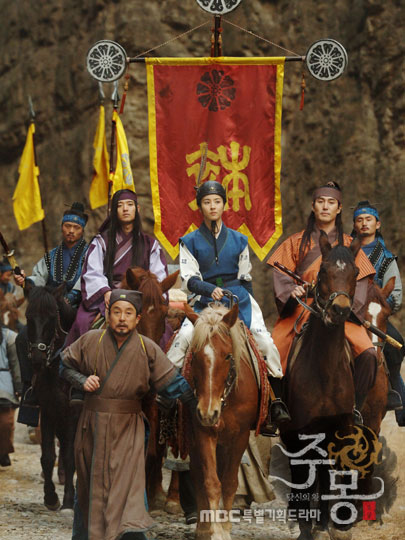
Let the Sino-Korean netizen war begin!
website for Jumong

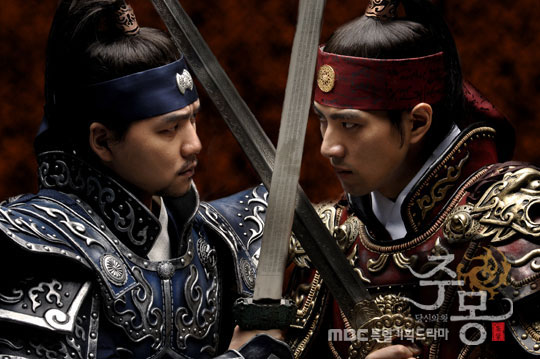
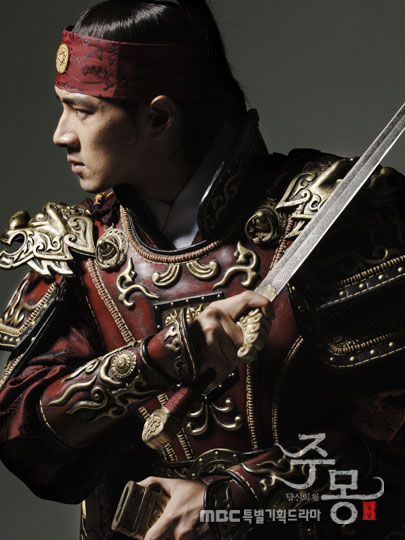
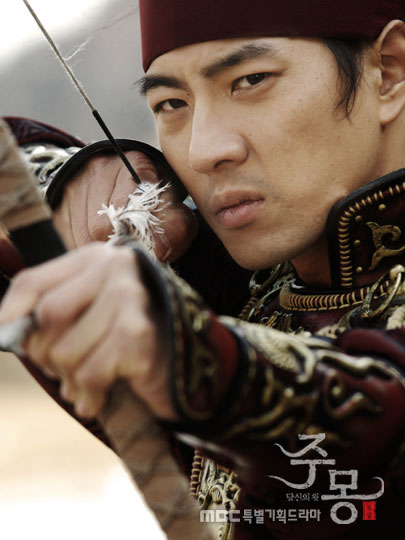
Some photos from Jumong:


East Asian nationalism is an ugly thing. I'm more sympathetic to the Korean claims; there's too much chauvinism at work in Chinese nationalism--tied in part to the inferiority complex that I've mentioned before. (Not sure if I've talked about it here though.) The desire that "we must show our cultural superiority"--a different form of cultural imperialism than what the Korea wave supposedly represents. (Just a trend in entertainment, those who are reacting against it badly in Japan and China need to calm down and find something else to do besides watch TV.)

As for the attempts of the Chinese government and nationalistic citizens to aggrandize territory, even in the historical past--it's the same old Chinese imperialism, which didn't die with the Qing dynasty. China may be one of the last places on earth where relocalization can take root as a movement. (The United States is also stubborn in holding on 'bigger is better' mentality or the 'big centralized state.' Canada isn't far behind--haha yes I had to put that in there. At least the UK has the UKIP and there are various separation movements in the UK.)

Koreans are a bit more justified in being zealous--they are trying to protect their ethnic and national identity after all, refusing to be assimilated as a satellite state of one big country or another. They did adopt neo-Confucian as official state orthodoxy, and continue to use Chinese characters (at least in South Korea)--the Chinese should be content with that, and focus instead on their internal problems. But it makes for a nice distraction, fostering this spirit of competitiveness with other countries--diverting the people from the real problems plaguing China.

Varia, 6 February 2007


Children in traditional costumes on Sunday celebrate Ipchun, one of the 24 seasonal divisions and the beginning of spring, by posting a banner wishing for good luck and happiness in the Namsangol Traditional village in Seoul Sunday.

The Bank of Korea appears to have given face lifts to the important Koreans engraved on their new banknotes. The new W1,000 bills issued last month depict Yi Hwang, a prominent Confucian scholar of the Chosun era, with reduced cheekbones and a thicker nose bridge. January's new W10,000 notes portray King Sejong with a higher nose. W5,000 banknotes issued last year show Confucian scholar Yi Yi with double eyelids./Yonhap

Customers in traditional Korean garments pose for photos at a post office shopping center in Gwanghwamun, Seoul, on Monday.

In a ceremony to mark the launch of a musical version of ‘Daejanggeum,’ or ‘A Jewel in the Palace,’ at the Westin Chosun Hotel in Seoul on Monday, actors Kim So-hyun as Janggeum and Won Ki-jun as Min Jeong-ho sing together./Newsis

Actress Lee Young-ae, the face of LG Electronics, poses with the home appliance giant’s new improved 'Time Machine' TV./Yonhap

Papal Message for 22nd Youth Day

Papal Message for 22nd Youth Day

"A 'Discovery' of Love"


VATICAN CITY, FEB. 5, 2007 (Zenit.org).- Here is a Vatican translation of the message Benedict XVI wrote to young people, for the diocesan-level World Youth Day, to be observed April 1.

* * *

"Just as I have loved you, you also should love one another" (Jn 13:34)

My dear young friends,

On the occasion of the 22nd World Youth Day that will be celebrated in the dioceses on Palm Sunday, I would like to propose for your meditation the words of Jesus: "Just as I have loved you, you also should love one another" (Jn 13:34).

Is it possible to love?

Everybody feels the longing to love and to be loved. Yet, how difficult it is to love, and how many mistakes and failures have to be reckoned with in love! There are those who even come to doubt that love is possible. But if emotional delusions or lack of affection can cause us to think that love is utopian, an impossible dream, should we then become resigned? No! Love is possible, and the purpose of my message is to help reawaken in each one of you -- you who are the future and hope of humanity --, trust in a love that is true, faithful and strong; a love that generates peace and joy; a love that binds people together and allows them to feel free in respect for one another. Let us now go on a journey together in three stages, as we embark on a "discovery" of love.

God, the source of love

The first stage concerns the source of true love. There is only one source, and that is God. Saint John makes this clear when he declares that "God is love" (1 Jn 4:8,16). He was not simply saying that God loves us, but that the very being of God is love. Here we find ourselves before the most dazzling revelation of the source of love, the mystery of the Trinity: in God, one and triune, there is an everlasting exchange of love between the persons of the Father and the Son, and this love is not an energy or a sentiment, but it is a person; it is the Holy Spirit.

The Cross of Christ fully reveals the love of God

How is God-Love revealed to us? We have now reached the second stage of our journey. Even though the signs of divine love are already clearly present in creation, the full revelation of the intimate mystery of God came to us through the Incarnation when God himself became man. In Christ, true God and true Man, we have come to know love in all its magnitude. In fact, as I wrote in the Encyclical Deus caritas est, "the real novelty of the New Testament lies not so much in new ideas as in the figure of Christ himself, who gives flesh and blood to those concepts -- an unprecedented realism" (n. 12). The manifestation of divine love is total and perfect in the Cross where, we are told by Saint Paul, "God proves his love for us in that while we still were sinners Christ died for us" (Rm 5:8). Therefore, each one of us can truly say: "Christ loved me and gave himself up for me" (cf Eph 5:2). Redeemed by his blood, no human life is useless or of little value, because each of us is loved personally by Him with a passionate and faithful love, a love without limits. The Cross, -- for the world a folly, for many believers a scandal --, is in fact the "wisdom of God" for those who allow themselves to be touched right to the innermost depths of their being, "for God's foolishness is wiser than human wisdom, and God's weakness is stronger than human strength" (1 Cor 1:25). Moreover, the Crucifix, which after the Resurrection would carry forever the marks of his passion, exposes the "distortions" and lies about God that underlie violence, vengeance and exclusion. Christ is the Lamb of God who takes upon himself the sins of the world and eradicates hatred from the heart of humankind. This is the true "revolution" that He brings about: love.

Loving our neighbor as Christ loves us

Now we have arrived at the third stage of our reflection. Christ cried out from the Cross: "I am thirsty" (Jn 19:28). This shows us his burning thirst to love and to be loved by each one of us. It is only by coming to perceive the depth and intensity of such a mystery that we can realize the need and urgency to love him as He has loved us. This also entails the commitment to even give our lives, if necessary, for our brothers and sisters sustained by love for Him. God had already said in the Old Testament: "You shall love your neighbor as yourself" (Lev 19:18), but the innovation introduced by Christ is the fact that to love as he loves us means loving everyone without distinction, even our enemies, "to the end" (cf Jn 13:1).

Witnesses to the love of Christ

I would like to linger for a moment on three areas of daily life where you, my dear young friends, are particularly called to demonstrate the love of God. The first area is the Church, our spiritual family, made up of all the disciples of Christ. Mindful of his words: "By this everyone will know that you are my disciples, if you have love for one another" (Jn 13:35), you should stimulate, with your enthusiasm and charity, the activities of the parishes, the communities, the ecclesial movements and the youth groups to which you belong. Be attentive in your concern for the welfare of others, faithful to the commitments you have made. Do not hesitate to joyfully abstain from some of your entertainments; cheerfully accept the necessary sacrifices; testify to your faithful love for Jesus by proclaiming his Gospel, especially among young people of your age.

Preparing for the future

The second area, where you are called to express your love and grow in it, is your preparation for the future that awaits you. If you are engaged to be married, God has a project of love for your future as a couple and as a family. Therefore, it is essential that you discover it with the help of the Church, free from the common prejudice that says that Christianity with its commandments and prohibitions places obstacles to the joy of love and impedes you from fully enjoying the happiness that a man and woman seek in their reciprocal love. The love of a man and woman is at the origin of the human family and the couple formed by a man and a woman has its foundation in God's original plan (cf Gen 2:18-25). Learning to love each other as a couple is a wonderful journey, yet it requires a demanding "apprenticeship". The period of engagement, very necessary in order to form a couple, is a time of expectation and preparation that needs to be lived in purity of gesture and words. It allows you to mature in love, in concern and in attention for each other; it helps you to practice self-control and to develop your respect for each other. These are the characteristics of true love that does not place emphasis on seeking its own satisfaction or its own welfare. In your prayer together, ask the Lord to watch over and increase your love and to purify it of all selfishness. Do not hesitate to respond generously to the Lord's call, for Christian matrimony is truly and wholly a vocation in the Church. Likewise, dear young men and women, be ready to say "yes" if God should call you to follow the path of ministerial priesthood or the consecrated life. Your example will be one of encouragement for many of your peers who are seeking true happiness.

Growing in love each day

The third area of commitment that comes with love is that of daily life with its multiple relationships. I am particularly referring to family, studies, work and free time. Dear young friends, cultivate your talents, not only to obtain a social position, but also to help others to "grow". Develop your capacities, not only in order to become more "competitive" and "productive", but to be "witnesses of charity". In addition to your professional training, also make an effort to acquire religious knowledge that will help you to carry out your mission in a responsible way. In particular, I invite you to carefully study the social doctrine of the Church so that its principles may inspire and guide your action in the world. May the Holy Spirit make you creative in charity, persevering in your commitments, and brave in your initiatives, so that you will be able to offer your contribution to the building up of the "civilization of love". The horizon of love is truly boundless: it is the whole world!

"Dare to love" by following the example of the saints

My dear young friends, I want to invite you to "dare to love". Do not desire anything less for your life than a love that is strong and beautiful and that is capable of making the whole of your existence a joyful undertaking of giving yourselves as a gift to God and your brothers and sisters, in imitation of the One who vanquished hatred and death forever through love (cf Rev 5:13). Love is the only force capable of changing the heart of the human person and of all humanity, by making fruitful the relations between men and women, between rich and poor, between cultures and civilizations. This is shown to us in the lives of the saints. They are true friends of God who channel and reflect this very first love. Try to know them better, entrust yourselves to their intercession, and strive to live as they did. I shall just mention Mother Teresa. In order to respond instantly to the cry of Jesus, "I thirst", a cry that had touched her deeply, she began to take in the people who were dying on the streets of Calcutta in India. From that time onward, the only desire of her life was to quench the thirst of love felt by Jesus, not with words, but with concrete action by recognizing his disfigured countenance thirsting for love in the faces of the poorest of the poor. Blessed Teresa put the teachings of the Lord into practice: "Just as you did it to one of the least of these who are members of my family, you did it to me" (Mt 25:40). The message of this humble witness of divine love has spread around the whole world.

The secret of love

Each one of us, my dear friends, has been given the possibility of reaching this same level of love, but only by having recourse to the indispensable support of divine Grace. Only the Lord's help will allow us to keep away from resignation when faced with the enormity of the task to be undertaken. It instills in us the courage to accomplish that which is humanly inconceivable. Contact with the Lord in prayer grounds us in humility and reminds us that we are "unworthy servants" (cf Lk 17:10). Above all, the Eucharist is the great school of love. When we participate regularly and with devotion in Holy Mass, when we spend a sustained time of adoration in the presence of Jesus in the Eucharist, it is easier to understand the length, breadth, height and depth of his love that goes beyond all knowledge (cf Eph 3:17-18). By sharing the Eucharistic Bread with our brothers and sisters of the Church community, we feel compelled, like Our Lady with Elizabeth, to render "in haste" the love of Christ into generous service towards our brothers and sisters.

Towards the encounter in Sydney

On this subject, the recommendation of the apostle John is illuminating: "Little children, let us love, not in word or speech, but in truth and action. And by this we will know that we are from the truth" (1 Jn 3:18-19). Dear young people, it is in this spirit that I invite you to experience the next World Youth Day together with your bishops in your respective dioceses. This will be an important stage on the way to the meeting in Sydney where the theme will be: "You will receive power when the Holy Spirit has come upon you; and you will be my witnesses" (Acts 1:8). May Mary, the Mother of Christ and of the Church, help you to let that cry ring out everywhere, the cry that has changed the world: "God is love!" I am together with you all in prayer and extend to you my heartfelt blessing.

From the Vatican, 27 January 2007

BENEDICTUS PP. XVI

[Translation of Italian original issued by the Holy See]

© Copyright 2007 -- Libreria Editrice Vaticana


Bishop Pietro Paolo Li Panshi, 95, Dies

Bishop Pietro Paolo Li Panshi, 95, Dies

His Top Concerns Included Formation of Clergy

ZHONGSHAN, China, FEB. 5, 2007 (Zenit.org).- A Chinese bishop who, in the wake of the Cultural Revolution, made reconciliation among Catholics and formation of the clergy his main concerns, has died.

Bishop Pietro Paolo Li Panshi died at 95 on Jan. 4, the Fides news agency reported last week.

He was the bishop of Jiangmen, in the Guangdong province.

The prelate's funeral service was presided over by Bishop Giuseppe Liao Hongquing of Kaying, Meixian/Meizhou, together with the vicar general and all the priests of the diocese. About 1,000 Catholics, and several civil authorities were in attendance.

Bishop Li was buried in the Catholic cemetery of Zhongshan.

Born on July 12, 1911, he entered Macao Seminary in 1922. He was ordained a priest in 1944.

For many years after 1949, Father Li earned a living growing bananas and keeping rabbits, while he continued to announce the Gospel.

After the Cultural Revolution of 1966-1976 he was allowed to return to his village to work as a peasant.

In 1981, he was given permission to resume his pastoral work in the city of Zhongshan. That year he was ordained a bishop.

The little money he managed to save served for the formation of clergy.

The Diocese of Jiangmen has about 20,000 Catholics, primarily in the cities of Foshan, Jiangmen and Zhongshan, and in 20 rural counties.

Its eight priests have to speak three languages -- Cantonese, Hacca and Mandarin -- to carry out their pastoral work.

NLM may sell copies of the Can. ed. of Into Great Silence

Shawn Tribe writes:

The NLM has been approached with an opportunity and is thus exploring the possibility of making available for purchase to readers the much anticipated film, Into Great Silence, which as most should know by now, looks in depth at the monastic and semi-eremetical lives of the Carthusian monks of La Grande Chartreuse.

To make this feasible and fruitful for the NLM (especially as a lot of work and organization would be involved), it would require a certain number of pre-orders, followed by collection of payment and shipping information so that I could then safely tell the supplier how many copies would be needed and pay them accordingly. Copies would cost $30.00 USD plus shipping and handling. (Shipping and Handling would likely be $10 USD to locations in Canada and the Continental USA.)

However, if the NLM is to pursue this, we need firm committments of people who would be ready to commit to ordering this product through the NLM as of March. As such, those who are interested, please go here and fill in your name and email address (so that I may ascertain the level of interest): Form to Express Interest in Ordering DVD from the NLM

As the numbers matter in determining whether to move ahead with this, only those committing to ordering this through the NLM should put their name on the form. The formal decision will be made when numbers are sufficient, or by the last week in Februrary, whichever comes first.

Please spread the word on your own blogs about this. The DVD seems worth promoting and getting into people's hands.


I hope an American edition comes out--I don't know if I could afford a $30+ DVD.