Wednesday, April 26, 2006

"Jane Jacobs, Urban Activist, Is Dead at 89"

Jane Jacobs, Urban Activist, Is Dead at 89
By THE ASSOCIATED PRESS
Published: April 25, 2006


Steve Payne for The New York Times
The author Jane Jacobs on the porch of her home in Toronto, June 9, 2003.


NEW YORK (AP) -- Jane Jacobs, an author and community activist of singular influence whose classic "The Death and Life of Great American Cities" transformed ideas about urban planning, died Tuesday, her publisher said. Jacobs, a longtime resident of Toronto, was 89.

Jacobs died in her sleep Tuesday morning at a Toronto hospital, which she entered a few days ago, according to Random House publicist Sally Marvin. Jacobs' son, James, was with her at the time. The author, who would have turned 90 on May 4, had been in poor health.

A native of Scranton, Pa., Jacobs lived for many years in New York before moving to Toronto in the late 1960s. She and her husband, architect Robert Jacobs Jr., were unhappy their taxes were supporting the Vietnam War and they eventually made Canada their permanent home. Robert Jacobs died in 1996. Her impact transcended borders. Basing her findings on deep, eclectic reading and firsthand observation, Jacobs challenged assumptions she believed damaged modern cities -- that neighborhoods should be isolated from each other, that an empty street was safer than a crowded one, that the car represented progress over the pedestrian.

Her priorities were for integrated, manageable communities, for diversity of people, transportation, architecture and commerce. She also believed that economies need to be self-sustaining and self-renewing, relying on local initiative instead of centralized bureaucracies.

"She inspired a kind of quiet revolution," her longtime editor, Jacob Epstein, said Tuesday. "Every time you see people rise up and oppose a developer, you think of Jane Jacobs."

"Death and Life," published in 1961, evolved from opposing the standards of the time to becoming a standard itself. It was taught in urban studies classes throughout North America and sold more than half a million copies. City planners in New York and Toronto were among those who cited its importance and her book became an essential text for "New Urban" communities such as Hercules, Calif., and Civano, Ariz.

Jacobs also received a number of prizes, including a lifetime achievement award in 2000 from the National Building Foundation in Washington, D.C.

With her bangs and owlish glasses, and her look of cheerful curiosity, it was easy to mistake Jacobs for an idle eccentric, the kind of woman to be found late at night in the research room of the public library.

But Jacobs was a dedicated, even iconic activist. In the 1950s, she was interrogated by the U.S. government over her loyalty to the country and in the 1960s she was arrested during protests against the Vietnam War. She successfully opposed a Toronto highway project not long after moving there and was a distinctive presence at public hearings.

"You sort of fell in love with Jane when you met her," Epstein said. "She was exuberant, original, strong-minded and a very kind woman."

Her most famous confrontation came in the early '60s, when she helped defeat a plan by New York City park commissioner Robert Moses to build an expressway through Washington Square, their rivalry immortalized in the 2004 play "Boozy." During a 2000 interview with The Associated Press, Jacobs recalled the city hearing where she first laid eyes on the mighty Moses.

"As is often the case in these hearings, the officials speak first and then they leave before they hear the opposition. So he was one of the first speakers," she said. "He was furious and he stood up there, inside the railed enclosure, and not where most speakers spoke -- outside where the public microphone was. He was privileged.

"He gripped this railing and he said, in dismissing scornfully our plan to have no more than the existing road and better not even that, he said, 'These protests are just by a bunch of, a bunch of, ... a bunch of mothers!"'

Born in 1916, Jacobs was a doctor's daughter with a compulsion to question authority, an unfortunate quality if she happened to be one of your students -- even more unfortunate if you were trying to tell her something about cities.

"One of our teachers, I guess it was the fourth grade, told me cities form because there's a waterfall around and so there is power," she recalled. "Well, I was very dubious about this and immediately told her that in our neighborhood park there was a waterfall and it had nothing to do with the city."

During the Depression, on days when job hunts went nowhere, she would invest a nickel in the subway and explore a neighborhood: the diamond district, the garment district, the meatpacking district. Soon, she made money out of her passion, writing articles for various magazines.

One of her favorite phrases was "in the real world." She continued a long tradition of American pragmatism, from Benjamin Franklin to John Dewey and William James. She believed ideas should come from experience as opposed to the other way around.

"Death and Life" emerged from her reporting. Not only did it attack canonical beliefs in city planning, it attacked such canonical figures as Moses and historian Lewis Mumford.

Jacobs thought cities suffered from an anti-city bias among planners, the romanticization of a more rural way of life. Because of this, she wrote, vital communities were being torn down simply because they were "crowded," other neighborhoods were fatally isolated and parks were being constructed without regard to their surrounding environment.

She specifically criticized Mumford, author of "The Culture of Cities," for his misguided attachment to the anti-city philosophy, and Moses for his dogmatic attachment to the automobile.

Her arguments were clearly heard. Mumford, who had praised Jacobs' magazine work as "devastatingly just," dismissed her as a "sloppy novice." Moses told her publisher, Random House, that "Death and Life" was "intemperate and inaccurate, and also libelous."

But Jacobs' book was widely praised and in her subsequent works, she examined the ideas outlined in "Death and Life" from a variety of perspectives: "Cities and the Wealth of Nations" focused on the economy; "Systems of Survival" on morals; "The Nature of Economies" on science and ecology. Her final book, "Dark Age Ahead," came out in 2004.

Jacobs is survived by her three children, James, Edward and Mary.

"America's Eating Disorder"

America's Eating Disorder
By Blair Golson, Truthdig. Posted April 19, 2006.

It became obvious to journalist Michael Pollan in the summer of 2002 that America had a national eating disorder. That July, The New York Times Magazine published an article titled "What if It's All Been a Big Fat Lie?" which reported that a growing number of respected nutritional researchers were beginning to conclude that perhaps Dr. Robert Atkins had been right all along: Carbohydrates, not fats, were the cause of America's obesity problem.

Almost overnight, in Pollan's estimation, bakeries went out of business, dinner rolls in New York restaurants went the way of the pterodactyl, and pasta became regarded as a toxin.

"These foods were wonderful staples of human life for thousands of years," Pollan told Truthdig, "and suddenly we've decided that they're evil. Any culture that could change its diet on a dime like that is suffering from an eating disorder, as far as I can see."

Pollan was well placed to make such an observation. The previous year, he had published a critically acclaimed, best-selling book called The Botany of Desire, an examination of humans' relationships to plants, and how plants shape human societies as much as we shape them. His writings on the natural world and food stretch back to the late 1980s. Early in his career, he was an editor at Harper's magazine, and since 1995 he has been a contributing editor at The New
York Times Magazine. Over the years he won a gaggle of writing awards and fellowships from environmental, food and journalistic organizations, in addition to publishing two other books, on gardening and architecture.

So when Atkins-mania achieved terminal velocity in the summer of 2002, Pollan started to wonder whether it wasn't time to ask some fundamental questions about a country so apparently susceptible to the whims of a fad diet. Pulling together the threads of stories he had written in the past decade on topics ranging from the ethics of vegetarianism to the dangers of over-reliance on corn, Pollan set off on a journey to answer a deceptively sophisticated question: "What should we have for dinner?"

The search for an answer found expression in Pollan's just-published book The Omnivore's Dilemma. The title refers to the quandary faced by animals like humans (and rats and cockroaches) that, in order to stay alive, must choose from the bewildering array of edible and non-edible substances. We can eat a lot, but what should we eat?

The subtitle of his book is "A Natural History of Four Meals," which is Pollan's way of describing his exploration of four types of food that eventually terminate in some kind of human meal: food that he himself grew and hunted; organic or "alternative" food (found at farmer's markets); industrial-organic foods (much of the stock at Whole Foods); and industrial, or processed, food (the snack or cereal aisles at Safeway). Through this series of "food detective stories," the author found things to cheer and things to fear about the ethical, biological and ecological ramifications of the American way of eating.

Truthdig managing editor Blair Golson recently spoke with Pollan from his home in Northern California, where he is the Knight Professor of Journalism at UC Berkeley's Graduate School of Journalism. He discussed how the omnivore's dilemma had returned in the unlikeliest of places; the truth about so-called "free range" chickens; and how in the world food manufacturers can get away with labels that read: "This product may contain one or more of the following…."

Blair Golson: The omnivore's dilemma is typically associated with animals in the wild that have to choose between food that will either nurture or kill them. What's the relevance of the term to modern human society?
Michael Pollan: Out in nature, if you're a creature looking for something to eat, you might see some attractive looking red berries and think to yourself, "I wonder if I can eat those without getting sick? And what about those mushrooms?" Well, the same thing is happening in the supermarket. There are many tasty things, some of which can kill you. Trans fats, for example, or all the sugar we're eating.

So we're back where we were once upon a time, trying to navigate a treacherous food landscape -- full of attractive things, but some of which are liable to shorten our lives.

BG: Is that what prompted you to write the book?
MP: It was a gathering sense that Americans -- myself included -- had gotten deeply confused and worried about what they were eating and unsure where to turn. To read the newspaper over the last couple of years is to read one story after another that makes you wonder if the way you've been eating all these years is such a good idea -- for yourself or the planet or the animals.

Just reading the coverage of mad cow disease was an incredible educational experience. For example, we read that you've got to stop feeding cows to cows. It's like, "What? We've been feeding cows to cows?" And we've got to tighten up those rules about feeding chicken litter to cows. "We've been feeding chicken crap to cows?"

If you read those stories, it made me realize that the system by which we're producing our food is not one I feel very good about participating in. So I began looking into the food chain and alternatives to the main industrial food chain -- doing what I think of as a series of food detective stories, and much of what I learned in these detective stories was astonishing to me, and forced me to re-approach the way I shop for food and go about eating it.

BG: Like facing up to the realities of shopping at Whole Foods?
MP: Yeah, I use the term "supermarket pastoral" for the experience of shopping in a place like that. Whole Foods, they're brilliant storytellers. You walk into that store, and it just looks like a beautiful garden, and there are pictures of organic farmers up on the walls, and little labels that describe how the cow lived that became your milk or your beef, and the cage-free vegetarian hens who got to free range.

They're creating in your minds an image of a farm very much like the ones in the books you read as children -- with a diversity of happy animals wandering around the farmyard. It's very cleverly designed, but unfortunately like a lot of pastoral forms of art, it's based on illusions. Not entirely, but if you go to the farm depicted on those labels, you find that in fact, things look a little bit different. Organic milk might be coming from a dry organic feedlot where 500 cows are milling around and never get to eat a blade of grass. I have a feeling that's not what the consumer thinks they're getting.

BG: Does the same thing go for free-range chickens and eggs?
MP: It's very interesting. Free-range chickens -- I did go visit a large organic chicken producer here in California, and if you look at their label, there's a farmstead with a little silo and a farm house and a farmyard and chickens running around, but if you go to the farm, the chickens are grown in these huge barracks as long as a football field. They're indoors, there are 20,000 of them in a house, and running along this barrack is what looks like a little front lawn -- mowed, maybe 15 or 20 feet deep.

There's a little door at either side of the barrack where, theoretically, chickens could step outside and take the air. But they don't. One reason is that the doors are closed until the chickens are about five weeks old. The farmers -- if you can use that word, the managers -- are concerned that the chickens might catch their death of cold or pick up a germ, so they don't open the doors until the chickens are five weeks old.

They smother them at seven weeks; so it's not exactly a lifestyle. It's more like a two-week vacation option. And the chickens don't avail themselves of this option because they've never been outside before. They're terrified of going outside. First of all, it's not big enough for the whole flock. Second of all, the food and water is inside; they're not used to it; they weren't brought up this way.

They're like the cat in the Manhattan apartment; when you open the door they just stand there in terror wondering about the other dimension of reality outside that door. Free range is a conceit. It's to make us feel better about these chickens. It's not doing anything for the chickens, as far as I can tell.

Yes, that organic chicken is still a better product, I think. It's getting better feed, it's got a few more inches of legroom than a conventional chicken, but it's not all it's cracked up to be.

BG: And hence your efforts to find places that were all they were cracked up to be…
MP: I went looking for a better model of farming -- a truly biological or ecological farm. They are out there. There are people doing amazing, visionary work. And the one I chose to focus on is a farm called Polyface. And it's run by a man named Joel Salatin and his son, Daniel. They grow six different animals on 100 acres of open land and another 400 of forest. And they do it in this very intricate rotation, so that on one day, the cows are on a pasture.

Then they wait a couple of days and the chickens come in. They eat all of the grubs out of the manure, which takes care of the farm's problem with flies and disease, and they spread that manure in the process of doing that, and they fertilize it with their own manure to keep the pastures very healthy. Then the chickens move out and another animal moves in. This rotation going through the farm several times every season, and the result is a great deal of high-quality food, but also, most astoundingly of all, an improvement in the environment of this farm. There is more top soil, more grass, more fertility than there would be if nothing were being done here.

That is a very significant achievement, because it belies this basic American idea that our relationship with nature is a zero sum game -- by which we all assume that for us to get what we want from nature, nature is diminished. This farm is saying, "No, that is not necessarily true. There is a way to get your food from the earth in such a way that it leaves the earth improved."

To me, that's an incredibly heartening message; it says we're not this pest species in nature, that we really have a contribution to make.

BG: Is there any evidence to suggest that that model is spreading?
MP: It's not about to take over American agriculture, but there's a very strong movement to put animals back on grass, get them off of feed lots, and sell grass-finished meat. Grass-fed beef is growing very quickly, and I find it a very hopeful development.

BG: But didn't you write that places like Polyface can't ever hope to make money supplying the biggies like Wal-Mart or Whole Foods because those places only buy from mega farms?
MP: You have to get out of the supermarket, basically. The supermarket is not going to support this world in the long run, I don't think. But the supermarket is not the only place to buy your food. There are very many good alternatives -- the farmers' market being the most obvious.

But also CSAs -- which stands for community-supported agriculture -- where you essentially join a farm and every week you get a box of produce. People are buying really good grass-fed meat over the Internet.

BG: If you're someone living in a major metropolitan city, and you wanted to eat in the healthiest way, patronizing the most ecologically friendly food purveyors -- setting aside cost for the moment -- how would you shop?
MP: I am that person. I've joined a CSA, so I get a box of produce every week. I also go to the farmers' market. I have found some producers of things like beef that I buy in quantity and keep in my freezer. But I also find grass-finished beef -- I'm kind of lucky here in Northern California -- I can find it in local markets. So I do a little bit of many different things. And it's a little easier to do here in California than in others places. Our farmers' markets are open 12 months a year, and that isn't true everywhere.

But I also get on the Internet and find interesting food. There are terrific websites. There's the Eat Well Guide, where you put in your ZIP code and it tells you about local farms doing interesting things. The other thing to do is to visit local farms and establish a personal connection, if you have the time and the inclination. I find that incredibly interesting. I like knowing farmers who are growing my food.

But all of us are going to take this to different degrees. I don't think it's all or nothing. I still go to the Safeway. I still stop at Whole Foods every now and then. And many people don't have the time or inclination to put any more work into it, and so maybe Whole Foods is fine, and maybe they've got a lot of money, because Whole Foods is really expensive. And that helps. The kind of farming that Whole Foods supports is better than conventional farming.

All I'm suggesting is that you can take it to the next step if you want. And the next step is incredibly rewarding, because the quality of the food is so high, and the kind of stewardship going on is very impressive. But like I said, it's not all or nothing. We have three food votes every day -- that's more votes than we have in most other aspects of our lives. And if you used one
of them in a way that supported a change -- an alternative food chain, that's a big accomplishment. That's enough to create these alternatives and make them more accessible and probably cheaper as well, as more people use them. You can go whole hog or just dip your toes in, but either way, I think it's a very important food vote you have.

BG: Sure, we have votes; but as a society, we seem to vote most often for fad diets. Why are Americans in particular so susceptible to those kinds of appeals?
MP: I think it is because we're not anchored by a single, stable food culture, that we're really vulnerable to messages from marketers, messages from scientists, and we're willing to throw it all out every few years.

BG: What do you mean a "stable food culture"? Do you mean the immigrant, melting-pot aspect of America?
MP: Yeah. Since we didn't have one national kind of cuisine, and one sort of eating rules, the result has been a diluted food culture that is much more vulnerable to marketing. If we had a
stable food culture that had a consistent set of answers about, "This is what you eat, and this is how you eat it," I think we'd be much less vulnerable to a news article saying, "Fat is good, carb is bad."

BG: But surely there's more to the erosion of a healthy food culture than our immigrant roots?
MP: The food marketers deserve a lot of the blame for this. When you sell a product like Go-Gurt, or a nonfood like this new stuff called "Gu" -- which is a pure nutrients in a gel that athletes are supposed to use, but that kids are taking in their lunch boxes -- you're destroying something.

You're destroying the idea of people eating together. If you're selling products designed to go in the cup holder, you are, not intentionally, but effectively destroying the idea of people sitting at a table across from one another and eating. We don't eat together as families nearly as much as we once did. Twenty percent of meals are now eaten in the car. Food marketers are barraging us with messages about what we should eat. New food products are redefining the eating experience. Your great-grandmother wouldn't recognize a Pop Tart or a tube of Go-Gurt, or know what to do with it. So we've changed the way we eat more in the last 50 years than probably in the thousand years before that -- at every level: in the farm, but also in the market. So all this has contributed to this confusion about what we should eat. Of course, because before you figure out what you should eat, you need to figure out what you are eating.

BG: Which, it turns out, is a ton of corn. Literally. You write that each of us is responsible for eating approximately a ton of corn per year. How could that be?
MP: Most of it is hidden from view, because most of that corn is passed through animals first. We eat corn in the form of chickens and pork and beef and eggs and milk. Almost all the rest of it is highly processed. It's in chicken McNuggets. Not just in the chicken, but in 13 out of the 38 ingredients there -- the additives, the various corn starches, the various oils, the oil it's fried in. It's kind of a hidden food chain. And it's not just corn. There's a lot of soybean in our food, too.

But the way our food system works, is we take these very simple commodity crops -- that the government heavily subsidizes, by the way -- and we break them down into their constituent molecules, and then we reassemble them in the form of proteins, carbohydrates and fats in highly processed foods: snack foods, chicken nuggets, Coca-Cola. We eat something like 56 pounds of high-fructose corn syrup sweetener every year.

When you're drinking that soda, you're really drinking quite a bit of corn. So we should worship the corn plant, because that's what's supporting us right now. We don't, because we don't realize we're eating it. The Mayans, who called themselves the corn people, had a healthier sense of their indebtedness o this one plant.

BG: What are the ramifications of relying so heavily upon one crop?
MP: The last people to rely so heavily upon one crop were the Irish in the 19th century who ate potatoes and nothing else. This wasn't very good for their health, and when the potato crop failed in 1845, a million of them died. In general, it's a really bad idea to put all your eggs in one basket.

Nature doesn't work that way, and we are leaving ourselves open to risk from the devastation of the corn crop from some new microbe or terrorism. As a health matter, we're omnivores. We do need those 50 or so different chemical nutrients, and you're not going to get them from processed corn. Processed corn is the building block of the fast food diet.

And that diet, we're learning, is leaving us mal-nourished, even as it makes us fat. There are kids showing up in clinics in Oakland with rickets -- very well-fed, over-fed kids who are suffering from nutrient deficiencies. That's from eating too much processed corn.

BG: Do you think we need new rules applied to food labeling? Either from the government, or maybe from the industry itself? Are labels the answer?
MP: I think labels are important. They are a substitute for people actually being able to meet farmers and go to farms. But I think there are a lot of other changes at the federal level that would help. Our food system is not a creation of the free market. It's a combination of a set of rules combined with the market. And those rules are dictating the fact that, for example, cheap corn and soybeans are the predominant ingredients in our food supply.

Because we subsidize those calories, we end up with a supermarket in which the least healthy calories are the cheapest. And the most healthy calories are the most expensive. That, in the simplest terms, is the root of the obesity epidemic for the poor -- because the obesity epidemic is really a class-based problem. It's not an epidemic, really. The biggest prediction of obesity is
income.

BG: You write about resistant starch, a new starch from corn that is virtually indigestible, which means it goes through the digestive track without breaking down and turning into glucose. Does this mean it doesn't add any calories to our waistline?
MP: That's right. This has been the holy grail of food science for a while: to allow people to eat endlessly without getting full or fat.

BG: So how do you feel about this new substance at first blush?
MP: I think it's a crazy idea. In the same way Olestra was a crazy idea. Olestra was an oil that passes through your system, but people rejected it because of other things it did to your system. Did you ever read the warning label on Olestra? It warns of anal leakage. I find this very unappetizing. This is going to be a very novel food; and we don't know what it's doing to us.
The food we have, the food we have had, is perfectly fine. I get an enormous amount of pleasure in eating the carbs that are already out there. I don't think we need this. I think this serves the food marketers more than us. I suppose for obese people looking to lose weight, it'll be useful to them. But sell it with a prescription.

BG: We gotta ask: Why do ingredients labels say, "This product may contain one or more of the following…" How can the manufacturers be unclear about something like that?
MP: They're not unclear. What they're doing is keeping their options open. So that on a given day, they can use any fat -- they could switch from soy to cottonseed to corn oil, depending on today's market conditions. That symbolizes a food that is highly processed. The reason you process food is so that you're not highly dependent on any one raw ingredient, and you want to be as far removed from dependence on the corn market or soy market as possible. You engineer your foods so you could substitute any one ingredient for another.

BG: After all you've seen about the way that animals are grown and slaughtered, what moral calculus do you use to continue eating meat?
MP: I'm a limited carnivore. I only eat meat that is grown in a way that I feel morally comfortable with. And that's not a lot of meat. But I've found a few producers whose practices strike me as defensible. I also think that there are always trade-offs when we eat. Even vegans inflict collateral damage on the environment. Many animals die in row crop agriculture -- not just in animal agriculture, and we have to remember that. Animals are going to die so that we many live. And then you have to think about which animals, and how. And I think animals coming off of a humane farm where they get to live as their evolution dictates -- cows on grass, for example -- is better for them and for us than if they never lived at all. Domestic animals only exist to the extent that we eat them. There would be no pigs, no chickens, no cows as we know them, if people weren't eating them. I don't see domestication as something we've imposed on other species. I see it as a co-evolutionary arrangement, where the animal gets something out of it as well.

You can't domesticate a species just because you want to. There are many species who have refused to be domesticated. The ones who have are the ones who gain something from the relationship. And I think that's true even of the animals we are eating. Many animals depend on their predators for the health of their species. I also think you can make a very strong ecological argument for eating meat. As I described earlier, the sustainably-raised meat is ecologically a very positive thing for the environment, for the grasslands. There are many grasslands that are diminished for not having ruminants on them. And ruminants need predators to be healthy, and we are those predators in cases of certain ruminants.

And without animals on farms, you'd need artificial fertilizer, because you wouldn't have manure to compost. So I think truly sustainable agriculture depends on animals in relation to plants. And if we took the animals out, I'm not sure we'd like the result. I don't think the vegan utopia, from an ecological standpoint, is very sustainable.

I also think that if you didn't have meat agriculture, there are many places in this country and this world that would not be able to feed themselves. I'm talking about hilly places, places where grass grows, but where you can't grow crops. You condemn people in those places to eat off of a very long food chain. I'm thinking of New England: without meat protein, you'd have to eat off
the Midwest.

BG: Finally, what did you mean in writing that we're not only what we eat, but how we eat, too?
MP: At the end of the industrial food chain, you need an industrial eater. What you eat, and how you eat are equally important issues. There is a lot of talk and interesting comparisons drawn between us and the French on the subject of food. We're kind of mystified that they can eat such seemingly toxic substances -- triple crème cheeses and foie gras, and they're actually healthier than we are.

They live a little bit longer, they have less obesity, less heart disease. What gives? Well, according to the people who study this: It's not what they eat, it's how they eat it. They eat smaller portions; they do not snack as a rule; they do not eat alone. When you eat alone, you tend to eat more. When you're eating with someone there's a conversation going on, there's a sense of propriety; you don't pig out when you're eating at a table with other people.

So the French show you can eat just about whatever you want, as long as you do it in moderation. That strikes me as a liberating message. But it's not the way we do things here. We have a food system here that is all about quantity, rather than quality. So how you eat is very, very important, and to solve the obesity and the diabetes issue in this country, we're going to have change the way we eat, as well as what we eat.

Blair Golson is the managing editor of Truthdig

.

Tuesday, April 25, 2006

"Gestational Blues"

"Gestational Blues, A quest for a healthy pregnancy in an unhealthy society," by Erin Middlewood

Also of interest, "Slum Ecology," by Mike Davis

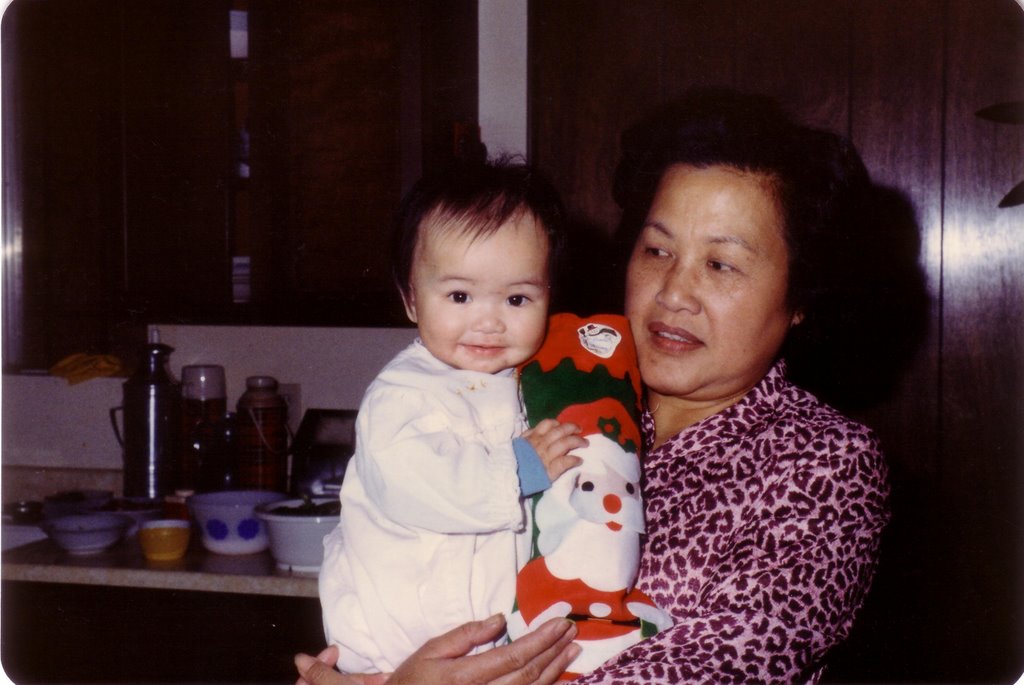
My grandmother's birthday...


is today. Beautiful woman. A pic of her with my second sister, Christmas 1982. Please keep her in your prayers.

"The Illusion of Autonomy in the Fossil Fuel Age"

The Illusion of Autonomy in the Fossil Fuel Age
(Thanks to Energy Bulletin.)

Excerpt:

We have long since abolished slavery as an absolute moral evil. And, we have long since replaced the energy it supplied with a dependency on concentrated forms of energy mined from the ground, namely coal, oil, and natural gas. Those fuels, supplemented with some nuclear, hydroelectric and renewable energy, provide Americans with the equivalent of 147 "energy slaves." That means it would take the equivalent of 147 people working continuously 24
hours a day, 7 days a week to supply the energy currently used by each American. (Some people estimate the number is closer to 100 energy slaves; still, the point remains the same.)

But all those energy slaves are largely invisible. We flip a switch and the light goes on. We twist a key and the car starts. We turn on the stove and the flame lights. We adjust the thermostat and
the heat comes on. We get what we want from our energy slaves, it seems, without having to deal with real people in any way remotely approaching the intimate way those living with or without slavery in the pre-fossil fuel age had to. Our main task is to pay the bill. It is an illusion of autonomy.

It is a libertarian fantasy seemingly come true. Cooperation and community appear optional; we can get everything we need so long as we have a little money.

Of course, in reality, the modern, energy-intensive world is a marvel of human cooperation mediated by financial and information flows of gargantuan proportion. But, that's not how it
feels. The deserted, anonymous suburban streets; the impersonal big box stores; the self-service gas stations; the lonely commute; the untold hours in front of a computer--all can give us a false sense of being isolated and autonomous. At the same time these things give us unrivaled luxury in our living quarters, unparalleled selection in our consumer goods, unprecedented mobility, and unhindered access to information about nearly everything we might want to buy or
wish to learn.

We feel omnipotent and self-contained.How then will we come together for the great task ahead, a transformation that must move us away from this powerful, seemingly autonomous, but ultimately unsustainable existence? Will we accept the true context in which we live, that is, a world with limits? Will we rediscover our neighbors? Will we realize our dependence on one another? Will we find the will to cooperate rather than fight?

Will we be able to give up the illusion of autonomy which the fossil fuel age has engendered in nearly every one of us? And, most important of all, will we be able to do it in time?

Newsday Editorial: "Brace for $100-a-barrel oil"

Brace for $100-a-barrel oil - and the sacrifices required to put in place a national policy for energy alternatives

(Thanks to Energy Bulletin.)

April 23, 2006
Are Americans willing to live with $100-a-barrel oil prices, which could translate into $6-a-gallon gasoline and heating oil? They may have no choice. It could happen as soon as five years from now, according to some energy experts. The price for a barrel of crude has nearly tripled in three years, from $25 in April 2003, to over $72 today.

But the more crucial question is this: Are Americans and their political representatives willing to make the individual and collective sacrifices needed to come up with viable mass-market energy alternatives to heat our homes, drive our cars and run our industries? They would have to accept the unpalatable rospect that a concerted national push for alternatives to oil will be neither
cheap nor easy, and it won't generate significant results for quite some time, even when such alternatives are made to work.


With global demand for oil rising much faster than supply, competition for this precious resource will continue to put enormous pressure on prices. The rapid industrial growth of China and India alone is already responsible for much of he price increase that's shocking motorists at the gas pumps today. And the International Energy Agency (IEA) projects that the world's total energy
requirements will rise by half in the next 25 years - an increase that will be unsustainable at the rate oil is being produced today.

No, the world is nowhere near running out of oil soon. But there is a general agreement that it's close to reaching peak oil production - a plateau after which production will begin to decline. It's a geological reality that won't change. As supplies of oil easily pumped from existing wells dry up, costly and complicated processes will be needed to extract oil trapped in shale and oil sands, or to liquefy coal into synthetic fuels. The result will be ever-higher prices for a shrinking commodity.

To be sure, there is more to recent price increases than competition from newly industrialized nations. The market in oil futures is jittery about the rise in tensions over Iran's nuclear weapons program, Iraq's failure to resume normal oil production, civil unrest that's cut Nigeria's production by a quarter, and an armed rebellion in Chad. In the United States, where not a
single new refinery has been built in the past 30 years, gasoline and diesel prices have been jacked up by fuel shortages caused by Hurricane Rita's damage to Gulf Coast refineries. Add to that the federal requirement for oxygenated fuels in the summer. While the former additive, the water-polluting MBTA, is being phased out, the ethanol brewed from corn in the Midwest is in short supply and costs a great deal to ship to the coasts, which increases gas prices. To add
insult to injury, Congress, in a blatant nod to the corn-producing states, has imposed stiff tariffs and fees on imported ethanol, which is considerably cheaper than the stuff produced in the United States.

No easy ways out

What's the alternative to oil? None of the clean, desirable alternatives - solar, wind, thermal and hydropower, hybrid cars - are more than "boutique" solutions. They're unlikely to replace more than a small portion of oil. Fuel in the form of ethanol from biomass - renewable sources like grasses, grain, sugar cane, even garbage - is feasible, but would require a massive federal program and a huge distribution infrastructure.

Developing a hydrogen-based economy is promising, but would need a decade or more of research and great quantities of power to free up the element from water - power that could only come from the wide adoption of nuclear power production, a proven alternative that carries major problems with the disposal of radioactive waste and the potential for theft of nuclear material for terrorist weapons. The dream of clean, safe nuclear fusion - the source of the
sun's power - remains just that: a search for the modern equivalent of the philosopher's stone. It's never worked outside the laboratory, and no commercial reactors are expected before 2050, if at all.

Coal is abundant in the United States - it's the largest source of carbon fuel in the world - and it's already producing much of this nation's electricity. But mining more coal has vast environmental costs. And using it with advanced scrubbers to clean up its emissions makes it almost as expensive as oil. Still, greater use of coal is part of the solution, as is the acceptance of nuclear power to generate more of the nation's electricity than it does today. Even environmentalists are increasingly embracing nuclear power as an oil substitute, as much for its potential to lessen global warming as for its energy substitution.

What's left? While substitutes are explored and nuclear power is sold to a skeptical public as a necessity, we must adopt the more prosaic but effective ways of dealing with fuel shortages and price hikes: conservation, higher mileage requirements for vehicles, greater reliance on public transportation and, for auto buyers, a willingness to switch to more frugal cars and trucks.
But even these stratagems, however sensible and promising, will only be stopgaps until the nation weans itself away from oil and develops a sustainable alternative.

Examining alternatives is important. But far more crucial is persuading consumers to stop deluding themselves that there will be easy solutions. This will continue to be a slow, rolling crisis that needs a combination of savvy management, creative ideas about alternatives and, above all, the political will to frame a sustainable energy policy and demand sacrifices to implement it. That's the more intractable shortage.

Another band-aid for a GSW

Bush Eases Environmental Rules on Gasoline
By NEDRA PICKLER, Associated Press Writer

WASHINGTON - Under election-year pressure to reduce surging gasoline prices, President Bush on Tuesday halted filling of the nation's emergency oil reserve, urged the waiver of clean air rules to ease local gas shortages and called for the repeal of $2 billion in tax breaks for profit-heavy oil companies.

Still, experts said Bush's actions wouldn't have much impact on prices at the pump. The president warned that motorists would have to dig deep into their pockets all summer long.

Bush urged lawmakers to expand tax breaks for the purchase of fuel-efficient hybrid automobiles, a politically popular measure that's also supported by environmentalists. He also directed the Environmental Protection Agency to use its authority to temporarily waive air quality laws in states if that would relieve a local gasoline supply shortage.
To read the rest of the article, click here.

What the mainstream media are not telling you about the run up in oil prices
by Jeffrey J. Brown

Why Are Oil Prices up?

Oil prices are up substantially since mid-February. Most of the Mainstream Media (MSM) attribute this run up in oil prices to geopolitical tensions. However, a careful examination of recent supply data provided by the US Energy Information Agency (EIA) suggest a different reason--oil importers are bidding against each other for available total petroleum (crude oil + product) imports.

Since the week ending 2/10/06, average daily US net petroleum imports have fallen about 15%, down about two mbpd. Since the week ending 2/24/06, on a smoothed, four week running
average basis, average daily US net petroleum imports have fallen about 8%, down about one mbpd. (A comparable time period last year showed about a 2% decline.)

This sharp decline in net US petroleum imports corresponded to the beginning of the recent run up in oil prices.

It is true that we have relatively high crude oil inventories, but note that we don't know what
percentage of crude oil inventories consists of heavy, sour crude, which cannot be used in light, sweet crude oil refineries. Also, total product inventories are up only slightly year over year. It is quite possible that building inventories of heavy, sour crude oil have been obscuring falling inventories of light, sweet crude oil inventories.

Why is This Decline in Imports Important?

Producing regions tend to peak and then decline when they have used about 50% of their total recoverable conventional oil reserves (Qt).

Kenneth Deffeyes, using a method called Hubbert Linearization (HL), estimated that the world crossed the 50% of (conventional crude + condensate) Qt mark in December, 2005. According to the EIA, December 2005 was the all time record high for world crude + condensate production. The latest data, for January, 2006, show a decline of about 500,000 bpd.

In an article that “Khebab” and I coauthored, “M. King Hubbert’s Lower 48 Prediction Revisited,” we evaluated the accuracy of the HL technique as a predictive tool, once a region has hit the 50% of Qt mark.

As most people know, Dr. Hubbert, in 1956, accurately predicted that US Lower 48 oil production would peak around its actual peak in 1970. Using only production data through 1970, we found that actual post-1970 cumulative Lower 48 oil production was 99% of what the HL method predicted. We concluded that Dr. Deffeyes’ prediction that the world peaked in 2005 should be given a lot of credibility.

In our article, we also analyzed the top four net oil exporters worldwide, and we found that they are collectively farther down the depletion curve than the world is overall. In the article, we had the following statements:

A critical point to keep in mind is that an exporter can only export what is left after domestic consumption is satisfied.

Consider a simple example, a country producing 2.0 mbpd, consuming 1.0 mbpd and therefore exporting 1.0 mbpd. Let's assume a 25% drop in production over a six year period (which we have seen in the North Sea, which by the way peaked at 52% of Qt) and let's assume a 10% increase in domestic consumption. Production would be 1.5 mbpd. Consumption would be 1.1 mbpd. Net exports would be production (1.5 mbpd) less consumption (1.1 mbpd) = 0.4 mbpd. Therefore, because of a 25% drop in production and because of a 10% increase in domestic consumption, net oil exports from our hypothetical net exporter dropped by 60%, from 1.0 mbpd to 0.4 mbpd, over a six year period.

We are deeply concerned that the world is probably facing an imminent and catastrophic collapse in net oil export capacity because of declining production and increasing domestic consumption in the top exporting countries.


Consider the simple math. If Deffeyes is correct that the world oil production peaked in December, 2005, then we will use--at our current rate of consumption--more than 10% of all remaining conventional crude + condensate reserves in the next four years.

Why Aren’t the MSM Discussing the Import Situation?

I think that we are seeing an "Iron Triangle" of sorts defending the status quo concept of ever expanding energy supplies: (1) most housing, auto, financing and related companies; (2) Most MSM companies that are selling advertising to Group #1 and (3) some major oil companies, major oil exporters and energy analysts that are working for the major oil companies and exporters.

The housing/auto group wants to keep selling and financing large homes and SUV's.

The MSM wants to keep selling advertising to the housing/auto group.

In my opinion, some major oil companies are afraid of punitive taxation, and some exporters are afraid of military takeovers. This group of oil companies, exporters and their analysts provide the intellectual ammunition for the other two groups, i.e., promising trillions and trillions of barrels of conventional and nonconventional oil reserves.

Is There a Solution?

There is one important exception to housing/auto group: Mike Jackson, the CEO of AutoNation, is calling for a much higher gasoline tax. While this is a start, I recommend a much higher energy tax, offset by the elimination of the Payroll Tax, combined with a crash electrification of transportation program, as outlined by consulting engineer Alan Drake, see link below.

Jeffrey J. Brown is a petroleum geologist in the Dallas, Texas area. westexas@aol.comM.
King Hubbert's Lower 48 Prediction Revisited www.energybulletin.net/13575.html
EIA Supply Data tonto.eia.doe.gov/dnav/pet/pet_sum_sndw_dcus_nus_w.htm
Electrification of Transportation as a Response to Peaking of World Oil Production www.lightrailnow.org/features/f_lrt_2005-02.htm
~~~~~~~~~~~~~~~ Editorial Notes ~~~~~~~~~~~~~~~~~~~
An earlier version of this article appears on GraphOilogy
Jeffrey wrote the recent Open letter to Texas newspapers about peak oil: 'Why aren’t you listening?', one of the most heavily viewed articles on Energy Bulletin in recent months.
UPDATE: The article is being discussed at EZ
Board
-BA

A Conversation with Wendell Berry

From counterpunch.org

Weekend EditionApril 15 / 16, 2006
A Conversation with Wendell Berry
Taking Care of What We've Been Given
By THOMAS P. HEALY

For the past four decades, writer Wendell Berry has crafted a body of work within the "green" American literary tradition that includes Henry David Thoreau, Ralph Waldo Emerson, Gary Snyder and Edward Abbey. His poems, essays and novels extol the virtues of agrarian life, lament the depredations of the industrial economy and celebrate the integration of ethics, responsibility and humility that come from devoting careful attention to the natural world. Berry also has been one of the most eloquent voices for peace in the period preceding the war in Iraq as well as in the catastrophic aftermath of the Bush administration's unilateral military action.

His most recent books are a collection of essays and speeches entitled The Way of Ignorance (Shoemaker & Hoard, 2005) and Blessed Are the Peacemakers: Christ's Teachings of Love, Compassion & Forgiveness (Shoemaker & Hoard, 2005) which assembles citations from the Gospels of the King James Version of the Bible that serve as the foundation for his faith and advocacy of peace and justice. Berry writes and works the land on Lane's Landing Farm, five miles from his birthplace in northern Kentucky, just across the Ohio River from Madison, Ind.

TH: You retired from teaching?
WB: I didn't retire. I quit.

TH: Was that a sweet parting?
WB: Oh, it was amicable enough. I didn't go away with any grudge. It was time for me to leave.

TH: I only ask because it was the opportunity to return to Kentucky to teach that brought you back from your wanderings. In a mid-1970s "debate" in North Manchester, Indiana, with then-Secretary of Agriculture Earl Butz, he chided you for having off-the-farm income. He said you were making his point for him, "get big or get out," but also that people need to work off the farm to generate income. If they have a small farm, they're not going to generate enough income to actually live off the farm.
WB: Just depends on the one you're talking to. I've never tried to live from farming. Farming has contributed to our living here. We still grow a lot of our food and we have a small sheep flock
and we supply a lot of our own heating fuel from the woods on our place. I'm a very marginal farmer. I'm a very marginal writer too.

TH: You're kidding!
WB: Well, economically. I can't judge whether I'm marginal in any other way but I know damn well that I'm marginal economically. I don't write bestsellers. I have a cottage industry. My work
sells in modest numbers that are economically significant for me. But I'm not a huge literary property.

TH: Writing about your early years--"Trying to become a Henry County poet," as you expressed it in a letter to Ed McClanahan that he published in the final "All About Kesey" edition of Spit in the Ocean--it seemed that at the time you were expressing an ambivalence about that desire. Have you succeeded in becoming a Henry County poet? And was it worth all the effort?
WB: [Laughing]
Oh, I guess so. I've enjoyed being a writer and I s'pose I'm a poet and I certainly still am a Henry Countian, after a fashion. I live in Henry County and I like living here. I don't approve of everything that's happening here by any means.

TH: The erosion of agrarian life?
WB: Yes, absolutely. The ruin of the agrarian life, the disintegration of communities, a considerable amount of urban development in part of this county. Young people are not much interested in farming. There is a lot to worry about here.

TH: I remember reading that your children settled in the area and your son was farming. Is that still the case?
WB: My son and daughter both are farming here. My son is on a farm that my father owned for many years and he is farming with my brother too. He lives about five miles away. About 10 or 12 miles away my daughter and son-in-law are farming. And now in addition to cattle they have a winery.

TH: Wineries are part of the big push in Indiana for "agricultural tourism"--getting city people to visit rural areas to stimulate economic development. The other big push is for increased pork production through Confined Animal Feeding Operations.
WB: Those are wrong. That's not farming. It involves an immense cruelty to the animals and to the people who work in those circumstances and to the neighbors, and it's not sustainable.

TH: Individual farmers are using Community Supported Agriculture to market directly to consumers, and we're seeing an explosive growth of farmers markets.
WB: That's a great thing. The health of farming now is up to the consumers. So it's very exciting that these Community Supported Agriculture farms and farmers markets are having some success. The success that they are having doesn't represent a victory for good agriculture, so far, because the corporate hold is still oppressive and depressive and destructive.

TH: You don't have much good to say about the industrial economy, calling it "oppressive," "destructive" and "predatory."
WB: I have nothing good to say about it. I don't think anything good is to be expected from it. The corporations don't fulfill any responsibilities to the public or to the land that they're not required and forced to fulfill. That's their record.

TH: The whole sustainable agriculture movement and farmers' markets are grassroots phenomena. They're not getting support from the land-grant colleges.
WB: Well, the attitude is changing, and changing significantly in some colleges of agriculture, and one reason is that the failure of industrial agriculture is now too obvious to be ignored by anybody--even its one-time advocates. We've got the hypoxic zone in the Gulf of Mexico, we've got toxic ground water--there are places in Kansas where children and pregnant women are
instructed not to drink the water.

TH: Indiana has fish consumption advisories on all streams and rivers.
WB: That is a result of agriculture to a considerable extent, and you can't call that an agricultural success.

TH: There are people of my generation who grew up on farms or their parents or grandparents grew up on farms and they say, "Without mechanization, I wouldn't have been able to go to college. My pa, my grandpa couldn't have earned a living off the land." They suggest we have to have industrial methods in order to feed people. Why does this notion have such persistent currency?
WB:
People in prestigious positions persist in saying it but it's not true.

TH: In your book The Way of Ignorance, there's an essay "Imagination in place," in which you object to "anybody for rating the land as 'capital' or its human members as 'labor.'" Do you find these terms offensive?
WB: The issue is abstraction. The nature of things is that you can't properly value something
on abstract terms. Every parcel of land in the country is a particular place, and you can't love it or care for it or use it properly in the abstract. To reduce it to money value obscures its existence as a particular good. And when you reduce human beings to an abstraction like "labor" or a "labor force," you obscure the whole issue of their community membership and their involvement in a particular economy and their particular worth as individual people, individual
creatures--that's what I was saying in that essay. I'm against referring to people as "human resources" because it reduces them to abstract counters like dollar bills. I am insisting that you must not regard your community members as a labor force that is subject to being moved about at the whim of the economy. You must not accept the breakup of community relationships or homes as a normal cost of production. Communities shouldn't give up their members so easily.

TH: You maintain that the basis of the economy is the land, the air and the water, including the fertility of the land and the ability to make good use of it. Is that an accurate reading?
WB: That's right. Try to imagine an economy without fertile land or drinkable water or breathable air. You won't get very far. The people who've carried on this line of baloney about the "information economy" are fantasists. The idea that you can have a sound economy of money or stocks and bonds with a degraded landscape underneath it is preposterous.

We're investing in the development of fuel the effort and the economic power that we ought to be investing in taking care of our land and our forests.

TH: You mean alternatives to fossil fuels?
WB: No. Any fuel that's burnt is a very curious kind of property. When you think of fuel as a property, you're thinking about a property that is valuable only insofar as it can be destroyed, whereas land, as a property and given proper care, has a permanent value. Given the degraded state of a lot of our soils, it's a property that can appreciate as a "good"--on the condition of good treatment.

In Kentucky, we're destroying mountains, including their soils and forests, in order to get at the coal. In other words, we're destroying a permanent value in order to get at an almost inconceivably transient value. That coal has a value only if and when it is burnt. And after it is burnt, it is a pollutant and a waste--a burden.

TH: Your colleague Wes Jackson talks about "geologic time"--the tens of thousands of years it took to build up fossil fuels--and how we're using them up in "industrial time"--a couple of hundred years. We're spending the capital that has accrued over tens of thousands of years in hundreds of years.
WB: That's right. As Wes is pointing out to anybody who will listen, something like 99
percent of all the oil that's been burnt has been burnt in his or my lifetime. It finally comes down to a question of the stewardship of natural gifts. You have to take care of what you've been given. We've arrogated to ourselves the right to destroy what we have judged to be worthless or of
inferior worth--which, like the wetlands at the mouth of the Mississippi, turn out to have a very significant worth. The forested mountains of eastern Kentucky and West Virginia will eventually turn out to be worth more than the coal.

TH: I'm sorry to say that Hoosier John Roberts, the Chief Justice of the U.S. Supreme Court, has written several briefs for Peabody Coal in support of "mountaintop removal."
WB: I know that, and I think you have to separate the sin from the sinner, if you can. You can't say that everybody who has written briefs in support of Peabody Coal is necessarily a monster of some kind. But you have to say that the result is monstrous.

TH: In your taxonomy of "ignorance" there's a special kind of ignorance for the corporate mind. So writing briefs in support of that corporate mind is a kind of willful ignorance of the values you hold?
WB: It is. The great writers have known--Shakespeare knew it--to make up your mind to be willing to commit evil is a very dangerous thing to do. It's always done on the assumption
that "well, we'll do it a little and then we'll quit; we'll destroy the Earth just a little bit, then we'll quit." An eastern Kentucky politician said to me, 'Well, we've got to have this coal. We can't say anything to the coal mine owners--can't require anything of them. We've got to indulge them because we need that coal to tide us over until we find something better."

TH: What about biofuels?
WB: Well, ethanol, from what I've seen in test reports--and I've seen significant ones and several, and from what I get from Wes and his people at the Land Institute--the conversion ratio on ethanol is a laugh. The ratio between the energy you put in and energy you get out is about one to one. A little more or a little less than one to one, even according to the USDA. So ethanol is just a way to get rid of surplus corn.

TH: And it's not going to help reduce our dependence on fossil fuel.
WB: No. And to start raising a burnable fuel from your cropland at the present cost in erosion and soil degradation and toxicity is a fool's bargain.

TH: Do you consider yourself a spiritual man or a religious man?
WB: Well, I don't like that dichotomy of matter and spirit very much, so you can say I consider myself a religious man.

TH: In your essay "Compromise, Hell!" you write, "If we believe, as so many of us profess to do, that the Earth is God's property and is full of His glory, how can we do harm to any part of it?" And in several other essays you ask, "How do we create an economy that makes love an economic practice?"
WB: That's right. I've developed that idea most painstakingly in the essay "The Burden of the Gospels." If you take love as the prescribed way of life, how do you make that an economic practice? That's the crisis question. A lot of people who accept that gospel of love don't think of economic practice as having any religious significance at all.

TH: And not just from an agricultural or economic sensibility. We're also talking about a peacemaker sensibility, especially if you look at the terrible violence in everyday life in America compared to the rest of the world.
WB: [Chuckling] It's very interesting to try to think of our nuclear stockpile as a property of Jesus.

TH: I can't see it. But there are so many people who wrap themselves in the pages of the Bible, using that sort of unctuous righteousness to promulgate horrific policies that really injure people, the planet and everything we hold dear.
WB: That's been true ever since Constantine, so we shouldn't be surprised.

TH: When you align secular political power with the presumptive moral authority of the religious community, you get problems.
WB: You sure do.

TH: I have thought that changes in the country could emanate from the Heartland here in the Midwest. After reading "The Way of Ignorance" I got to thinking that the Heartland is an abstraction, isn't it?
WB: Yes.

TH: So I'm way off base thinking that the Heartland is going to transform either East Coast or West Coast sensibilities.
WB: The Heartland could do it but the Heartland can only do it if it's willing to take national
security or regional security as the complex issue it really is. If the powers that be in Louisville and Indianapolis, for instance, were to ask themselves, Why should we be living like Phoenix, trucking in everything we use, when we're sitting here in the middle of a fertile, well-watered landscape? Why should we be dependent on long-distance transportation for our food?"

TH: That's a great question that's not being asked.
WB: It's a real question. It's a valuable question. They won't ask it until they ask another
question, and that is, "If you take our present life and subtract cheap fossil fuel from it, what would we have left?" That's the first question and it would lead naturally to the second one. That question is an exercise that I learned from Wes. It has certainly been the burden of a lot of conversation between us. Ask it of almost anything you can think of--the school system, for instance. Suppose you subtracted cheap fossil fuel from the public school system. It's a
petroleum-based education. And it's a cheap petroleum-based education, moreover.
Things will change as we leave this cheap fossil fuel, cheap energy economy.

TH: That's going to require a huge shift in perspective in how we view the natural world and how we view our work.
WB: Yes. You have an obligation to see that people can answer their calling. You have to take vocation seriously and then we've got to learn to pay the essential people fairly. We're living at
the expense of basic or primary workers, primary producers. We're living off the backs of small farmers and Central American and Mexican migrants. And all the while we're congratulating ourselves for getting over slavery. And that hasn't happened.

And there are a lot of people in well-paid jobs who consider themselves slaves. When you have a workforce whose motto is, "Thank God, it's Friday," you're in the midst of a very serious cultural and economic failure.

Thomas P. Healy is a journalist in Indianapolis. He can be reached at thomasphealy@sbcglobal.net

"A green Christian conservative," by Rod Dreher

USA Today.

A green Christian conservative

By Rod Dreher Tue Apr 25, 9:16 AM ET
Earth Day is not my day, not
really.

As both a conservative and an avid indoorsman, I've always seen it as a high holy day for hippies, Whole Foods devotees, spotted-owl fetishists and sundry crunchy-granola types who believe that "Think Globally, Act Locally" is the Eleventh Commandment.

But you know, I've got to wonder how much longer we on the right can justify an environmental philosophy that amounts to little more than sneering at liberal tree-huggers.

For one thing, whatever the self-righteous excesses of the environmentalist left, it is impossible to be true to traditional conservative values (to say nothing of the Christian faith conservatives like me profess) and hold laissez faire attitudes about the use and abuse of the natural world. And for another, have you noticed that, um, it's getting really warm in here?

I justified my hostility to environmentalists because of their alarmism, their stridency and even a narrow but toxic vein of misanthropy among their lot. What turned me around was reading Dominion, a book by former Bush speechwriter Matthew Scully, who made a conservative moral case for animal welfare.

Scully's critique rests on the classical virtue of piety - a term taken these days to mean religiosity but which, in its older usage, means a deep sense of reverence and humility as a fundamental stance to reality. In fact, piety toward nature is part of traditional conservatism's intellectual
patrimony.

Russell Kirk and Richard Weaver, two founding fathers of modern American conservatism, hated the way industrial capitalism saw nature as merely a thing to be exploited. Weaver observed that we moderns "have allowed ourselves to be blinded by the insolence of material success [and] the animal desire to consume." He saw this as alienating us from nature and the foundations of a
sustainable conservative order.

Kirk wrote: "In America, especially, we live beyond our means by consuming the portion of posterity, insatiably devouring minerals and forests and the very soil, lowering the water table, to gratify the appetites of the present tenants of the country." He demanded that Americans act with more self-discipline to honor "the future partners in our contract with eternal
society.

A world with no limits

As it turns out, the ecological catastrophe Kirk feared that would be the consequence of our impiety appears not to be one of radically diminished resources, but of potentially catastrophic climate change. It comes from an arrogant refusal by a modern consumerist society to accept limits on its desires. Kirk's idea of the "eternal society" evaporates before the insatiable demands of the Everlasting Now.

No serious person can deny the overwhelming scientific evidence that the world's climate is changing dramatically for the worse. Conservative skeptics, however, argue that the science isn't clear enough to pinpoint the degree to which human activity is responsible. Even if that were true, given the staggering magnitude of the stakes, it is wildly imprudent to wait for a level
of certainty that may never come, or come too late.

Tim Flannery, an Australian scientist and former global-warming skeptic, says there is no way to account for the temperature rise outside of human activity. In his book The Weather Makers, Flannery writes, "Skepticism is an indispensable element in scientific inquiry, but when the intention is to mislead rather than clarify, we have not skepticism but deceit."

There's much self-deceit about global warming among us conservatives. To take this stuff seriously would mean confronting the fact that we cannot continue living as we like. It would mean dealing like grown-ups with the real possibility that we are condemning future generations to excruciating hardship because we refuse our duty to stewardship.

A spiritual duty

For too long, conservatives have ceded political efforts to care for creation to liberals. We Christian conservatives are finally recognizing that conservation is a matter of moral and spiritual integrity. And we're learning that the challenge facing humankind from climate change dwarfs the narcissism of the usual left-right politics.

Politics, however, is the primary way to address a challenge to the commons this massive - and politics won't shift until our paradigm for thinking and talking about the environment does. The responsibility for that lies with open-minded and imaginative folks from both the liberal and conservative camps - men and women who care more about conserving the natural world and the human civilization dependent on it than they do about protecting their political purity and fundraising base.

Bottom line: When people like me start to believe Earth Day is for us, too, the earth will move under Washington's feet. But as long as cultural perceptions keep Earth Day a sectarian holiday for secular liberals, the pace of political change will be, alas, glacial.

Rod Dreher is author of Crunchy Cons and is assistant editorial page editor at The Dallas Morning News. He also writes the Crunchy Con blog at beliefnet.com.

Thanks again to Catholic Shinja.

"Princes Charles: Not Your Typical Radical"


Source: National Geographic

Excerpt:
By Sandy Mitchell
Photographs by Catherine Karnow
Prince Charles's great experiment is proving a success on ancestral lands turned testing grounds for his ideas about sustainable agriculture, architecture, and community.

Prince Charles gave no warning that he was about to abandon his usual restraint. He simply began slicing the air with his hands as his voice rose in frustration: "I had witnessed this appalling horror of the 1960s, when everything was thrown away, denigrated, abandoned. I watched as woods were cut down, hedges uprooted, wonderful old buildings knocked down. I minded
dreadfully.

"My whole aim was to repair the damage, to heal the wounds, as it were, of the countryside." Calmer now, his voice falling to its usual hoarse whisper, he settled back in the silk armchair, smoothing his flawless blue suit. Meanwhile, the uniformed footman at Clarence House, the prince's London mansion, went about his business, sliding in and out of the drawing room.

One day Prince Charles, now 57, will be crowned king (his mother is already 80). Judging from the way he has handled his inheritance so far—more than 135,000 acres of mostly rural land known as the Duchy of Cornwall—the country may be in for some surprises. He has used this private little kingdom as a place to test solutions to the problems of modernity, for the prince believes, fervently, that life in both town and country has gone awry.

"All my life," the prince said, "I have tried to break conventional molds because I think they are mistaken. The only way I could do it was through the duchy, to show there was an alternative way of looking at things."

Prince Charles's duchy legacy stretches back a long way. On March 17, 1337, after "anxious meditation," King Edward III declared that his eldest son, the Black Prince, must henceforth enjoy an income worthy of an heir to the throne. So the king granted some of his castles, manors, and hamlets—largely in the counties of Devon and Cornwall—to his son, along with a spiffy new title: the Duke of Cornwall.

Most of the dukes left the tenants and lands alone. Not Prince Charles, who oversees the estate's work to an astonishing degree. His 72-strong duchy staff has learned not to build any new cottage, or fell an acre of woodland, without first seeking the royal nod. He sends Bertie Ross, his chief executive (officially, the Secretary and Keeper of the Records), a constant flow of detailed notes, handwritten in ink, with ideas or queries. But the day-to-day work of dealing with duchy projects and tenants is left to the staff, spread between the head office in London and four regional outposts managed by land stewards. They are long-serving men—all men—who have absorbed the thinking of "the boss" so deeply that most of them at times slip into his distinctive
strangulated voice.

The duchy provides the prince's entire annual income—13.2 million pounds (23.5 million dollars) in 2004—which covers most of the cost of his official duties, his charitable activities, and all his private expenses. It is money that comes as rent from roughly 250 tenanted farms and from, among many other sources, transatlantic undersea fiber-optic cables and a gay bar in London. The only real curb on the prince, aside from easily roused British public opinion, is the government's treasury department, charged by law with ensuring that management of the duchy finances safeguards the interests of future Dukes of Cornwall.
Read the rest in the current issue. Thanks to Catholic Shinja.

Audio file of interview with William Lind

04 October 2004 interview with William Lind from The Weekend Interview Show with Scott Horton. Lind discusses the American war in Iraq and its impact on national security. DL here. From DNI.

Language imperialism

Wired's "The Mandarin Offensive"

Monday, April 24, 2006

Stephen Roach articles

"Globalization's New Underclass"
"Time for a New Global Architecture"

future research topic: globalization and its correlation to current financial system

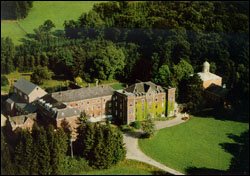
Monastère de Chevetogne


Monastère de Chevetogne
the old website

The community was founded by Dom Lambert Beauduin, one of the pioneers of the Liturgical Movement. Dom Beauduin did spend some of his formation at Maredsous, and was influenced by Dom Columba Marmion. According to the history given by the websites:

The monastery of Chevetogne was founded in 1925 by Dom Lambert Beauduin (1873-1960). This monk of the Benedictine abbey of Mont César (Louvain), previously was deeply involved with the liturgical movement in Belgium. When he came to know the Christian East he realized the extend to which the Churches are divided and started to work for a foundation of a monastery
devoted to Christian unity.

The pontifical letter "Equidem Verba" of Pius XIth to the abbot primate of the Benedictine Order drew attention to the importance of Christian unity and presented the opportunity to accomplish this project. In December 1925, Dom Lambert Beauduin was able to settle down in his foundation, together with a few fellow monks, at Amay-sur-Meuse (diocese of Liege). From there the community moved to Chevetogne (diocese of Namur in the Ardennes) in 1939. On December 11th, 1990 the Priory became an Abbey.

Read more about the history. Dom Beauduin's place in the Liturgical Movement should not be neglected, but I will devote a separate post to him some time. He placed great emphasis on the cultivation of a liturgical spirituality. Chevetogne was one of forerunners of 20th ce Catholic ecumenicism, aimed specifically at reconciling Catholics and Orthodox, with two different groups of monks worshipping in the Roman and Byzantine rites.

I remember seeing a picture of the interior of the Byzantine church, but the relevant part of the new website is under construction. (Moreover, I found no such pic on the old website--overactive imagination?) I thought the Byzantine church looked better than the Latin church, especially since the Latin church was built recently, and appears to be have been built with the spirit of the post-conciliar liturgical reform. Then again, I usually have a strong preference for Byzantine and Eastern architecture; Latin styles beyond the Romanesque are not as appealing, especially when it comes to the placement and design of the altar. (Especially altars with large reredos.) Here is the old page for the Byzantine church.
Some photos of the community's past from the new website; Dom Beauduin:

The community of Amay and Msgr. Roncalli (the future Pope John XXIII--at the left, front row), 14 September 1930:

Amay-sur-Meuse, the Byzantine chapel:

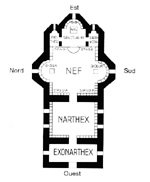
From the old website, plan for the Byzantine church:

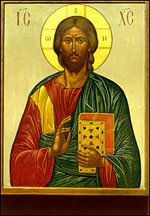
Icons from the iconostasis:


According to their old website:


The icons of the Iconostasis in Chevetogne were painted by the Russian painter George Morozov (1900-1993). The two major icons on either side of the central doors are of Christ, and of the Blessed Virgin Mary, Mother of God, worshipping her son.
Icon of St. Benedict:


Dom Beauduin's book, Liturgy the Life of the Church, is published by St. Michael's Abbey and distributed in the U.S. through St. Augustine's Press.

Address by Patriarch Bartholomew at Chevetogne, 15 November 1994

The monastery's ecumenical journal, Irénikon.

They sell CDs of their chant and other items online. I do not know what period their chant is from, but it sounds to be of a more recent origin--my guess is that it is the same as the contemporary chant of the Russian Orthodox Church. (Perhaps Slavic chant developed under Western influences?) More investigation would be warranted.

Valaam Monastery

"Hefsiman's skete. The church in the name of the Assumption of Mother of God, 1993" (source)

Revived in 1989 by six monks, the monastery is currently being restored. Apparently some of their chant can be downloaded now! I wonder what their attitude is towards Rome.

Resources on Znamenny Chant: Russian Znamenny Chant, Znamenny chant / Russian Orthodox Hymnody / Veliky Novgorod, http://www.liturgica.com/html/litEOLitMusDev4.jsp?hostname=null, http://www.rus-sky.org/deisus/eng/p.htm

Another website for Valaam.

Sunday, April 23, 2006

Orthodox Pascha! Christos anesti!

Source: OCA

Christos anesti! Alleluia!

While Catholics celebrated Pascha last weekend, the Orthodox are celebrating it this weekend. The Catholic and Orthodox Churches celebrate Pascha on different dates because of their use of the Gregorian and Julian calendars, respectively.

For Catholics, as I noted earlier, this is the second Sunday of Easter, or Divine Mercy Sunday, instituted as a feast for the Universal Church by Pope John Paul II in 2000.

While there is some dispute about the origin of the word "Easter" in English, in Latin countries and most Orthodox countries, some variation of Pascha is used. Pascha means "Passover," and ties the Passion, Death, and Resurrection of our Lord Jesus Christ to the Jewish Passover, through which the Jews were liberated from bondage in Egypt. Christ is the Passover Lamb, who saves men from the bondage of sin and the dominion of death and the devil. (Hence the question by Mary, the Blessed Mother of God in The Passion of the Christ, "Why is this night different from all others?")

Proclamation by Bartholomew, Patriarch of Constantinople.

Message of Archbishop Demetrios of the Greek Orthodox Archdiocese of America (includes both text and audio files).

The greetings of Archbishop Herman of the OCA.

Holy Week photos from St. Vladimir's Seminary.

Maybe I'll post some other pics later.

Muriel Spark, RIP


(Jerry Bauer, AP)

Muriel Spark passed away on Thursday, 13 April 2006. I have not had a chance to read any of her novels; I did give a copy of her last novel to my second sister, but I do not know if she has read it yet. I hope I will get a chance to read something by her soon, but I am afraid that the list of books I should read continues to grow and the time I have diminishes, and this hourglass cannot be turned over.


Roger Kimball's post at Armavirumque.

From First Things:
April 18, 2006
Joseph Bottum writes:
Muriel Spark is gone, dying on Thursday at age eighty-eight, the last representative of Great Britain’s high literary converts before Vatican II.

There’s a revealing moment toward the end of her 1992 memoir of her early career, Curriculum Vitae. Times were hard for her in 1953. She was thirty-five and still quite poor—so poor that when, the next year, she began to have the hallucinations that prompted her first novel, The Comforters, her doctor assumed that the cause was simple lack of food. She herself blames the cheap diet pills she was taking to make herself “feel less hungry” while she lived hand to month in London as a minor poet, book reviewer, and freelance literary critic, editing the Brontë family letters, working on a life of Mary Shelly, and preparing a study of the poet laureate John Masefield.

Things eased a little when Graham Greene, who strongly believed in her talent, began giving Spark £20 and a few bottles of wine a month to keep her going. And one day in 1953, coming home from an authors’ lunch, she bumped into the literary entrepreneur Fr. Philip Caraman, the Farm Street Jesuit and editor of the British Catholic journal The Month, whom she so amused with her stories as they walked along that her sent her a check the next day for £15 “for having made him laugh.”

As though prompted by this anecdote about Fr. Caraman, Spark devotes the next paragraph—and only the next paragraph—of Curriculum Vitae to her conversion, finally mentioning, 202 pages into a 213 page book, that this Scottish-born daughter of a Jewish engineer and an English mother had joined the Catholic Church. “The simple explanation,” she writes, “is that I felt the Roman Catholic faith corresponded to what I had always felt and known and believed.”

What’s revealing about this is, of course, its unrevealingness. Language and structure are everything in the fiction Muriel Spark spent the rest of her life composing. You can see it in the perfect construction of her most famous work, The Prime of Miss Jean Brodie, published in 1962, with its tale of the effect of a self-dramatizing teacher on a Scottish girls’ school. You can see it in the careful unfolding of her best book, the 1959 Memento Mori, in which a voice rings on the telephone to whisper over and over again to a collection of London’s elderly men and women, “Remember that you must die.” You can see it in the somewhat cold precision of The Abbess of Crewe, her 1973 parody of the Nixon White House as a nunnery. You can see it even in those slim, elegant titles she chose for her slim, elegant novels: The Girls of Slender Means in 1963,
Loitering with Intent in 1981, A Far Cry from Kensington in 1988.

In all her work—20 novels and more than 50 stories—there are no personal confessions of the author herself and few insights into her characters’ psychology. Characters always first appear on Spark’s stage as members of a particular class of humankind. Her 1961 The Bachelors begins by denying any individuality among the unmarried men whose uniform existences are shaped by cooking, cleaning, and living for themselves. “Long ago in 1945 all the nice people in England were poor, allowing for exceptions,” The Girls of Slender Means opens. Of Miss Jean Brodie, the author cruelly remarks that there were “legions of her kind during the nineteen-thirties.”

And yet, these characters are not merely types—much less symbols whose humanity has disappeared into their literary function in Spark’s fiction. Sometimes they manage to grow into unique personalities by the novel’s end, as Matthew emerges from his crowd at the end of The Bachelors or William by the conclusion of the 1990 Symposium. But that is usually reserved for the few characters who accept the necessity for self-sacrifice, or stumble across a chance for self-denying love, or find a small measure of selfless grace. When, in opening pages of The Prime of Miss Jean Brodie, a student claims that Leonardo da Vinci is the greatest Italian painter and Jean Brodie answers, “That is incorrect. The answer is Giotto, he is my favorite”—or when, later in the book, she responds to the news that her student Sandy has become a nun by saying, “Do you think she has done this to annoy me?”—Spark has launched as brutal an attack as anyone has ever written against self-absorption, self-importance, and the use of the self as the measure for truth in the world.

Real individuality, in other words, is reserved in Muriel Spark’s fiction for those who manage to forget their individuality. Each small success human beings have at disappearing from hemselves is unique, and each small revelation that a human life can lose itself is a story never told before. But our supposedly unique failures are in fact merely universal, and our supposedly individual lives are actually indistinguishable participations in the common arc of fallen man.

There is considerable irony in a novelist taking such a view of things, for what the novel as an artform typically undertakes—illustrating the universal human condition by drawing a picture of a particular human being—is exactly the opposite of what Spark attempts. This is perhaps the irony that made all the Catholic fiction of the 1940s and 1950s—the Graham Greene books, for instance, of the era in which Spark was formed as a writer and a convert—so peculiar. But in Spark’s case, the irony of fiction’s inverted purpose produced a set of simultaneously witty, elegant, satirical, and macabre novels, each extremely short, each dominated by the calm detachment of a very distant third-person narrator, and each ruled by a sternly deliberate structure designed to conceal the key incident until the novel’s end.

But then, language and structure are everything for Spark because they have to be. In the world long after Vatican II, we can forget both the enormous wave of famous converts in the 1940s and 1950s and the extent to which Catholicism appealed to those converts precisely because what it offered was a structure and a language with which to express what they, in Spark’s words, “had always felt and known and believed” about the world. Personal faith in the truth of that structure and language was somehow simultaneously too obvious for Muriel Spark to bother putting in a novel and too hidden to be reached by literature. “When I am asked about my conversion, why I became a Catholic,” she once explained, “I can only say that answer is both too easy and too difficult.”


Divine Mercy Sunday


(source)

From the diary of Saint Maria Faustina Kowalska:
I am offering people a vessel with which they are to keep coming for graces to the fountain of mercy. That vessel is this image with the signature: "Jesus, I trust in You." (Diary 327)

The two rays denote Blood and Water. the pale ray stands for the Water which makes souls righteous. The red ray stands for the Blood which is the life of souls. These two rays issued forth from the very depths of My tender mercy when My agonized heart was opened by a lance on the Cross. These rays shield souls from the wrath of My Father. Happy is the one who dwell in their shelter, for the just hand of God shall not lay hold of him. (Diary 299)
Taken from EWTN's explanation of the image.

The EWTN page on the feast. More.

From the homily of Pope John Paul II on Divine Mercy Sunday, 22 April 2001.

2. "Give thanks to the Lord, for he is good; for his mercy endures for
ever!" (Ps 117: 1).
Let us make our own the Psalmist's exclamation which we sang in the Responsorial Psalm: the Lord's mercy endures for ever! In order to understand thoroughly the truth of these words, let us be led by the liturgy to the heart of the event of salvation, which unites Christ's Death and Resurrection with our lives and with the world's history. This miracle of mercy has radically changed humanity's destiny. It is a miracle in which is unfolded the fullness of the love of the Father who, for our redemption, does not even draw back before the sacrifice of his Only-begotten Son.

In the humiliated and suffering Christ, believers and non-believers can admire a surprising solidarity, which binds him to our human condition beyond all imaginable measure. The Cross, even after the Resurrection of the Son of God, "speaks and never ceases to speak of God the Father, who is absolutely faithful to his eternal love for man.... Believing in this love means believing in mercy (Dives in misericordia, n. 7). Let us thank the Lord for his love, which is stronger than death and sin. It is revealed and put into practice as mercy in our daily lives, and prompts every person in turn to have "mercy" towards the Crucified One. Is not loving God and loving one's neighbour and even one's "enemies", after Jesus' example, the programme of life of every baptized person and of the whole Church?

Hey, Buddy

Hi Miss Kim, maybe you can show this post to your sister so she knows what I was talking about...


(source)

(From www.toytokyo.com)


(From www.venusvintage.com.)

It's Buddy Lee, icon for Lee Jeans. (Personally I think the doll in the commercials is a bit creepy, like something from a horror movie... too many Twilight Zone episodes and Chucky movies I suppose. The dolls here aren't so bad.)

Someone's classroom handout explaining this advertising creation.

"Let me fight or I quit, says Prince Harry"

From the Manchester Evening News:

Saturday, 22nd April 2006
Let me fight or I quit, says Prince Harry

PRINCE Harry has threatened to quit the Army unless he is sent to the front line, it was reported today.


The Prince and his older brother, Prince William, have both previously made it clear they are determined to see active service with their units.

Harry, 21, was commissioned earlier this month as a Second Lieutenant in the Household Cavalry's Blues and Royals, the Army's oldest and most senior regiment.

The Blues and Royals have been deployed in almost every major Army operation of the past two decades, including the Falklands, both Gulf wars, Bosnia and Kosovo.

The Mail on Sunday reported that Harry told senior officers at Sandhurst before passing out on April 12: "If I am not allowed to join my unit in a war zone, I will hand in my uniform."

This poses serious problems for the advisers tasked with protecting William and Harry, the second and third in line to the throne, and those fighting alongside them.

A spokeswoman for Clarence House said: "Prince Harry is very clear that he is joining the Army, and the Household Cavalry in particular, to serve his country as an operational soldier."

Circumstances

But she added: "On occasion there may be some circumstances in which his presence could attract additional attention, which could lead to additional risk to those he commands or himself.

"In these instances it is a judgment call which would principally be made by his commanding officer."

Harry said in an interview to mark his 21st birthday last September: "The last thing I said was there's no way I'm going to put myself through Sandhurst and then sit on my arse back home while my boys are out fighting for their country.

"That may sound very patriotic, but it's true."

Earlier this month a senior Army figure said it was "eminently possible" Harry could be in a danger zone within 12 months.

Major General Sebastian Roberts remarked on the dangers involved: "The risks for all soldiers are the same. We all sign a blank cheque when we join the Army."