At the heart of Benedict XVI‘s teaching: to present the salvific truth of Jesus Christ to the mindset of our times
by Camillo Ruini
1. Some premises
One characteristic of the magisterium of Benedict XVI is his great commitment to the question of the truth of the Christian faith, in the current historical situation and in relation to the forms of rationality prevalent today.
In the language of theology, we could say that the pope is confronting, in his style and in an innovative manner, the central question of apologetics, or – in today’s preferred phrase – of fundamental theology.
The aim of this address is, evidently, not that of exploring these problems, and not even that of making a complete presentation of these, but only of entering into them, offering a few main lines of orientation and keys of interpretation, in the light of both the magisterium of Benedict XVI – in particular, the September 12, 2006 address at the University of Regensburg and the October 19 address at the Verona Conference, in addition to the encyclical “Deus Caritas Est” – and his previous work as a theologian.
Among his many important books, I refer primarily to the “Introduction to Christianity,” printed in Italy by Queriniana (referred to hereafter as “Introduction”), and to the two collections of essays “Faith, Truth, and Tolerance: Christianity and the Religions of the World,” published by Cantagalli in 2003 (referred to hereafter as “Faith”), and “Benedict’s Europe in the Crisis of Cultures,” also published by Cantagalli, in 2005 (referred to hereafter as “Europe”), because these three books are the most pertinent to our topic.
In fact, although Benedict XVI is very careful to distinguish between his magisterium as pontiff and his work as a theologian, as he himself asserts in the early publication of the preface to his book “Jesus of Nazareth,” due to be released next spring, there is still a profound correspondence and substantial unity between his magisterium and his theology. Attentive examination therefore permits identifying, through both the one and the other, those very fundamental outlines that I will seek to present today.
Before embarking upon this topic, it may be helpful to say a few words on the theological outlook and manner of proceeding proper to Joseph Ratzinger/Benedict XVI.
Having taught fundamental theology at first and later dogmatic theology, he has an approach to issues in which theoretical and philosophical exploration is placed within a perspective that is above all historical and concrete.
Furthermore, his formation is essentially biblical, patristic, and liturgical, and he confronts current problems in the light of this. His attitude toward these problems certainly denotes acute critical capacities, but it is marked above all by the desire to be constructive, by openness, and by friendliness. His autographical book, “My Life,” is of particular interest for gaining an idea of how he himself views his formation and his work as a theologian.
Coming now to our topic, I think it’s right to take as our point of departure the conviction, expressed by cardinal Ratzinger, that “at the end of the second millennium, Christianity finds itself, precisely in the place of its original diffusion, Europe, in a profound crisis, based upon the crisis over its claim to truth” (“Faith,” p. 170).
This crisis has a twofold dimension: mistrust toward man’s ability to grasp the truth about God and about divine things, and the doubts that the modern natural and historical sciences have raised about the tenets and origins of Christianity.
2. The original nature of Christianity: Being, Lógos, Agape
The gravity and the radical nature of this crisis can be understood in the light of what is the nature proper to Christianity.
It is certainly true that this is not in the first place “an ethical choice or a lofty idea, but the encounter with an event, a person, which gives life a new horizon and a decisive direction.” (“Deus Caritas Est,” no. 1), but it is likewise true that the choice of lógos rather than of myth has characterized Christianity itself from the beginning.
J. Ratzinger has argued extensively in favor of this assertion, above all on the historical level, beginning with his inaugural academic address in 1959 at the University of Bonn, entitled “The God of faith and the God of the philosophers,” and up until his very recent address at the University of Regensburg.
In concrete terms, well before the birth of Christ the criticism of religious myths advanced by Greek philosophy – criticism that can be described as the philosophical Enlightenment of the ancient world – found a counterpart in the criticism of the false Gods made by the prophets of Israel (and in particular by Deutero–Isaiah) in the name of Yahwistic monotheism, and then the encounter between Judaic faith and Greek philosophy gradually developed and found expression even within the Greek tradition of the Old Testament of the “Septuagint,” which “is more than a mere tradition” and represents “an important concrete step in the history of revelation” (Regensburg address).
Thus the affirmation “In the beginning was the Lógos,” which begins the prologue of the Gospel of John, constitutes “the final word on the biblical concept of God, and in this word all the often toilsome and tortuous threads of biblical faith find their culmination and synthesis” (ibid.).
The patristic world moved along the same line, as emerges from the audacious and incisive expression by Tertullian, “Christ asserted that he was the truth, not custom” (“Introduction,” p. 102) and by the clear choice of saint Augustine, who, referring to the three forms of religion identified by the pagan author Terentius Varro, resolutely places Christianity in the realm of “physical theology,” or of philosophical rationality, and not in that of the “mythical theology” of the poets, or of the “civil theology” of the states and the politicians.
Christianity thus described itself as a “true religion,” unlike the pagan religions, which had been stripped of their truth by pre-Christian rationality, and with respect to these it carried out a great work of “demythification.”
Judaism had already begun a process of this kind, but there remained the difficulty of the special bond between the one, universal creator God and the one Jewish people, a bond that was overcome by Christianity, in which the one God is presented as the savior, without discrimination, of all peoples.
In this sense, the encounter between the biblical message and Greek philosophical thought was not a mere accident, but rather the historical embodiment of the intrinsic relationship between revelation and rationality. And this is precisely another of the fundamental reasons for Christianity’s power of penetration into the Greco-Roman world (cf. “Faith,” pp. 173-180).
But with this we have, so to speak, only half of the discussion: the other half is constituted by the radical novelty and the profound otherness of biblical revelation with respect to Greek rationality, and this concerns above all the central theme of religion, which is clearly that of God.
J. Ratzinger takes great pains in demonstrating, through the examination of the biblical texts, from the account of the burning bush in Exodus chapter 3 all the way to the formula “I am” that Jesus applies to himself in the Gospel of John, that the one God of the Old and New Testaments is the Being, self-existing from eternity, sought after by the philosophers (cf. “Introduction,” pp. 79-97).
But he emphasizes with just as much force that this God radically surpasses what the philosophers had thought about Him.
In the first place, in fact, God is clearly distinct from nature, from the world that He created: only in this way do “physics” and “metaphysics” arrive at a clear distinction from one another.
And above all, this God is not a reality inaccessible to us that we cannot encounter or turn to in prayer, as the philosophers maintained.
On the contrary, the biblical God loves man, and for this reason he enters into our history, gives life to an authentic love story with Israel, his people, and then, in Jesus Christ, not only expands this story of love and salvation to include all of humanity, but he carries this story to the extreme, to the point of “turning against himself” in the cross of his own Son, in order to raise man up again and save him, and to call man to that union of love with Him that culminates in the Eucharist (cf. “Deus Caritas Est,” nos. 9-15, where Benedict XVI sums up with great force what he has explored ever since the beginning of his work as a theologian).
In this way, the God who is Being and the Word is also and identically Agape, the original Love and the measure of authentic love, who precisely out of love created the universe and man.
More precisely, this love is entirely disinterested, free, and gratuitous. God, in fact, freely creates the universe from nothing (only with the freedom of the act of creation does the distinction between God and the world become full and definitive) and freely, out of his measureless mercy, saves sinful humanity.
Thus biblical faith reconciles the two dimensions of religion that were separated from each other at first; that is, the eternal God of whom the philosophers spoke, and the need for salvation that man carries within himself and that the pagan religions tried to satisfy in some way.
The God of the Christian faith is thus indeed absolute Being, the God of metaphysics, but he is also, and just as much, the God of history, the God who enters into history and into the most intimate relationship with us. This, according to J. Raztinger, is the only adequate response to the question of the God of faith and the God of the philosophers (cf. “Faith,” pp. 180-182).
All of this has inevitable and decisive consequences with regard to man and the way of understanding life, meaning ethics. As Saint Paul explicitly said, “when the pagans who do not have the law act according to the law by nature [...] they show that the demands of the law are written in their hearts” (Romans 2:14-15). In the same spirit, Paul asks believers in Christ: “Whatever is true, whatever is honorable, whatever is just, whatever is pure, whatever is lovely, whatever is gracious, if there is any excellence and if there is anything worthy of praise, think about these things” (Philippians 4:8).
There is a clear reference here to the ethical interpretation of nature, which was cultivated in morality of the Stoics. This interpretation was then taken up by Christianity, but at the same time it was surpassed: when the encounter with the living God replaces a God who exists only in thought, the passage takes place from a theoretical ethics to a communitarian moral praxis that is lived out and put into action in the faith community, and concretely through the crystallization of all morality in the twofold commandment of love for God and for neighbor.
And just as God creates and gives himself in freedom, so also faith in Him cannot be anything but a free act, which no statutory authority can prohibit or impose: thus “fundamental to Christianity is the distinction between what belongs to Caesar and what belongs to God (cf. Matthew 22:21)” (“Deus Caritas Est,” 28).
This is, in its fullness, the reason for the missionary dynamism developed by Christianity in the Greco–Roman world. This was convincing because it reconnected within itself the bond between faith and reason, and the orientation of action toward “caritas,” loving care for the suffering, the poor, and the weak, apart from any distinction of social condition.
We can therefore conclude that the power that made a worldwide religion out of Christianity and made convincing its claim to being the “true religion” consists of the synthesis that this has been able to achieve among reason, faith, and life (cf. “Faith,” pp. 182-184, and also the address to the Roman Curia on December 22, 2005).
3. The separation of reason and freedom from Christianity
This synthesis and this claim have endured for many centuries, despite many historical vicissitudes, and were at the basis of the later phases of Christianity’s missionary expansion (cf. the Verona address).
At this point, J. Ratzinger forcefully poses this question: “Why is this synthesis no longer convincing today? Why are reason and Christianity, on the contrary, considered today as contradictory and even as mutually exclusive? What has changed about the former, and what has changed about the latter?” (“Faith,” p. 184).
So let us examine, in the first place, the changes that have taken place in “reason.”
In a very summary manner, we will say only that the relational unity between rationality and faith, to which saint Thomas Aquinas gave systematic form, was gradually and increasingly demolished through the major phases of modern thought, from Descartes to Vico to Kant, while the new synthesis between reason and faith attempted by Hegel does not really restore to faith its rational dignity, but tends instead to convert it completely into reason, destroying it as faith.
The next phase, which has emblematic figures like Marx and Comte, overturns the position of Hegel, who reduced matter to spirit, in reducing spirit to matter instead – with the exclusion of the very possibility of a transcendent God – and by again diminishing, in the line of principle, a “metaphysics” as distinct from “physics.”
Contextually there took place a transformation of the concept of truth, which ceased to be the understanding of reality existing independently from us, to become the understanding of what we ourselves have done in history, and then of what we can accomplish through the empirical sciences and technology (a “functional” concept of reason and life).
Thus the primacy of (metaphysical) philosophy was replaced by the primacy of history, later replaced by that of science and technology. This latter primacy is today fairly clearly visible in Western culture, and, to the extent to which it claims that only scientific understanding is really true and rational, must be described as “scientism” (cf. “Introduction,” pp. 27-37; “Fede,” pp. 186-187).
In this context, the theory of the evolution of species proposed by Darwin has ended up taking on – among many scientists and philosophers, and to a great extent within modern culture – the role of a kind of vision of the world or of “first philosophy,” which on the one hand would be rigorously “scientific” and on the other would constitute, at least potentially, a universal explanation or theory of all reality, based upon natural selection or casual mutations, beyond which other questions about the origin and nature of things are not supposed to be necessary any longer, or even licit.
The assertion that “in the beginning was the Lógos” is thus overturned, with the placing at the beginning of everything matter-energy, chance, and necessity, and thus something that would not itself be rational (cf. “Faith,” pp. 187-190).
Even among those who do not believe in Christ, such positions are certainly not shared by all, often being perceived as an insufferable dogmatism that claims to be “scientific” but blurs the intrinsic limits of scientific knowledge.
But J. Ratzinger observes that, because of that great change by which, from Kant on, human reason is no longer thought to be capable of understanding reality in itself, and above all transcendent reality, the alternative to scientism most culturally accepted today seems to be, not the affirmation of God the Word, but rather the idea that “latet omne verum,” all reality is hidden, or that the true reality of God remains entirely inaccessible and incomprehensible to us, while the various religions are thought to present only images of God relative to different cultural contexts, and thus all are equally “true” and “untrue.”
In this way, the Western world is again inhabited by that approach to the divine that is proper to the great Eastern religions or visions of the world, like Hinduism and Buddhism (although the two are very different), and that Neoplatonism tried to propose in its own way as an alternative to Christianity, during the first centuries of the Christian era (cf. “Faith,” pp. 184-186).
It is not difficult to realize how such ideas are in practice spread among our people. A God, or better a “divinity,” thus understood tends to identify itself with the most profound and mysterious dimension of the universe, present at the foundation of all reality: it is therefore difficult to attribute a personal character to this divinity, and prayer itself, rather than being a dialogue between God and man, takes the form of spiritual stages of self-purification, which culminate in the reabsorption and dissolution of our ego in the primordial infinity.
And so, in the end, there does not seem to be such a radical difference between these forms of religiosity and the agnosticism, or even atheism, that goes together with the scientist approach (cf. “Faith,” pp. 184-186, and also pp. 23-43; 125-134). As the Christian faith in a God who is Being, Word, and Agape has embodied itself in a precise form of life and ethics, something analogous has taken place and is taking place with the forms of rationality that tend to take the place of Christianity, and which in their turn express themselves in concrete ethical guidelines.
If “all truth is hidden,” or even if only that is rationally valid which can be experienced and measured, at the same time on the practical level of life and behavior the fundamental value becomes that of “tolerance,” in the sense that no one should or can maintain that his own convictions and choices are preferable and are better with respect to those of others. This is the current and apparently full-grown figure of Enlightenment philosophy, which defines itself concretely through the rights to freedom, with the individual freedoms as the supreme and decisive criterion by which all others are measured, and with the consequent exclusion of any possible discrimination that might harm anyone.
There is therefore the diminishing, especially at the social and public level, of moral conscience as something objectively valid, because it refers to what is good or bad in itself. But since some morality is necessary in any case in order to live, this is in some way recovered by making reference to the calculation of the useful or harmful consequences of one’s behaviors, and keeping always as the guiding criterion the principle of not limiting another’s freedom (cf. “Europe,” pp. 35-37).
On the level of content, to the conception of the world that absolutizes the evolutionistic model there corresponds an ethics that places at the center natural selection, and therefore the struggle for survival and the triumph of the strongest, while in the perspective of those forms of religiosity that refer to an incomprehensible and tendentiously impersonal divinity, the human person himself, with his inalienable rights, freedom, and responsibility, loses his own consistency and becomes something relative and transitory, tending to dissolve into an indistinguishable totality.
So also the irreducible difference between good and evil becomes relativized, and becomes merely the opposition of two aspects, both necessary and complementary, of the single original whole.* * *
Let us now look more quickly at the changes in Christianity itself that have contributed to the divorce that has taken place between it and reason in our age.
In the discourse at Regensburg, Benedict XVI put particular emphasis on the theme of the “de-Hellenization” of Christianity, which first emerged in the sixteenth century with the Protestant Reformation: the intention was that of returning to pure biblical faith, liberating it from the influences of Greek philosophy, or of metaphysics. Such an intention can also be found in Kant, although in a rather different form.
The second wave of the process of de-Hellenization emerged from liberal Protestant theology in the nineteenth and twentieth centuries, but it also held strong interest for Catholic theology. In the thought of its most radical representatives, like Harnack, this was a matter of returning to Jesus strictly as man, taken as the Jesus of history, and to his simple moral message, thought to constitute the apex of the religious development of humanity, liberating it from its later philosophical and theological developments, beginning with the very divinity of Christ. At the roots of this is the modern self-limitation of reason to that which is verifiable.
The third wave of de-Hellenization now spreading concerns the problem of the encounter between Christianity and the many cultures of the world: the synthesis with Hellenism made by the ancient Church is supposed to be an early inculturation that should be shaken off now, to return to the simple message of the New Testament in order to inculturate this anew within the various socio-cultural contexts. The result is inevitably that of relativizing the bond between faith and reason established since Christianity’s beginning, maintaining that this is merely circumstantial, and therefore disposable.
Another and even more relevant change has been the one by which, with the passing of the centuries, Christianity unfortunately became to a great extent a human tradition and a state religion, contrary to its nature (cf. the words of Tertullian: “Christ asserted that he was the truth, not custom”). Although the search for rationality and freedom has always been present in Christianity, the voice of reason has been too domesticated.
It is to the credit of the Enlightenment that it re-proposed, often in opposition to the Church, these original values of Christianity, and that it gave voice again to reason and freedom. The historical significance of Vatican Council II lies in its having brought forward again, especially in the constitution on the Church in the modern world and in the declaration on religious freedom, this profound correspondence between Christianity and Enlightenment philosophy, aiming at a real reconciliation between the Church and modernity, which is the great patrimony to be safeguarded by both sides (“Europe,” pp. 57–59; cf. the discourse to the Roman Curia on December 22, 2005).
4. For a new accord of reason and freedom with Christianity
And so we arrive at the true objective of all the preceding reflections: to seek out pathways toward a new accord of reason and liberty with Christianity, or, as the title of this address states, “to propose the salvific truth of Jesus Christ to the mindset of our times.”
The reply that J. Ratzinger/Benedict XVI gives to this question is, above all, that of “making more room for rationality.”
Limiting reason to what can be experienced and examined is, in fact, useful, precise, and necessary in the specific field of the natural sciences, and constitutes the key of their unceasing development. But if it is universalized and held to be absolute and self-sufficient, such a limitation becomes untenable, inhuman, and, in the end, contradictory.
By virtue of this, in fact, man would no longer be able to ponder rationally on the essential realities of his life, on his origin and his end, on moral duty, on life and death, but would have to leave these decisive problems to irrational emotion.
But this mutilates reason, and man becomes divided within himself and almost disintegrated, provoking pathology in both religion – which, detached from rationality, easily degenerates into superstition, fanaticism, and fundamentalism – and science, which easily turns against man when it is detached from ethics, and in concrete terms from the recognition of the human person as a being that can never be reduced to an instrument (cf. “Fede,” p. 99, pp. 164–166).
The very claim that reality is only that which can be experienced and measured leads inevitably to, among other things, the reduction of the human subject to a product of nature, which as such is not free and is susceptible to being treated like any other animal. This leads to a complete overturning of modern culture’s point of departure, which consists in the affirmation of man and his freedom.
Analogously, on the practical level, when indiscriminate individual freedom, for which in the ultimate analysis everything is relative to the subject, is erected as the supreme ethical criterion, this ends up as a new dogmatism, because it excludes all other positions, which can be licit only as long as they remain subordinate to, and do not contradict, this relativistic criterion.
In this way, there is a systematic censuring of Christianity’s moral norms, and excluded from the outset is any attempt to demonstrate that these norms, or any others, have objective validity because they are founded upon the very reality of man. The public expression of an authentic moral judgment thus becomes inadmissible.
This has led to the development in the West of a form of culture that deliberately severs its own historical roots, and constitutes the most radical contradiction possible, not only of Christianity, but also of the religious and moral traditions of humanity (cf. “Europe,” pp. 34–35, and the Regensburg address).
To demonstrate how the limitation of reason to what can be experienced and measured is not only full of negative consequences, but is also self-contradictory, J. Ratzinger concentrates his attention on the structure and the presuppositions of scientific knowledge, and in particular on the position that would like to make of evolutionary theory the universal explanation, at least potentially, of all reality.
A fundamental characteristic of scientific understanding is, in fact, the synergy between mathematics and experience, or between mathematical hypotheses and their experimental verification: this synergy is the key to the enormous and constantly growing results obtained through technology, in working with nature and placing its immense energies at our service.
But mathematics as such is a creation of our intelligence, the pure and “abstract” result of our reasoning. The unavoidable correspondence between mathematics and the real structures of the universe – without which scientific forecasts and technology would not work – thus poses a great question: it implies that the universe itself is structured in a rational manner, such that there exists a profound correspondence between our subjective reasoning and the reason embodied in nature.
It thus becomes inevitable to ask oneself under what conditions such a correspondence is possible, and concretely, if there must not exist a primordial intelligence that is the common source of nature and of our own rationality.
Thus, precisely in reflecting upon the development of the sciences, we are brought back to the creating Lógos, and there is a reversal of the tendency to accord primacy to the irrational, to chance and necessity, and the tendency to reduce to these even our own intelligence and freedom (cf. the addresses in Verona and Regensburg, in addition to “Faith,” pp. 188-192).
Naturally, such a question and such reflection, although they begin from an examination of the structure and presuppositions of scientific knowledge, pass beyond this form of understanding and arrive at the level of philosophical inquiry: this does not conflict, therefore, with the theory of evolution, as long as it remains within the realm of science. And furthermore, even on the philosophical level the creating Lógos is not the object of an apodictic demonstration, but remains “the best hypothesis,” an hypothesis that demands that man and his reasoning “renounce a position of domination, and take the risk of a stance of humble listening.”
In concrete terms, especially in the current cultural climate, man by his own strength is unable to make entirely his own this “best hypothesis”: he remains, in fact, the prisoner of a “strange shadow” and of the urge to live according to his own interests, leaving aside God and ethics. Only revelation, the initiative of God who, in Christ, manifests himself to man and calls him to approach Him, makes us capable of emerging from this shadow (cf. “Europe,” pp. 115-124; 59-60, and the Regensburg address).
The very perception of this sort of “strange shadow” makes it such that the attitude most widespread among non-believers today is not atheism – seen as something that exceeds the limits of our reason no less than faith in God does – but agnosticism, which suspends judgment about God in that He is not accessible to reason.
The response that J. Ratzinger gives to this problem brings us even closer to the reality of life: in his judgment, in fact, agnosticism cannot be lived out in practice; it is not a program for human life that can be carried out.
The reason for this is that the question of God is not merely theoretical, but also eminently practical; it has consequences in all areas of life.
In practice, I am in fact forced to choose between the two alternatives identified by Pascal: either to live as if God did not exist, or to live as if God existed and were the decisive reality in my existence. This is because God, if He exists, cannot be an accessory to be removed or added without any effect, but is rather the origin, the meaning, and the end of the universe, and of man within it.
If I act according to the first alternative, I adopt in point of fact an atheistic position, and not a merely agnostic one. But if I decide in favor of the second alternative, I adopt the position of a believer: the question of God is, therefore, unavoidable (cf. “Europe,” pp. 103-114).
It is interesting to note the profound analogy that exists, under this aspect, between the question of man and the question of God: both, because of their great importance, must be faced with all the rigor and effort of our intelligence, but both are always eminently practical questions as well, inevitably connected with the concrete decisions in our lives.* * *
At this point, we are able to understand better Benedict XVI’s theological and pastoral approach.
He devotes great attention to the relationship between faith and reason, and to the assertion of the truth of Christianity.
But he does this in a way that is not at all rationalistic. On the contrary, he views as a failure the Neo–Scholastic attempt to demonstrate the truths of the premises of faith (the “praeambula fidei”) through a form of reasoning rigorously separated from the faith itself, and he maintains that similar attempts are also destined to fail, as failure has met the contrary attempt by Karl Barth to present the faith as a pure paradox, which can subsist only in total independence from reason (cf. “Faith,” pp. 141-142).
So in concrete terms, the way that leads to God is Jesus Christ, not only because it is only in Him that we can know the face of God, his attitude toward us, and the mystery of his intimate life itself, of the one and absolute God who exists in three Persons totally “interrelated” – all of the implications of this mystery for our lives and our understanding of God, man, and the world have yet to be elaborated – but also because it is only in the cross of the Son, in which God’s merciful and steadfast love for us is displayed in its most radical form, that a mysterious but convincing response can be found for the problem of evil and suffering, which has always been – although it has new power in our humanistic age – the source of the most serious doubts about the existence of God. For this reason prayer, the adoration that opens us to the gift of the Spirit and frees our hearts and minds, is an essential dimension not only of the Christian life, but also of the believer’s understanding and the theologian’s work (cf. the Verona address; “Introduction,” pp. 135-146; and the 1959 inaugural address at the University of Bonn).
It is not out of mere personal taste, therefore, that Benedict XVI is using “all his free moments” to carry forward his book “Jesus of Nazareth,” the first part of which will be published soon, and portions of the preface and introduction of which have already been released.
The separation between the “Christ of faith” and the real “historical Jesus,” which exegesis based upon the historical-critical method seems to have deepened more and more, constitutes a “dramatic” situation for the faith, because “it brings uncertainty to its authentic point of reference.”
For this reason, J. Ratzinger/Benedict XVI has dedicated himself to demonstrating that the Jesus of the Gospels and of the Church’s faith is, in reality, the true “historical Jesus,” and he does this by employing the historical-critical method. He willingly acknowledges the many positive results of this, but he also goes beyond it, taking a broader perspective that permits a properly theological interpretation of Scripture, and which thus requires faith without dispelling the need for historical seriousness (cf. the published sections of the preface).
This is a matter, for historical criticism as for the empirical sciences, of “making more room for rationality,” and not permitting these to close off within themselves and present themselves as self-sufficient (cf. “Faith,” pp. 136-142, 194-203; “Introduction,” pp. 149-180).
This type of approach to Jesus Christ clearly refers back to the role of the Church and of the apostolic tradition in the transmission of revelation.
In this regard, J. Ratzinger not only upholds the Church’s origin from Jesus himself and its intimate union with Him, centered upon the Last Supper and the Eucharist (cf. “Il nuovo popolo di Dio [The New People of God],” published in Italy by Queriniana, pp. 83-97), but he intrinsically connects revelation to the Church and tradition.
Revelation, in fact, is in the first place the act by which God manifests himself, and not the objectified (written) result of this act.
In consequence, a place in the very concept of revelation belongs to the subject that receives and comprehends it – concretely, the Church – since, if no one perceived the revelation nothing would be unveiled, no revelation would have taken place.
For this reason, revelation precedes Scripture and is reflected within it, but it is not simply identical with this; it is always something greater. There cannot exist, therefore, a pure “sola Scriptura”: Scripture itself is connected to the subject that receives and comprehends both the revelation and Scripture, meaning the Church. Together with this comes the essential meaning of tradition (cf. “My Life,” pp. 72; 88-93).
This is also the profound reason for the ecclesial character of the faith, or better, for the indissoluble interweaving of the “I” and the “we,” of the ecclesial and personal dimensions, in the act of belief that enters into relation with the “Thou” of God, who reveals himself to us in Jesus Christ (cf. “Introduction,” pp. 53-64), as well as the reason for the insufficiency of a purely historical-critical exegesis.
The proposed way of making Christianity convincing again remains, in any case, today as in the beginning and throughout its history, that “of the unity between truth and love in the conditions proper to our times.” This is the meaning of the “great ‘yes’ that God, in Jesus Christ, has spoken to man and his life, to human life, to our freedom and our intelligence” and which, through Christian witness, must also be made visible to the world (the Verona address).
In concrete terms, as by making more room for our reason and reopening reason to the great questions of truth and goodness it becomes possible “to connect theology, philosophy and science [both natural and historical] with each other in full respect for their individual methods and their reciprocal autonomy” (ibid.), so also, at the level of life and practice, in the current context it is particularly necessary to highlight the liberating power of Christianity, the bond that joins Christian faith and freedom, and at the same time to make it understood how freedom is intrinsically connected to love and truth.
Man as such, in fact, is certainly a being “of his own,” conscious and free, but he is just as essentially a being “from,” “with,” and “for,” necessarily open to and in relation with others: for this reason, his freedom is intrinsically connected to the criterion of reality – that is, to truth – and is a shared freedom, a freedom that is realized in the coexistence of many freedoms, which limit but also uphold each other, a freedom that thus builds itself up in charity (cf. “Faith,” pp. 260-264 and, more in general, 245-275).
Vatican Council II’s declaration on religious freedom represented, from this point of view, a decisive step forward, because it recognized and made its own an essential principle of the modern state, without thereby giving into relativism, but rediscovering and implementing instead Christianity’s deepest heritage (cf. the address to the Roman Curia on December 22, 2005).* * *
In the current situation in the West, in any case, Christian morality seems to be divided into two parts.
One of these concerns the great themes of peace, nonviolence, justice for all, concern for the world’s poor, and respect for creation: this part enjoys great public appreciation, even if it risks being polluted by a politically tinged moralism.
The other part concerns human life, the family, and marriage: this is rather less welcome at the public level; even more, it constitutes a very serious obstacle in the relationship between the Church and the people.
Our task, then, is above all that of presenting Christianity not as mere moralism, but as love that is given to us by God and that gives us the strength to “lose our lives,” and also to welcome and live the law of life that is the Decalogue.
In this way the two parts of Christian morality can be reconnected, reinforcing each other, and the ‘nos’ of the Church to weak and distorted forms of love can be understood as ‘yeses’ to authentic love, to the reality of man as he was created by God (cf. the address to the Swiss bishops on November 9, 2006; the Verona address; “Europe,” pp. 32-34). The message for the 2007 World Day of Peace moves precisely in this direction.
But the entire anthropological and ethical approach of Christianity, its way of understanding life, joy, pain, and death, finds its legitimacy and its consistency only in the historical, but above all eschatological, perspective of salvation that was opened up by the resurrection of Christ (cf. the Verona address). J. Ratzinger wrote the book “Eschatology, Death, and Eternal Life,” published in Italy by Cittadella in 1979, on the themes of death, resurrection, and immortality, which we cannot touch upon here.
Until now, our attention has been focused upon the relationship between the Christian faith and the secularized culture of the modern and “postmodern” West, the victim of a strange “self-hatred,” which goes hand in hand with its distancing itself from Christianity.
But J.Ratzinger/Benedict XVI absolutely does not lose sight of a much broader horizon, that of relations with the other cultures and religions of the world, to which he has dedicated a good part of his reflection, especially in recent years.
The key concept to which he refers is that of the encounter of cultures, or “interculturalism,” which is different from both inculturation, which seems to presuppose a culturally denuded faith that transplants itself in various cultures regardless of their religion, and from multiculturalism, as the simple coexistence – hopefully peaceful – of cultures different from each other.
Interculturalism “belongs to the original form of Christianity” and implies both a positive attitude toward other cultures and toward the religions that constitute the soul of these cultures, and the work of purification and the “courageous stance” that are indispensable for every culture if it really wants to encounter Christ, and that become for a culture “maturation and healing” (cf. “Faith,” pp. 66 and 89, the Verona address, and in particular the dialogue on January 19, 2004, between J. Ratzinger and J. Habermas, published in Italy by Morcelliana in 2005 in “Etica, religione e stato liberale [Ethics, Religion, and the Liberal State]”).
Thus it is precisely Christianity that can help the West to tie the knots of that new and positive encounter with other cultures and religions of which the world has such great need today, but which cannot be built upon the foundation of a radical secularism.
In the face of the somehow “excessive” greatness of these tasks, J. Ratzinger/Benedict XVI is certainly not a person who tends to deceive himself about the current state of health of the Catholic Church, and of Christianity more in general.
But he is sure that that “he who believes is never alone,” as he continually repeated during his trip to Bavaria, and also that our faith always has “a possibility of success,” because it “finds a correspondence in the nature of man,” who is created to encounter God (“Faith,” pp. 142-143).
This certainty also sustains our lives and our daily toil.
Tuesday, January 02, 2007
Magister, R&R, Inc. The Vicar of Christ As Explained by His Vicar
R&R, Inc. The Vicar of Christ As Explained by His Vicar

Sandro Magister, A Summary Account of Four Voyages – And a Year’s Pontificate
A Summary Account of Four Voyages – And a Year’s Pontificate
From "A voyage in search of what it means to be man" by Benedict XVI:
From "A voyage in search of what it means to be man" by Benedict XVI:
The other great topic connected to the topic of God is that of dialogue. [...] The encounter at the University was dedicated - as is fitting for the place - to the dialogue between faith and reason.The complete text.
On the occasion of my meeting with the philosopher Jürgen Habermas, which took place a few years ago in Munich, [Habermas] said that we need thinkers capable of translating the encoded convictions of the Christian faith into the language of the secularized world, in order to make them effective in a new way. In fact it becomes ever more clear how urgently the world needs dialogue between faith and reason. In his time, Immanuel Kant had seen the essence of Enlightenment thought expressed the saying “sapere aude”: in a courage of thought that does not let itself be embarrassed by any prejudice. So then, man’s cognitive capacity, his dominion over matter through the power of thought, has in the meantime made progress that was unimaginable back then. But the expansion of man’s power due to science becomes more and more a danger that threatens man himself and the world. When oriented entirely toward the mastery of the world, reason no longer accepts any limits.
Reason is at the point of treating man himself simply as the raw material for its own production and power. Our knowledge is increasing, but at the same time there is the growing blindness of reason toward its own foundations, toward the criteria that give it direction and meaning. Faith in that God who is in person the Reason that creates the universe must be welcomed by science in a new way as challenge and opportunity.
Reciprocally, this faith must recognize again its intrinsic vastness and its own reasonableness. Reason needs the Logos that lies at the beginning and is our light; the faith, for its part, needs conversation with modern reason in order to realize its own greatness and measure up to its responsibilities.
It is this that I sought to emphasize in my lecture in Regensburg. It is a question that is not at all of a solely academic nature; in it the future of all of us is at stake.
In Regensburg, the dialogue among religions was touched upon only marginally, and under a twofold point of view. Secularized reason is not capable of entering into a true dialogue with the religions. If it remains closed before the question of God, this will end up leading to the clash of cultures. The other point of view concerned the assertion that the religions must encounter one another in the common task of placing themselves at the service of the truth, and therefore of man.
popsicle sticks
For KK, who doesn't know the story because she wasn't even born yet when it happened.
One shouldn't run in a hallway with a popsicle stick in one's mouth, especially if one is not very well-coordinated, because...
one might trip!
And tear a hole in one's throat with the popsicle stick!
Anyways, the hole eventually healed up. Don't ask me what it looked like, if I were old enough I might be curious to see; I can't remember if it felt like a sore throat, or something else. Anyways, I got to eat congee for the next couple of days.
[Attached to that story is the detail that I didn't get a ride to the emergency room at Kaiser until later b/c OB was busy buying a car or something.]
One shouldn't run in a hallway with a popsicle stick in one's mouth, especially if one is not very well-coordinated, because...
one might trip!
And tear a hole in one's throat with the popsicle stick!
Anyways, the hole eventually healed up. Don't ask me what it looked like, if I were old enough I might be curious to see; I can't remember if it felt like a sore throat, or something else. Anyways, I got to eat congee for the next couple of days.
[Attached to that story is the detail that I didn't get a ride to the emergency room at Kaiser until later b/c OB was busy buying a car or something.]
Monday, January 01, 2007
Domenico Zipoli
I missed the concert since I was down in San Luis Obispo visiting my sister and her family:
The Ensemble Zipoli for the Spanish American Baroque
Music from the Jesuit Missions in South America by Domenico Zipoli (1688-1726) and the Cathedral of Mexico by Ignacio de Jerusalem (1707-1769)
It was sponsored by the Domenico Zipoli Institute. Should have been good.
Not sure if the Ensemble Zipoli is the same as the Domenico Zipoli Ensemble.
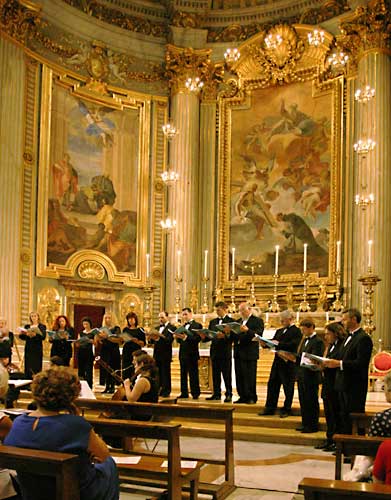
An article on the performance by the Domenico Zipoli Ensemble at St. Ignatius Church in Rome.
More on Domenico Zipoli:
Goldbergweb; an biographical essay
Naxos
HOASM
wiki entry
Karadar Dictionary entry
another link?
Tesori Musicali Toscani
I should do a search for cds at Amazon.
The Ensemble Zipoli for the Spanish American Baroque
Music from the Jesuit Missions in South America by Domenico Zipoli (1688-1726) and the Cathedral of Mexico by Ignacio de Jerusalem (1707-1769)
It was sponsored by the Domenico Zipoli Institute. Should have been good.
Not sure if the Ensemble Zipoli is the same as the Domenico Zipoli Ensemble.
An article on the performance by the Domenico Zipoli Ensemble at St. Ignatius Church in Rome.
More on Domenico Zipoli:
Goldbergweb; an biographical essay
Naxos
HOASM
wiki entry
Karadar Dictionary entry
another link?
Tesori Musicali Toscani
I should do a search for cds at Amazon.
Conspicuous Consumption
Is what I would call my outing last Tuesday at Golden Corral (located on Northern Ave., near 56th St. in the Walmart strip mall). It's a buffet place, specializing in grilled items, like STEAK. Hmmm. Guavajavalava might like the place. My yi yi recommended it because she, of course, likes eating the steak there. My mom and she both liked the clam chowder. If there were a location in CA it would probably be popular with the Asians. Anyways, I had about 3 pieces of steak (or was it four), and was very much a glutton that night. Eh... that's the problem with buffets. They don't really serve any useful purpose except to tempt people to be gluttons. Sure, it's possible to go there and eat in moderation, but then one thinks one is not getting his money's worth. Eh... I am still tempted to go there next time I'm in Phoenix.
It was good to see most of the relatives there; Uncle Nacho and Aunt Mercy didn't go because of a golfing 'incident.' It's too bad more of the kids didn't show up. I only saw Daniel once, and didn't get a chance to see Kale.*
I didn't try any of the filet; just the strip steak(?). The fried chicken was ok, but it wasn't KFC. The dessert selection looked good... red velvet cake... mmmm... all of this for just $10 for dinner. Not bad. (Soft drinks, etc. are extra though.) It is a better deal than Hometown, etc. The service there was good--our busboy took dishes away and refilled drinks. We should have left a larger tip for him... next time. (Then again, there is the case to be made for temperance.)
On Wednesday we had lunch at Ming's Pagoda on 19th--my po po's favorite because it is so close to her home and also because the food there is rather good. It was just our family--AmorKCC and her fiance, the M.D., her husband and their daughter (kam bo lo), my father (who surprisingly came with us again this year--two years in a row--is this a new trend?), my mother and my po po. We ordered 2 sets from the special menu (4 dishes for $26.95?) and it was quite filling... I liked the baat jan dou fu and... what else... the fish filet was a bit soggy, but still ok. The other dishes were good, but not as good as Emperor Palace. (Of course!)
Thursday... my sisters were determined to find a new place to bring my po po. They found Best Hong Kong Dining (1116 S. Dobson in Mesa). The cha siu there was pretty good, good enough that po po asked my mom to get some for her. (AmorKCC ended up buying it, I think.) AmorKCC said the salt and spicy pork at Best Hong Kong Dining was better than even Emperor Palace! I don't know if I would agree with that, I'll have to go to Emperor Palace again... I do think the Best Hong Kong Dining pork was crispier and spicier though. They did have a room with some tables set apart from the main dining room, plus an additional folding screen dividing a side section off from the rest of the main dining room. I wonder if they can hold wedding receptions. Hahaha.
*Which reminds me... my cousin DW told Daniel about what happened when I was young with the popsicle stick. Apparently Daniel misunderstood and thought I died, and he told Nicole, who was concerned and called DW to find out more about it. How nice...
It was good to see most of the relatives there; Uncle Nacho and Aunt Mercy didn't go because of a golfing 'incident.' It's too bad more of the kids didn't show up. I only saw Daniel once, and didn't get a chance to see Kale.*
I didn't try any of the filet; just the strip steak(?). The fried chicken was ok, but it wasn't KFC. The dessert selection looked good... red velvet cake... mmmm... all of this for just $10 for dinner. Not bad. (Soft drinks, etc. are extra though.) It is a better deal than Hometown, etc. The service there was good--our busboy took dishes away and refilled drinks. We should have left a larger tip for him... next time. (Then again, there is the case to be made for temperance.)
On Wednesday we had lunch at Ming's Pagoda on 19th--my po po's favorite because it is so close to her home and also because the food there is rather good. It was just our family--AmorKCC and her fiance, the M.D., her husband and their daughter (kam bo lo), my father (who surprisingly came with us again this year--two years in a row--is this a new trend?), my mother and my po po. We ordered 2 sets from the special menu (4 dishes for $26.95?) and it was quite filling... I liked the baat jan dou fu and... what else... the fish filet was a bit soggy, but still ok. The other dishes were good, but not as good as Emperor Palace. (Of course!)
Thursday... my sisters were determined to find a new place to bring my po po. They found Best Hong Kong Dining (1116 S. Dobson in Mesa). The cha siu there was pretty good, good enough that po po asked my mom to get some for her. (AmorKCC ended up buying it, I think.) AmorKCC said the salt and spicy pork at Best Hong Kong Dining was better than even Emperor Palace! I don't know if I would agree with that, I'll have to go to Emperor Palace again... I do think the Best Hong Kong Dining pork was crispier and spicier though. They did have a room with some tables set apart from the main dining room, plus an additional folding screen dividing a side section off from the rest of the main dining room. I wonder if they can hold wedding receptions. Hahaha.
*Which reminds me... my cousin DW told Daniel about what happened when I was young with the popsicle stick. Apparently Daniel misunderstood and thought I died, and he told Nicole, who was concerned and called DW to find out more about it. How nice...
More LYA, pt 3 [Maimonde]
Maimonde
alt
Older cfs -- Korean makeup schemes from the 90s
Handprinting
I think her on-screen persona is really... something else. (Sure, I have no idea what her real character is like.) If she would only convert to Catholicism...
alt
Older cfs -- Korean makeup schemes from the 90s
Handprinting
I think her on-screen persona is really... something else. (Sure, I have no idea what her real character is like.) If she would only convert to Catholicism...
Sunday, December 31, 2006
Misc EB articles
Travel Habits Must Change to Make a Big Difference in Energy Consumption
Matthew L. Wald, NY Times
(EB Transport)
Top energy stories of 2006
It’s the energy and the economy, stupid
An open letter to US policymakers
Strategic Thinking and Strategic Planning
Byron W. King, Whiskey & Gunpowder
David Hughes on Canada's Oil and Natural Gas (video)
Julian Darley, Global Public Media
Matthew L. Wald, NY Times
(EB Transport)
Top energy stories of 2006
It’s the energy and the economy, stupid
An open letter to US policymakers
Strategic Thinking and Strategic Planning
Byron W. King, Whiskey & Gunpowder
David Hughes on Canada's Oil and Natural Gas (video)
Julian Darley, Global Public Media
Wednesday, December 27, 2006
JHK comments on corporations
And in particular on what has been going on at Pfizer.
So, do the layoffs have anything to do with the poor performance of the company, stockwise, despite the increase in profits?
So, do the layoffs have anything to do with the poor performance of the company, stockwise, despite the increase in profits?
Energy Bulletin links on hydrogen
Hydrogen - Dec 24
Why a hydrogen economy doesn't make sense
What's wrong with hydrogen
Lovins: 20 hydrogen myths
Why a hydrogen economy doesn't make sense
What's wrong with hydrogen
Lovins: 20 hydrogen myths
Father Cantalamessa on the Family
Father Cantalamessa on the Family
When "We Are Not Pursuing the Child's Good …"
ROME, DEC. 25, 2006 (Zenit.org).- Here is a translation of a commentary by the Pontifical Household preacher, Capuchin Father Raniero Cantalamessa, on the liturgical readings for next Sunday, the feast of the Holy Family.
* * *
Sunday after Christmas: Feast of the Holy Family
1 Samuel 1:20-22,24-28; 1 John 3:1-2,21-24; Luke 2:41-52
On the family
"Son, why have you done this to us? Behold, your father and I have been looking for you with great anxiety." In these words of Mary we see that all three of the essential components of a family are mentioned: father, mother and child. This year we cannot talk about the family without touching on the problem that in the present moment is most disturbing society and causing the Church concern: the discussion in Parliament about the recognition of cohabiting couples.
The state cannot be prevented from responding to new situations present in society, from recognizing some civil rights of persons, even of the same sex, who have decided to live together. That which is essential for the Church -- and which must be essential for all those interested in the future good of society -- is that this is not translated into a weakening of the institution of the family, which is already so threatened by modern society.
We know that the best way to weaken a reality or a word is to thin it out, to make it banal, making it embrace different and even contradictory things. This happens if homosexual couples are put on the same footing with a marriage between a man and a woman. The meaning itself of the word "matrimony" -- from the Latin for maternal office -- reveals the insensitivity of such a project.
Above all, I must say that I just do not see the reason for making these two things equal, given that there are other ways of safeguarding the rights in question. I do not understand the suggestion that there has been an offense to the dignity of homosexual persons whom all today feel the need to respect and love. I know personally the rectitude and suffering of some of these persons.
What we are saying applies even more to the problem of homosexual couples adopting children. Adoption by homosexual couples is unacceptable because it is an adoption exclusively for the benefit of the couple and not the child, who could just as well be adopted by a normal couple, that is, by a father and mother. There are many who have been waiting for years.
Homosexual women have a maternal instinct and they want to satisfy it by adopting a child; homosexual men experience the need to see a young life grow beside them and want to satisfy this need by adopting a child. But what attention is given to the needs and sentiments of the child in this case? Rather than having a father and mother, the child will find himself having two mothers or two fathers with all the psychological problems and problems of identity that this brings with it in and outside the home. At school, what effect will this situation, which makes the child different from his companions, have on the child?
Adoption is disturbed in its deeper significance: It is no longer a giving of something but a looking for something. True love, Paul says, "does not seek its own interests." It is true that even in normal adoptions the parents sometimes seek their own good. They want to have someone with whom they can share their reciprocal love, someone who can benefit from all their labors. But in this case the good of those who adopt coincides with that of the adoptees, it is not opposed to it. Objectively speaking, we are not pursuing the child's good but his harm if we allow him to be adopted by a homosexual couple when it would have been possible for him to be adopted by a normal couple.
The Gospel passage of the feast ends with a small portrait of family life that gives us insight into the whole life of Jesus from 12 to 30 years: "He went with them and returned to Nazareth and was obedient to them. His mother stored up all these things in her heart. And Jesus grew in wisdom, age and grace before God and men." May the Virgin obtain for all the children of the world the gift to be able to grow up in grace surrounded by the affection of a father and a mother.
Father Cantalamessa on Christmas
Father Cantalamessa on Christmas
Pontifical Household Preacher on Sunday's Gospel
ROME, DEC. 24, 2006 (Zenit.org).- Here is a translation of a commentary by the Pontifical Household preacher, Capuchin Father Raniero Cantalamessa, on the readings from the liturgy of Christmas.
* * *
Why did God become man?
Isaiah 52:7-10; Hebrews 1:1-16; John 1:1-18
Let us go right to the apex of the prologue of John's Gospel, which is read at the third Mass on Christmas day.
In the Credo there is a line that on this day we recite on our knees: "For us men and for our salvation he came down from heaven." This is the fundamental and perennially valid answer to the question -- "Why did the word become flesh?" -- but it needs to be understood and integrated.
The question put another way is in fact: "Why did he become man 'for our salvation?'" Only because we had sinned and needed to be saved?
There is a vein of the theology inaugurated by Blessed Duns Scotus, a Franciscan theologian, which loosens a too exclusive connection to man's sin and regards God's glory as the primary reason for the Incarnation. "God decreed the incarnation of his Son in order to have someone outside of him who loved him in the highest way, in a way worthy of God."
This answer, though beautiful, is still not the definitive one. For the Bible the most important thing is not, as it was for Greek philosophers, that God be loved, but that God "loves" and loved first (cf. 1 John 4:10, 19). God willed the incarnation of the Son not so much as to have someone outside the Trinity that would love him worthily as to have someone to love in a way worthy of him, that is, to love without measure!
At Christmas, when the child Jesus is born, God the Father has someone to love in an infinite way because Jesus is together man and God. But not only Jesus, but us together with him. We are included in this love, having become members of the body of Christ, "sons in the Son." John's prologue reminds of this: "To those who welcomed him he gave the power to become sons of God."
Therefore, Christ did descend from heaven "for our salvation," but what moved him to come down for our salvation was love, nothing else but love.
Christmas is the supreme proof of God's "philanthropy," as Scripture calls it (Titus 3:4), that is, of God's love (philea) for man (anthropos). John too responds to the why of the Incarnation in this way: "God so loved the world that he gave his only Son so that whoever should believe in him would not die but have life everlasting" (John 3:16).
So, what should be our response to the message of Christmas? The Christmas carol "Adeste Fideles" says: "How can we not love one who has so loved us?"
There is much that we can do to solemnize Christmas, but the truest and most profound thing is suggested to us by these words. A sincere thought of gratitude, a feeling of love for him who came to live among us is the best gift we can give to the child Jesus, the most beautiful ornament in the manger.
To be sincere, however, love needs to be translated into concrete gestures. The simplest and most universal -- when it is pure and innocent -- is the kiss.
Let us kiss Jesus, then, as we desire to kiss all children just born. But let us not just kiss the statue of plaster or porcelain but the child Jesus in flesh and blood. When we have kissed those who are wretched, suffering, we have kissed him!
To kiss someone, in this sense, is to help in a real way, but it is also to speak a good word, to give encouragement, to pay a visit, to smile, and sometimes -- why not -- to give an actual kiss. These are the most beautiful candles that we can light in our manger.
Pope's Christmas Address to Rome's Students
Pope's Christmas Address to Rome's Students
"Fix Your Gaze on the Child"
VATICAN CITY, DEC. 24, 2006 (Zenit.org).- Here is a Vatican translation of the address Benedict XVI gave to the university students and professors of Rome gathered in St. Peter's Basilica on Dec. 14.
* * *
ADDRESS OF HIS HOLINESS BENEDICT XVI
TO THE TEACHERS AND STUDENTS
OF ROMAN UNIVERSITIES
St Peter's Basilica
Thursday, 14 December 2006
Dear Friends,
This year too, I have the welcome opportunity of meeting the Roman university world and of exchanging greetings with you for Holy Christmas, which is now at hand. I greet Cardinal Camillo Ruini who has presided at the Eucharistic celebration and guided you in reflection on the liturgical texts. I next thank the Rector of the Rome III University and the young student, both of whom have spoken on behalf of your learned assembly. I offer my affectionate greeting to each and every one.
We are meeting just before Christmas, which is the feast of gifts, as I recalled last Sunday when I visited the new Roman parish dedicated to Our Lady Star of Evangelization. Christmas gifts evoke the gift par excellence which the Son of God made of himself and offered to us in the Incarnation.
For this reason, Christmas is appropriately emphasized by the many gifts that people give to one another in these days. But it is important that the principal Gift of which all other gifts are a symbol not be forgotten. Christmas is the day on which God gave himself to humanity, and in the Eucharist this gift of his becomes, so to speak, perfect.
Under the appearance of a little piece of bread, as I said to the children of the above-mentioned Roman parish who are preparing for First Communion and Confirmation, it is really Jesus who gives himself and wishes to enter our hearts.
Dear young people, this year you are reflecting precisely on the theme of the Eucharist, as you follow the spiritual and pastoral programme prepared by the Diocese of Rome.
The Eucharistic mystery is the privileged point of convergence between the various contexts of Christian life, including that of intellectual research.
Encountered in the liturgy and contemplated in adoration, Jesus in the Eucharist is like a "prism" through which one can penetrate further into reality, in the ascetic and mystical, the intellectual and speculative, as well as the historical and moral perspectives.
In the Eucharist, Christ is really present and Holy Mass is a living memorial of his Pasch. The Blessed Sacrament is the qualitative centre of the cosmos and of history. Therefore, it constitutes an inexhaustible source of thought and action for anyone who sets out to seek the truth and desires to cooperate with it.
It is, so to speak, a "concentrate" of truth and love. It not only illumines human knowledge, but also and above all human action and human life, in accordance with "the truth in love" (Eph 4:15), as St Paul said, in the daily task of acting as Jesus himself did.
Thus, the Eucharist fosters in those who nourish themselves on it with perseverance and faith a fruitful unity between contemplation and action.
Dear friends, let us enter into the mystery of Christmas, now approaching, through the "door" of the Eucharist; in the grotto of Bethlehem let us adore the Lord himself who, in the Sacrament of the Eucharist, desired to make himself our spiritual food to transform the world from within, starting with the human heart.
I know that for many of you, university students of Rome, it is now a custom at the beginning of the academic year to go on a special diocesan pilgrimage to Assisi, and I know that many of you took part in the recent one, too.
Well, were not St Francis and St Clare both "conquered" by the Eucharistic Mystery? In the Eucharist they experienced the love of God, that same love which, in the Incarnation, impelled the Creator of the world to make himself little, indeed, the smallest one and the servant of all.
Dear friends, as you prepare for Holy Christmas, may you nourish the same sentiments as these great Saints, so beloved by the Italian People. Like them, fix your gaze on the Child wrapped in swaddling clothes and laid in a manger (cf. Lk 2:7,12,16).
Learn from the Virgin Mary, the first person to contemplate the humanity of the Incarnate Word, the humanity of Divine Wisdom. In the Baby Jesus, with whom she had infinite and silent conversations, she recognized the human Face of God, so that the mysterious Wisdom of the Son was impressed on the Mother's mind and heart.
So it was that Mary became the "Seat of Wisdom", and with this title is venerated in particular by the Roman Academic Community.
A special Icon is dedicated to the Sedes Sapientiae. From Rome it has already visited various countries on a pilgrimage to university institutions. It is present here today, so that it may be passed on from the delegation which has come here from Bulgaria to the one which has come from Albania.
I greet with affection the representatives of both these Nations and express the wish that per Mariam their respective academic communities may advance ever further in their search for truth and goodness, in the light of Divine Wisdom.
I warmly address this wish to each one of you present here and I accompany it with a special Blessing which I willingly extend to all your loved ones. Merry Christmas!
[Translation issued by the Holy See]
© Copyright 2006 -- Libreria Editrice Vaticana
Sunday, December 24, 2006
Rome, Season 2
As good as The Sopranos? Better? I doubt it, but then again I haven't really watched The Sopranos. I've skimmed through most of the episodes for season 1, and thought it was ok... but not really worth the time. There are also questions about its accuracy, of course. Apparently it has been decided that the second season will also be the last season. Season 2 is set to premiere in January 14, 2007.
official website; a promo for season 2 on YouTube
From Yahoo! TV photos


Rome Fans
TV.com fansite
chiff.com
official website; a promo for season 2 on YouTube
From Yahoo! TV photos
Rome Fans
TV.com fansite
chiff.com
Seraphim Falls
Western starring Liam Neeson and Pierce Brosnan, looks interesting. Looks like a straightforward revenge flick, involving a massacre of civilians during the Civil War, with Liam Neeson protesting the orders of his superior officer (played by Brosnan) and getting punished as a result. Looks promising.
official website for Seraphim Falls
Yahoo! movies
Speaking of dark Westerns, The Proposition received good reviews, but I haven't seen that one yet...
Sarge said he saw the trailer for The Kingdom, with Jamie Foxx and Jennifer Garner. I can't find anything online yet, but I do want to see the trailer and make some sort of preliminary judgment.
Not sure if I will see Letters from Iwo Jima with the cousins... maybe they will want to see Curse of the Golden Flower.
official website for Seraphim Falls
Yahoo! movies
Speaking of dark Westerns, The Proposition received good reviews, but I haven't seen that one yet...
Sarge said he saw the trailer for The Kingdom, with Jamie Foxx and Jennifer Garner. I can't find anything online yet, but I do want to see the trailer and make some sort of preliminary judgment.
Not sure if I will see Letters from Iwo Jima with the cousins... maybe they will want to see Curse of the Golden Flower.
Father Cantalamessa on the Peacemakers
Father Cantalamessa on the Peacemakers
Delivers Advent Meditation in the Vatican
VATICAN CITY, DEC. 23, 2006 (Zenit.org).- Here is a translation of the Advent sermon delivered Friday by Father Raniero Cantalamessa, Pontifical Household preacher, in the presence of Benedict XVI and members of the Roman Curia in preparation for Christmas.
Preaching in the Redemptoris Mater Chapel of the Apostolic Palace, Father Cantalamessa continued a series of meditations on the beatitudes.
* * *
"Blessed are the peacemakers, for they will be called sons of God"
1. The Holy Father's Message for the world day of peace
The beatitudes are not arranged according to a logical order. Except for the first one, which sets the tone for all the others, each one can be considered separately without its meaning being in the least compromised.
The Pope's message for the World Day of Peace has made me decide to dedicate our meeting today to the beatitude about the peacemakers and to postpone for another time my reflections on the third beatitude, the one about the meek. Let us hope that the message of peace, directed to the whole world, be above all accepted, meditated on, and bear fruit here among us, at the center of the Church.
This year message is for peace in all areas, from the more personal ambit to the more vast ones of politics, economy, ecology, and international organizations. These are different fields, but they are united by the fact that all have the human person as their primary object, as the title of the message indicates "The Human Person: Heart of Peace."
There is a fundamental affirmation in the message that is the interpretive key of the whole. The Holy Father says: "Peace is both gift and task. If it is true that peace between individuals and peoples -- the ability to live together and to build relationships of justice and solidarity -- calls for unfailing commitment on our part, it is also true, and indeed more so, that peace is a gift from God.
"Peace is an aspect of God's activity, made manifest both in the creation of an orderly and harmonious universe and also in the redemption of humanity that needs to be rescued from the disorder of sin. Creation and Redemption thus provide a key that helps us begin to understand the meaning of our life on earth."[1]
These words help us to understand the beatitude of the peacemakers and this beatitude, in turn, throws light on these words of the Pope's message. The nearness of Christmas sets a particular tone, a liturgical one, to our meditation. On Christmas night we will hear the words of the angelic hymn: "Peace on earth to men loved by the Lord." The meaning of these words is not may there be peace, but rather there is peace. "The birth of the Lord," St. Gregory the Great said, "is the birth of peace": Natalis Domini natalis est pacis.[2]
2. Who are the peacemakers?
The seventh beatitude says: "Blessed are the peacemakers, for they will be called sons of God." Along with the beatitude about the merciful, this one does not speak so much about how we must "be" (poor, afflicted, meek, pure of heart) but about what we must "do." The Greek term "eirenopoioi" means those who work for peace, who "make peace." Not so much, however, in the sense of being reconciled with our enemies as in the sense of helping enemies to be reconciled with each other. "What we are dealing with here are people who so love peace that they have no fear of compromising their own personal peace when they intervene in conflicts to help those who are divided to find peace."[3]
Peacemakers are not synonymous, then, with the peaceful or pacific, that is, tranquil, calm persons who avoid contrariety as much as possible (they are proclaimed blessed by another beatitude, that of the meek); neither are peacemakers synonymous with pacifists, if by pacifists we mean those who are against war (with great frequency, against one of the two sides in a war!) but who do nothing to reconcile the combatants. The most just term is pacifier.
In New Testament times the rulers were called the peacemakers, above all the Roman Empire. Augustus Caesar put world peace as his top accomplishment, which he achieved through military victory (parta victoriis pax). He built the famous Ara pacis, the Altar of Peace, in Rome as a testament of his legacy.
Some have understood the Gospel beatitude to be intentionally opposed to this position and to have pointed to the true peacemakers are the true way in which peace is promoted: through victory, yes, but victory over themselves, not over their enemies, not by destroying the enemy, but by destroying enmity, as Jesus did on the cross (Ephesians 2:16).
Today, however, the prevalent view is that this beatitude must be read according to the Bible and the Jewish sources in which helping people in discord to reconcile and live in peace is seen as one of the principal works of mercy. On Christ's lips the beatitude of the peacemakers is derived from the new commandment of fraternal love, it is a way in which love of neighbor expresses itself.
In this sense we would say that this is the beatitude par excellence of the Church of Rome and of her bishop. One of the more precious services that the papacy has rendered to Christianity has always been to promote peace among the various churches, and, in certain eras, also among the first Christians. The first apostolic letter of a Pope, that of St. Clement I, written around the year 96, (perhaps even before the fourth Gospel) had the purpose of returning peace to the Church of Corinth which was divided by discord. It is a service that cannot be rendered without some sort of real juridical authority. If we want to see the value of this service we just need to look at those situations where it is absent.
The history of the Church is full of episodes in which local churches, bishops or abbots, arguing among themselves or with their flocks, have turned to the pope as an arbiter of peace. I am certain that even today this is one of the more frequent services, even if little known, of the pope to the universal Church. Equally the Vatican diplomacy and the apostolic nuncios find their justification in being instruments at the service of peace.
3. Peace as a gift
But God himself, and not man, is the true and supreme "peacemaker." It is for this reason that those who work for peace are called "sons of God." They resemble God, imitate him, they do what he does. The Pope's message says that peace is characteristic of the divine action in the creation and redemption, whether in God's action or in Christ's.
Scripture speaks of the "peace of God" (Philippians 4:7) and more often of the "God of peace" (Romans 15:32). Here peace does not mean what God does or gives, but also what God is. Peace is what reigns in God. Almost all the religions that flourished around the Bible know divine worlds marked by internal warfare. Babylonian and Greek myths about the world's coming into being speak of divinities at war with each other and tearing each other to pieces. In heretical gnostic sects in Christianity there is no unity and peace between the celestial Aeons, and the material world is supposed to be the fruit of an accident and a disharmony in the higher world.
Against this religious background we can better grasp the novelty and the absolute otherness of the doctrine of the Trinity as perfect unity of love in the plurality of persons. In one of her hymns, the Church calls the Trinity an "ocean of peace," and this is not only a bit of poetry. The thing that is most striking when we contemplate Rublev's icon of the Trinity (reproduced in this chapel in the front wall, over the enthroned Virgin) is the sense of superhuman peace that emanates from it. The painter has succeeded in translating into an image the motto of St. Serge of Radonezh, for whose monastery the icon was painted: "Contemplating the Most Holy Trinity, overcome the hateful disharmony of this world."
The one who has best celebrated this divine Peace that comes from beyond history, was Pseudo-Dionysius the Areopagite. Peace is for him one of the "names of God" just as "love" is.[4] Even of Christ it is said that he "is" himself our peace (Ephesians 2:14-17). When he says, "My peace I give to you," he transmits that which he is.
There is an inseparable link between peace gift from above and the Holy Spirit; it's not without reason that both are represented symbolically with a dove. In the afternoon on Easter Jesus gave, in practically the same instant, to this disciples peace and the Holy Spirit: "Peace be with you!" ... He blew over them and said to them "Recieve the Holy Spirit" (John 20: 21-22). Peace, says St. Paul, is a "fruit of the Spirit" (Galatians 5:22).
It is then understood what it means to be a peacemaker. It is not about inventing or creating peace but of transmitting it, letting in the peace of God and of Christ "that transcends all understanding." "Grace and peace from God our Father and from the Lord Jesus Christ" (Romans 1:7). This is the peace that the Apostle passes on to the Christians of Rome.
We must not, nor can we be, the origin but only the channel of peace. The prayer attributed to St. Francis of Assisi expresses this perfectly: "Lord, make me a channel of your peace."
But what is the peace of which we speak? The definition of peace proposed by Augustine has become classic: "Peace is the tranquility of order."[5] Taking this definition, St. Thomas says that in man there exist three types of order: order with oneself, with God, and with our neighbor, and, in consequence, there exist three forms of peace: interior peace, by which man is at peace with himself; the peace whereby man is at peace with God, submitting himself fully to God's dispositions; and the peace relative to one's neighbor, by which we live in peace with all men."[6]
In the Bible, however, shalom, peace, says more than simply tranquility of order. It also means well-being, repose, security, success, glory. Indeed, sometimes it means the totality of the messianic goods and is synonymous with salvation and goodness: "How beautiful are the feet of the messenger of good news on the mountains, he who announces peace, the messenger of goodness and of salvation" (Isaiah 52:7). The new covenant is called a "covenant of peace" (Ezekiel 37:26) and the Gospel is called the "Gospel of peace" (Ephesians 6:15), as if the word "peace" summarized the whole content of the covenant and the Gospel.
In the Old Testament, peace is often side by side with justice (Psalm 85:11, "Justice and peace shall kiss") and in the New Testament it is side by side with grace. When Paul writes: "Justified by faith we are at peace with God" (Romans 5:1), it is clear that "at peace with God" has the same pregnant meaning as "in the grace of God."
4. Peace as a task
The Pope's message also says that besides being a gift, peace is also a task. It is of peace as a task the beatitudes speak to us in the first place.
The condition for being a channel of peace is being in union with its source, which is the will of God. "In his will is our peace," says a soul in Dante's purgatory. The secret to interior peace is total and ever renewed abandonment to the will of God. To maintain or find this peace of heart again it helps to repeat the words of St. Teresa of Avila often to ourselves: "Let nothing disturb you, nothing frighten you. Everything is passing, only God remains. Patience overcomes everything. Nothing is lacking to those who have God. God alone suffices."
The apostolic preaching is rich with practical indications about what makes for and what is an obstacle to peace. One of the better known passages is that of the Letter of James: "For where jealousy and selfish ambition exist, there is disorder and every foul practice. But the wisdom from above is first of all pure, then peaceable, gentle, compliant, full of mercy and good fruits, without inconstancy or insincerity. And the fruit of righteousness is sown in peace for those who cultivate peace" (James 3:16-18).
From this very personal sphere must begin every effort to bring about peace. Peace is like the wake of a great ship that expands toward the infinite but begins as a point, and the point in this case is the heart of man. John Paul II's message for the World Day of Peace in 1984 bore the title: "Peace is Born in a New Heart."
But it is not on this personal sphere that I want to focus. Today a new, difficult, and urgent field of work is opening up to peacemakers: promoting peace between religions and with religion, that is, promoting peace between different religions and between the various religions and the secular, non-believing world. The Pope dedicates a paragraph of his message to this field.
The Pope writes: "As far as the free expression of personal faith is concerned, another disturbing symptom of lack of peace in the world is represented by the difficulties that both Christians and the followers of other religions frequently encounter in publicly and freely professing their religious convictions…
"There are regimes that impose a single religion upon everyone, while secular regimes often lead not so much to violent persecution as to systematic cultural denigration of religious beliefs. In both instances, a fundamental human right is not being respected, with serious repercussions for peaceful coexistence. This can only promote a mentality and culture that is not conducive to peace."
In the present moment we have and example of this cultural derision, or at least marginalization, of religious beliefs with the campaign in different European countries and cities against the religious symbols of Christmas. The reason often given for this is the desire to not offend persons of other religions among us, especially the Muslims. But it is a pretext, an excuse. In reality it is not the Muslims who do not want these symbols but a certain non-believing group in society. Muslims have nothing against the Christian celebration of Christmas, indeed, they honor it.
We have arrived at a rather absurd juncture: On the one hand, many Muslims celebrate the birth of Jesus and want a creche in their house and say that "those who do not believe in the miraculous birth of Jesus are not Muslim,"[7] while others call themselves Christians who want to make Christmas a "winter festival" populated only by reindeer and teddy-bears.
In the Qur'an there is a Sura worth knowing (also as an aid in friendly dialogue between religions) that is dedicated to the birth of Jesus:
"The angels said, 'O Mary! Allâh gives you good tidings through a word from Him. His name is the Messiah, Jesus, son of Mary. He shall be worthy of regard in this world and in the hereafter… 'And he will speak to the people when in the cradle and when of old age, and shall be of the righteous.' Mary said, 'My Lord, how can I have a child when no man has yet touched me?' He said, 'In this way: Allâh creates what He will. When He decides something He simply says "be" and it is.'"[8]
In an episode of the RAI 1 program "In His Image," which is on the Sunday Gospel, and which will air tomorrow evening, I asked a Muslim brother to read this passage and he did so with great joy, saying that he was happy to clear matters up about something which other Muslims have rendered confused with the pretext of advancing their cause.
What that allows for a dialogue between religions -- founded not only the reasons that we know well, but rather on a solid theological foundation -- is that "we alll have a single God," as the Holy Father recalled when he visited the Blue Mosque in Istanbul. It is with this same truth that St. Paul began his discourse at the Areopagus in Athens (cf. Acts 17:28).
Subjectively we have different ideas about God. For us Christians God is "the Father of our Lord Jesus Christ," whom we do not know except "through him," but objectively we know well that God can only be one. There is "only one God, Father of all, who is above all, who acts in all, and is present in all" (Ephesians 4:6).
Our faith in the Holy Spirit is also a theological foundation for dialogue. As the Spirit of the redemption, and Spirit of grace, he is the bond of peace among the baptized and of the different Christian confessions; as the Spirit of creation, Spiritus creator, he is the bond of peace among the believers of all religions and indeed among all men of good will. "Every truth, whoever pronounces it," says St. Thomas Aquinas, "comes from the Holy Spirit." [9]
The recent trip of the Holy Father to Turkey was on behalf of religious peace, which has shown itself to have produced rich fruit, as do all things that are born from the womb of the cross: peace between the Eastern and Western Christian Church, between Christianity and Islam. On the occasion of his silent prayer at the Blue Mosque the Holy Father said that "this visit will help us to find together the means and the roads to peace for the good of humanity."
5. Peace without religion?
To tell the truth, the secularized West hopes for a different type of religious peace, one that would result from the disappearance of religion:
"Imagine there's no heaven, it's easy if you try. No hell below us, above us only sky. Imagine all the people, living for today. Imagine there's no countries, it isn't hard to do. Nothing to kill or die for, and no religion too. Imagine all the people, living for today. Imagine there's no countries, it isn't hard to do. Nothing to kill or die for, and no religion too.
"Imagine all the people, living life in peace. You may say I'm a dreamer, but I'm not the only one. I hope someday you'll join us, and the world will live as one."[10]
This song, written by one of the idols of modern rock music, with its suave melody, has become a kind of secular manifesto of pacifism. If that which is envisioned here were to be realized, the world would be poorer and more squalid than we can imagine. It would be a drab world in which all differences were abolished, where people are destined, not to peace, but to tear each other apart because -- as René Girard has shown -- where everyone wants the same thing, the "mimetic desire" will be unleashed and with it rivalry and war.
We believers must not allow ourselves to fall into resentment and polemics not even with the secularized world. Alongside dialogue and peace between religions, there is another aim of peacemakers: that of peace between believers and non-believers, between religious persons and the secular world, indifferent or hostile to religion.
It will be difficult this test: to give a reason, with firmness, for the hope in us, but to do so, as St. Peter says, "with sweetness and respect" (1 Peter 2:15-16). Respect does not mean in this case "human respect," keeping Jesus hidden so as not to excite reactions. It is a respect of an interiority that is known only to God and that no one can violate for constrain us to change. It is not putting Jesus into parentheses, but rather a showing forth of Jesus and the Gospel through our lives. We ask only that an equal respect be shown by others to Christians, something which so far has often been lacking.
We end returning with a thought on Christmas. An old response of evening prayer for Christmas said: "Hodie nobis de caelo pax vera descendit. Hodie per totum mundum melliflui facti sunt caeli" (Today true peace has come down from heaven for us. Today the heavens distill honey over the world).
How can we correspond to the infinite gift that our Father gave to the world, giving his only son? If there is one faux paux that we should not commit during Christmas, it is to recycle a gift and give it back to the person that gave it to us. But with God, we can't help but do this continuously! The only act of thanksgiving possible is the Eucharist: Giving back Jesus, his son, our brother.
And what gift do we give to Jesus? A text of the oriental rite for Christmas says: "What can we offer to you, Christ, for having become man on Earth? Every creature gives you a sign of recognition: The angels their songs, the heavens their star, the earth a cave, the desert a manger. But we offer to you a virgin mother!"[11]
Holy Father, venerable Fathers, brothers and sisters: thanks for your kind attention and Merry Christmas!
* * *
[1] Benedict XVI, "The Human Person: The Heart of Peace," Message for the World Day of Peace, 2007, §3.
[2] St. Leo the Great, "Treatises," 26 (CC 138, line 130).
[3] J. Dupont, "Le beatitudini," III, p.1001.
[4] Pseudo Dionysius the Areopagite, "The Divine Names," XI, 1 s (PG 3, 948 s).
[5] St. Augustine, "The City of God," XIX, 13 (CC 48, 679).
[6] Cf. St. Thomas Aquinas, "Commentary on the Gospel of John," XIV, lect.VII, n.1962.
[7] Magdi Allan, "Noi musulmani diciamo sì al presepe," Il Corriere della sera, Dec. 18, 2006, p. 18.
[8] Qur'an, Sura III.
[9] St. Thomas Aquinas, "Summa Theologiae," I-IIae q. 109, a. 1 ad 1; Ambrosiaster, On the First Letter to the Corinthians, 12, 3 (CSEL 81, 132).
[10] John Lennon.
[11] Idiomelon of the Vespers for Christmas.
Subscribe to:
Posts (Atom)