葉準師傅傳授甄子丹詠春黐手
葉偉信單挑葉問後人葉準
Wednesday, December 17, 2008

NLM: The O Antiphons. Sandro Magister: Advent in Music. Seven Antiphons, All Worth Discovering Again.
On the Meaning and Value of Our Lives
Christ "Appeals … to Our Free Decision to Accept His Love"
VATICAN CITY, DEC. 17, 2008 (Zenit.org).- Here is a translation of the address Benedict XVI delivered during today's general audience in Paul VI Hall.
* * *
Dear brothers and sisters:
Precisely today, we begin the days of Advent that immediately prepare us for the nativity of the Lord: We are in the Christmas novena, which in many Christian communities is celebrated with liturgies rich in biblical texts, all oriented toward nourishing hope for the birth of the Savior. The entire Church, in effect, turns its gaze of faith toward this approaching feast, readying itself, like each year, to unite to the joyful song of the angels, who in the heart of the night will announce to the shepherds the extraordinary event of the birth of the Redeemer, inviting them to draw close to the cave of Bethlehem. There lies Emanuel, the Creator made creature, wrapped in swaddling clothes and lying in a poor manger (cf. Luke 2:13-14).
Because of the environment that characterizes it, Christmas is a universal feast. Even those who do not profess to be believers, in fact, can perceive in this annual Christian celebration something extraordinary and transcendent, something intimate that speaks to the heart. It is the feast that sings of the gift of life. The birth of a child moves us and causes tenderness. Christmas is the encounter with a newborn who cries in a miserable cave. Contemplating him in the manger, how can we not think of so many children who even today see the light from within a great poverty in many regions of the world? How can we not think of the newborns who are not welcomed and are rejected, of those who do not survive because of a lack of care and attention? How can we not think, too, of the families who desire the joy of a child and do not see this hope fulfilled?
Under the influence of a hedonistic consumerism, unfortunately, Christmas runs the risk of losing its spiritual significance to be reduced to a mere commercial occasion to buy and exchange gifts. In truth, nevertheless, the difficulties and the uncertainties and the very economic crisis that in these months so many families are living, and which affects all of humanity, can be a stimulus to discover the warmth of simplicity, friendship and solidarity -- characteristic values of Christmas. Stripped of consumerist and materialist incrustations, Christmas can thus become an occasion to welcome, as a personal gift, the message of hope that emanates from the mystery of the birth of Christ.
All of this, nevertheless, is not enough to assimilate fully the value of the feast for which we are preparing. We know that it celebrates the central event of history: the incarnation of the divine Word for the redemption of humanity. St. Leo the Great, in one of his numerous Christmas homilies, thus exclaimed: "Let us exult in the Lord, my dear ones, and open our hearts to the most pure joy. Because the day has dawned that for us means the new redemption, the ancient preparation, eternal bliss. Thus in the yearly cycle, the elevated mystery of our salvation is renewed for us, which, promised at the beginning and fulfilled at the end of times, is destined to endure without end (Homily XXII).
St. Paul returns to this fundamental truth many times in his letters. To the Galatians, for example, he writes: "But when the fullness of time had come, God sent his Son, born of a woman, born under the law … so that we might receive adoption" (4:4). In the Letter to the Romans he sets forth the logic and consequent demands of this saving event: "And if [we are] children, then heirs, heirs of God and joint heirs with Christ, if only we suffer with him so that we may also be glorified with him" (8:17).
But it is above all St. John, in the prologue to the fourth Gospel, who meditates profoundly on the mystery of the Incarnation. And it is because of this that the prologue has been part of the Christmas liturgy since ancient times: There is found, in fact, the most authentic expression and the deepest synthesis of this feast, and of the base of his joy. St. John writes: "Et Verbum caro factum est et habitavit in nobis" -- And the Word was made flesh and dwelt among us (John 1:14).
At Christmas, then, we are not limited to commemorating the birth of a great personality; we do not celebrate simply and in the abstract the mystery of the birth of man or in general, the birth of life; neither do we celebrate only the beginning of a great season. At Christmas, we remember something very concrete and important for man, something essential for Christian faith, a truth that St. John summarized in these few words: "The Word was made flesh."
It is a historical event that the Evangelist Luke concerns himself with situating in a very determined context: in the days in which the decree of the first census of Caesar Augustus was issued, when Quirinius was already governor of Syria (cf. Luke 2:1-7). It is therefore a night dated historically, in which was verified the salvation event that Israel had been awaiting for centuries. In the darkness of the night of Bethlehem, a great light was truly lit: The Creator of the universe incarnated himself, uniting himself indissolubly with human nature, to the point of really being "God from God, light from light" and at the same time, man, true man.
That which John calls in Greek "ho logos," translated in Latin "Verbum" and in Italian, "il Verbo" (the Word), also means "the Meaning." Therefore, we can understand John's expression in this way: the "eternal Meaning" of the world has made himself tangible to our senses and our intelligence. Now we can touch him and contemplate him (cf. 1 John 1:1). The "Meaning" that has become flesh is not simply a general idea inscribed in the world; it is a "word" directed to us. The Logos knows us, calls us, guides us. It is not a universal law, in which we fulfill some role, but rather it is a Person who is interested in each individual person: It is the living Son of God, who has become man in Bethlehem.
To many people, and in some way to all of us, this seems too beautiful to be true. In effect, here it is reaffirmed for us: Yes, there is meaning, and this meaning is not an impotent protest against the absurd. The Meaning is powerful: It is God. A good God, who is not to be confused with some lofty and distant power, to which it is impossible to ever arrive, but rather a God who has made himself close to us and to our neighbor, who has time for each one of us and who has come to stay with us.
Thus the question spontaneously arises: How is such a thing possible? Is it worthy of God to become a child? To try to open one's heart to this truth that enlightens all of human existence, it is necessary to yield the mind and recognize the limits of our intelligence. In the cave at Bethlehem, God shows himself to us as a humble "infant" to overcome our pride. Perhaps we would have submitted more easily before power, before pride; but he does not want our submission. He appeals, rather, to our heart and to our free decision to accept his love. He has made himself little to free us from this human pretension of greatness that arises from pride; he has incarnated himself freely to make us truly free, free to love him.
Dear brothers and sisters, Christmas is a privileged opportunity to meditate on the meaning and value of our existence. Approaching this solemnity helps us to reflect, on one hand, about the drama of history in which men, wounded by sin, are permanently seeking happiness and a satisfactory meaning to life and death; on the other hand, it exhorts us to meditate on the merciful goodness of God, who has gone out to meet man to communicate to him directly the Truth that saves, and make him participate in his friendship and his life.
Let us prepare for Christmas, therefore, with humility and simplicity, readying ourselves to receive the gift of light, joy and peace that irradiates from this mystery. Let us welcome the nativity of Christ as an event capable of today renewing our existence. May the encounter with the Child Jesus make us people who do not think only of ourselves, but rather open to the expectations and necessities of our brothers. In this way we too become testimonies of the light that Christmas radiates over the humanity of the third millennium. Let us ask most holy Mary, the tabernacle of the incarnate Word, and St. Joseph, silent witness of the events of salvation, to communicate to us the sentiments they had while they awaited the birth of Jesus, so that we can prepare ourselves to celebrate in a holy way the coming Christmas, in the joy of faith and enlivened by the determination of a sincere conversion.
Merry Christmas!
[Translation by ZENIT]
[The Holy Father then greeted the people in several languages. In English, he said:]
Dear Brothers and Sisters,
Today we commence the Christmas Novena of Advent by contemplating the fulfilment of the ancient prophecies in the coming of the Son of God, born of the Virgin Mary in the stable of Bethlehem. Christmas speaks to everyone; it celebrates the gift of life – often fragile or endangered – and the fulfilment of our deepest hopes for a world renewed. The present economic crisis, causing so much suffering, can however help us to focus on the spiritual meaning of Christmas, and to welcome into our hearts the hope brought by God’s coming among us as man. The Word became flesh to offer humanity the salvation which can only be received as a gracious gift from God. The same Word by whom the universe was made, the Word which gives all creation its ultimate meaning, has come to dwell among us: he now speaks to us, he reveals the deepest meaning of our life on earth, and he guides us to the Love which is our fulfilment. In the Christ Child, God humbly knocks on the doors of our hearts and asks us freely to accept his love, his truth, his life. As Christmas approaches, let us rekindle our hope in God’s promises and, in humility and simplicity, welcome the light, joy and peace which the Saviour brings to us and to our world.
I am pleased to greet all the English-speaking pilgrims and visitors present at today’s Audience, including the various student groups and those coming from Ireland and the United States of America. To you and your families, especially those who may be in difficulty or suffering, I extend my best wishes for a happy and blessed Christmas!
© Copyright 2008 -- Libreria Editrice Vaticana

Dr. Wilson on Nathaniel Macon.
It is a fact that many of the American founding fathers owned slaves. Should they nonetheless be shown some respect (even gratitude) because of their contributions to the federation of states? While respect and gratitude are matters of justice, I must admit that I have difficulty elevating these men to the status of civic heroes or role models. How can it be otherwise, since I received my early formation in modern American public schools?
Are there any Catholic saints who owned slaves (and didn't free them eventually)?
There is also the question of which American founding fathers were liberals, and to what degree. It should be argued that liberalism is not the same as the classical republican tradition of Rome, much less the Greek political tradition. (Some still identify the two.)
Links:
Nathaniel Macon
wiki
Google Books: The Life of Nathaniel Macon
AN: Bao Tong: Beijing should explain how Charter '08 violates the law
Bao Tong: Beijing should explain how Charter '08 violates the law
"1. I call on the Chinese government to to answer me this: "Where is the crime in Charter 08?" The basic concepts of the Charter are freedom, human rights, equality, republicanism, democracy, and constitutional rule. So would the powers-that-be please tell 1.3 billion people why freedom is a crime, why human rights, why equality, or republicanism, and what is criminal about democracy and the rule of law under the Constitution? "Charter 08" puts forward 19 propositions. Not one of them is the invention of the people who signed it. They have all already been implemented in modern, civilized countries, and they have shown themselves to be part of a worthwhile system with beneficial effects. If the authorities care to examine each of the propositions closely, under a magnifying glass, under a microscope, in the hall of mirrors, they could perhaps tell us which crimes are being committed by each article? The aim of the Charter is to call on any Chinese people who still have a sense of purpose, whether in the corridors of power or in remote parts of the country, regardless of personal status, to take part in a movement of citizens, to help realize a dream that has gripped the people of this country for more than 100 years. How is that a crime?The China Beat: Charter 08: Five Links

Zenit: Conclusions of Catholic-Orthodox Family Forum
Conclusions of Catholic-Orthodox Family Forum
"Without the Mutual Love of the Family Our Society Dies"
TRENT, Italy, DEC. 16, 2008 (Zenit.org).- Here is the final statement of the 1st European Catholic-Orthodox Forum on the theme: "The Family: A Good for Humanity," held Dec. 10-14 in Trent.
* * *
Preamble
By the grace of the Holy Spirit, we, thirty representatives of the Catholic Church and the Orthodox Churches in Europe, from countries stretching from the Urals to the Atlantic, have gathered together for the First European Catholic-Orthodox Forum. We express our gratitude to all who have worked for the success of this meeting, especially to the Archbishop of Trent who warmly received us and offered hospitality. The meeting has been organised by the Council of European Bishops Conferences (CCEE), in close collaboration with various Orthodox Churches and some of the dicasteries of the Holy See.
We have expressed our deep sorrow at the sudden death of His Holiness, Patriarch Alexis II of Moscow and All Russia, who had warmly extended his blessing upon the project of this Forum.
What is the purpose of the Forum? It is not to discuss theological issues that are treated at other levels. Our task rather is to concentrate on anthropological issues of crucial importance for the present and future of humanity. The goal of the Forum is to help define common positions on social and moral questions. By engaging in this exchange, we help each other realize just how close our moral and social doctrines are. At the same time we make the world aware of our concerns.
We agreed to dedicate our first encounter to "The Family: A Good for Humanity". Countless numbers of families have contributed so much to European culture. We are grateful to them and in our prayer for families we remember specially those going through difficulties.
Over our four days together we have discussed topics relating to marriage and family, as well as various aspects of sexual ethics. It has been an opportunity for us to proclaim and live our faith, pray to the Lord for grace and reflect on how we might collaborate more. In particular, animated by the love of Christ for humanity, we have focused on the family, acknowledging all the efforts being done to promote family life on our continent, but also voicing our concern for the deteriorating condition of family life that is evident in many ambits of society.
Marriage and the family belong to the created order and are not a product of mere human decision. Written into the very nature of human being and revealed to us in the Bible, the family, founded on marriage, was established by God as a union between man and woman. The Bible presents us with a vision of the family as a unity of life-giving love, an indissoluble relationship, open to life.
I – Marriage and Family
Over the course of these days, we listened to some reports concerning the views of Catholic and Orthodox Churches in Europe. The following is a summary.
A. Orthodox Views on Marriage and the Family
In the Christian Orthodox tradition marriage is viewed as an eternal union of spouses, strengthened not only by physical, but also by spiritual intimacy. In spite of widespread belief to the contrary, the Orthodox Church "by no means calls on its members to shun the body or sexual intimacy as such, for physical relations between a man and a woman are blessed by God in marriage, where they become a source of the continuation of the human race and express chaste love, total community and the 'unity of souls and bodies' of the spouses." According to the teaching of the Orthodox Church, "the transformation of these relations, which are pure and worthy according to God's plan, as well as of the body itself into an object of degrading exploitation and trade aimed at the receiving of egoistic and impersonal, loveless and distorted satisfaction, deserves condemnation." (The Bases of the Social Conception of the Russian Orthodox ChurchX, 6.)
According to the Orthodox understanding, an essential element of the marital union and the fruit of the love between man and wife are children, the birth and upbringing of which are one of the main goals of marriage (Ibid., X 3-4). In accordance with this view, the Orthodox Church considers the freely willed rejection of childbirth and the artificial termination of pregnancy inadmissible. As the equivalent of murder, abortion is unequivocally rejected by the Church, which insists on the personal responsibility of all who take part in this act: the woman, the man (in the case of his consent) and the doctor(Ibid., XII,2).
On the basis of Holy Scripture and Tradition the Orthodox Church denounces homosexual relations, seeing in them the distortion of man's divinely created nature (Ibid., XII, 9). It also rejects all forms of fornication, adultery and marital infidelity, as well as prostitution and promiscuity. At the same time, it recognizes the need to pastorally assist those people who have disordered inclinations and whose way of life does not correspond to the Gospel's moral teaching.
B. Catholic Positions on Marriage and the Family
According to Catholic teaching, as affirmed also by the Orthodox, Jesus Christ raised natural marriage to the dignity of a sacrament: "The marriage covenant, by which a man and a woman establish between themselves a partnership of their whole life and which of its own very nature is ordered to the well-being of the spouses and to the procreation and upbringing of children, has, between the baptized, been raised by Christ the Lord to the dignity of a sacrament" (CIC can. 1055 - §1).
This sacramental value requires fidelity unto death among the spouses in the indissolubility of the marriage bond. Marital love between the spouses is the basis of the family, the first personal communion into which a human being is born. It must be promoted by society as its fundamental cell. The Catholic Church recognises the inseparable link willed by God between the unitive and procreative meanings of married love. Exclusion of offspring is therefore contrary to the unity of marital love. Sexuality is recognized as a dimension of the image of God in human beings and so has a personal value. Men and women must learn in the language of the body their vocation to responsible love as a true gift of themselves. Other sexual expressions such as fornication, homosexual acts and sexual unions outside marriage are contrary to this vocation to love.
II. Mission of the Family
After outlining some elements of the teachings of our Churches, we also underlined how much we hold in common. And so we would like to underline the following issues that we together consider important for the well-being of society.
A. Key Common Points
God's commandment to the first human family remains relevant to all subsequent families: "Be fruitful and multiply, and fill the earth and subdue it" (Gen 1:28). Catholics and Orthodox agree that the family is the unique moral environment in which the gift of human life should be transmitted by the marital act.
The human being is the only one created in the image and likeness of God and this constitutes his particular dignity. We do not give life to ourselves, nor are parents the sole source of human life, since divine intervention is necessary. The sacredness of human life from conception to natural death should be fully respected.
We acknowledge the positive international documents that support the family. For instance, art. 16 of the Universal Declaration of Human Rights states that: "Man and woman of full age, without any limitation due to race, nationality or religion, have the right to marry and to found a family" and "the family is the natural and fundamental group of society and is entitled to protection by society and the State." In the past the family and childbirth were regarded as something sacred. In recent years, however, these notions are questioned. There is an attempt to change language and introduce ambiguity into international documents under the ideological introduction of the gender theory.
Today both men and women are equally busy with the realization of their professional potential, and both have to bear the burden of financial responsibility for the family. Under these circumstances the possibilities of bearing and rearing children are drastically reduced.
A particularly tragic phenomenon has emerged in twenty first century Europe. Due to wages that do not sustain families, hundred of thousands of mothers and fathers have had to leave their families to go to wealthier countries to provide for the basic needs of their families. This has resulted in increased numbers of divorces, and in great suffering to children, with many of them being deprived of the presence of their parents' love and care.
The secular vision prevailing in modern society often undermines the notion of motherhood as a personal vocation. It is sometimes devalued. We, Orthodox and Catholics together, insist on the sacredness of motherhood and on the need for society to respect it. Mothers who stay at home in order to raise and educate children should be afforded support both morally and financially. Their mission is in no way less important than that of other respected professions. Motherhood is a mission, and as such it deserves unconditional support and respect. The idea of fatherhood is also fundamental for society and it too needs to be rediscovered by contemporary society. It's impossible to speak of a fraternal society without fatherhood.
B. Family and Education
Having given the gift of life to their children, parents are their first educators. "The right and duty of parents to give education is essential, since it is connected with the transmission of human life; it is original and primary with regard to the educational role of others, on account of the uniqueness of the loving relationship between parents and children; and it is irreplaceable and inalienable, and therefore incapable of being entirely delegated to others or usurped by others". ("Familiaris Consortium," 36). Integral education within the family is not limited simply to the development of a child's natural gifts and capacities, but refers also to spiritual values, in particular the handing on of faith. Parents are to be the first witnesses of the Gospel. In the family life we learn the meaning of faith as the true light that guides a person's life.
The most suitable environment for the harmonious development of the child is the family, composed of a father, mother and siblings. Other bodies that help the family in education of their children must act in collaboration with parents, passing on the principles and values which always remain the parents' primary responsibility to transmit. In the context of education one often hears about the rights of the child. This is good but such rights must always be considered within the environment of the family.
The issue of "sex education" merits particular attention. Here, too, parents are the first teachers. The principle aim of such teaching is directed towards forming young people in the meaning of married love: "Education in love as self-giving is also the indispensable premise for parents called to give their children a clear and delicate sex education" (Ibid., 37). In the family, where we have the first experience of personal communion, we are introduced into love in all its dimensions: the family is the first place of personal socialization. Furthermore, parents must provide information proportionate to each stage of the individual development of their children. Other bodies, such as the school, for example, constitute, in this sense, an aid for parents.
Particular influence is brought to bear on the education of children and young people by the mass media that strongly condition family relations. Young people imitate the examples communicated through the media. Alongside many positives aspects, however, the means of communication unfortunately and increasingly present pornographic material and an individualist, egoistic culture.
Families that teach their children well, attentive to establishing proper relationships between all family members, constitute a valuable human capital that has great importance for society in both its economic and spiritual well-being. Family life creates culture: man learns the essential language of life and all that helps him become fully human. All culture, in its beginnings and in its development is a family event.
C. The Crisis of our Society: Challenges and Opportunity
Today we are faced with a certain ideology of culture that emerged with the sexual revolution in the last century. This has brought about a deep crisis in the vision of what it is to be human and family life. It is a major challenge to the evangelization of the Christian Churches that are attentive to the needs of the heart of the human being and his or her calling to full life in Christ.
Among the profound changes of our society, a deep economic crisis has recently emerged. The banking, financial and economic crisis of today is one of the indicators of a major turning point in our global and European society. We are all rightly concerned. But another vital element of this turning point is the crisis in regard to family life. The demographic trends alone in Europe are clear signals of a crisis much greater than the financial one. The family, born of marriage between man and woman that gives rise to children and an extended network of relationships, needs to be rediscovered as valuable social capital. We appeal to political and social leaders to address this major social issue before it is too late. Without this attention, lack of financial funds will pale before the lack of social and human resources that the family brings.
On the other hand, we express gratitude for what has been done. Many positive developments have helped the family: recent social and economic recognition in some countries of the contribution of motherhood to society, financial and social assistance for the care of disabled and elderly, medical cover for those disadvantaged members of society.
III - Recommendations and Appeals
In recent years the Churches have become aware of the importance of supporting spiritual renewal and in particular accompanying young people as they journey towards becoming husbands and wives, fathers and mothers. While assisting all families pastorally, we recognize that special care needs to be given to newly established families. Marginalized families (and often migrant families are such) deserve attentive care. The Church's mission is to give hope to our society that today is faced with many challenges. We need to show signs of solidarity and through the media communicate our positive message regarding the family.
All of us together, Catholics and Orthodox, affirm the following recommendations and appeal to all people of good will in society to act together with us on them:
1. There is a most urgent need to rediscover the understanding of the family and marriage. We believe that one of the primary causes of the current demographic crisis and all related crises is the rejection of this understanding. Much effort needs to be invested in the promotion of family life. The family needs to be rediscovered for what it offers society. In the family, we have homes that are creative, dynamic and vital schools of socialization in many ways: educating family members to a discovery of the value of community and otherness, forming them in a culture of giving, encouraging openness to diversity in solidarity, facilitating mutuality in communication and providing a dynamic towards discovery and novelty, fruit of interpersonal endeavor.
2. We affirm that it is only in relationship to God that all human beings blossom in their full humanity. Accordingly, it is our belief that promoting family institution, based on the marriage of man and woman, Europe will be furthering this fundamental unit of society that carries out a vital liberating, fulfilling and enlightening role in society. To recognize this is the beginning of a renewal of our European culture that is seeking its way forward at this time of profound soul-searching. Our appeal to political and social leaders is the following: The family is not an outdated notion! Rightly rediscovered, it is the future. Without the mutual love of the family our society dies.
3. We affirm that, since they have conferred life on their children, parents have the original, primary and inalienable right to educate them. They must be acknowledged as the generally best suited and the first and foremost educators of their children. We call upon the political institutions to ensure the parents' right to educate their children in conformity with their moral and religious convictions, taking into account the cultural traditions of the family. This includes the right to freely choose schools or other means necessary to educate their children in keeping with their convictions. In particular, sex education is a basic right of the parents and must always be carried out according to their choice and under their close supervision.
4. We see a great danger in the apparent subordination of the needs of children and the well-being of the family to economic interests.
5. We call upon all public institutions to ensure that policies regarding remuneration for work are consistent with establishing and maintaining a family with dignity. This could be obtained by tax laws which recognize the indispensible contribution of the family to society. It should be such that both parents need not necessarily be obliged to work full time outside the home to the detriment of family life and especially to the detriment of the education of children. We call upon the public institutions to recognize and respect the work of the mother in the home because of its value for the family and for society. The issue of "child care" needs further consideration with the best interests of the child as the guiding principle.
6. Finally, we call to mind the moral choice on which the future of the whole of humanity depends. Its essence is expressed as a central point of the Covenant God made with the humankind which is fulfilled in Christ: 'See, I have set before thee this day life and good, and death and evil; In that I command thee this day is to love the Lord thy God, to walk in his ways, and to keep his commandments… that thou may live and multiply: and the Lord thy God shall bless thee... I have set before you life and death, blessing and cursing: therefore choose life, that both thou and thy seed may live' (Deut. 30:15-19).
IV – Follow up
The experience of this Forum has been very positive in building up our fraternity and enabling us to share in our Christian concern for people. On the basis of this good experience, we intend to meet regularly to strengthen our mutual relations and address common challenges facing Europe.
Tuesday, December 16, 2008
From the Big Mac: Mammon and Uniquity (in which he asks whether Notre Dame can maintain its Catholic Identity)
(via Insight Scoop)
(via Insight Scoop)
Sandro Magister, And It Was Night. The Real Story of Original Sin
That we do evil may not in itself be sufficient evidence of original sin--some may even mistakenly argue that that power to evil is a necessary consequence or characteristic of freedom. For those who have some vague belief in God, I think a more compelling proof would begin with the awareness that we do not, by our own power, love God. It can also be shown that all creatures love (or should love) God more than themselves. Therefore there is something wrong with us, for which God is not responsible, but some among us are (or were).
It is one of the most overlooked and rejected dogmas. But for Benedict XVI, it is "overwhelmingly obvious." He has talked about it three times in eight days. Without it, he says, Christian redemption "would lose its foundation"
That we do evil may not in itself be sufficient evidence of original sin--some may even mistakenly argue that that power to evil is a necessary consequence or characteristic of freedom. For those who have some vague belief in God, I think a more compelling proof would begin with the awareness that we do not, by our own power, love God. It can also be shown that all creatures love (or should love) God more than themselves. Therefore there is something wrong with us, for which God is not responsible, but some among us are (or were).
I think I've posted this link before, but if I haven't... Blessed Karl of Austria Beatification and Canonization Site.
(To facilitate a search of the blog: Emperor Charles Hapsburg.)
(To facilitate a search of the blog: Emperor Charles Hapsburg.)
St. Ann Choir -- Liturgy Schedule
From the current calendar (also under "Coming Events"):
Wednesday, December 24, 12:00 midnight. Midnight Mass preceded by Christmas Carols (probably Victoria, Missa O Magnum Mysterium).I'm still thinking of going to both the Christmas Eve Mass and Christmas Day Mass...
Thursday, December 25, 12:00 noon. Christmas Day (probably Byrd Four-Part Mass
Wednesday, December 31, 8:00 p.m. (rehearsal 7:00), Vespers of New Year’s Day (with Josquin’s antiphons, Dufay’s Hymn, Mouton’s motet, etc.), probably at St. Ann Chapel
Thursday, January 1, 12:15 p.m. New Year’s Day Mass, probably Morales, Missa Caça
Sunday, January 6, 12 noon, Epiphany, probably Byrd Four-Part Mass
Sunday, January 13, 12 noon, Baptism of Christ, probably Victoria, Missa O Magnum Mysterium
Monday, December 15, 2008
El Cid offers some survival tips
His posts so far:
First Things First: The Bug-Out-Bag
Bugging Out: How, Where, Why
If some sort of prolonged disaster were to occur, I think I'd be going to the nearest church, among other things. At this point I don't think I'd be able to escape town, unless my obligations were dispensed with.
(It reminds me of the church scene in 28 Days Later.)
Do adolescent members of both sexes interact with one another like children, even in their flirtation? Watching them talk to one another, one wonders if there is much difference between the way they talk to each other when they start college and when they are in middle school. Sure, some males may seem more 'mature' but that's more because they exhibit 'alpha male' qualities than real maturity. Or they show certain characteristics associated with manly men, though their behavior (promiscuity, drunkeness, and so on) reveals a deficit of character. Is it any surprise that the nice boys who still relate to girls on this more 'immature' (if that is an accurate way of characterizing it) level are viewed as nothing more than friends, and not as potential spouses? And does this have anything to do with the pervasiveness of sex "mis-education" in the schools and the mass media? Such that because everyone is so aware of sex that they trivialize it, instead of taking it seriously, and as a result, acting in serious manner when dealing with members of the other sex? A woman is just not the same as a girl, and a failure to respect her as a woman hurts her and inevitably men, since they hinder themselves from growing up.
On second thought... their lack of seriousness may have more to do with their continued infantilization, loss of a sense of vocation, and lack of a clear direction with regards to marital [sexual] matters.
Edit. Which reminds me... I was at Korea House today for lunch, and at the table next to us was a table of... engineers? Anyway, a young attractive woman (Vietnamese?) with dyed blonde hair, in shirt and pants was at the buffet, and at least 2 or 3 of them seemed to be looking... she was rather tall, for an Asian girl. (Yeah, I was looking too.)
Can I think of anything more frivolous for a woman than painting her toenails? There probably are some cosmetic changes or enhancements that would qualify. And some may say that painting them covers up ugly toenails, like those that have been damaged by fungal infections or what have you. Still... I can't help but think, "Don't you have something better to do with your time?"
She was wearing those open-toed shoes with a thick heel, which reminded me of athletic shoes except for the front.
Patrick Deneen, What's in a Name?
Professor Deneen rectifies the names of various agencies of the Executive Branch.
Professor Deneen rectifies the names of various agencies of the Executive Branch.
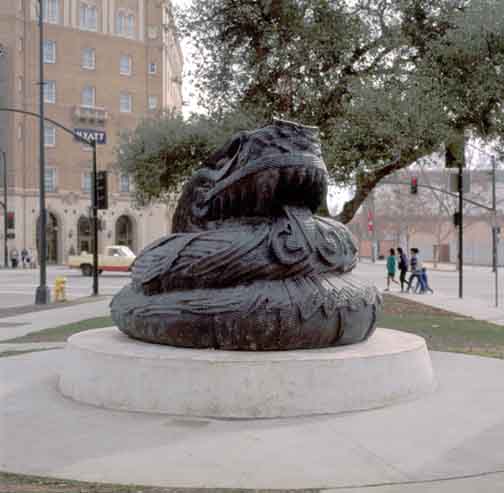
I was reminded by this week's bulletin from the oratory of that the city of San Jose commissioned and put on display a statue by Robert Graham (wiki) of the Aztec god Quetzalcoatl "in a park just adjacent to St. Joseph's Cathedral"; this reminder was occasioned by the feast of Our Lady of Guadalupe.
How many of the city's Mexican[-American] residents identify with Quetzalcoatl instead of la Guadalupana? Sure there are some, perhaps a growing number of Mexican-Americans radicals who reject Christianity as an imperialist import, identifying with their Aztec (or other) roots instead. But before comissioning the statute did the city of San Jose take a poll asking its Mexican[-American]s whether they wanted a statue of Quetzalcoatl or some sort of public display of la Virgen de Guadalupe? I don't recall one being done.
Another sign of the [public] rebellion against Christianity by the elites? (Somewhat akin to Julian the Apostate's reversion to paganism, but at least he believed in something, not like the secular atheists who now have power and are just interested in symbolic actions that show their rejection of Christianity.)
As a side note, there are some Mexicans who have undoubtedly embraced some form of Protestantism who reject la Guadalupana, or at least devotion to her... one student was forced to throw a picture of Nuestra Señora away by her mother. Is the diocese doing enough to reach out to them? How can it, when it is not getting enough vocations? (And whose fault is that?)
Links:
Aztlan pride sites? La Voz de Aztlan and In Search of Atzlan
SanJose.com on the statue of Quetzalcoatl
The Flaw of Western Economies
Marcin Gerwin, The Permaculture Research Institute of Australia
Let’s imagine a green and responsible consumer. Let’s call him George. George lives in a sleepy town, near the center and the park where he often goes for a walk with his dog. George built his house with his friends two years ago. It is a very small house, only 320 square feet and it was made with cob – clay mixed with straw and aggregate.
Suburbs, cities and sustainability
Lakis Polycarpou, City of the Future (nea-polis.net)
If we’re going to understand the problems that the modern megapolis will face in the coming decades, we need to look past the usual distinctions, to the design flaws that now lie behind not just suburbia but cities and even “rural” communities (a depressing number of which have been Walmartized).
Sunday, December 14, 2008
John Rao: From Hoboken to Eternity. (October, 2008). The value of Catholic traditionalism in the life of one traditionalist: an unpublished memoir.
B16: On the Lord's Return
On the Lord's Return
"The 'Nearness' of God Is a Question of Love"
VATICAN CITY, DEC. 14, 2008 (Zenit.org).- Here is a translation of the address Benedict XVI delivered today before praying the Angelus with those gathered in St. Peter's Square.
* * *
Dear Brothers and Sisters,
This third Sunday of Advent is called "Gaudete Sunday" -- "Rejoice," following the entrance antiphon of the Holy Mass that takes up St. Paul's expression in his Letter to the Philippians, which says: "Rejoice in the Lord always. Again I tell you: Rejoice."
Immediately afterward St. Paul explains why: "The Lord is near" (Philippians 4:4-5). This is the reason for joy. But what is meant by "The Lord is near"? How are we to understand this "nearness" of God? The Apostle Paul, writing to the Christians of Philippi, is obviously thinking about Christ's return, and he invites them to rejoice because this return is certain. Nevertheless, the same St. Paul, in his first Letter to the Thessalonians, warns that no one can know the moment of the Lord's return (cf. 1 Thessalonians 5:1-2) and puts them on guard against all alarmism, as if the Lord's return were imminent (2 Thessalonians 2:1-2).
Thus, already at that time, the Church, enlightened by the Holy Spirit, understood more and more that the "nearness" of God is not a question of space and time, but rather a question of love: Love is near! Christmas will come to remind us of this fundamental truth of our faith and, before the crèche, taste Christian joy, contemplating in the face of the newborn Jesus the God who drew near to us for love.
In light of this, it is a true pleasure for me to renew the tradition of the blessing of the "Bambinelli," the statues of baby Jesus that will be placed in the manger. I especially turn to you, dear boys and girls of Rome, who have come with your "Bambinelli" this morning, which I will now bless. I invite you to join with me and attentively follow this prayer:
God, our Father,
you so loved men
to send us your only Son, Jesus,
born of the Virgin Mary,
to save us and to bring us back to you.
We pray to you, that with your blessing
these images of Jesus, who is about to come among us,
be, in our houses,
a sign of your presence and your love.
Good Father,
grant us also, our parents, our families and our friends,
your blessing.
Open our heart,
so that we know how to receive Jesus with joy,
do always what he asks
and see him in all those
who need our love.
We ask this in the name of Jesus,
your beloved Son, who came to bring peace to the world.
He who lives and reigns forever and ever.
Amen.
And now let us recite together the "Angelus Domini," calling upon the intercession of Mary, so that Jesus, who in his birth brings God's benediction to men, be welcomed with love in all the homes of Rome and the world.
[After praying the Angelus, the Holy Father greeted the crowds in several languages. In Italian, he said:]
Today in the Diocese of Rome we celebrate the day for the building of new churches. There have been some new parish complexes built in recent years but there are still communities who gather in provisional and inadequate buildings. I thank from my heart those who have supported this crucial undertaking of the diocese and I renew the invitation to everyone: Let us help the parishes of Rome build their church.
[Translation by Joseph G. Trabbic]
[In English he said:]
I am happy to greet all the English-speaking pilgrims and visitors present for today's Angelus prayer. On this Third Sunday of Advent we are called to rejoice because the Lord is near. As we renew our hope in Jesus and look forward to his coming, may we experience in our lives the deep joy of his salvation. I wish you all a pleasant stay in Rome, and a blessed Sunday!
© Copyright 2008 -- Libreria Editrice Vaticana
Zenit: Father Cantalamessa's 2nd Advent Sermon
Father Cantalamessa's 2nd Advent Sermon
"Called by God to Communicate With his Son Jesus Christ"
VATICAN CITY, DEC. 12, 2008 (Zenit.org).- Here is the Advent homily Capuchin Father Raniero Cantalamessa, preacher of the Pontifical Household, delivered today in the Vatican in the presence of Benedict XVI and the Roman Curia.
This is the second of three Advent sermons the preacher wrote on the theme "'When the Fullness of Time Had Come, God Sent his Son, Born of a Woman: Going With St. Paul to Meet the Christ Who Comes."
The last sermon will be given Dec. 19.
* * *
In order to remain faithful to the method of "lectio divina" so recommended by the recent synod of bishops, we listen above all to St. Paul's words, on which we wish to reflect in this meditation:
"But whatever gain I had, I counted as loss for the sake of Christ. Indeed I count everything as loss because of the surpassing worth of knowing Christ Jesus my Lord. For his sake I have suffered the loss of all things, and count them as refuse, in order that I may gain Christ and be found in him, not having a righteousness of my own, based on law, but that which is through faith in Christ, the righteousness from God that depends on faith; that I may know him and the power of his resurrection, and may share his sufferings, becoming like him in his death, that if possible I may attain the resurrection from the dead. Not that I have already obtained this or am already perfect; but I press on to make my own, because Christ Jesus has made me his own" (Philippians 3:7-12).
1. "That I may know him"
Last time we meditated on Paul's conversion as a metanoia, a change of mind, in the way of conceiving salvation. Paul, however, did not convert to a doctrine, be it also the doctrine of justification through faith; he converted to a person! Before a change of thought, his was a change of heart, the encounter with a living person. Often used is the expression "stroke of lightning" to indicate a love at first sight that sweeps away every obstacle; in no case is this metaphor more appropriate than for St. Paul.
Let us see how this change of heart shines from the text just heard. He speaks of the "surpassing worth" (hyperechon) of knowing Christ, and it is known that in this case, as in the whole Bible, to know does not indicate only an intellectual discovery, having an idea of something, but a vital and profound bond, an entering into relation with the object known. The same is true for the expression "that I may know him and the power of his resurrection, and may share in his sufferings." "To know sharing in sufferings" does not mean, obviously, to have an idea, but to experience suffering.
It so happened that I read this passage in a particular moment of my life in which I also found myself before a choice. I was concerned with Christology, I had written and read so much on this argument, but when I read "that I may know him," I understood all of a sudden that that simple personal pronoun "him" (autòn) contained more truth about Jesus Christ than all the books written or read about him. I understood that, for the Apostle, Christ was not an ensemble of doctrines, heresies, dogmas; he was a living person, present and very real who could be designated with a simple pronoun, as is done, when one speaks of someone who is present, indicating him with the finger.
The effect of falling in love is double. On one hand there is a drastic reduction to one, a concentration on the person loved that makes all the rest of the world pass to a second plane; on the other hand, it renders one capable of suffering anything for the person loved, accepting the loss of everything. We see both these effects realized to perfection at the moment in which the Apostle discovers Christ: "For his sake I have suffered the loss of all things, and count them as refuse."
He has accepted the loss of his privileges of "Jew of Jews," the esteem and friendship of his teachers and fellow countrymen, the hatred and commiseration of all those who did not understand how a man like him was able to allow himself to be seduced by a sect of fanatics without art or position. In the second Letter to the Corinthians is found the impressive list of all the things suffered for Christ (cf. 2 Corinthians 11:24-28).
The Apostle himself found the word that alone contains all: "Christ has made me his own." It could also be translated as seized, fascinated, or with an expression of Jeremiah, "seduced" by Christ. Those in love do not hold back, it has been done by so many mystics at the height of their ardor. I have no difficulty, therefore, imagining Paul who, in an impetus of joy after his conversion, shouts alone to the trees on the seashore that which he would later write to the Philippians: "Christ has made me his own! Christ has made me his own!"
We know well the lapidary and pregnant phrases of the Apostle that every one of us would love to be able to repeat in our own life: "For me to live is Christ" (Philippians 1:21), and "it is no longer I who live, but Christ who lives in me" (Galatians 2:20).
2. "In Christ"
Now, keeping faith with all that was announced in the program of these homilies, I would like to bring to light that which Paul's thought might mean on this point, first for today's theology and then for the spiritual life of believers.
Personal experience led Paul to a global vision of Christian life that he indicates with the expression "in Christ" (en Christō). The formula recurs 83 times in the Pauline corpus, without counting the similar expression "with Christ" (syn Christō) and the equivalent pronominal expressions "in him" or "in him that."
It is almost impossible to translate with words the poignant content of these phrases. The preposition "in" has a meaning now local, now temporal (at the moment in which Christ dies and rises), now instrumental (through Christ). It delineates the spiritual atmosphere in which the Christian lives and acts. Paul applies to Christ that which in the address to the Areopagus of Athens he says of God, quoting a pagan author: "In him we live, and move and have our being" (Acts 17:28). Later the evangelist John would express the same vision with the image of "abiding in Christ" (John 15:4-7).
Those who speak of Pauline mysticism refer to these expressions. Phrases such as "God was in Christ reconciling the world to himself" (2 Corinthians 5:19) are all-encompassing, they do not leave anything and anyone outside of Christ. To say that believers are "called to be saints" (Romans 1:7) is for the Apostle equivalent to saying that they are "called by God into the fellowship of his Son Jesus Christ" (1 Corinthians 1:9). Rightly, beginning to be considered today, also in the heart of the Protestant world, is the vision synthesized in the expression "in Christ" or "in the Spirit" as more central and representative of Paul's thought than the doctrine itself of justification through faith.
The Pauline Year might be revealed as the providential occasion to close a whole period of discussions and disagreements linked more to the past than to the present, and to open a new chapter in the use of the Apostle's thought. To return to his letters, in the first place the Letter to the Romans, for the purpose for which they were written was not, of course, that of furnishing future generations with a gymnasium in which to exercise their theological acumen, but that of edifying the faith of the community, formed in the main by simple and illiterate people. "For I long to see you," he wrote to the Romans, "that I may impart to you some spiritual gift to strengthen you, that is, that we may be mutually encouraged by each other's faith, both yours and mine" (Romans 1:11-12).
3. Beyond the Reformation and Counter-Reformation
I believe it is time to go beyond the Reformation and the Counter-Reformation. What is at stake at the start of the third millennium is no longer the same as at the beginning of the second millennium, when at the heart of Western Christianity the separation took place between Catholics and Protestants.
To give but one example, the problem is no longer that of Luther and of how to liberate man from the sense of guilt that oppresses him, but how to give again to man the true meaning of sin which has been totally lost. What sense does it make to continue to discuss how "justification of the godless comes about," when man is convinced of not having need of any justification and says with pride: "I accuse myself today and I alone can absolve myself, I the man"?[1]
I believe that all the age-old discussions between Catholics and Protestants about faith and works have ended up by making us lose sight of the main point of the Pauline message, often shifting attention from Christ to doctrines on Christ, in practice, from Christ to men. That which the Apostle is anxious above all to affirm in Romans 3 is not that we are justified by faith, but that we are justified by faith in Christ; it is not so much that we are justified by grace, but that we are justified by the grace of Christ. The accent is on Christ, more than on faith and grace.
After having two preceding chapters of the Letter presenting humanity in its universal state of sin and perdition, the Apostle has the incredible courage to proclaim that this situation has now radically changed "through the redemption which is in Christ Jesus," "by one man's obedience" (Romans 3:24; 5:19). The affirmation that this salvation is received by faith, and not by works, is most important, but it comes in the second place, not in the first. The error has been committed of reducing to a school problem, in the interior of Christianity, what for the Apostle was an affirmation of a more vast, cosmic and universal event.
This message of the Apostle on the centrality of Christ is of great importance today. Many factors have lead in fact to put his person in parenthesis today. Christ does not come into question in any of the three liveliest dialogues taking place today between the Church and the world. Not in the dialogue between faith and philosophy, because philosophy is concerned with metaphysical concepts; not of historical reality as is the person of Jesus of Nazareth; not in the dialogue with science, with which one can only discuss the existence or nonexistence of a creator God, of a project of evolution; not, finally, in the interreligious dialogue, where we are concerned with that which religions can do together, in the name of God, for the good of humanity.
Asked about what they believe in, few even among believers answered: I believe that Christ died for my sins and has risen for my justification. And few answered: I believe in the existence of God, in life after death. Yet for Paul, as for the whole of the New Testament, faith that saves is only faith in the death and resurrection of Christ: "if you confess with your lips that Jesus is Lord and believe in your heart that God raised him from the dead, you will be saved" (Romans 10:9).
In the past month, a symposium was held here in the Vatican, in the Pius IV Casina, promoted by the Pontifical Academy of Sciences, titled "Scientific Views About the Evolution of the Universe and of Life," which was attended by top scientists from around the world. I wished to interview, for the program I conduct every Saturday on TV on the Gospel, one of the participants, professor Francis Collins, director of the research group that led in 2000 to the complete deciphering of the human genome. Knowing he was a believer, I asked him, among others, the question: "Did you believe first in God or in Jesus Christ?" He answered:
"Up to the age of 25 I was an atheist, I had no religious preparation, I was a scientist who reduced almost everything to equations and laws of physics. But as a doctor I began to see people that had to face the problem of life and death, and this made me think that my atheism was not a rooted idea. I began to read texts on the rational arguments of faith that I did not know. As the first result I came to the conviction that atheism was the less acceptable alternative. Little by little I came to the conclusion that a God must exist who has created all this, but I didn't know how this God was."
It is useful to read, in his book "The Language of God," how he overcame this impasse:
"I found it difficult to build a bridge toward God. The more I learned about him, the more his purity and holiness seemed unapproachable. Into this deepening gloom came the person of Jesus Christ. A full year had passed since I decided to believe in some sort of God, and now I was being called to account. On a beautiful fall day, as I was hiking in the Cascade Mountains during my first trip west of the Mississippi, the majesty and beauty of God's creation overwhelmed my resistance. I knew the search was over. The next morning, I knelt in the dewy grass as the sun rose and surrendered to Jesus Christ."[2]
What comes to mind is the word of Christ: "No one comes to the Father except by me." It is only in him that God becomes accessible and credible. Thanks to this rediscovered faith, the moment of the discovery of the human genome was, at the same time, he says, an experience of scientific exaltation and of religious adoration.
The conversion of this scientist shows that the Damascus event is renewed in history; Christ is the same today as then. It is not easy for a scientist, especially for a biologist, to declare himself publicly today to be a believer, as it was not for Saul: one risks being immediately "thrown out of the synagogue." And, in fact, that is what happened to professor Collins who because of his profession of faith had to suffer the arrows of many supporters of laicism.
4. From the Presence of God to the Presence of Christ
It remains for me to say something about the point: What does Paul's example have to say for the spiritual life of believers? One of the most treated topics in Catholic spirituality is that of the thought of the presence of God.[3] Not counted are the treatises on this argument from the 16th Century up to today. In one of these, one reads:
"The good Christian must be accustomed to this holy exercise in every time and place. On awakening he turns the gaze of his soul immediately to God, he speaks and converses with him as his beloved Father. When he walks through the streets he must keep the eyes of his body down and modest elevating those of the soul to God."[4]
To be distinguished is the "thought of the presence of God" from the "feeling of his presence": the first depends on us, the second, instead, is a gift of grace that does not depend on us. (It is known that for St. Gregory of Nyssa "the feeling of the presence" of God, the "aisthesis parousia," was a synonym of mystical experience).
It is a rigidly theocentric vision that in some authors is driven to the counsel of "leaving to one side the holy humanity of Christ." St. Teresa of Avila reacted energetically against this idea that reappears periodically in Origen and then at the heart of Christianity, whether Eastern or Western. But the spirituality of the presence of God, also after him, will continue to be rigidly theocentric, with all the problems and the "aporie" that derive from it, brought to light by the very authors that treat it.[5]
On this point St. Paul's thought can help us to overcome the difficulty that has led to the decline of the spirituality of the presence of God. He always speaks of a presence of God "in Christ." An irreversible and unsurpassable presence. There is no stage of the spiritual life in which one can make less of Christ, or go "beyond Christ." Christian life is a "hidden life with Christ in God" (Colossians 3:3). This Pauline Christocentrism does not attenuate the Trinitarian horizon of the faith but exalts it, because for Paul the whole movement comes from the Father and returns to the Father, through Christ in the Holy Spirit. The expression "in Christ" is interchangeable, in his writings, with the expression "in the Spirit."
The need to overcome the humanity of Christ to accede directly to the eternal Logos and to divinity, was born from a scarce consideration of the resurrection of Christ. The latter was seen in its apologetic meaning, as proof of the divinity of Jesus, and not sufficiently in its mysterious meaning, as inauguration of his life "according to the Spirit," thanks to which the humanity of Christ appears now in its spiritual condition and therefore omnipresent and existing.
What derives on the practical plane? That we can do everything "in Christ" and "with Christ," whether we eat, or sleep, or do any other thing, says the Apostle (1 Corinthians 10:31). The Risen One is not present only because we think about him, but is really beside us; it is not us who must, with thought and imagination, go back to his earthly life and represent to ourselves the episodes of his life (as we were forced to do in the meditation of the "mysteries of the life of Christ"); it is he, the Risen One, who comes toward us. It is not us that, with imagination, must become contemporaries of Christ; it is Christ who really makes himself our contemporary. "I am with you all the days until the end of the world." (In this connection, why not make an act of faith immediately? He is here, in this chapel, more present than is each one of us; he seeks the gaze of our heart and is joyful when he finds it).
A text that reflects this vision of Christian life marvelously is the prayer attributed to St. Patrick: "Christ with me, Christ before me, Christ behind me, Christ below me, Christ above me, Christ at my right, Christ at my left!"[6]
What new and higher meaning the words of St. Louis Grignion de Montfort acquire, if we apply to the "Spirit of Christ" what he says of the "spirit of Mary":
"We must abandon ourselves to the Spirit of Christ to be moved and guided according to his will. We must put ourselves and remain between his hands as an instrument between the hands of a worker, as a lute between the hands of a skillful player. We must lose and abandon ourselves in him as a stone that is thrown into the sea. It is possible to do all this simply and in an instant, with just one interior glance or a light movement of the will, or also with some brief word."[7]
5. Forgetting the past
We conclude by turning to the text of Philippians 3. St. Paul ends his "confessions" with a declaration:
"Brethren, I do not consider that I have made it my own; but one thing I do, forgetting what lies behind and straining forward to what lies ahead, I press on toward the goal for the prize of the upward call of God in Christ Jesus" (Philippians 3:13-14).
"Forgetting the past." What past? That of Pharisee, of which he first spoke? No, the past of apostle in the Church! Now the gain of considering loss is another: It is proper to have already once considered all a loss for Christ. It was natural to think: "What courage, was that of Paul: to abandon the career of rabbi so well underway for an obscure sect of Galileans! And what letters he wrote! How many voyages he undertook, how many churches he founded!"
The Apostle saw in a confused manner the mortal danger of putting behind himself and Christ his "own justice" derived from works -- this time the works done by Christ -- and he reacted energetically. "I do not think," he says, "that I have arrived at perfection." Toward the end of his life, St. Francis of Assisi cut short every temptation of self-complacency, saying: "We begin, brothers, to serve the Lord, because up to now we have done little or nothing."[8]
This is the most necessary conversion for those who have already followed Christ and have lived at his service in the Church. An altogether special conversion, which does not consist in abandoning what is evil, but, in a certain sense, in abandoning what is good! Namely, in detaching oneself from everything that one has done, repeating to oneself, according to Christ's suggestions: "We are unworthy servants; we have only done what was our duty" (Luke 17:10).
This emptying of one's hands and pockets of every pretension, in a spirit of poverty and humility, is the best way to prepare for Christmas. We are reminded of it by a delightful Christmas legend that I would like to mention again. It narrates that among the shepherds that ran on Christmas night to adore the Child there was one who was so poor that he had nothing to offer and was very ashamed. Reaching the grotto, all competed to offer their gifts. Mary did not know what to do to receive them all, having to hold the Child in her arms. Then, seeing the shepherd with his hands free, she entrusted Jesus to him. To have empty hands was his fortune and, on another plane, will also be ours.
* * *
[1] J.-P. Sartre, "Le Diable et le Bon Dieu" (The Devil and the Good Lord), X, 4 (Paris, Gallimard, 1951, p. 267).
[2] F. Collins, "The Language of God: A Scientist Presents Evidence for Belief," pp. 219-255.
[3] Cf. M. Dupuis, "Présence de Dieu" (Presence of God), in D Spir. 12, coll. 2107-2136.
[4] F. Arias (+1605), cit. by Dupuis, col. 2111.
[5] Dupuis, cit., col 2121: "If the omnipresence of God is not distinguished from his essence, the exercise of the presence of God does not add to the traditional subject of the remembrance of God, if not an imaginative effort."
[6] "Christ with me, Christ before me, Christ behind me, Christ below me, Christ above me, Christ at my right, Christ at my left."
[7] Cf. S.L. Grignon de Montfort, "Treatise on True Devotion to Mary," nr. 257.259 (in Complete Works, Paris, 1966, pp. 660.661).
[8] Celano, "Vita Prima," 103 (Franciscan Sources, No. 500).
Subscribe to:
Posts (Atom)