Tuesday, April 25, 2006

"A green Christian conservative," by Rod Dreher

USA Today.

A green Christian conservative

By Rod Dreher Tue Apr 25, 9:16 AM ET
Earth Day is not my day, not
really.

As both a conservative and an avid indoorsman, I've always seen it as a high holy day for hippies, Whole Foods devotees, spotted-owl fetishists and sundry crunchy-granola types who believe that "Think Globally, Act Locally" is the Eleventh Commandment.

But you know, I've got to wonder how much longer we on the right can justify an environmental philosophy that amounts to little more than sneering at liberal tree-huggers.

For one thing, whatever the self-righteous excesses of the environmentalist left, it is impossible to be true to traditional conservative values (to say nothing of the Christian faith conservatives like me profess) and hold laissez faire attitudes about the use and abuse of the natural world. And for another, have you noticed that, um, it's getting really warm in here?

I justified my hostility to environmentalists because of their alarmism, their stridency and even a narrow but toxic vein of misanthropy among their lot. What turned me around was reading Dominion, a book by former Bush speechwriter Matthew Scully, who made a conservative moral case for animal welfare.

Scully's critique rests on the classical virtue of piety - a term taken these days to mean religiosity but which, in its older usage, means a deep sense of reverence and humility as a fundamental stance to reality. In fact, piety toward nature is part of traditional conservatism's intellectual
patrimony.

Russell Kirk and Richard Weaver, two founding fathers of modern American conservatism, hated the way industrial capitalism saw nature as merely a thing to be exploited. Weaver observed that we moderns "have allowed ourselves to be blinded by the insolence of material success [and] the animal desire to consume." He saw this as alienating us from nature and the foundations of a
sustainable conservative order.

Kirk wrote: "In America, especially, we live beyond our means by consuming the portion of posterity, insatiably devouring minerals and forests and the very soil, lowering the water table, to gratify the appetites of the present tenants of the country." He demanded that Americans act with more self-discipline to honor "the future partners in our contract with eternal
society.

A world with no limits

As it turns out, the ecological catastrophe Kirk feared that would be the consequence of our impiety appears not to be one of radically diminished resources, but of potentially catastrophic climate change. It comes from an arrogant refusal by a modern consumerist society to accept limits on its desires. Kirk's idea of the "eternal society" evaporates before the insatiable demands of the Everlasting Now.

No serious person can deny the overwhelming scientific evidence that the world's climate is changing dramatically for the worse. Conservative skeptics, however, argue that the science isn't clear enough to pinpoint the degree to which human activity is responsible. Even if that were true, given the staggering magnitude of the stakes, it is wildly imprudent to wait for a level
of certainty that may never come, or come too late.

Tim Flannery, an Australian scientist and former global-warming skeptic, says there is no way to account for the temperature rise outside of human activity. In his book The Weather Makers, Flannery writes, "Skepticism is an indispensable element in scientific inquiry, but when the intention is to mislead rather than clarify, we have not skepticism but deceit."

There's much self-deceit about global warming among us conservatives. To take this stuff seriously would mean confronting the fact that we cannot continue living as we like. It would mean dealing like grown-ups with the real possibility that we are condemning future generations to excruciating hardship because we refuse our duty to stewardship.

A spiritual duty

For too long, conservatives have ceded political efforts to care for creation to liberals. We Christian conservatives are finally recognizing that conservation is a matter of moral and spiritual integrity. And we're learning that the challenge facing humankind from climate change dwarfs the narcissism of the usual left-right politics.

Politics, however, is the primary way to address a challenge to the commons this massive - and politics won't shift until our paradigm for thinking and talking about the environment does. The responsibility for that lies with open-minded and imaginative folks from both the liberal and conservative camps - men and women who care more about conserving the natural world and the human civilization dependent on it than they do about protecting their political purity and fundraising base.

Bottom line: When people like me start to believe Earth Day is for us, too, the earth will move under Washington's feet. But as long as cultural perceptions keep Earth Day a sectarian holiday for secular liberals, the pace of political change will be, alas, glacial.

Rod Dreher is author of Crunchy Cons and is assistant editorial page editor at The Dallas Morning News. He also writes the Crunchy Con blog at beliefnet.com.

Thanks again to Catholic Shinja.

"Princes Charles: Not Your Typical Radical"


Source: National Geographic

Excerpt:
By Sandy Mitchell
Photographs by Catherine Karnow
Prince Charles's great experiment is proving a success on ancestral lands turned testing grounds for his ideas about sustainable agriculture, architecture, and community.

Prince Charles gave no warning that he was about to abandon his usual restraint. He simply began slicing the air with his hands as his voice rose in frustration: "I had witnessed this appalling horror of the 1960s, when everything was thrown away, denigrated, abandoned. I watched as woods were cut down, hedges uprooted, wonderful old buildings knocked down. I minded
dreadfully.

"My whole aim was to repair the damage, to heal the wounds, as it were, of the countryside." Calmer now, his voice falling to its usual hoarse whisper, he settled back in the silk armchair, smoothing his flawless blue suit. Meanwhile, the uniformed footman at Clarence House, the prince's London mansion, went about his business, sliding in and out of the drawing room.

One day Prince Charles, now 57, will be crowned king (his mother is already 80). Judging from the way he has handled his inheritance so far—more than 135,000 acres of mostly rural land known as the Duchy of Cornwall—the country may be in for some surprises. He has used this private little kingdom as a place to test solutions to the problems of modernity, for the prince believes, fervently, that life in both town and country has gone awry.

"All my life," the prince said, "I have tried to break conventional molds because I think they are mistaken. The only way I could do it was through the duchy, to show there was an alternative way of looking at things."

Prince Charles's duchy legacy stretches back a long way. On March 17, 1337, after "anxious meditation," King Edward III declared that his eldest son, the Black Prince, must henceforth enjoy an income worthy of an heir to the throne. So the king granted some of his castles, manors, and hamlets—largely in the counties of Devon and Cornwall—to his son, along with a spiffy new title: the Duke of Cornwall.

Most of the dukes left the tenants and lands alone. Not Prince Charles, who oversees the estate's work to an astonishing degree. His 72-strong duchy staff has learned not to build any new cottage, or fell an acre of woodland, without first seeking the royal nod. He sends Bertie Ross, his chief executive (officially, the Secretary and Keeper of the Records), a constant flow of detailed notes, handwritten in ink, with ideas or queries. But the day-to-day work of dealing with duchy projects and tenants is left to the staff, spread between the head office in London and four regional outposts managed by land stewards. They are long-serving men—all men—who have absorbed the thinking of "the boss" so deeply that most of them at times slip into his distinctive
strangulated voice.

The duchy provides the prince's entire annual income—13.2 million pounds (23.5 million dollars) in 2004—which covers most of the cost of his official duties, his charitable activities, and all his private expenses. It is money that comes as rent from roughly 250 tenanted farms and from, among many other sources, transatlantic undersea fiber-optic cables and a gay bar in London. The only real curb on the prince, aside from easily roused British public opinion, is the government's treasury department, charged by law with ensuring that management of the duchy finances safeguards the interests of future Dukes of Cornwall.
Read the rest in the current issue. Thanks to Catholic Shinja.

Audio file of interview with William Lind

04 October 2004 interview with William Lind from The Weekend Interview Show with Scott Horton. Lind discusses the American war in Iraq and its impact on national security. DL here. From DNI.

Language imperialism

Wired's "The Mandarin Offensive"

Monday, April 24, 2006

Stephen Roach articles

"Globalization's New Underclass"
"Time for a New Global Architecture"

future research topic: globalization and its correlation to current financial system

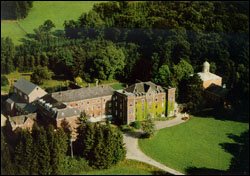
Monastère de Chevetogne


Monastère de Chevetogne
the old website

The community was founded by Dom Lambert Beauduin, one of the pioneers of the Liturgical Movement. Dom Beauduin did spend some of his formation at Maredsous, and was influenced by Dom Columba Marmion. According to the history given by the websites:

The monastery of Chevetogne was founded in 1925 by Dom Lambert Beauduin (1873-1960). This monk of the Benedictine abbey of Mont César (Louvain), previously was deeply involved with the liturgical movement in Belgium. When he came to know the Christian East he realized the extend to which the Churches are divided and started to work for a foundation of a monastery
devoted to Christian unity.

The pontifical letter "Equidem Verba" of Pius XIth to the abbot primate of the Benedictine Order drew attention to the importance of Christian unity and presented the opportunity to accomplish this project. In December 1925, Dom Lambert Beauduin was able to settle down in his foundation, together with a few fellow monks, at Amay-sur-Meuse (diocese of Liege). From there the community moved to Chevetogne (diocese of Namur in the Ardennes) in 1939. On December 11th, 1990 the Priory became an Abbey.

Read more about the history. Dom Beauduin's place in the Liturgical Movement should not be neglected, but I will devote a separate post to him some time. He placed great emphasis on the cultivation of a liturgical spirituality. Chevetogne was one of forerunners of 20th ce Catholic ecumenicism, aimed specifically at reconciling Catholics and Orthodox, with two different groups of monks worshipping in the Roman and Byzantine rites.

I remember seeing a picture of the interior of the Byzantine church, but the relevant part of the new website is under construction. (Moreover, I found no such pic on the old website--overactive imagination?) I thought the Byzantine church looked better than the Latin church, especially since the Latin church was built recently, and appears to be have been built with the spirit of the post-conciliar liturgical reform. Then again, I usually have a strong preference for Byzantine and Eastern architecture; Latin styles beyond the Romanesque are not as appealing, especially when it comes to the placement and design of the altar. (Especially altars with large reredos.) Here is the old page for the Byzantine church.
Some photos of the community's past from the new website; Dom Beauduin:

The community of Amay and Msgr. Roncalli (the future Pope John XXIII--at the left, front row), 14 September 1930:

Amay-sur-Meuse, the Byzantine chapel:

From the old website, plan for the Byzantine church:

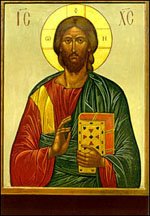
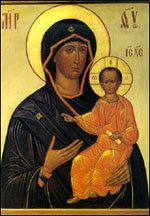
Icons from the iconostasis:


According to their old website:


The icons of the Iconostasis in Chevetogne were painted by the Russian painter George Morozov (1900-1993). The two major icons on either side of the central doors are of Christ, and of the Blessed Virgin Mary, Mother of God, worshipping her son.
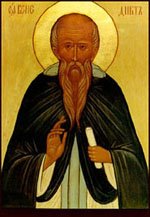
Icon of St. Benedict:


Dom Beauduin's book, Liturgy the Life of the Church, is published by St. Michael's Abbey and distributed in the U.S. through St. Augustine's Press.

Address by Patriarch Bartholomew at Chevetogne, 15 November 1994

The monastery's ecumenical journal, Irénikon.

They sell CDs of their chant and other items online. I do not know what period their chant is from, but it sounds to be of a more recent origin--my guess is that it is the same as the contemporary chant of the Russian Orthodox Church. (Perhaps Slavic chant developed under Western influences?) More investigation would be warranted.

Valaam Monastery

"Hefsiman's skete. The church in the name of the Assumption of Mother of God, 1993" (source)

Revived in 1989 by six monks, the monastery is currently being restored. Apparently some of their chant can be downloaded now! I wonder what their attitude is towards Rome.

Resources on Znamenny Chant: Russian Znamenny Chant, Znamenny chant / Russian Orthodox Hymnody / Veliky Novgorod, http://www.liturgica.com/html/litEOLitMusDev4.jsp?hostname=null, http://www.rus-sky.org/deisus/eng/p.htm

Another website for Valaam.

Sunday, April 23, 2006

Orthodox Pascha! Christos anesti!

Source: OCA

Christos anesti! Alleluia!

While Catholics celebrated Pascha last weekend, the Orthodox are celebrating it this weekend. The Catholic and Orthodox Churches celebrate Pascha on different dates because of their use of the Gregorian and Julian calendars, respectively.

For Catholics, as I noted earlier, this is the second Sunday of Easter, or Divine Mercy Sunday, instituted as a feast for the Universal Church by Pope John Paul II in 2000.

While there is some dispute about the origin of the word "Easter" in English, in Latin countries and most Orthodox countries, some variation of Pascha is used. Pascha means "Passover," and ties the Passion, Death, and Resurrection of our Lord Jesus Christ to the Jewish Passover, through which the Jews were liberated from bondage in Egypt. Christ is the Passover Lamb, who saves men from the bondage of sin and the dominion of death and the devil. (Hence the question by Mary, the Blessed Mother of God in The Passion of the Christ, "Why is this night different from all others?")

Proclamation by Bartholomew, Patriarch of Constantinople.

Message of Archbishop Demetrios of the Greek Orthodox Archdiocese of America (includes both text and audio files).

The greetings of Archbishop Herman of the OCA.

Holy Week photos from St. Vladimir's Seminary.

Maybe I'll post some other pics later.

Muriel Spark, RIP


(Jerry Bauer, AP)

Muriel Spark passed away on Thursday, 13 April 2006. I have not had a chance to read any of her novels; I did give a copy of her last novel to my second sister, but I do not know if she has read it yet. I hope I will get a chance to read something by her soon, but I am afraid that the list of books I should read continues to grow and the time I have diminishes, and this hourglass cannot be turned over.


Roger Kimball's post at Armavirumque.

From First Things:
April 18, 2006
Joseph Bottum writes:
Muriel Spark is gone, dying on Thursday at age eighty-eight, the last representative of Great Britain’s high literary converts before Vatican II.

There’s a revealing moment toward the end of her 1992 memoir of her early career, Curriculum Vitae. Times were hard for her in 1953. She was thirty-five and still quite poor—so poor that when, the next year, she began to have the hallucinations that prompted her first novel, The Comforters, her doctor assumed that the cause was simple lack of food. She herself blames the cheap diet pills she was taking to make herself “feel less hungry” while she lived hand to month in London as a minor poet, book reviewer, and freelance literary critic, editing the Brontë family letters, working on a life of Mary Shelly, and preparing a study of the poet laureate John Masefield.

Things eased a little when Graham Greene, who strongly believed in her talent, began giving Spark £20 and a few bottles of wine a month to keep her going. And one day in 1953, coming home from an authors’ lunch, she bumped into the literary entrepreneur Fr. Philip Caraman, the Farm Street Jesuit and editor of the British Catholic journal The Month, whom she so amused with her stories as they walked along that her sent her a check the next day for £15 “for having made him laugh.”

As though prompted by this anecdote about Fr. Caraman, Spark devotes the next paragraph—and only the next paragraph—of Curriculum Vitae to her conversion, finally mentioning, 202 pages into a 213 page book, that this Scottish-born daughter of a Jewish engineer and an English mother had joined the Catholic Church. “The simple explanation,” she writes, “is that I felt the Roman Catholic faith corresponded to what I had always felt and known and believed.”

What’s revealing about this is, of course, its unrevealingness. Language and structure are everything in the fiction Muriel Spark spent the rest of her life composing. You can see it in the perfect construction of her most famous work, The Prime of Miss Jean Brodie, published in 1962, with its tale of the effect of a self-dramatizing teacher on a Scottish girls’ school. You can see it in the careful unfolding of her best book, the 1959 Memento Mori, in which a voice rings on the telephone to whisper over and over again to a collection of London’s elderly men and women, “Remember that you must die.” You can see it in the somewhat cold precision of The Abbess of Crewe, her 1973 parody of the Nixon White House as a nunnery. You can see it even in those slim, elegant titles she chose for her slim, elegant novels: The Girls of Slender Means in 1963,
Loitering with Intent in 1981, A Far Cry from Kensington in 1988.

In all her work—20 novels and more than 50 stories—there are no personal confessions of the author herself and few insights into her characters’ psychology. Characters always first appear on Spark’s stage as members of a particular class of humankind. Her 1961 The Bachelors begins by denying any individuality among the unmarried men whose uniform existences are shaped by cooking, cleaning, and living for themselves. “Long ago in 1945 all the nice people in England were poor, allowing for exceptions,” The Girls of Slender Means opens. Of Miss Jean Brodie, the author cruelly remarks that there were “legions of her kind during the nineteen-thirties.”

And yet, these characters are not merely types—much less symbols whose humanity has disappeared into their literary function in Spark’s fiction. Sometimes they manage to grow into unique personalities by the novel’s end, as Matthew emerges from his crowd at the end of The Bachelors or William by the conclusion of the 1990 Symposium. But that is usually reserved for the few characters who accept the necessity for self-sacrifice, or stumble across a chance for self-denying love, or find a small measure of selfless grace. When, in opening pages of The Prime of Miss Jean Brodie, a student claims that Leonardo da Vinci is the greatest Italian painter and Jean Brodie answers, “That is incorrect. The answer is Giotto, he is my favorite”—or when, later in the book, she responds to the news that her student Sandy has become a nun by saying, “Do you think she has done this to annoy me?”—Spark has launched as brutal an attack as anyone has ever written against self-absorption, self-importance, and the use of the self as the measure for truth in the world.

Real individuality, in other words, is reserved in Muriel Spark’s fiction for those who manage to forget their individuality. Each small success human beings have at disappearing from hemselves is unique, and each small revelation that a human life can lose itself is a story never told before. But our supposedly unique failures are in fact merely universal, and our supposedly individual lives are actually indistinguishable participations in the common arc of fallen man.

There is considerable irony in a novelist taking such a view of things, for what the novel as an artform typically undertakes—illustrating the universal human condition by drawing a picture of a particular human being—is exactly the opposite of what Spark attempts. This is perhaps the irony that made all the Catholic fiction of the 1940s and 1950s—the Graham Greene books, for instance, of the era in which Spark was formed as a writer and a convert—so peculiar. But in Spark’s case, the irony of fiction’s inverted purpose produced a set of simultaneously witty, elegant, satirical, and macabre novels, each extremely short, each dominated by the calm detachment of a very distant third-person narrator, and each ruled by a sternly deliberate structure designed to conceal the key incident until the novel’s end.

But then, language and structure are everything for Spark because they have to be. In the world long after Vatican II, we can forget both the enormous wave of famous converts in the 1940s and 1950s and the extent to which Catholicism appealed to those converts precisely because what it offered was a structure and a language with which to express what they, in Spark’s words, “had always felt and known and believed” about the world. Personal faith in the truth of that structure and language was somehow simultaneously too obvious for Muriel Spark to bother putting in a novel and too hidden to be reached by literature. “When I am asked about my conversion, why I became a Catholic,” she once explained, “I can only say that answer is both too easy and too difficult.”


Divine Mercy Sunday


(source)

From the diary of Saint Maria Faustina Kowalska:
I am offering people a vessel with which they are to keep coming for graces to the fountain of mercy. That vessel is this image with the signature: "Jesus, I trust in You." (Diary 327)

The two rays denote Blood and Water. the pale ray stands for the Water which makes souls righteous. The red ray stands for the Blood which is the life of souls. These two rays issued forth from the very depths of My tender mercy when My agonized heart was opened by a lance on the Cross. These rays shield souls from the wrath of My Father. Happy is the one who dwell in their shelter, for the just hand of God shall not lay hold of him. (Diary 299)
Taken from EWTN's explanation of the image.

The EWTN page on the feast. More.

From the homily of Pope John Paul II on Divine Mercy Sunday, 22 April 2001.

2. "Give thanks to the Lord, for he is good; for his mercy endures for
ever!" (Ps 117: 1).
Let us make our own the Psalmist's exclamation which we sang in the Responsorial Psalm: the Lord's mercy endures for ever! In order to understand thoroughly the truth of these words, let us be led by the liturgy to the heart of the event of salvation, which unites Christ's Death and Resurrection with our lives and with the world's history. This miracle of mercy has radically changed humanity's destiny. It is a miracle in which is unfolded the fullness of the love of the Father who, for our redemption, does not even draw back before the sacrifice of his Only-begotten Son.

In the humiliated and suffering Christ, believers and non-believers can admire a surprising solidarity, which binds him to our human condition beyond all imaginable measure. The Cross, even after the Resurrection of the Son of God, "speaks and never ceases to speak of God the Father, who is absolutely faithful to his eternal love for man.... Believing in this love means believing in mercy (Dives in misericordia, n. 7). Let us thank the Lord for his love, which is stronger than death and sin. It is revealed and put into practice as mercy in our daily lives, and prompts every person in turn to have "mercy" towards the Crucified One. Is not loving God and loving one's neighbour and even one's "enemies", after Jesus' example, the programme of life of every baptized person and of the whole Church?

Hey, Buddy

Hi Miss Kim, maybe you can show this post to your sister so she knows what I was talking about...


(source)

(From www.toytokyo.com)


(From www.venusvintage.com.)

It's Buddy Lee, icon for Lee Jeans. (Personally I think the doll in the commercials is a bit creepy, like something from a horror movie... too many Twilight Zone episodes and Chucky movies I suppose. The dolls here aren't so bad.)

Someone's classroom handout explaining this advertising creation.

"Let me fight or I quit, says Prince Harry"

From the Manchester Evening News:

Saturday, 22nd April 2006
Let me fight or I quit, says Prince Harry

PRINCE Harry has threatened to quit the Army unless he is sent to the front line, it was reported today.


The Prince and his older brother, Prince William, have both previously made it clear they are determined to see active service with their units.

Harry, 21, was commissioned earlier this month as a Second Lieutenant in the Household Cavalry's Blues and Royals, the Army's oldest and most senior regiment.

The Blues and Royals have been deployed in almost every major Army operation of the past two decades, including the Falklands, both Gulf wars, Bosnia and Kosovo.

The Mail on Sunday reported that Harry told senior officers at Sandhurst before passing out on April 12: "If I am not allowed to join my unit in a war zone, I will hand in my uniform."

This poses serious problems for the advisers tasked with protecting William and Harry, the second and third in line to the throne, and those fighting alongside them.

A spokeswoman for Clarence House said: "Prince Harry is very clear that he is joining the Army, and the Household Cavalry in particular, to serve his country as an operational soldier."

Circumstances

But she added: "On occasion there may be some circumstances in which his presence could attract additional attention, which could lead to additional risk to those he commands or himself.

"In these instances it is a judgment call which would principally be made by his commanding officer."

Harry said in an interview to mark his 21st birthday last September: "The last thing I said was there's no way I'm going to put myself through Sandhurst and then sit on my arse back home while my boys are out fighting for their country.

"That may sound very patriotic, but it's true."

Earlier this month a senior Army figure said it was "eminently possible" Harry could be in a danger zone within 12 months.

Major General Sebastian Roberts remarked on the dangers involved: "The risks for all soldiers are the same. We all sign a blank cheque when we join the Army."

Saturday, April 22, 2006

Mrs. Maggie Murray, RIP


"Christendom Holds Memorial Mass for Long Time Friend and Staff Member Maggie Murray

On Friday, April 21, Christendom faculty, staff, students, and many alumni came together to commemorate the passing away of staff member Maggie Murray, who had suddenly died from pancreatic cancer on April 11. College Chaplain Fr. John Heisler celebrated Mass in Christendom's Christ the King Chapel and focused his homily on the many gifts Maggie had offered Christendom. "Maggie had the incredible ability to remain peaceful in the most chaotic of times," Fr. Heisler remarked, " and her strength and perseverance, even up to the point of her death, is a great example for us all."
Many alumni also came to honor their long-time friend. "Maggie has been a constant strength in our Christendom family," said Alumna Shalon Riddle, "and her absence is sorely felt. In any situation we could always count on her smile!"

May the soul of Maggie Murray, and the souls of all the faithful departed, rest in peace. "

From: http://www.christendom.edu/admissions/chronicler/april06/april2106.html

She was a very friendly person, got along well with the students at Christendom, cheerful... she will be missed.

Lamentations clip

http://newforum.catholic.org/frz/06_04_14_Friday_ten_1st_lam.mp3

It's a week late, but still good...

Found it somewhere on http://newforum.catholic.org/, not sure where though...

A Bloody Business


(pic source)
Sarge, this is the book I was talking about: A Bloody Business: America's War Zone Contractors And the Occupation of Iraq, by Col. Gerald Schumacher. He also wrote To Be a U.S. Army Green Beret and the Foreward for Hunting al Qaeda. He even has his own website.

Newsweek/msnbc audio program featuring Col. Schumacher.

btw, have you heard about Roughneck Nine-One? Is it legit? Edit: Heads up to Live From the Rear for info about the book and book signing tour.

Paul Craig Roberts, 06/04/19

Another Grim Report on the Jobs Front, by Paul Craig Roberts

For you 24 fans

http://youtube.com/watch?v=K_swFUVeVKo

http://youtube.com/watch?v=CmugkhTx8bw&search=24%20jpn
(When Carlos Bernard glares at the end, he reminds me of my cousin's son Kale.)

Thanks to SlashRain at Soompi.

See also: http://cmt24.net/cm/tvcm.html; older commercials here.

It's the Queen's Birthday...

Actually it was yesterday, April 21.

The Queen's official portrait by Lord Snowdon (Snowdon/Camera Press)

Time article on Her Majesty. The official website for the British Royal Family.

Also, Prince Harry recently graduated from Sandhurst:


Britain's Prince Harry marches at the Sovereign's Parade at Sandhurst Military Acadamy, in south-east England. To the strains of "God Save the Queen" and a sergeant-major barking orders, Prince Harry, the red-headed party animal of the royal family, formally embarked on his army career as he graduated from the elite Sandhurst military academy.(AFP/Carl De Souza)

Prince William is currently at Sandhurst, having entered after his brother.

(AFP/Carl De Souza)


Britain's Queen Elizabeth II (L) smiles with her grandson Prince Harry (4th R) during the Sovereign's Parade at the Royal Military Academy in Sandhurst, southern England. (AFP/Carl De Souza)

Info on Sandhurst

I have not heard what Prince Harry's assignment will be. It would be interesting if he had to spend some time in Iraq.

Out on DVD, Windsor Castle A Royal Year. The PBS intro.

(House of Windsor, bah. Not that the Jacobites have a chance of regaining the throne...)

Typepad vs. Blogger

Evidently Typepad has more features, but then again one pays for those features... at least Blogger is better than Xanga, for now...

Some pictures from Rome last weekend


Pope Benedict XVI baptises two Japanese pilgrims during the celebration of the Easter Vigil service at Saint Peter's Basilica in the Vatican April 15, 2006. REUTERS/Tony Gentile


Pope Benedict XVI kisses the icon of the Most Holy Saviour as he leads the Easter mass in Saint Peter's Square at the Vatican April 16, 2006. REUTERS/Max Rossi
More on the restoration of the Resurrexit ritual.

Easter vigil homily

Code: ZE06041606
Date: 2006-04-16
Benedict XVI's Easter Message
"Jesus Is Risen, and He Gives Us Peace"


VATICAN CITY, APRIL 16, 2006 (Zenit.org).- Here is a translation of Benedict XVI's Easter message delivered today at midday before he imparted his blessing "urbi et orbi" (to the city of Rome and the world).

* * *

Dear Brothers and Sisters!

"Christus resurrexit!" -- Christ is risen!

During last night's great vigil we relived the decisive and ever-present event of the Resurrection, the central mystery of the Christian faith. Innumerable paschal candles were lit in churches, to symbolize the light of Christ which has enlightened and continues to enlighten humanity, conquering the darkness of sin and death for ever.

And today echo powerfully the words which dumbfounded the women on the morning of the first day after the Sabbath, when they came to the tomb where Christ's body, taken down in haste from the cross, had been laid. Sad and disconsolate over the loss of their master, they found the great stone rolled away, and when they entered they saw that his body was no longer there.

As they stood there, uncertain and bewildered, two men in dazzling apparel surprised them, saying: "Why do you seek the living among the dead? He is not here, he is risen" (Luke 24:5-6). "Non est hic, sed resurrexit" (Luke 24:6). Ever since that morning, these words have not ceased to resound throughout the universe as a proclamation of joy which spans the centuries unchanged and, at the same time, charged with infinite and ever new resonances.

"He is not here ... he is risen." The heavenly messengers announce first and foremost that Jesus "is not here": The Son of God did not remain in the tomb, because it was not possible for him to be held prisoner by death (cf. Acts 2:24) and the tomb could not hold on to "the living one" (Revelation 1:18) who is the very source of life.

Like Jonah in the belly of the whale, so too Christ crucified was swallowed up into the heart of the earth (cf. Matthew 12:40) for the length of a Sabbath. Truly, "that Sabbath was a high day," as St. John tells us (John 19:31): the highest in history, because it was then that the "Lord of the Sabbath" (Matthew 12:8) brought to fulfillment the work of creation (cf. Genesis 2:1-4a), raising man and the entire cosmos to the glorious liberty of the children of God (cf. Romans 8:21).

When this extraordinary work had been accomplished, the lifeless body was suffused with the living breath of God and, as the walls of the tomb were shattered, he rose in glory. That is why the angels proclaim "he is not here," he can no longer be found in the tomb. He made his pilgrim way on earth among us, he completed his journey in the tomb as all men do, but he conquered death and, in an absolutely new way, by an act of pure love, he opened the earth, threw it open toward heaven.

His resurrection becomes our resurrection, through baptism which "incorporates" us into him. The prophet Ezekiel had foretold this: "Behold, I will open your graves, and raise you from your graves, O my people; and I will bring you home into the land of Israel" (Ezekial 37:12). These prophetic words take on a singular value on Easter Day, because today the creator's promise is fulfilled; today, even in this modern age marked by anxiety and uncertainty, we relive the event of the Resurrection, which changed the face of our life and changed the history of humanity. From the risen Christ, all those who are still oppressed by chains of suffering and death look for hope, sometimes even without knowing it.

May the Spirit of the risen one, in particular, bring relief and security in Africa to the peoples of Darfur, who are living in a dramatic humanitarian situation that is no longer sustainable; to those of the Great Lakes region, where many wounds have yet to be healed; to the peoples of the Horn of Africa, of Ivory Coast, Uganda, Zimbabwe and other nations which aspire to reconciliation, justice and progress. In Iraq, may peace finally prevail over the tragic violence that continues mercilessly to claim victims.

I also pray sincerely that those caught up in the conflict in the Holy Land may find peace, and I invite all to patient and persevering dialogue, so as to remove both ancient and new obstacles. May the international community, which reaffirms Israel's just right to exist in peace, assist the Palestinian people to overcome the precarious conditions in which they live and to build their future, moving toward the constitution of a state that is truly their own.

May the Spirit of the Risen One enkindle a renewed enthusiastic commitment of the countries of Latin America, so that the living conditions of millions of citizens may be improved, the deplorable scourge of kidnapping may be eradicated and democratic institutions may be consolidated in a spirit of harmony and effective solidarity.

Concerning the international crises linked to nuclear power, may an honorable solution be found for all parties, through serious and honest negotiations, and may the leaders of nations and of international organizations be strengthened in their will to achieve peaceful coexistence among different races, cultures and religions, in order to remove the threat of terrorism.

May the risen Lord grant that the strength of his life, peace and freedom be experienced everywhere. Today the words with which the Angel reassured the frightened hearts of the women on Easter morning are addressed to all: "Do not be afraid! ... He is not here; he is risen" (Matthew 28:5-6). Jesus is risen, and he gives us peace; he himself is peace. For this reason the Church repeats insistently: "Christ is risen -- 'Christós anésti.'"

Let the people of the third millennium not be afraid to open their hearts to him. His Gospel totally quenches the thirst for peace and happiness that is found in every human heart. Christ is now alive and he walks with us. What an immense mystery of love! "Christus resurrexit, quia Deus caritas est!" Alleluia!

© Copyright 2006 -- Libreria Editrice Vaticana [adapted]

Benedict XVI Torte


Baker Gertraud Becker presents a chocolate 'Pope Benedict XVI. cake' in a bakery in the small Bavarian village of Marktl, the birth place of Pope Benedict XVI., April 19, 2006. REUTERS/Michaela Rehle

Sarge's Ideal Woman


Maggie Q, from Mission: Impossible 3. "Opens May 5th in theaters everywhere."

Notice she's carrying a HK UMP.

Black Pope and White Pope


AP - Sat Apr 22, 8:17 AM ET
Jesuit Rev. Peter-Hans Kolvenbach, general superior of the largest religious order in the Roman Catholic Church, kisses Pope Benedict XVI's ring during a Mass in St. Peter's Basilica at the Vatican, Saturday April 22, 2006. Kolvenbach is expected to retire at the order's Jan. 5, 2008 meeting, paving the way for delegates to elect his successor, the Society of Jesus' U.S. office said in a statement earlier this year. (AP Photo/Plinio Lepri)

The superior general of the Society of Jesus (Societas Iesu) is nicknamed "the black pope" because of his black cassock--St. Ignatius did not wish for the order to have a distinctive habit, so he adopted the typical garb of the clerics of the Church of Rome--and also because of the power and influence the Jesuits had, and still have to a certain extent, though their reputation has suffered in the last half of the last century because of heterodox members and a failure to enforce discipline by the superiors.

Societas does not really capture the meaning of 'company,' the idea of militancy that St. Ignatius wished to imbue within the order, devoting all of their efforts ad majorem Dei gloriam, for the greater glory of God.

With the election of a new superior general, will we get reform of the order? Will it become what St. Ignatius intended? Will things at BC improve?

(AP Photo/Plinio Lepri)

I found out from a Jesuit that the Jesuits have a special relationship with the Carthusians. Evidently St. Ignatius of Loyola was an admirer of St. Bruno, and so members of the two communities can "transfer" to the other without having to go through probation. (Or something like that--"In fact, in the Jesuit rules, the only religious orders a Jesuit can transfer to and come back without having to undergo probation again are the Carthusians.") I suppose it would be nice to get official confirmation of this though, since Sarge says it's not true.

Gregorian University, founded by St. Ignatius and St. Francis Borgia. (Fr. Kevin Flannery, S.J. teaches there.)

Translation of the Holy Father's address on this occasion, from Rocco Palmo.

Friday, April 21, 2006

Revisions in Need of Revising

Revisions in Need of Revising: What Went Wrong in the Iraq War, by David C. Hendrickson and Robert W. Tucker pdf (original source page)

William Lind says it's "the best study I have thus far seen."

Plus: Unrestricted Warfare, by Qiao Liang and Wang Xiangsui

Sonshi.com, "The Largest Sun Tzu Art of War Site"

Why "The New Beginning"?

Because I might be blogging here regularly instead of xanga. Although I suppose I could just cut and paste entries into Xanga. Blogger lets me put up links, and that's a nice feature. I don't have time for MySpace, and using Facebook seems a bit too 'pervy.' (I don't even know if there is blogging at MySpace and Facebook.)
It would have been more appropriate to start a new blog once I had returned to California, but though I wish to leave as soon as I can, it is not clear when that will be. I hope oil prices don't make it impossible...

I still don't know how seriously I will take this, but I did consider posting on topics related to politics and the military on a separate blog, since Blogger makes it easy to create multiple blogs through one account.

The other reason why I chose the name is Mel Gibson's (mis-)translation of the Greek word apokalypto.

http://filmforce.ign.com/articles/702/702127p1.html

Apocalypto Later
Mel's Mayan movie makes a move.
by Stax

April 18, 2006 - USA Today reports, via The Associated Press, that Mel Gibson's next directing effort, Apocalypto, will not meet its anticipated August 4 release date after all. Mel's Mayan epic has been plagued by stormy weather during its South American shoot, which has delayed filming enough to warrant the release date switch.Apocalypto will now bow on December 8, right at the height of awards season no less. According to a recent write-up in Time, Gibson's film "takes place in an opulent but decaying Maya kingdom, whose leaders insist that if the gods are not appeased by more temples and human sacrifices, the crops will die." And the lucky winner? Jaguar Paw (newcomer Rudy Youngblood), who goes on the run to avoid his fate. Gibsons says that "Apocalypto" is derived from the Greek for "a new beginning," and was inspired by his work with the Mirador Basin Project to save the Guatemalan rain forest and the ruins of Mayan civilization.

Where did Mel get his translation? There's some controversy about that. According to the AP article cited:

The film’s title, "Apocalypto," a Greek word for an unveiling or new beginning, "just expresses so well that I want to convey," Gibson said. "I think it's just a universal word. In order for something to begin, something has to end. All of those elements are involved. But it's not a big doomsday picture or anything like that."

Unveiling, hence, the Book of Revelation. Of course, the Book of Revelation does talk about THE "new beginning"; maybe I should ask one of the Classics professors at BC about the word. I am looking forward to the movie, though the subject matter isn't as important as The Passion of the Christ, the movie should contain some important themes relevant for us today.

Anyways, English translations of some apocryphal/non-canonical texts can be found here.

Cardinal Newman, The Patristical Idea of the Antichrist:
Part 1, Part 2, Part 3, Part 4