SJCCC 2007 Christmas Party Line Dance Part 1
Not bad... haha.
San Jose Chinese Catholic Community
Cantonese group
Wednesday, July 16, 2008

Thomas Woods, Authority Issues—Is There Sovereignty Beyond the State?
The first few paragraphs are a diversion into Dr. Woods's libertarianism. Is Dr. Woods giving too much of a libertarian slant on medieval history and political theory? (The latter he does not discuss in this first part of the series.)
So what do the medievals say about dominium? How is Bodin's conception of sovereignty different from the claims put forth by the Holy Roman Emperor? Are there other competing notions of sovereignty in the 15th century and afterwards? Did not the medieval polities legislate against injustice? And is not injustice a concern of morality?
The first few paragraphs are a diversion into Dr. Woods's libertarianism. Is Dr. Woods giving too much of a libertarian slant on medieval history and political theory? (The latter he does not discuss in this first part of the series.)
So what do the medievals say about dominium? How is Bodin's conception of sovereignty different from the claims put forth by the Holy Roman Emperor? Are there other competing notions of sovereignty in the 15th century and afterwards? Did not the medieval polities legislate against injustice? And is not injustice a concern of morality?
We’re often told in the Peak Oil community “get out of debt,” and yet, as we continue to pay the minimum on the credit card each month, it appears to have little effect on the overall balance of the bill. Should we forget about getting out of debt and just start putting up supplies? Not unless you have a crystal ball that tells you when all US banks will fail, and that whatever entity takes them over will be unable to figure out how to collect your monthly payments.
Here are some concrete suggestions on how to break out of the cycle.
Here are some concrete suggestions on how to break out of the cycle.
In Aramaic!
The Lord's Prayer in Ancient Aramaic
The Lord's Prayer in Assyrian "Aramaic"
Abwoon D'Bashmaya - The Lords Prayer in Aramaic
Lords Prayer in the orignial Aramaic
TLIG - Abbun Dbashmayo - Lord's Prayer Our Father in Aramaic
The Lords Prayer in Aramaic
Our Father sung in Syriac Aramaic..Beautiful [Lisa Gerrard]
Syriac Orthodox - Our Father In Syriac, aramaic
Links:
wiki on Aramaic; the alphabet; Syriac; Syriac alphabet
The Aramaic Language
Aramaic Bible
Aramaic/Proto-Hebrew alphabet
Welcome to The Assyrian Aramaic Language Website
Learn Assyrian (Syriac-Aramaic) OnLine
Christus Rex
Syriac script
CE on Syriac
Beth Mardutho: The Syriac Institute
The Syriac Maronites
Syriac Studies Reference Library
Syriac Music
Hugoye: Journal of Syriac Studies
Shroro: The Syriac Orthodox Christian Digest
Syriac Orthodox Church Of Antioch
Malankara Syriac Christian Resources - http://SyriacChristianity.org
Something the New Scot would like--
The Lords Prayer in Old English from the 11th century
The Lord's Prayer in Assyrian "Aramaic"
Abwoon D'Bashmaya - The Lords Prayer in Aramaic
Lords Prayer in the orignial Aramaic
TLIG - Abbun Dbashmayo - Lord's Prayer Our Father in Aramaic
The Lords Prayer in Aramaic
Our Father sung in Syriac Aramaic..Beautiful [Lisa Gerrard]
Syriac Orthodox - Our Father In Syriac, aramaic
Links:
wiki on Aramaic; the alphabet; Syriac; Syriac alphabet
The Aramaic Language
Aramaic Bible
Aramaic/Proto-Hebrew alphabet
Welcome to The Assyrian Aramaic Language Website
Learn Assyrian (Syriac-Aramaic) OnLine
Christus Rex
Syriac script
CE on Syriac
Beth Mardutho: The Syriac Institute
The Syriac Maronites
Syriac Studies Reference Library
Syriac Music
Hugoye: Journal of Syriac Studies
Shroro: The Syriac Orthodox Christian Digest
Syriac Orthodox Church Of Antioch
Malankara Syriac Christian Resources - http://SyriacChristianity.org
Something the New Scot would like--
The Lords Prayer in Old English from the 11th century
W Bradford Wilcox, Faithful husbands and fathers
Churchgoing men are not a hangover of the old patriarchy but a new breed who are closely connected to their families.
Churchgoing men are not a hangover of the old patriarchy but a new breed who are closely connected to their families.
Inkling Books
From the comments section to the Crunchy Con's thread on Gopnik and Chesterton:
Chesterton and the New Yorker « All Manner of Thing
From the comments section to the Crunchy Con's thread on Gopnik and Chesterton:
Chesterton's alleged 'anti-Semitism'In his day, there were a number of writers who liked Chesterton's fiction and poetry but, for ideological reasons of their own, were infuriated by his politics or religion. One talked of wanting to split Chesterton in two, to which Chesterton replied that a lot of people who saw him traveling on buses thought the same. Gopnik seems to be one of that number and, like many of the rest, it seems to lead him into irrationalities.
Those who'd like to explore Chesterton's relationship with the Jews might want to read a book I recently edited, Chesterton on War and Peace: Battling the Ideas and Movements that Led to Nazism and World War II. Someone has noted that the book is the ultimate refutation of those who, like Gopnik, claim Chesterton was anti-Semitic. They're right.
To understand why, you need to step back a bit over a century to an era when almost everyone who was well-educated believed what the major universities were teaching almost without exception, that humanity was divided into superior and inferior races, with the former building civilizations and the latter tearing them down. That's simply how history was taught at places such as Harvard, Yale and Oxford in the late 1800s and for decades thereafter. Margaret Sanger's 1922 The Pivot of Civilization is an example of the thesis applied to birth control. We need birth control, she said, to keep the inferiors (mostly Irish, Italians and Polish Jewish immigrants) from outbreeding us. Chesterton's Eugenics and Other Evils was his attack on that idea as a domestic issue. Chesterton never collected under one cover his good articles on the same concept as an international issue, so I did it for him in Chesterton on War and Peace.
From his youth, Chesterton would have none of that racist nonsense. He poured scorn on the idea that there were racial distinctions that mattered among the various groups of Europeans (including Jews). He made it quite clear that ideas such as Teutons and Semities were totally nonsense, having absolutely no meaning at all. Chesterton was incapable of being anti-Semitic because he thought all ideas that Semities existed were bosh. He says that repeated. He says that clearly. He says that bluntly. And he says that in defiance of the conventional wisdom of his day.
As his pair of books, Heretics and Orthodoxy, indicate, he believed that what a nation, a people or a group believed mattered and determined how they lived not by who their ancestors were or trivial distinctions in how they looked. And in the realm of loathed beliefs, those of the Prussians, particularly Prussian professors and bureaucrats, ranked the highest. Call him anti-Prussian, and he would ;smile in delight. His loathing for all things Prussian (except their music) is why he was one of the first and definitely one of the loudest critics of the trends in Germany that became Nazism (hence my book's title). And he defined the distinction between civilization and barbarism in such a way as to include virtually all of academic Germany among the barbarians. Barbarians, he noted, see men driven by forces outside themselves. It matters not whether those forces are demons in the woods or historical nonsense like Teutonism.
I highly recommend the book. In it Chesterton was warning during WWI that there was something terrible wrong with Germany that, if not corrected, would lead to another and still more horrible war within a generation. In 1932 he went still further and warned that the next war would break out over a border dispute between Germany and Poland, precisely what happened in 1939.
--Michael W. Perry, editor of Chesterton on War and Peace.
Chesterton and the New Yorker « All Manner of Thing
Videos of Saint Josemaría Escrivá
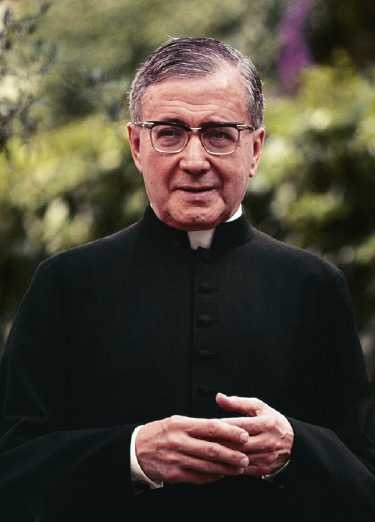
Some short videos with Saint Josemaría Escrivá (in Spanish). Videos with English subtitles can be found here. (His feast day is June 26.)
Passionately Loving the Word (windows media file)
Opus Dei - MULTIMEDIA - Photos: Saint Josemaría Escrivá, 1902-1975“Try to commit yourself to a plan of life”This tying of one's life to a plan, to a timetable, you tell me, is so monotonous! And I answer: there is monotony because there is little Love. (The Way, 77)Try to commit yourself to a plan of life and to keep to it: a few minutes of mental prayer, Holy Mass — daily, if you can manage it — and frequent Communion; regular recourse to the Holy Sacrament of Forgiveness — even though your conscience does not accuse you of mortal sin; visiting Jesus in the Tabernacle; praying and contemplating the mysteries of the Holy Rosary, and so many other marvellous devotions you know or can learn.
You should not let them become rigid rules, or water‑tight compartments. They should be flexible, to help you on your journey you who live in the middle of the world, with a life of hard professional work and social ties and obligations which you should not neglect, because in them your conversation with God still continues. Your plan of life ought to be like a rubber glove which fits the hand perfectly.
Please don’t forget that the important thing does not lie in doing many things; limit yourself, generously, to those you can fulfill each day, whether or not you happen to feel like doing them. These pious practices will lead you, almost without your realizing it, to contemplative prayer. Your soul will pour forth more acts of love, aspirations, acts of thanksgiving, acts of atonement, spiritual communions. And this will happen while you go about your ordinary duties, when you answer the telephone, get on to a bus, open or close a door, pass in front of a church, when you begin a new task, during it and when you have finished it: you will find yourself referring everything you do to your Father God. (Friends of God, 149)

Cardinal Ratzinger on St. Josemaria Escriva
Saint Josemaría Escrivá and the Holy Mother
Opus Dei Links:
Opus Dei; prayer card (pdf)
Saint Josemaría website; writings
Romana
"Grace in the spirituality of St. Josemaria Escriva," by Cardinal Leo Scheffczyk
St. Josemaria Institute
Midwest Theological Forum
Scepter Publishers
University of Navarra. Center of Documentation and Studies on Josemaría Escrivá
Don Álvaro del Portillo:
Google Books:Immersed in God: Blessed Josemaría Escrivá, Founder of Opus Dei by Álvaro del Portillo
Bishop Alvaro del Portillo Talks About St. Josemaria Escriva, part 2
Alvaro del Portillo, prelado del Opus Dei 1975-1994
YouTube - Don Alvaro del Portillo y el trabajo
YouTube - Álvaro del Portillo, Prelado del Opus Dei
Tuesday, July 15, 2008
Katharine Mieszkowski, The unbearable whiteness of being
The author of "Stuff White People Like" skewers the sacred cows of lefty Caucasian culture, from the Prius to David Sedaris.
Stuff White People Like by Christian Lander
The blog--there's even a Facebook application now.
More interviews with the author:
Heeb: HQ : Stuff White People Like's Christian Lander
The Daily Californian - The White Stuff: Christian Lander Interview
Salon conversations: "Stuff White People Like," Christian Lander
YouTube - Christian Lander, creator "Stuff White People Like" Part 1
The author of "Stuff White People Like" skewers the sacred cows of lefty Caucasian culture, from the Prius to David Sedaris.
Stuff White People Like by Christian Lander
The blog--there's even a Facebook application now.
More interviews with the author:
Heeb: HQ : Stuff White People Like's Christian Lander
The Daily Californian - The White Stuff: Christian Lander Interview
Salon conversations: "Stuff White People Like," Christian Lander
YouTube - Christian Lander, creator "Stuff White People Like" Part 1
EWTN coverage of WYD 2008
here
OPENING MASS WITH CARDINAL PELL (LIVE) 3 hrs
Presided over by Cardinal George Pell, this Mass formally celebrates the opening of WYD 2008. A much-anticipated feature of the Mass will be the arrival of the WYD Cross and Icon.
Tue 7/15/08 9:00 PM ET & 6 PM PT
Wed 7/16/08 12:00 AM ET & 9 PM PT (Tue)
ARRIVAL AND WELCOME OF THE HOLY FATHER (LIVE) 3 hrs
Pope Benedict XVI arrives in Sydney via the Sydney Harbour where he will be welcomed by thousands; festivities include a civic reception, a welcome to land from local indigenous leaders, and more.
Thu 7/17/08 12:30 AM ET & 9:30 PM PT ( Wed )
Thu 7/17/08 10:00 AM ET & 7 AM PT
Thu 7/17/08 4:00 PM ET & 1 PM PT
Thu 7/17/08 9:30 PM ET & 6:30 PM PT
STATIONS OF THE CROSS ~ A RE-ENACTMENT OF OUR LORD'S PASSION AND DEATH (LIVE) 3 hrs
This theatrical and devotional re-enactment of Our Lord’s Passion and Death will be held across a number of venues including Barangaroo, Darling Harbour and the Sydney Opera House, transforming the city into an outdoor cathedral.
Fri 7/18/08 12:30 AM ET & 9:30 PM PT ( Thu )
Fri 7/18/08 2:30 PM ET & 11:30 AM PT
HOLY MASS AND DEDICATION OF THE ALTAR (LIVE) 3 1/2 hrs
Fri 7/18/08 7:00 PM ET & 4 PM PT
EVENING VIGIL WITH THE HOLY FATHER (LIVE) 3 hrs
Sat 07/19/08 4:30 AM ET & 1:30 AM PT
CLOSING MASS (LIVE) 4 hrs.
Pope Benedict XVI celebrates the final Mass: the high point of the 2008 World Youth Day events.
Sat 7/19/08 7:00 PM ET & 4 PM PT
Sun 7/20/08 12:00 AM ET & 9 PM PT (Sat)
Sun 7/20/08 12:00 PM ET & 9 AM PT
Sun 7/20/08 8:00 PM ET & 5 PM PT
Mon 7/21/08 1:00 AM ET & 10 PM PT (Sun)
Mass. Senate votes to let out-of-state gays marry
What legal ramifications would this have on their home states?
What legal ramifications would this have on their home states?
World Youth Day 2008 stuff
Love and Life @ WYD 2008 website. Ruth Rusell is also mentioned by Dawn Eden. Miss Russell speaks on love and chastity. Click on the link to see a video. Here is an article.

High cost of free love | The Australian
Go fly down to Australia, Sarge. Unforunately, I think she has a bf already. haha.
The theme song for WYD 2008--Receive the Power - Guy Sebastian and Paulini
alt, international version
Yeah, I don't like it, but what can you do? At least Juventutem has a presence.
Juventutem Australia
AD2000: Juventutem Australia: young people devoted to the traditional liturgy
Juventutem blog
Fœderatio Internationalis Juventutem - Home
Bienvenue sur le site de JUVENTUTEM
Juventutem USA
"Sydney: Witness the Spirit" WYD08 DVD
Who designed the altar!?! (There's a better photo at NLM.)

(AP Photo/Rick Rycroft)
At least there is an icon of the Theotokos:

(AP Photo/Mark Baker)
An icon of the Theotokos is often displayed at important large liturgies, but it usually is alone. Would it not be nice if an icon of our Lord were to be put on the other side of the altar? I do not think this would be an example of the 'Byzantinization' of the Roman Rite, since everything else would be the same.* Some might defend having the icon of the Blessed Mother alone as a novel Roman practice precisely for this reason, that it is not like the iconostasis of the Byzantine rite. But as long as we are not adopting Byzantine practices and prayers for the icons, how could it hurt to have both icons in front of the altar? (They should be censed at the appropriate times, though.)
*Even though I wouldn't mind the creation of a rood screen that is more like an Eastern iconostasis. But I do not think such a development is likely to occur, except perhaps in the chapel of a religious community.
In contrast, the Kenthurst Study Center oratory looks typical for an Opus Dei oratory. I think the altar looks ok, certainly better than the main one being used for WYD 2008.

High cost of free love | The Australian
Go fly down to Australia, Sarge. Unforunately, I think she has a bf already. haha.
The theme song for WYD 2008--Receive the Power - Guy Sebastian and Paulini
alt, international version
Yeah, I don't like it, but what can you do? At least Juventutem has a presence.
Juventutem Australia
AD2000: Juventutem Australia: young people devoted to the traditional liturgy
Juventutem blog
Fœderatio Internationalis Juventutem - Home
Bienvenue sur le site de JUVENTUTEM
Juventutem USA
"Sydney: Witness the Spirit" WYD08 DVD
Who designed the altar!?! (There's a better photo at NLM.)

(AP Photo/Rick Rycroft)
At least there is an icon of the Theotokos:

(AP Photo/Mark Baker)
An icon of the Theotokos is often displayed at important large liturgies, but it usually is alone. Would it not be nice if an icon of our Lord were to be put on the other side of the altar? I do not think this would be an example of the 'Byzantinization' of the Roman Rite, since everything else would be the same.* Some might defend having the icon of the Blessed Mother alone as a novel Roman practice precisely for this reason, that it is not like the iconostasis of the Byzantine rite. But as long as we are not adopting Byzantine practices and prayers for the icons, how could it hurt to have both icons in front of the altar? (They should be censed at the appropriate times, though.)
*Even though I wouldn't mind the creation of a rood screen that is more like an Eastern iconostasis. But I do not think such a development is likely to occur, except perhaps in the chapel of a religious community.
In contrast, the Kenthurst Study Center oratory looks typical for an Opus Dei oratory. I think the altar looks ok, certainly better than the main one being used for WYD 2008.
Sisters of Mary, Mother of the Church
I learned about the group through the comments to this thread at NLM. They returned to full communion with the Church not too long ago. Please keep them in your prayers as they discern how to best serve our Lord.
I learned about the group through the comments to this thread at NLM. They returned to full communion with the Church not too long ago. Please keep them in your prayers as they discern how to best serve our Lord.
Cosmos-Liturgy-Sex: Do Thomists Make Bad Liturgists?
I think the question is whether Thomas reduces the Church's liturgy to the sacrament of the Holy Eucharist. I do not think he does, but as far as I know, he does not treat of the liturgy itself, either. (That is, he does not have a theology of the liturgy that can be pieced together.
I don't know if Dr. Hemming treats of liturgical theology (which is not the same as theology of the liturgy) in his book, but Dr. Reid's review indicates that Dr. Hemming does regard the liturgy as a source of the practice of theology. That is to say, one cannot do theology without being well-grounded in the Christian spiritual life, and the liturgy holds a central place in Christian spirituality. Certainly, many of the Dominicans I have met recognize this.
Just as Aquinas respected the Church Fathers, I think there is room within "Thomism" as a theological tradition to recognize that the Church's liturgy is a part of Sacred Tradition and thereby incorporate it as a theological source, using the insights of insights of theologians like Fr. Louis Bouyer and Fr. Alexander Schmemann in this regard. And a fuller account of the liturgy remains to be written from a Thomistic perspective.
I think the question is whether Thomas reduces the Church's liturgy to the sacrament of the Holy Eucharist. I do not think he does, but as far as I know, he does not treat of the liturgy itself, either. (That is, he does not have a theology of the liturgy that can be pieced together.
I don't know if Dr. Hemming treats of liturgical theology (which is not the same as theology of the liturgy) in his book, but Dr. Reid's review indicates that Dr. Hemming does regard the liturgy as a source of the practice of theology. That is to say, one cannot do theology without being well-grounded in the Christian spiritual life, and the liturgy holds a central place in Christian spirituality. Certainly, many of the Dominicans I have met recognize this.
Just as Aquinas respected the Church Fathers, I think there is room within "Thomism" as a theological tradition to recognize that the Church's liturgy is a part of Sacred Tradition and thereby incorporate it as a theological source, using the insights of insights of theologians like Fr. Louis Bouyer and Fr. Alexander Schmemann in this regard. And a fuller account of the liturgy remains to be written from a Thomistic perspective.
Patrick J. Ford on the iPhone and the End of Civilization
The iPhone is a tool that enables us be engrossed with music or videos during every spare moment of our time. We choose to remain prisoners in the cave, we choose to be passive consumers instead of citizens seeking to strengthen community and its cultural life. We may have our excuses, that there is nothing we can do on our own, that one person cannot improve the life of the community, if no one else is interested in cooperating. Yes, the young (and not-so-young) have certain burdens of living in this society, which they did not create and cannot easily escape. But we have to take our stand, pray, be vigilant, and seek other people who share the same goals as we, so that we can live out Christian friendship and spread it. That is as much a part of the 'new' evangelization as telling people about Christ.
How often do I see families walking by, where the kids are in their own worlds, listening to their iPods, while the parents are busy chatting on their cell phones through the use of bluetooth devices. I suppose it isn't that different from 10 or 20 years ago, when the children had walkmans and discmans, although the demographics in the hometown have certainly changed.
Chinese parents (E. Asian?) tend to be rather indulgent towards their children, buying for them the latest gadgets and toys, whether it be computers or game consoles. This sort of consumption is noticeable among all classes--even the poor will buy the same expensive toys for their children. The behavior of Chinese parents is just more noticeable since I'm Chinese, and also because most Chinese in the South Bay are in the middle-class. I don't see very often the poorer Chinese immigrants from Hong Kong or China, except at restaurants. But HK and China are not noted for showing restraint towards consumerism these days.
Now I wouldn't claim that the members of American families don't spend any time talking with one another. But the actual amount of awake time well-off parents spend with children is already rather limited--what fraction of that time is spent in meaningful conversation? Should we be surprised that moral education within the family is no longer being carried it? How many fathers give the direction and advice that children and adolescents need? How many parents prefer to take a laissez-faire approach instead, whether it be fornication, cohabitation, or some other 'risky' behavior? (And how many parents have the ability to engage in a deep conversation with their children? In such a rich country, the intellectual retardation of its adult citizenry is both rather telling and sad.)
Most Americans do their best to avoid the solitude and silence that are needed to encounter the Divine in private prayer. Would they be able to sit through Into Great Silence (official site), much less be inspired by it? Perhaps now more than ever we need the witness of monks and nuns, the Christian contemplatives. Let us pray that our youth at World Youth Day learn something about the Christian liturgical and contemplative traditions, as well as asceticism and take it home.


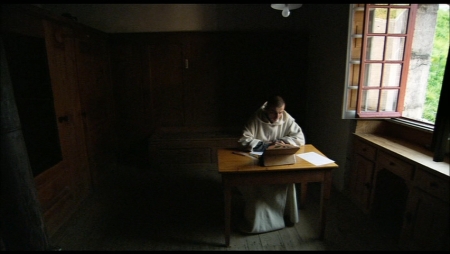
"Lord, teach us to pray" | Gabriel Bunge, O.S.B. (from the introduction to the following book)
Gabriel Bunge, O.S.B., Earthen Vessels: The Practice of Personal Prayer According to the Patristic Tradition
I'll Take My Stand by Twelve Southerners
[Google Books]
More:
Did Apple Really 'Sell' 1 Million iPhones To Customers? Nope.
Tripod Attack!
Wow. McCain just made a statement about how the lessons we learned in Iraq will help us win in Afghanistan. Clueless old man.
I’m no surly old man, but even at my ripe-young age I can see the iPhone for what it is: scary. It mainstreams a world previously left only to 80 hour a week workaholics, a world where every moment is dictated by a new email, a new text message, new stock quotes, new twitter feeds, GPS direction, and, when it all slows down a little, new “Monkey Ball” games, all the while those little white ear buds blast Coldplay and The Pussycat Dolls. The iPhone is a utopian fantasy, where we manage each nook and cranny of our lives in every waking second, leaving no stone unturned and not a minute unoccupied.Apple has preserved its market niche with its toys and computers. How many of my friends were waiting outside an Apple store to buy the new iPhone? I am guessing that a few of the contributors to The American Scene and other young bloggers have purchased one, or are planning to.In the world of the iPhone, everything revolves around “me”. Everything that I want, I need, and everything that I need, I need right now. Desires become rights. And impossibly enough, while the iPhone gives me everything I want, it leaves me with no time for myself. Who has time to sit and read when you’re forwarding emails, answering text messages, bidding on iPhone accessories, and watching Miss Teen South Carolina on YouTube? What was once mere distraction has now become your life.
Look at all the lonely people. Where do they all belong? On their iPhones.
The iPhone is a tool that enables us be engrossed with music or videos during every spare moment of our time. We choose to remain prisoners in the cave, we choose to be passive consumers instead of citizens seeking to strengthen community and its cultural life. We may have our excuses, that there is nothing we can do on our own, that one person cannot improve the life of the community, if no one else is interested in cooperating. Yes, the young (and not-so-young) have certain burdens of living in this society, which they did not create and cannot easily escape. But we have to take our stand, pray, be vigilant, and seek other people who share the same goals as we, so that we can live out Christian friendship and spread it. That is as much a part of the 'new' evangelization as telling people about Christ.
How often do I see families walking by, where the kids are in their own worlds, listening to their iPods, while the parents are busy chatting on their cell phones through the use of bluetooth devices. I suppose it isn't that different from 10 or 20 years ago, when the children had walkmans and discmans, although the demographics in the hometown have certainly changed.
Chinese parents (E. Asian?) tend to be rather indulgent towards their children, buying for them the latest gadgets and toys, whether it be computers or game consoles. This sort of consumption is noticeable among all classes--even the poor will buy the same expensive toys for their children. The behavior of Chinese parents is just more noticeable since I'm Chinese, and also because most Chinese in the South Bay are in the middle-class. I don't see very often the poorer Chinese immigrants from Hong Kong or China, except at restaurants. But HK and China are not noted for showing restraint towards consumerism these days.
Now I wouldn't claim that the members of American families don't spend any time talking with one another. But the actual amount of awake time well-off parents spend with children is already rather limited--what fraction of that time is spent in meaningful conversation? Should we be surprised that moral education within the family is no longer being carried it? How many fathers give the direction and advice that children and adolescents need? How many parents prefer to take a laissez-faire approach instead, whether it be fornication, cohabitation, or some other 'risky' behavior? (And how many parents have the ability to engage in a deep conversation with their children? In such a rich country, the intellectual retardation of its adult citizenry is both rather telling and sad.)
Most Americans do their best to avoid the solitude and silence that are needed to encounter the Divine in private prayer. Would they be able to sit through Into Great Silence (official site), much less be inspired by it? Perhaps now more than ever we need the witness of monks and nuns, the Christian contemplatives. Let us pray that our youth at World Youth Day learn something about the Christian liturgical and contemplative traditions, as well as asceticism and take it home.

"Lord, teach us to pray" | Gabriel Bunge, O.S.B. (from the introduction to the following book)
Gabriel Bunge, O.S.B., Earthen Vessels: The Practice of Personal Prayer According to the Patristic Tradition
I'll Take My Stand by Twelve Southerners
[Google Books]
More:
Did Apple Really 'Sell' 1 Million iPhones To Customers? Nope.
Tripod Attack!
Wow. McCain just made a statement about how the lessons we learned in Iraq will help us win in Afghanistan. Clueless old man.
Times: Walk Antonine's Wall (forget Hadrian's)
As Scotland's Antonine Wall gains world heritage status, Ian Belcher follows in the footsteps of the Roman legions
via LRC
As Scotland's Antonine Wall gains world heritage status, Ian Belcher follows in the footsteps of the Roman legions
via LRC
College leaders, with help from facilities managers, sustainability directors, faculty members, and even students, should think hard about how systems on their campus would operate in an energy-scarce world. That thinking should range beyond running part of the campus fleet on a cafeteria's fryer oil, a seemingly-popular response at the moment.
And if they were to really do so, how many of them could admit that they are quite useless for preparing the youth for a post-oil political economy?
And if they were to really do so, how many of them could admit that they are quite useless for preparing the youth for a post-oil political economy?
Michael Hudson, Why the Bail Out of Freddie Mac and Fannie Mae is Bad Economic Policy
The Democratic congress pushes for American families to pay higher home pricesCongressional banking committee heads are simply behaving as politicians traditionally do by giving priority to their major campaign contributors in the financial and real estate sectors. Led by Democratic senators Charles Schumer from Wall Street and Christopher Dodd from Connecticut’s insurance industry, and supported by Congressman Barney Frank from the real estate sector, Congress is seeking to bail out the bubble’s sponsors, not its victims. The plan is to re-inflate the housing bubble at least long enough for the largest banks and other financial speculators to dump their riskiest holdings. Book values on these mortgages – and the real estate that backs them – are purely fictitious, despite the AAA whitewash from bond-rating agencies which themselves are now under investigation for the fatal Arthur Anderson-style conflict of interest between their research and sales arms.
Dealing as they do with real estate, and hence with local urban politics where most of the property values and maneuvering occur, Fannie Mae and Freddie Mac are largely Democratic creations. James A. Johnson ran Fannie for most of the 1990s and was its main lobbyist. Until June he headed Barack Obama’s vice-presidential search team, but resigned when it was revealed that he got mortgages on unrealistically favorable terms from Angelo Mozilo’s notorious Countrywide Financial. FNMA’s former head, Franklin D. Raines, was President Clinton’s budget chief. He was forced to step down when serious accounting problems were discovered. Other Fannie apparatchiks include Jamie Gorelick, former Clinton deputy attorney general, and Thomas E. Donilon, Clinton chief of staff to the secretary of state.
To be sure, political opportunism leads Fannie and Freddie to cover all the bases, becoming known for hiring relatives of powerful politicians wherever they may be in a position to help. But at least this time the problem is not George Bush’s fault. The Wall Street Journal seems closer to reason than the Democratic Congress. Over the weekend its editorial clarified what socialists since Marx have been saying: “What taxpayers need to understand is that Fannie and Freddie already practice socialism, albeit of the dishonest kind. Their profit is privatized but their risk is socialized.” Calling FNMA and Freddie “high-risk monsters,” the newspaper noted that “Wall Street and the homebuilders also cashed in on the subsidized business, and also paid back Congress in cash and carry.” It concluded by questioning whether these government-sponsored enterprises (GSEs) were justified at all. “Apart from outright failure, the worst scenario would be a capital injection that left the companies free to commit the same mayhem all over again two or 10 years from now.”
In a separate article the Journal noted that, “On a fair-value basis, the company [Freddie Mac] had negative net worth of nearly $17 billion.” The problem is that there is no “market” – that is, no supply of equally gullible buyers – to take on these bad loans, except at distress prices. Through short-term greed and incompetence, the home-debt industry has pawned off highly debt-leveraged mortgage loans drawn up from fraudsters. They can’t be called crooks exactly, because instead of being indicted, they have been rewarded with tens of millions of dollars in bonuses for making so much money as debt innovators for the finance, insurance and real estate sectors.
Their place is to be taken by the government as bad-debt buyer of last resort. I suppose this might be called Finance Socialism – the stage at which it becomes necessary to rescue Finance Capitalism, at least its largest institutions (“too large to fail”) at the top of the economic pyramid. Or it might be called “real estate finance capitalism.” But in Washington-talk it is euphemized in the Democratic Party’s usual populist garb as “democratizing property” and “increasing homeownership,” by which is meant indebting a rising share of the population to the point where carrying their mortgage absorbs most of their disposable personal income.
Can a new real estate bubble be inflated?
The fact remains that like every financial bubble in history starting with England’s South Sea Bubble and France’s Mississippi Bubble in the 1710s nearly three centuries ago, today’s bubble has been sponsored by the government. Forget the “madness of crowds” free-market propaganda. Insiders and enabling politicians always try to blame the victim. The reality is that Fannie, Freddie and the FHA gave a patina of confidence to irresponsible lending and outright fraud. This confidence game led them to guarantee some $5.3 trillion of mortgages, and to keep $1.6 trillion more on their own books to back the bonds they issued to institutional investors. Their strategy has been to issue bonds paying fairly low interest rates, and use the proceeds to buy mortgages yielding somewhat higher rates. This kind of interest-rate arbitrage is what the S&Ls did in the 1980s – a relevant parallel, as I will discuss below.
The myth is that Fannie’s and Freddie’s role is simply to spread homeownership by making it affordable for more of the population. Fannie Mae was established in the Depression, in 1938 as part of Roosevelt’s New Deal, and privatized in 1968. Freddie Mac was established two years later, in 1970, to buy up S&L mortgages and give “liquidity” to their mortgages, by developing markets beyond the banks and S&Ls that originated these loans. But this turned out to be the “original sin,” so to speak. Non-bank investors were obliged to place their trust in the mortgage originators – banks, S&Ls and mortgage brokers, whose ranks are filled with fraudsters and crooks.
Whatever we may call it, their dream is to bring back the seeming golden age sponsored by Alan Greenspan at the Federal Reserve. It was a decade of quick mortgage billionaires writing fictitiously high mortgages and selling them off to pension funds and to German and English bankers eager to seek a few extra fractions of a percentage point in current income so as to justify a big bonus by claiming to outperform more reality-based money managers.
All this is as American as apple pie. Altruistic political talk aside, the reason why the finance, insurance and real estate (FIRE) sectors have lobbied so hard for Fannie and Freddie is that their financial function has been to make housing increasingly unaffordable. They have inflated asset prices with credit that has indebted homeowners to a degree unprecedented in history. This is why the real estate bubble has burst, after all. Yet Congress now acts as if the only way to resolve the debt problem is to create yet more debt, to inflate real estate prices all the more by arranging yet more credit to bid up the prices that homebuyers must pay. The plan is thus to pretend that the Bubble Economy’s financial unreality may be made real by Finance Socialism.
Can the plan work? The reason why Fannie and Freddie have been able to borrow at lower rates than their rivals is because their public sponsorship led investors to believe that there was an implicit public guarantee not to let them fail. And in view of the fact that these two agencies account for some $5 trillion in mortgages – nearly half the nearly $12 trillion U.S. home mortgage market – they do indeed seem to be “too big to fail.” The face value of mortgages they have guaranteed is nearly as large as the entire U.S. federal debt held by the public. This means that the nominal federal debt would double if they went under. But at least the government can always print money, while the real estate backing the mortgages guaranteed by Fannie and Freddie (or held in their own accounts) is plunging in price into the dreaded Negative Equity territory.
But on their shoulders ride the hope of re-inflating housing prices to bail out the financial managers who sought to make money by debt creation rather than tangible capital formation. So the question is whether housing prices can be raised to a level that oblige families to run into even more debt than they now are carrying – with even lower down payments, subsidized at public expense.
In this case the subsidy would not really be for homeowners at all, but for the financial system’s mortgage holders. The aim would not be to make housing more affordable, but less so, because the debts would be larger!
Most investors view the situation as being more political than strictly economic. One hears again and again these days about the “implicit” government guarantee to make good on the bonds Fannie and Fred issued to fund these junk mortgages. Its constant repetition reflects the anxiety that bondholders feel about how sound their bond holdings really are. (The stocks of Fannie and Freddie have now plunged to less than 10 percent of their former highs. Investors obviously expect their equity to be wiped out, a la Bear Stearns.)
The word “implicit” means “not explicit.” There is a tantalizing hint of what might be, but does not yet exist in a legal sense. Financial free lunchers on Real Estate Finance Capitalism claim to be innocent victims of an “unexpected” bad turn in the market. (Bad news always is “unexpected” as far as financial spokesmen and media reporters are concerned, just as Claude Rains was “shocked, shocked” to find that there was gambling going on at Rick’s Café.)
The distinction between implicit and explicit may be too philosophical for most money managers who work in the financial institutions that have bought Fannie Mae and Freddie Mac bonds and packages of junk mortgages. Most of these apparatchiks don’t need much of an education. All they need is greed, and that can’t be taught. It is an addiction – and on Wall Street it lives in the short run, from one annual bonus to the next.
Wall Street bonuses are based on how well one “performs” relative to the norm – a Treasury bond’s rate of return, or the average mutual fund or money market fund. Anyone can out-perform these averages simply by buying the most risky and hence highest-yielding bonds around.

Beauties in Vietnam: Miss Korea hopefuls in traditional Hanbok walk the catwalk at a hotel in Ho Chi Minh City, Vietnam, Sunday. They are visiting to promote cultural exchange between the two countries. The 2008 Miss Korea Pageant will take place at Sejong Center for the Performing Arts in Seoul on Aug. 8. The event will be organized by the Hankook Ilbo and its sister paper The Korea Times. / Korea Times Photo by Kim Ju-sung

Asiana’s new lounge: Travelers take a rest in Asiana Airlines’ newly opened business class lounge at Incheon International Airport, Wednesday. The carrier expanded and upgraded its lounges along with the airport’s rearrangement of counters and the opening of a satellite concourse. Passengers can use a shower booth, sleeping room, free Internet access, small theater and conference rooms in the lounges. / Korea Times

In memory of war: Children make a catwalk at a mock fashion show at Sokcho City Museum in Gangwon Province, Wednesday, featuring costumes people used to wear 58 years ago when the June 25 Korean War broke out. / Yonhap
Changdeok Palace Holds Traditional Performance
Subscribe to:
Posts (Atom)