but I don't. Perhaps Christianity Today needs to charge money to stay in business...
Interviews with Christina Hoff Sommers, Amitai Etzioni, Jonathan Spence
Sunday, September 24, 2006

Jared Diamond, Guns, Germs, and Steel
While at Barnes and Noble yesterday afternoon, I saw both this book and Diamond's Collapse: How Societies Choose to Fail or Succeed on display. (See also this post.) Apparently Guns, Germs, and Steel was turned into a three-part PBS series. Since I don't have time to read the book, perhaps the tv series would suffice--does the BC library have a copy?
Within the study of history, there is certainly room for making the connection between the impact of our practices on the ecology, and the connection between our way of life, politics, and the survivability of a political community. On the other hand, some have argued that this book is a bit simplistic, in so far as it attempts to reduce the explanation of European ascendancy to food cultivation and production and so on, and ultimately to geography, which explains differences in the distribution of various species. As I have not read the book, I can't say if this is an accurate representation of the book's arguments.
WM Norton page for Guns, Germs, and Steel
PBS page for the tv series; wired.com article
A summary and review by Michael McGoodwin
Steve Sailer's review (another)
Inside Higher Ed: "Guns, Germs, and Steel Reconsidered"
Jared Diamond
UCLA School of Medicine page; UCLA Dept. of Geography page
Interviews: The Paula Gordon Show; American Scientist Online; Nova interview; Sierra Club; Salon.com; National Academy of the Sciences; NPQ; bookbrowse; "The Thought Leader Interview"; KPFT [mp3]; Christianity Today
NPR story on Collapse
His intro to E. Mayr's "What Evolution Is"
"The Worst Mistake"
"Easter Island's End"
"The Ends of the World as We Know Them"
Frank W. Ewell's site introducing undergrads to Dr. Diamond
Saturday, September 23, 2006
NAS to honor Robert George
From Mere Comments:
I would go and ask him to sign his books, but registration is $40, and I don't think I can burn 3 days like that... besides the panel discussions look rather boring.
National Association of Scholars; Conference schedule--Professor George will be honored on Saturday, November 18.
As at past conferences, one of the highlights of the meeting will be the presentation of the Sidney Hook Memorial Award, bestowed in recognition of outstanding contributions to academic freedom and excellence. This year, we will honor Professor Robert P. George, McCormick Professor of Jurisprudence at Princeton University. Although Professor George has received wide praise and many awards for his distinguished record of teaching and scholarship, the award particularly recognizes his achievements in founding and directing the James Madison Program in American Ideals and Institutions, established in 2000 within Princeton’s Department of Politics.
I would go and ask him to sign his books, but registration is $40, and I don't think I can burn 3 days like that... besides the panel discussions look rather boring.
Why I hate Zach Braff
Why I hate Zach Braff, by Josh Levin
via Daniel Larison
Right on! The movie does seem rather self-indulgent and narcissistic, and an attempt to justify fear of commitment?
And the guy has his own myspace, like Carson Daly. Ugh. Arnold S. says: "Really, what a bunch of girly men." If abusive military training(like in S. Korea) could create some true manliness, I would recommend it for them and plenty of others...
Sigh. Myspace and Facebook. The yearning and the stalking that is involved... seems rather unhealthy. Hugh Heclo wants to maintain that the youth of today are becoming more "connected" through websites and blogs like myspace, but I think he is either enamored with technology, or he doesn't really understand what it means to be a part of a community. Not many moderns do. (Should we take it so far as to say he doesn't understand true friendship?)
Dune
After seeing The Lady Downstairs to the Kenmore bus stop (she had to return home in order to do some reading on fraternal correction for an Aquinas reading group dinner/discussion tonight), I went to the BU Barnes and Noble. After skimming through some magazines, I went upstairs to the philosophy section, to see what titles by Habermas were available. Nothing I was interested in, though there was a copy of Truth and Justification, but I didn't really feel like skimming through it, since it didn't seem susceptible to a quick skim (a review of the book by Richard Rorty). Perhaps I'll go to the Coop or Harvard Book Store to see their Habermas selections.
I came back downstairs and the science fiction section caught my eye--specifically, the Dune section. I had read the first four novels, but not the last two finished by Frank Herbert, Heretics of Dune and Chapterhouse: Dune. I knew Brian Herbert (in collaboration with Kevin Anderson) had written some prequels, like House Atreides, but I had read a lukewarm review, so I wasn't interested in those works. Besides, the Dune universe is a morally iffy one, and certainly there is no sign of a transcendent God, even if it handles some popular sci-fi themes in an epic and memorable manner. (I don't think Herbert was one for elaborate details--he certainly leaves a lot for the imagination, and I think this helps, rather than hurts, the novel.) In fact, religion (institutional or otherwise) is seen to be a means of manipulation of mankind, with the justification that those doing the manipulating are doing it for the sake of human progress and evolution. (Certainly, in the Dune universe, humans can improve themselves and create new powers through intelligence and the application of technology, such as genetic manipulation--another prominent theme within sci-fi. In fact, the powers that are acquired in the Dune universe might even be said to be "divine" or "godlike." There's no obvious and consistent account of what moral progress is and how it is to be ultimately--no endorsement of Enlightenment ideals here--it may be that Leto II's Golden Path is a path to peace, which will be achieved by balancing opposing tensions within human nature [and overcoming external enemies], and that peace is the best that we can hope for, while individuals pursue their own private interests. Such as indulging in spice addiction. Is consequentualism, and a consequentialist understanding of benevolent despotism, the moral system that resonates the most with the book? )
Review of The Butlerian Jihad
Working from materials left by his father, Brian Herbert published The Road to Dune in 2004, which has some "deleted scenes" from the novels, plus some short stories. Might be important for a fanatic. I took a quick look, perhaps I would borrow a library copy...
I skimmed through parts of Hunters of Dune, the first of two volumes which promises to wrap up the Dune series and tie all the various plot lines together, as well as answer the questions of Dune fans. It wasn't bad. The second volume, Sandworms of Dune, is scheduled for release September 2007. Fans complain that the writing of the son doesn't match that of his father; what should one expect? Unfortunately in this universe (not like the Dune universe), memories (and imaginations) can't be transferred. I don't think there are "notes" or "sayings" or the like at the head of each chapter--an indication that this is really the end? Or a lack of creativity?
Links
Official Dune website (Dune 7 blog)
wiki: Frank Herbert, Brian Herbert, Dune
various interviews with Brian Herbert: space.com; ugo.com; SF Site; about.com; Sci-Fi weekly; SciFi Dimensions
More Dune links
Sci-Fi channel's Dune; Children of Dune
David Lynch
Dune.info
Childen of Hurin
Speaking of unfinished works that have been completed by the author's children--in case you haven't heard, JRR Tolkien's unfinished Children of Hurin has been edited into a complete work by his son Christopher, and will be published next Spring.
I was just reminded that when we passed by Sonsie I saw two middle-aged Asian women (Korean? Japanese?) drinking something and chatting inside... attractive? Perhaps... but typical middle-aged look with lots of make-up, really red lipstick...
Kirsten Dunst, Vogue Sept 2006


The Protector
This morning the Lady Downstairs and I headed to Chinatown for dim sum; we went to the "usual," Grand Chau Chow (I think I got the name right). Next time I go I would like to try one of the other ones that are nearby, just to compare. Chau Chow has decent dim sum, though, it's a good fall-back place.
The Boston Commons theaters are no longer operated by Loews (unless Loews got bought out by AMC), and Fenway is no longer AMC--it's Regal Cinemas.

The Lady Downstairs wanted to see The Protector (Apple trailer), because it stars Tony Jaa, the Thai muay thai sensation. (An interview with him.) She loved him in Ong Bak. I haven't watched Ong Bak yet; the Lady Downstairs says it is a better movie, and I'm inclined to think so as well, based on the reviews I've read. By the way, the original name for the movie is Tom Yum Goong, it's the name of the soup that so many people like plus the name of the "exotic foods" restaurant in the movie. The Lady Downstairs doesn't think Tony Jaa is that handsome (and he has a high-pitched voice), but he does have a good body. Or was there another reason for the attraction? (His fighting skills? Haha.)
John Mark Butterworth wrote this review for the movie. I'd have to agree with his comments on the plot, script, dubbing, and editing... as an action movie I thought it was... not so good. Watching him knock down a bunch of people over and over again, like a human bowling ball gets repetitive. When Wong Fei Hung does it in the Once Upon a Time in China movies, at least the sequences are short. The sequences with Tony Jaa fighting a "big baddie" were quite good, though. And there were some literally big baddies--the 7-ft tall wrestler types who show up towards the end.

It reminded me of something similar in Fearless--apparently the only martial arts Westerners can do is some sort of mix between wrestling and boxing. Jet Li and the wrestler:

Heck, it might even be the same actor! haha! And it is! Nathan Jones! (More photos pertaining to Fearless.)
There is a fight in a Buddhist temple between Jaa and a capoeira artist, which was interesting. (I wonder how useful capoeria is, in real life...) After the capoeira guy went down, a wushu guy with a Chinese broadsword replaced him. Muay thai fighters look tough, and they are known for harsh training practices (strengthening their shins, etc.) and fights (like using broken glass in their hand guards), but I wonder if they are really that powerful. Has a muay thai fighter taken part in shoot boxing or something similar in Japan?
There was a woman in the row behind us (Sarge can guess what I'm talking about) making comments during the fight scenes. "Give it to him!" "Mm-hmm!" "Ow!" "Ooooh." Well, I'm glad she enjoyed the movie.
The Lady Downstairs thinks there are some racist undertones--the Chinese Dragon Lady, the Chinese gang, the Anglo-Australian cops who make comments about their Thai colleague, etc. Or is she being only half-serious? haha
"Where are my elephants!"


Misc Links
Muay Thai resource guide
World Muay Thai Council
Thai Boxing Association of the USA
Intro to Capoeira; Capoeira Arts; Capoeira SJ; Capoeira Brasil
Bongkoj Khongmalai, she stars in The Protector; my guess is that Range won't think she is as pretty as Thais of mixed heritage.


photos accompany this press release
Thai actress, Pumwaree Yodkamol (stars in Ong Bak)
Trailers
There were some trailers for horror movies, including the TCM: The Beginning and The Grudge 2; I discouraged The Lady Downstairs from watching the first since I knew what movie it was, and I think she avoided watching the one for The Grudge. Curious--Sarah Michelle Gellar gets star billing for the movie, but the trailer gives away the fact that her character is killed off. I'm not sure if I would pay money to see it, though there were some interesting aspects to the movie. They also played the trailer for Deja Vu--it might be ok, but it does have Denzel Washington, and he gets to wear SWAT gear, so... Apparently Jim Caviezel is in the movie, but I don't recall seeing him in the trailer. Plus Val Kilmer? I guess I'd have to rewatch it; it's a possible give-away that one of them is the villain? Or maybe it's outdated and inaccurate casting news.
After the movie...
After the movie we took a walk through the Common, and then on to Newbury Street. Although it was a cloudy day, there were still people walking down Newbury doing their shopping. (Ugh, the conversations...) I did see a group of Japanese students walk by--some were quite cute, I'm sure Range would like to have met them. The Lady Downstairs went to Toppers; she picked up a black beret, and will purchase a green one there, sooner or later. (Evidently she loses her berets easily.) Oh, she also liked the pair of jeans she was wearing today, having inherited them by "divine right"--they apparently fit her quite well, though the legs probably need to be shortened. Alas, a lot of young people wear jeans that are too long for them, and the edges end up becoming frayed after constact friction with the floor or ground. Young people...
I dropped by the Sanrio store--not too many dolls in there. I wonder if they special order.
The Boston Commons theaters are no longer operated by Loews (unless Loews got bought out by AMC), and Fenway is no longer AMC--it's Regal Cinemas.
The Lady Downstairs wanted to see The Protector (Apple trailer), because it stars Tony Jaa, the Thai muay thai sensation. (An interview with him.) She loved him in Ong Bak. I haven't watched Ong Bak yet; the Lady Downstairs says it is a better movie, and I'm inclined to think so as well, based on the reviews I've read. By the way, the original name for the movie is Tom Yum Goong, it's the name of the soup that so many people like plus the name of the "exotic foods" restaurant in the movie. The Lady Downstairs doesn't think Tony Jaa is that handsome (and he has a high-pitched voice), but he does have a good body. Or was there another reason for the attraction? (His fighting skills? Haha.)
John Mark Butterworth wrote this review for the movie. I'd have to agree with his comments on the plot, script, dubbing, and editing... as an action movie I thought it was... not so good. Watching him knock down a bunch of people over and over again, like a human bowling ball gets repetitive. When Wong Fei Hung does it in the Once Upon a Time in China movies, at least the sequences are short. The sequences with Tony Jaa fighting a "big baddie" were quite good, though. And there were some literally big baddies--the 7-ft tall wrestler types who show up towards the end.
It reminded me of something similar in Fearless--apparently the only martial arts Westerners can do is some sort of mix between wrestling and boxing. Jet Li and the wrestler:
Heck, it might even be the same actor! haha! And it is! Nathan Jones! (More photos pertaining to Fearless.)
There is a fight in a Buddhist temple between Jaa and a capoeira artist, which was interesting. (I wonder how useful capoeria is, in real life...) After the capoeira guy went down, a wushu guy with a Chinese broadsword replaced him. Muay thai fighters look tough, and they are known for harsh training practices (strengthening their shins, etc.) and fights (like using broken glass in their hand guards), but I wonder if they are really that powerful. Has a muay thai fighter taken part in shoot boxing or something similar in Japan?
There was a woman in the row behind us (Sarge can guess what I'm talking about) making comments during the fight scenes. "Give it to him!" "Mm-hmm!" "Ow!" "Ooooh." Well, I'm glad she enjoyed the movie.
The Lady Downstairs thinks there are some racist undertones--the Chinese Dragon Lady, the Chinese gang, the Anglo-Australian cops who make comments about their Thai colleague, etc. Or is she being only half-serious? haha
"Where are my elephants!"
Misc Links
Muay Thai resource guide
World Muay Thai Council
Thai Boxing Association of the USA
Intro to Capoeira; Capoeira Arts; Capoeira SJ; Capoeira Brasil
Bongkoj Khongmalai, she stars in The Protector; my guess is that Range won't think she is as pretty as Thais of mixed heritage.
photos accompany this press release
Thai actress, Pumwaree Yodkamol (stars in Ong Bak)
Trailers
There were some trailers for horror movies, including the TCM: The Beginning and The Grudge 2; I discouraged The Lady Downstairs from watching the first since I knew what movie it was, and I think she avoided watching the one for The Grudge. Curious--Sarah Michelle Gellar gets star billing for the movie, but the trailer gives away the fact that her character is killed off. I'm not sure if I would pay money to see it, though there were some interesting aspects to the movie. They also played the trailer for Deja Vu--it might be ok, but it does have Denzel Washington, and he gets to wear SWAT gear, so... Apparently Jim Caviezel is in the movie, but I don't recall seeing him in the trailer. Plus Val Kilmer? I guess I'd have to rewatch it; it's a possible give-away that one of them is the villain? Or maybe it's outdated and inaccurate casting news.
After the movie...
After the movie we took a walk through the Common, and then on to Newbury Street. Although it was a cloudy day, there were still people walking down Newbury doing their shopping. (Ugh, the conversations...) I did see a group of Japanese students walk by--some were quite cute, I'm sure Range would like to have met them. The Lady Downstairs went to Toppers; she picked up a black beret, and will purchase a green one there, sooner or later. (Evidently she loses her berets easily.) Oh, she also liked the pair of jeans she was wearing today, having inherited them by "divine right"--they apparently fit her quite well, though the legs probably need to be shortened. Alas, a lot of young people wear jeans that are too long for them, and the edges end up becoming frayed after constact friction with the floor or ground. Young people...
I dropped by the Sanrio store--not too many dolls in there. I wonder if they special order.
Cardinal Zen and the “obligation” to defend civil and religious rights in China
22 September, 2006
HONG KONG - CHINA
Cardinal Zen and the “obligation” to defend civil and religious rights in China
Thanks to its freedom, the Church in Hong Kong has found itself obliged to take sides even on political matters in the former colony where an alliance exists between rich capitalists and Beijing. A look at the school and family reunification questions.
Siena (AsiaNews) - Defending civil and political rights in Hong Kong and religious freedom of Christians in mainland China: it has been the political choices of the governments of Hong Kong and Beijing that "forced" the Catholic Church in Hong Kong to take up the cause of rights. This was explained by the Bishop of Hong Kong, Cardinal Joseph Zen Ze-kiun in his talk at the third edition of "Days of historical thought", organized by the Rome-based Liberal Foundation. The topic of this year's conference is "China and Freedom. A world power against human rights: but what is the West doing?" Also taking part in meetings, which are currently being held in Siena, Italy, are André Glucksmann, Rino Fisichella, Ferdinando Adornato, Renzo Foa, Bernardo Cervellera (director of AsiaNews), and Roberto de Mattei. Events also include the awarding of the Bellaveglia Prize which will go to Wei Jingsheng, president of the Transoceanic Coalition for Chinese Democracy (laudatio by Aldo Forbice).
In his presentation, Cardinal Zen began by affirming that, in history, Christianity overturned the distinction dear to Greco-Roman culture between men born to think and destined to dominate, and other, slaves, born to serve the former. "In China, too," he added, "we lived for centuries under the absolute power of emperors, who had the right of life and death over their subjects. Everyone was convinced that this too was the will of God."
"But the true God revealed himself to be very different. He made man in his own image. He does not tolerate slavery, he came to serve those he created." Once it arrived in China, Christianity urged Chinese intellectuals to understand "the need for democracy for building a strong nation, but many thought they saw salvation exclusively in scientific-technical progress, tinged with atheism. Contrary to what could have been predicted, the political situation led China, an agricultural nation, into the arms of dialectical materialism. In short, it seemed that there was no other choice but atheism, whether the right or left-winged kind, in any case both post-Christian. Many Chinese, before having had occasion to encounter Christianity, had known post-Christian atheism. "Luckily, this is not the whole story. The God of Christians did not go on vacation and his followers, missionaries of all nationalities came to bring true Christianity to the Chinese."
Meanwhile, "as the communist storm raged in China, ignored by the rest of the world, and while the Party arrogated everyone's rights, in Hong Kong, a population which was also Chinese lived peacefully in the shadow of the British colonial regime. These were people who had fled from China and who, with their hard work along with the administrative experience of colonial officials, made this city become the Pearl of the Orient. The Church had a relevant role in this happy story. Missionaries expelled from China stopped here to serve refugees, providing the education and social services that the government was not yet able to sufficiently provide. Every one enjoyed full freedom, even if, being a colonial regime, no one dreamed of obtaining democracy. But at a certain point, something unthinkable, something absurd happened: while other nations were freeing themselves of Communism, Hong Kong was to fall peacefully under Communist domination."
But, "the China of 1997 is under Communist dictatorship. To alleviate the fears of the population and capital investors in Hong Kong, Deng Xiao Peng invented the magic system, "one country, two systems": Hong Kong can keep its capitalist system despite becoming an integral part of the Popular Republic of China."
"The last British governor, Chris Pattern, a practicing Catholic, strove to put into place an almost democratic structure, but it is too late. At the fatal hour, July 1, 1997, that structure was quickly dismantled and power was put into the hands of a group of people friendly to Beijing. Thus, a strange alliance was set up between powers in Beijing and rich capitalists in Hong Kong."
"Looking back over these almost ten years since the turnover, a new culture has formed: one that adores the strong and oppresses the weak. Instead of rule of law, there is "rule by law": laws upon laws which impair the human rights of citizens so as to keep them under control. Did all this need to be accepted passively? There are those who accuse the Church of having been in alliance with the colonial regime and of having automatically become an opponent of the current government. There is nothing more untrue. The truth is that the colonial government, though not democratic, was controlled by a democracy in its homeland, and though it was strictly non-confessional, it represented a nation of Christian culture. Collaboration was natural given shared interests, but there was no question of favouritism on the part of the government nor enslavement on the part of the Church. After the turnover of July 1, 1997, a litany of injustices perpetrated or attempted by the government against the population forced the Church to come out in favour of the weak, to be the voice for those who were voiceless. It was not a systematic opposition, and there was certainly no segret agenda. The litany of injustices would be very long, but I shall concentrate on the following cases:
1) immediately after July 1, 1997, the provisional government abolished certain laws in favour of labourers which had been passed shortly prior to July 1, 1997;
2) it instead revived certain laws restrictive of civil freedoms which long before had fallen into disuse and had been abolished just before the turnover (e.g. the right to assembly, to protest);
3) the government restricted the right to family reunification, that is the right of children of residents of Hong Kong, born on the continent, to live in Hong Kong, a right recognized by international conventions and which was also clearly written into the Basic Law, and had been upheld by the court of last appeal; but the government obtained that the permanent committee of the People's Congress give an opposite interpretation to the law so as to deny a right already recognized by the Supreme Court;
4) hundreds of youngsters lacking an identity card (holders only of a temporary permit of stay which however lasts three or four years), are denied the right to go to school; this offends not only their right to learn, but it also causes them profound psychological suffering as they feel abandoned by society;
5) the Fa-lung-kung group, which has been declared an "evil sect" in China, risked being declared so also in Hong Kong;
6) Article 23 of the Basic Law prescribed that Hong Kong must pass its own anti-subversion laws, in other words a matter of national security. No one denies the need for such laws, but the bill drafted by the government was so badly written that it threatened various fundamental human rights. It was asked that everyone be given the chance to participate in discussions on that proposal, but the government did not accept the request and forced it through the Legislative Council. The public expressed its indignation in a peaceful march of 500,000 people and, in the end, the government had to withdraw the bill;
7) faking a series of consultations, the government passed a new education law in 2004 which will enter into full effect in 2010. This law denies us, the Catholic Church and also Protestant Churches, the authority to run our schools.
In all these cases, we associated ourselves with the population to oppose injustices, at times putting ourselves at the head of the initiative (as in cases 3, 4, 6, 7); at times, we were able to block injustice (as in cases 4 and 6), other times we had to face defeat (as in cases 3 and 7, but in case 7, which regards the new education law, we noticed that it contradicts the Basic Law, and so we are suing the government, the case will be discussed in court shortly). In some cases, we were with the majority of the population (cases 4 and 6), other times we were part of a minority group (as in case 3), because the government was able to arouse collective selfishness. Then, in case 7, even our own people, that is people in the Church who are engaged in teaching, did not immediately recognize the serious danger of the new law and we thus lost time for fighting it. There are even those -- including some ecclesiastics -- who think that all these interventions by the Church amount to political action and therefore are not in accordance with its mission."
"Among human rights," the Cardinal went on to say, "religious freedom certainly takes first places. In this regard, as far as the strict sense of exercising our faith is concerned, we have nothing to complain about in Hong Kong. But, across the border between Hong Kong and the rest of China, it is entirely a different story. Religious freedom, which is constitutionally guaranteed, is practically administered by government officials who are convinced followers of atheism. Let us hope that, the next time the Holy See and Beijing negotiate, an agreement is reached that truly guarantees religious freedom to our brothers in China, but in the meantime we must lament not only the persecution inflicted on Catholics of the so-called underground Church, but also the continuous harassment against the official Church. We in Hong Kong have been called to respect the Basic Law which in continental China prohibits any interference in Church matters. But we belong to the same family: how can we remain silent when we see our brothers' rights constantly and brazenly crushed? It is true that it is up to our brothers to defend their own religious freedom, and they do so with much constance and tenacity. But our spiritual support is also of great help. I am happy that in certain occasions I was able to say that which they want to say but cannot, as in the case of the anti-canonization campaign of 2000 and in the recent illegitimate ordinations of bishops."
And in terms of his knowledge of Chinese reality, it seems to be the intention of Cardinal Zen, who hopes to take advantage of his stay in Italy to see the Pope, to ask Benedict XVI to lessen his load as the head of the diocese of Hong Kong so as to have more time available to better carry out a role as the Holy See's counsellor for Chinese affairs.
Anson Chan will not contest election for chief executive
23 September, 2006
HONG KONG
Anson Chan will not contest election for chief executive
Today, the popular ex-secretary-general of the territory will announce her decision not to challenge the current governor Tsang in a “predetermined” election.
Hong Kong (AsiaNews/SCMP) – Anson Chan Fang On-sang, Hong Kong’s popular ex-secretary-general in the last English government and in the first one under China, will not contest the upcoming election for chief executive. She will announce this at a press conference this afternoon, putting an end to rumours about her intention to contest the election.
On 4 December last, Chan’s participation in a big rally for universal suffrage was interpreted by analysts as the launch of her campaign for the chief executive’s seat. According to the South China Morning Post, friends close to Chan said the ex-secretary-general was not convinced about the idea of contesting an election with a “predetermined” result, referring to the likely re-election of Chief Executive Donald Tsang Yam-kuen, approved by the Chinese government. During the democracy march on 1 July in Hong Kong, Chan told the press that election of the chief executive is currently decided just by the vote of 800 delegates, most of them chosen by Beijing.
Chan’s decision means the democrats and their allies will have to field another candidate if they wish to contest the election. A source from the democrats said: "No one in the Democratic Party or the Civic Party can match her weight.”
According to the Hong Kong daily, at this afternoon’s press conference, Anson Chan will announce the main members of a core group to push for the development of universal suffrage and good governance.
Anson Chan, a 66-year-old Catholic, was the first Chinese in Hong Kong to play a role in the leadership of the British colony. In 1992, the last English governor, Chris Patten, wanted her to be secretary general. When Hong Kong was returned to China, the new chief executive, Tung Chee-hwa, had her confirmed in the post of secretary.
Much loved by all, firm in her principles, intelligent, efficient, the population of the territory has always hoped to elect her as governor, especially after the management failures of Tung. In 2001, without making any fuss, she handed in her resignation. She has always fought for the autonomy of Hong Kong guaranteed by the Basic Law (one country, two systems), undersigned by Beijing. After years of silence she reappeared in public some months ago to take part in a march on 5 December last.
Navy's 'Top Gun' jet takes final flight

An F-14A Tomcat is launched from the flight deck of the aircraft carrier USS Kitty Hawk as the sun sets in the Persian Gulf during the Gulf War, Tuesday, March 18, 2003. The aging, Cold War-era fighter jet with moveable, swept-back wings that was glamorized in the 1986 Tom Cruise movie 'Top Gun' is being replaced with the newer F/A-18 Super Hornet attack fighter. The F-14 originally was intended to defend U.S. aircraft carriers from Soviet bombers carrying long-range cruise missiles. Built by what was then Grumman Aircraft Corp., the F-14 joined the Navy fleet in 1972. (AP Photo/Steve Helber)
Navy's 'Top Gun' jet takes final flight
By SONJA BARISIC, Associated Press Writer Fri Sep 22, 7:30 PM ET
VIRGINIA BEACH, Va. - The F-14 Tomcat, the dogfighting Cold War fighter jet immortalized in the movie "Top Gun," made its ceremonial final flight Friday in a display that suggested the timing was right for retirement.
Pilot Lt. Cmdr. David Faehnle and radar intercept officer Lt. Cmdr. Robert Gentry gave a final salute from inside their cockpit before aircraft no. 102 taxied down the runway and out of sight at Oceana Naval Air Station.
The plane that actually took off as thousands applauded and whistled, however, was aircraft no. 107, with Lt. Cmdr. Chris Richard at the controls and intercept officer Lt. Mike Petronis in the back seat.
The first jet had mechanical problems — "a common occurrence with the F-14," said Mike Maus, a Navy spokesman. The second jet had been on standby just in case.
Before the flight, Adm. John Nathman, commander of U.S. Fleet Forces Command and a former F-14 pilot, said the retiring jet with the moveable, swept-back wings was "sometimes tough to fly" and tough to fix — but it was resilient.
"The legacy of this aircraft is not the 'Top Gun' movie," Nathman said. "The legacy is found in America's commitment to win the Cold War."
Built by what was then Grumman Aircraft Corp., the F-14 joined the Navy fleet in 1972 and originally was intended to defend U.S. aircraft carriers from Soviet bombers carrying long-range cruise missiles.
Its dogfighting capabilities were glamorized in the 1986 film "Top Gun," starring Tom Cruise, but the need for such aerial feats dropped steeply when the Soviet Union collapsed in 1991.
The Navy retooled the F-14 as a ground-attack jet, and it dropped bombs over Bosnia and
Kosovo in the late 1990s, and helped support ground troops in
Iraq as recently as this year.
The jet's replacement is the F/A-18 Super Hornet attack fighter. The Navy's last 22 F-14 aircraft deployed came home to Oceana in March, but one squadron continued to flying the jets until this month.
Gentry likened retiring the Tomcat to "losing a member of the family."
"It's a bittersweet moment to look and realize that pretty soon you won't be flying that aircraft," he said. "There are few aircraft that elicit such a strong bond between the air crew and the maintainers and the people who build them."
About 3,000 guests — mainly former aviators, mechanics, suppliers and builders — were on hand for the jet's official retirement. The last flying F-14s will go to museums such as the Virginia Aviation Museum in Richmond, which received one last week.
Mike Boehme, the museum's executive director, expects the F-14 to be a big draw. "There's a certain mystique about it," he said.
___
On the Net:
Tomcat Sunset: http://www.tomcat-sunset.org/
F-14 information: http://www.anft.net/f-14
Stem cells made from 'dead' human embryo
Stem cells made from 'dead' human embryo
By MALCOLM RITTER, AP Science Writer Fri Sep 22, 11:07 PM ET
NEW YORK - Scientists say they have created a stem cell line from a human embryo that had stopped developing naturally, and so was considered dead. Using such embryos might ease ethical concerns about creating such cells, they suggested.
One expert said the technique makes harvesting stem cells no more ethically troublesome than organ donation. But others said it still carries scientific and ethical problems.
Scientists want to use human embryonic stem cells to study diseases and create transplant tissue for treating illnesses such as diabetes and Parkinson's disease. Such cells are taken from human embryos that are a few days old, and the harvesting process destroys the embryo. That raises ethical objections.
The new work, published online Thursday by the journal Stem Cells, comes from Miodrag Stojkovic of the Prince Felipe Research Center in Valencia, Spain, with colleagues there and in England.
They studied embryos donated by an in vitro fertilization clinic with consent of the patients. Part of the work focused on 132 "arrested" embryos, those that had stopped dividing for 24 or 48 hours after reaching various stages of development.
Thirteen of these embryos had developed more than the others, reaching 16 to 24 cells before cell division stopped. Scientists were able to create a stem cell line from just one of these embryos.
These stem cells performed normally on a series of tests, Stojkovic said in a telephone interview.
He said he did not know whether the result indicated a solution to ethical concerns about embryonic stem cells. The point of the research was to show that such embryos provide an additional source of the cells beyond healthy embryos, rather than to set up any kind of a competition, he said. Both sources should be used, he said.
Dr. Donald W. Landry, director of the division of experimental therapeutics at the Columbia University Medical Center in New York, who proposed the idea of getting stem cells from arrested embryos in 2004, called the work an important addition to the field.
"Regardless of how you feel about personhood for embryos, if the embryo is dead, then the issue of personhood is resolved," Landry said.
"This then reduces the ethics of human embryonic stem cell generation to the ethics of, say, organ donation. So now you're really saying, `Can we take live cells from dead embryos the way we take live organs from dead patients?'"
Landry is part of a consortium that is pursuing the approach.
But others said the approach fails to solve the ethical problems.
There is no way to prove that an arrested embryo would have stopped growing if it had been put into a woman's womb rather than a lab dish, said Robin Lovell-Badge of the Medical Research Council's National Institute for Medical Research in London. So that leaves open the possibility that it was the lab conditions that halted their growth, he said.
The Rev. Tad Pacholczyk, director of education for the National Catholic Bioethics Center in Philadelphia, said he believed an embryo may not be dead if individual cells are still alive and able to create stem cell lines.
Landry says an embryo is dead if its cells irreversibly stop working together to function as a single organism. But even under that definition, Pacholczyk said, scientists know too little about early embryos to discern when one is truly dead.
Dr. George Daley of the Harvard Stem Cell Institute said the new paper's approach also raises a scientific concern: Stem cells from arrested embryos might carry the risk of some undetected defect.
"If there was something wrong with the embryo that made it arrest, isn't there something wrong with these cells?" that could cause problems with their use, he asked. "We don't know."
___
On the Net:
Stem Cells journal:
http://stemcells.alphamedpress.org
Friday, September 22, 2006
The New Pantagruel ends its run
Daniel Larison passes along the sad news.
The e-journal's website.
The e-journal's website.
Taking that charge seriously, The New Pantagruel has, essentially, argued itself out of existence. This is a good thing. In the end, we are pessimistic romantics. We believe life is eucatastrophic: a joyous catastrophe. Instead of spending endless hours before the faceless void of the “new media,” we will be engaging the tragedies and necessities of raising families, rebuilding neighborhoods and small towns, and fighting to preserve and save that which we love. As we dive back into the particularities of our places and people and their needs, we hope you will do the same. And remember, Fr. Jape is watching you.I think ultimately this will be the fate of all Catholic bloggers, as they proceed to spend less time with virtual reality (which is valuable for the communication of truth) and more on living out their vocations and participating in the evangelization of their communities... until then, let us speak about truth and glorify God and pray that the friendships we form in virtual reality, however imperfect they may be, will be perfected in heaven, through God's grace.
Vid: Macho men, small dogs
"Lap dogs aren't just for ladies and socialites--tough guys are also toting toy-sized breeds."
Macho in what sense? Not sure I want to watch the video to find out.
Macho in what sense? Not sure I want to watch the video to find out.
Sen. McCain visits BC
He was the guest for this year's Freshman Convocation, which was held last Monday, same day as Dr. Garcia's talk. (People were wondering how many people would have attended the talk if the convocation had not been taking place that same evening.)
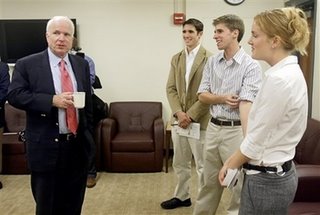
U.S. Sen. John McCain, R-Ariz., talks with Boston College student journalists before he addresses the 3rd annual First Year Academic Convocation on the university's campus in Boston Monday night Sept. 18, 2006. (AP Photo/Stephan Savoia)
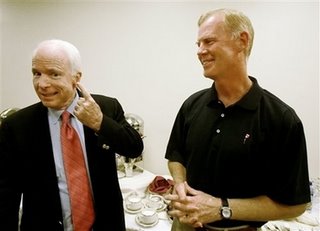
Sen. John McCain, R-Ariz., points to the area of his face that was treated for skin cancer several years ago as he advises Boston College football coach and fellow Naval Academy graduate, Tom O'Brien, to protect himself from the sun as he patrols the sideline and practice field on sunny days before McCain addressed the 3rd annual Boston College First Year Academic Convocation on the campus in Boston Monday night Sept. 18, 2006. (AP Photo/Stephan Savoia)
AP - Sep 18 6:39 PM

Sen. John McCain, R-Ariz., watches as freshman process into Boston College's 3rd annual First Year Academic Convocation on the university campus in Boston Monday night Sept. 18, 2006. (AP Photo/Stephan Savoia)
AP - Sep 18 6:48 PM
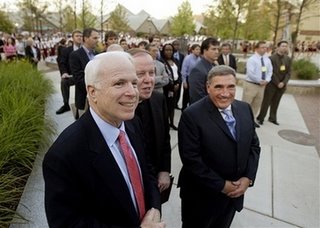
U.S. Sen. John McCain, R-Ariz., left, stands with Boston College President Rev. William Leahy, S.J., center, and Father Joseph Marchese, right, as they watch freshman proceed into the First Year Academic Convocation on the university campus in Boston Monday night Sept. 18, 2006. (AP Photo/Stephan Savoia)
AP - Sep 18 5:22 PM
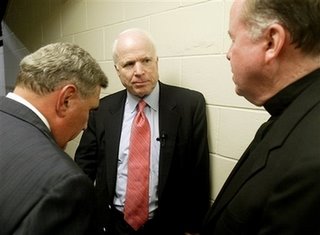
U.S. Sen. John McCain, R-Ariz., talks with Boston College President Rev. William Leahy, S.J., right and Father Joseph Marchese, left, before addressing the First Year Academic Convocation on the university campus in Boston Monday night Sept. 18, 2006. (AP Photo/Stephan Savoia)
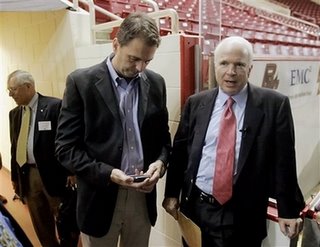
Sen. John McCain, R-Ariz. stands with political advisor John Weaver, center, back stage before addressing Boston College's First Year Academic Convocation on the university campus in Boston Monday night Sept. 18, 2006. (AP Photo/Stephan Savoia)
AP - Sep 18 5:25 PM
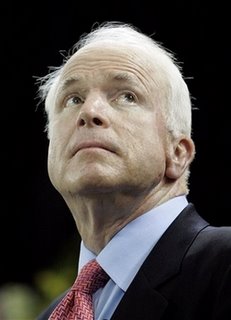
U.S. Sen. John McCain, R-Ariz., looks up as he listens to the singing of 'God Bless America' by a student before addressing the Boston College First Year Academic Convocation on the university campus in Boston Monday night Sept. 18, 2006. (AP Photo/Stephan Savoia)
AP - Sep 18 6:37 PM
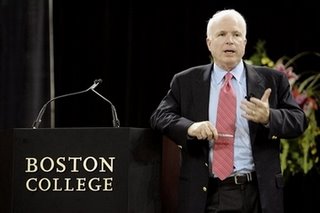
U.S. Sen. John McCain, R-Ariz., responds to a student's question druing Boston College's 3rd annual First Year Academic Convocation on the university's campus in Boston Monday night Sept. 18, 2006. (AP Photo/Stephan Savoia)
photo; Heights article (AP, Boston Globe)
I haven't found the text of his speech online yet.
The senator's website.

U.S. Sen. John McCain, R-Ariz., talks with Boston College student journalists before he addresses the 3rd annual First Year Academic Convocation on the university's campus in Boston Monday night Sept. 18, 2006. (AP Photo/Stephan Savoia)

Sen. John McCain, R-Ariz., points to the area of his face that was treated for skin cancer several years ago as he advises Boston College football coach and fellow Naval Academy graduate, Tom O'Brien, to protect himself from the sun as he patrols the sideline and practice field on sunny days before McCain addressed the 3rd annual Boston College First Year Academic Convocation on the campus in Boston Monday night Sept. 18, 2006. (AP Photo/Stephan Savoia)
AP - Sep 18 6:39 PM

Sen. John McCain, R-Ariz., watches as freshman process into Boston College's 3rd annual First Year Academic Convocation on the university campus in Boston Monday night Sept. 18, 2006. (AP Photo/Stephan Savoia)
AP - Sep 18 6:48 PM

U.S. Sen. John McCain, R-Ariz., left, stands with Boston College President Rev. William Leahy, S.J., center, and Father Joseph Marchese, right, as they watch freshman proceed into the First Year Academic Convocation on the university campus in Boston Monday night Sept. 18, 2006. (AP Photo/Stephan Savoia)
AP - Sep 18 5:22 PM

U.S. Sen. John McCain, R-Ariz., talks with Boston College President Rev. William Leahy, S.J., right and Father Joseph Marchese, left, before addressing the First Year Academic Convocation on the university campus in Boston Monday night Sept. 18, 2006. (AP Photo/Stephan Savoia)

Sen. John McCain, R-Ariz. stands with political advisor John Weaver, center, back stage before addressing Boston College's First Year Academic Convocation on the university campus in Boston Monday night Sept. 18, 2006. (AP Photo/Stephan Savoia)
AP - Sep 18 5:25 PM

U.S. Sen. John McCain, R-Ariz., looks up as he listens to the singing of 'God Bless America' by a student before addressing the Boston College First Year Academic Convocation on the university campus in Boston Monday night Sept. 18, 2006. (AP Photo/Stephan Savoia)
AP - Sep 18 6:37 PM

U.S. Sen. John McCain, R-Ariz., responds to a student's question druing Boston College's 3rd annual First Year Academic Convocation on the university's campus in Boston Monday night Sept. 18, 2006. (AP Photo/Stephan Savoia)
photo; Heights article (AP, Boston Globe)
I haven't found the text of his speech online yet.
McCain also invoked the importance of using one's gifts to give back to one's country, to embrace and perpetuate the liberty associated with America. Freedom, he said, is a right that comes with a set of duties, and the responsible citizen should recognize those obligations and pursue them to the fullest extent.Sounds like the typical Americanist liberal propaganda. Really, my patience for such demagogy is wearing thin... since everyone (like the President whenever he talks about the "War against Terror" or Dr. Rice at commencement last May... and so do the Democrats) uses it but doesn't link it to anything substantial.(Ah yes, "think" versus "thick" accounts of the good.)
"As blessed as we are, we are an unfinished nation," he said. "We must take our place in the enterprise of renewal, giving it our time, our counsel, our labor, and our passion to the enduring test that will make our nation and this world a better place."
It is the freedom and liberty that the American people enjoy that has spurred them to make this nation great, he said, and these ideals should carry over into America's interaction with the world. "As long as people are free to act in their own interest and will perceive their interest in an enlightened way … we will be a civilization for the ages, in which we all share in the promise and responsibility of freedom," said McCain.
"We must represent to the world, even in perilous times, when we confront enemies who share none of our values, scorn the right to life, liberty, and the pursuit of happiness, that are noble to our history. We must always show the world that those values are dearer to us than anything - dearer even than life itself," he said, alluding to the current U.S. involvement in the war on terror.
The senator's website.
UN Press Release: Sec-Gen Kofi Annan's last address
to world leaders
So are we talking about a thin notion of the common good or a thick notion?
Share in the pain of all who suffer? And how will this be accomplished? Internationalism and universalism--the twin goals of a certain form of liberalism. At the same time he acknowledges that the state is not everything, a legitimate reaction to a modern notion of the state. Will he able to recognize the need for decentralization? Or will the UN be the instrument by which consolidation of power is eventually achieved?
Maybe the conspiracy theorists aren't wrong about the UN and the "New World Order." It seems to me that the UN is inseparable from internationalism and universalism.
Sarge brought up Wilson Philips in a phone conversation. Weird, I had a dream about them this afternoon.
And that was happening at the very time when, more than ever before, human beings throughout the world formed a single society, he said. So many of the challenges were global and demanded a global response, in which all peoples must play their part. “I deliberately say ‘all peoples’, echoing the preamble of our Charter, and not ‘all States’”. International relations were not a matter of States alone. They were relations between peoples, in which so-called ‘non-State actors’ played a vital role. “All must play their part in a true multilateral world order, with a renewed, dynamic United Nations at its centre”, he said.
“Yes, I remain convinced that the only answer to this divided world must be a truly United Nations”, he said. Climate change, HIV/AIDS, fair trade, migration, human rights -– “all these issues, and many more, bring us back to that point”, he said, adding: “addressing each is indispensable for each of us in our village, in our neighbourhood, and in our country. Yet each has acquired a global dimension that can only be reached by global action, agreed and coordinated through this most universal of institutions”.
What mattered was that the strong, as well as the weak, agreed to be bound by the same rules, to treat each other with the same respect, he said. What mattered was that all peoples accepted the need to listen; to compromise; to take each other’s views into account. What mattered was that they come together, not at cross purposes, but with a common purpose: to shape their common destiny.
So are we talking about a thin notion of the common good or a thick notion?
“And that can only happen if peoples are bound together by something more than just a global market, or even a set of global rules. Each of us must share the pain of all who suffer, and the joy of all who hope, wherever in the world they may live”, he said. Each of us must earn the trust of his fellow men and women, no matter what their race, colour or creed, and learn to trust them in turn. “It is what I believe in. It is what the vast majority of people in this world want to believe in”, he said.
Share in the pain of all who suffer? And how will this be accomplished? Internationalism and universalism--the twin goals of a certain form of liberalism. At the same time he acknowledges that the state is not everything, a legitimate reaction to a modern notion of the state. Will he able to recognize the need for decentralization? Or will the UN be the instrument by which consolidation of power is eventually achieved?
Maybe the conspiracy theorists aren't wrong about the UN and the "New World Order." It seems to me that the UN is inseparable from internationalism and universalism.
Sarge brought up Wilson Philips in a phone conversation. Weird, I had a dream about them this afternoon.
Silence is golden
From: Some say apologies by pope are too much
By Ian Fisher The New York Times
By Ian Fisher The New York Times
Yet other Catholics feel he did make a slip in his speech.
"He should apologize," said Jennifer Ferreris, 20, a theology student at Boston College who went to see the pope on Wednesday during her trip to Rome.
"Too much emphasis is placed on the fundamentalists of Islam, the militants, and not enough on the faith. We adore the same God. They have respect for the Virgin Mary."
Articles of Interest
Christopher Reed, Goodbye Koizumi, Hello Abe (an older ATimes article: Japan firmly on a conservative path, by Hisane Masaki)
Calm follows riots caused by execution of three Catholics, by Benteng Reges
Turkey starts to admit it has an ‘Armenian Question’, by Mavi Zambak
Hundreds of Dalits attacked for entering Hindu temple, by Prakash Dubey
Living one’s faith in society in order to bring justice, Vietnamese bishops urge
Card. Cheong: “Pray that Eucharist may return to North Korea”
audio file on the F-22 (is it a big waste of money?)
Pope: Early Christians a Model for Parish Life
Pope: Early Christians a Model for Parish Life
Tells of Need for Encounter With Christ
CASTEL GANDOLFO, Italy, SEPT. 22, 2006 (Zenit.org).- The renewal of a parish does not depend on beautiful pastoral plans, but on its members' encounter with Christ, especially in the Eucharist, says Benedict XVI.
The Pope presented to modern-day parishes the model of the early Christian communities, when he received participants of the plenary assembly of the Pontifical Council for the Laity. He met them today at the papal summer residence of Castel Gandolfo.
Cardinals, bishops, priests and numerous lay people attended the council's plenary assembly. It was presided over by the council's president, Archbishop Stanislaw Rylko, and it reflected on the theme: "To Rediscover the Parish: Paths of Renewal."
As the Holy Father explained in his address in Italian, the desired renewal of the parish "cannot come only from suitable pastoral initiatives, regardless of how useful they are, or from blackboard plans."
The book of the Acts of the Apostles, he continued, "describes the first community of Jerusalem persevering in listening to the teaching of the apostles, in fraternal union, in the breaking of bread and in prayer, a welcoming and solidaristic community to the point that everything was held in common."
Inspired by this model, "the parish 'rediscovers itself' in the encounter with Christ, especially in the Eucharist," said Benedict XVI.
"Nourished by the Eucharistic bread, it grows in Catholic communion, walks in full fidelity to the magisterium and is always ready to receive and discern the different charisms that the Lord inspires in the People of God," affirmed the Holy Father.
"From constant union with Christ," he assured, " the parish draws vigor to commit itself ceaselessly in the service of brothers, particularly the poor, for whom it is in fact the first point of reference."
Yes! Precisely! I'll be looking for a complete text of his remarks.
Benedict XVI on Problems of Priestly Life (Part 1)
Benedict XVI on Problems of Priestly Life (Part 1)
"We Have to Leave Most Things to the Lord"
"We Have to Leave Most Things to the Lord"
Stuff from Filmforce
video interview with Jet Li
Rush Hour 3 casting news (I don't remember seeing this The Last Samurai poster in theaters. I like it more than the Tom Cruise one.) ; Outlander casting news -- Jim Caviezel cast as the main character; The Other Boleyn Girl
Eragon trailer; Pathfinder info; The Prestige photos; The Departed photos
Review of The Ground Truth
TCM
Hugh Heclo, "Respect for the Game"
Went to the Bradley lecture this afternoon; the lecturer was Hugh Heclo, and he talked about thinking institutionally, or institutional thinking. He made some references to Charles Taylor. Not bad; if I had a copy of the full paper, maybe I'd take some points out to discuss, but ultimately I don't think it would be worthwhile. (At the core, he's still a liberal, even if he thinks that the rationality embodied in practices and core institutions can help us find a way out of current problems.)
During the lecture, I was able to get a lot of work done on the thesis, surprise, surprise. I should go to more lectures and ignore what's going on. As soon as I get back to the apartment, I'll do some typing. But I'll unwind a bit first. I still have that cover letter to finish tonight...
On next Monday Scott MacDonald (from Cornell) will be giving a talk for the Bradley Medieval Lecture Series--I think he'll be talking about Augustine. I'll probably go, but I don't know if I will get that much out of it, especially since he is, iirc, an analytic. (I think he studied under Kretzmann.)
Why Benedict XVI Did not Want to Fall Silent or Backpedal
the latest from Sandro Magister.
To be honest, I'm a bit tired of all the coverage and commentary. There are some Catholi netizens who advance the position that the pope wasn't tactful in citing the Byzantine emperor Manuel Paleologos. The Holy Father invited Muslim envoys for a meeting on Monday--apparently the meeting will be taking place, so at least some have accepted.
I don't know what exactly he expecting. Should the Holy Father be the spokesman for the Church and for Christ, and be at the forefront of dialogue? It would seem to go with his office. On the other hand, I am very doubtful that there can be any dialogue, so I wonder what the point would be, besides maintaining appearances and smoothing things over for the sake of Christians' safety.
The fact that Bertone is not a career diplomat, but a man of doctrine and a pastor of souls, is now being held even more against the pope as proof of his ineptitude on the world political scene. In Bavaria, with the assignment changes not yet having taken place, Benedict XVI was accompanied by the outgoing secretary of state, cardinal Angelo Sodano, who has spent his entire life in diplomacy. But the pope was careful to avoid having cardinal Sodano read in advance the lecture he was preparing to deliver in Regensburg. Whole sections of the text would have been censored, if its supreme criterion had been the Realpolitik upon which the Vatican diplomacy of Sodano and his colleagues is nourished.
For Benedict XVI, too, realism in relations between the Church and states is a value. It was so with the totalitarian systems of the twentieth century: with German Nazism as with Soviet Communism. The controversial silences of Pius XII with Nazism, and later, with Communism, of John XXIII, of Vatican Council II, and of the Ostpolitik of Paul VI, had compelling reasons, and in the first place the defense of the victims of those systems themselves. But now, it is being demanded of Benedict XVI that he maintain a similar silence in regard to the new adversary of Islam: it is a silence that is often given the name of “dialogue.” Has pope Ratzinger not respected this? Then this is the comeuppance he deserves from “offended” Islam: threats, demonstrations, burning in effigy, governments demanding retractions, the recall of ambassadors, churches burned, a religious sister killed. The pope is seen as bearing his part of the blame in all this. On the other hand, it’s “post mortem” beatification for his predecessor John Paul II, who prayed humbly in Assisi together Muslim mullahs, and when visiting the Umayyad mosque in Damascus listened in silence to the invectives his hosts hurled against the perfidious Jews. No fatwa was issued for the demolition of the Vatican walls, or for the slitting of Karol Wojtyla’s throat. It was a mere coincidence that Ali Agca, who shot him, was a Muslim – the assassination had been planned in Christian territory...
Benedict XVI does not deny the proper value of political realism. The secretariat of state has mobilized its network of nunciatures to provide for governments the complete text of the lecture in Regensburg, the official note of explanation released on September 16 by cardinal Bertone, and the explanations presented by the pope in person at the Angelus on Sunday the 17th. By the end of September, the ambassadors to Muslim-majority countries will be called to the Vatican for another effort to defuse the tensions. And the pontifical council for culture, headed by cardinal Paul Poupard, is preparing a meeting with Muslim religious representatives.
But realism isn’t everything for Benedict XVI. The dialogue with Islam that he wants to create is not made of fearful silences and ceremonial embraces. It is not made of mortifications which, in the Muslim camp, are interpreted as acts of submission. The citation he made in Regensburg, from the “Dialogues with a Mohammedan” written at the end of the fourteenth century by the Christian participant in the dialogue, the Byzantine emperor Manuel II Paleologos, was deliberate choice. A war was on. Constantinople was under siege, and in a half century, in 1453, it would fall under the dominion of the Ottoman Empire. But the learned Christian emperor brought his Persian counterpart to the terrain of truth, reason, law, and violence, to what marks the real difference between the Christian faith and Islam, to the key questions upon which war or peace between the two civilizations depends.
Pope Ratzinger sees modern times, too, as being fraught with war, and with holy war. But he asks Islam to place a limit of its own on “jihad.” He proposes to the Muslims that they separate violence from faith, as prescribed by the Qur’an itself, and that they again connect faith with reason, because “acting against reason is in contradiction with the nature of God.”
To be honest, I'm a bit tired of all the coverage and commentary. There are some Catholi netizens who advance the position that the pope wasn't tactful in citing the Byzantine emperor Manuel Paleologos. The Holy Father invited Muslim envoys for a meeting on Monday--apparently the meeting will be taking place, so at least some have accepted.
I don't know what exactly he expecting. Should the Holy Father be the spokesman for the Church and for Christ, and be at the forefront of dialogue? It would seem to go with his office. On the other hand, I am very doubtful that there can be any dialogue, so I wonder what the point would be, besides maintaining appearances and smoothing things over for the sake of Christians' safety.
Subscribe to:
Posts (Atom)