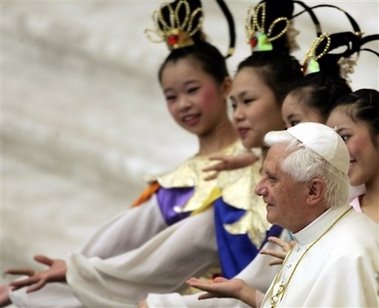
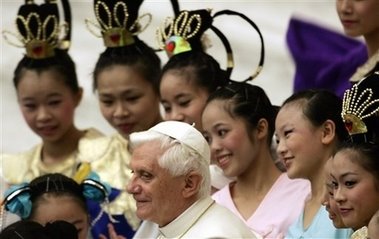
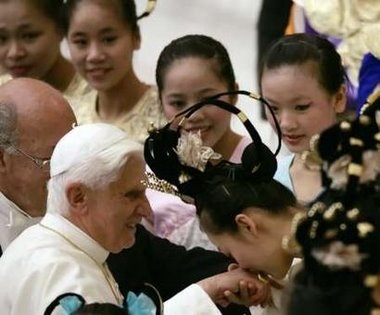
Pope Benedict XVI poses for a family picture with Chinese dancers of the Lan Yang Catholic Youth Center, during the weekly general audience in the Paul VI hall at the Vatican, Wednesday, Aug. 9, 2006. The Pontiff kept up his appeals for prayers for peace in the Middle East, saying goodwill and trust are needed to obtain a cease-fire and a 'just and lasting solution of the conflict.'' (AP Photo/Gregorio Borgia)
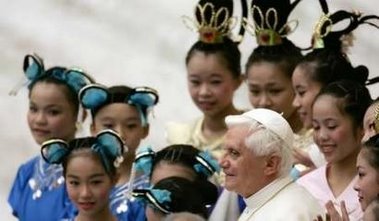
REUTERS/Tony Gentile
The costumes are from the Tang dynasty, I believe, which was not as puritannical as, say, the Ming. (See House of Flying Daggers; I think that was set during the Tang as well.)
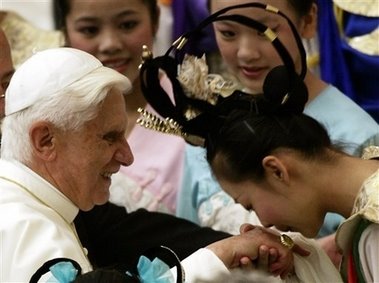
A Chinese dancer of the Lan Yang Catholic Youth Center kisses the hand of Pope Benedict XVI during the weekly general audience in the Paul VI hall at the Vatican, Wednesday, Aug. 9, 2006. The Pontiff kept up his appeals for prayers for peace in the Middle East, saying goodwill and trust are needed to obtain a cease-fire and a 'just and lasting solution of the conflict.'' (AP Photo/Gregorio Borgia)
REUTERS/Tony Gentile
Apparently the dancers were educated on protocol; although I guess the genuflection is not required under circumstances such as this? Or is it?
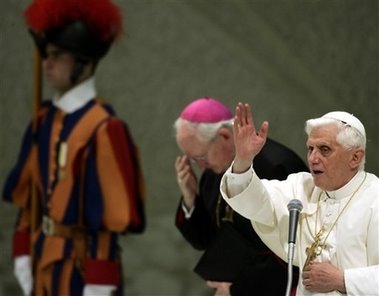
Pope Benedict XVI flanked by Bishop James Harvey delivers his blessing during the weekly general audience in the Paul VI hall at the Vatican, Wednesday, Aug. 9, 2006. The Pontiff kept up his appeals for prayers for peace in the Middle East, saying goodwill and trust are needed to obtain a cease-fire and a 'just and lasting solution of the conflict.'' (AP Photo/Gregorio Borgia)
One article on the group.
The graceful dance titled 'Peacock Forest' cleverly plays on the traditional Chinese fan dance, with young girls wearing green and purple costumes and holding shimmering fans that resemble peacock feathers. The peacock is an auspicious Chinese symbol of beauty, and the dance expresses a respect for life and peace. The dancers press their thumbs and index fingers together to resemble the bird's head, creating a stage filled with peacocks praising nature.
This is just one of many dances in the Lan Yang Dance Troupe's repertoire. The troupe takes ancient Chinese folk stories as its starting point and weaves them into dance patterns. Although this is a Taiwanese troupe, with its personal ethnic history, the choreography is universal in its appeal.
Another article on the group. (alternate)
The Lan Yang Dance Troupe was founded in 1966 by the Italian Catholic missionary
Father Gian Carlo Michelini in the then sleepy rural town of Luodong in the northeastern county of Yilan. The dance troupe takes its name from the county's Lan Yang Plain -- lan yang meaning "orchid sun" -- signifying the importance Michelini and those who cooperated with him have always given to loving one's native soil.
When Michelini arrived in Luodong in 1964, he discovered a community he felt was sadly lacking in appreciation of the breadth and depth of its cultural heritage. Hoping to rectify this situation, he organized the Lan Yang Youth Catholic Center in 1966. The main focus of the center's activities -- besides fun and games -- was training in mainstream traditional Chinese arts, including classical music, painting and dance. The Lan Yang Dance Troupe is an outgrowth of the youth center.

No comments:
Post a Comment