There is another joke that I've heard, but I can't remember the first part--
There are three things that only God knows:
- ???
- How many Franciscan groups there are.
- What a Jesuit is thinking.
It's unfortunate that very few are willing to comment upon and revise Aristotle. While much of his data can be supplemented by what we have observed sine then, and hence many of his positions corrected, his basic philosophy of nature reminds valid, for the most part. I suspect that his analysis of alteration could be revised though, and his understanding of quantity, to take into account generation and corruption at all levels of natural being. But I really should read his work on Generation and Corruption.
(Dominican International Seminar, 2003: The Role of Philosophy in Dominican Formation and Apostolic Work. Fr. Benedict Ashley's "What Should be Done in the Future" -- text, pdf, abstract. Proposed Guide for Sharing Our Secular Resources. UND press should be publishing his The Way Toward Wisdom soon. His Health Care Ethics. Fifth edition already! Mark Latkovic's Natural Law in the Moral Thought of Benedict Ashley. Flyer.)
Enough about Aristotle and philosophy, though. Back to St. Dominic and the Dominicans. I have remarked elsewhere that the history of the Dominicans has been tied to the development of the medieval city and the university. If the medieval intellectual project is dead, and megapolises are in danger of sever reduction in size, will the Dominicans have a role to play in the future? At least the Jesuit serve as missionaries, even if their colleges and universities and schools are forced to shut down. Will scholasticism remain in some form, even if isolated to a few houses here and there, being replaced by so-called "monastic theology"?
One can view the debate over the New Theology in that light--however, renewal of the Church has always depends on a "return to the sources," and to concrete manifestations of Sacred Tradition, like the writings of the Church Fathers because of the very nature of the theological virtue of Faith, which is mediated by what is communicated to us by others. So while one should be securely anchored within Tradition before proceding to inquiry and speculation, it does not seem to me that the traditional Dominicans were wrong to emphasize that the roots and principles of St. Thomas (and other scholastics) were still valid. Though it may be the case that they did not take their inquiry in certain directions because there was no need for them to, or at worst, that their grasp of the Faith may not have been so deep on certain points--still I would not be so quick to judge the work of saints. Theology begins in and remains in Faith; otherwise, it is not theology.
If the human sciences of metaphysics and physics were abandoned, along with formal training in logic, we would be left with whatever talents an individual monk or theologian might possess, whether they be natural gifts or supernatural gifts. Theology inevitably makes use of our understanding of the world, and simply because one does not have training in the human sciences does not mean that one's theology will not be appropriating one's knowledge of reality.
(This seems to be the mistake certain Orthodox make, in appealing to a "theology" exclusively centered on Christ and one's experience of God. There is the "theology" which is identical to the spiritual life, the divine life, living in union or friendship with God. But there is also theology as rational activity which flows from the first. [This is the use of analogy.] I cannot see if they concede that Sacred Tradition is a proper foundation of theological inquiry, and it, through the activity of the Church's teaching authority, can serve to judge the results of inquiry as being proper or orthodox, then how they cannot recognize that the link between its "incarnate" nature and human language and understanding does not entail some sort of dependence on authentic human knowledge. Unless they appeal to some sort of supernatural experience being directly translatable into human language, without being mediated by our understanding of the natural world--which is what they may be getting at by their emphasis on the divine energies, and how they explain divinization or divine union.
Scholastics would also assert that their theological inquiry is rooted in their experience of the divine and in Faith--but they also acknowledge the role the human sciences have to play as tools for meditating upon the divine mysteries. Hence I wonder if the Orthodox focus on developing an ontology from Tradition alone is not somehow circular (leading to confusion rather than clarification, as is evident from what some have said on how Scripture is to be interpreted when it talks of light and other metaphors), or worse, actually depends upon presuppositions taken from outside of Tradition. This certainly leads credence to polemicists who charge them with an attitude of anti-rationalism; either they must deny that human reason alone can come to know anything about divine realities, or that if there is a conflict between what human reason knows and what their theological speculation states, then they must identify the latter with Tradition itself in order for the latter to triumph.)
Within an urban setting, perhaps the Dominicans, with their common life, have a role to play in liturgical renewal, more so than the Jesuits, who are more "free" with respect to liturgical duties as a direct result of St. Ignatius' intentions and legislation in the Constitutions of the Society of Jesus. (Perhaps too free [in a different sense], given the prevalence of liturgical dancing within Jesuit parishes and such.) In that respect the Dominican houses would be like monasteries and societies for apostolic life (most notably the Oratorians).
Unfortunately, it does not seem that a return to the old Dominican rite will take place any time soon, though I believe the Fraternity of St. Vincent Ferrer uses it exclusively. Nonetheless, among the younger Dominicans I have encountered there is a great interest in liturgical tradition and liturgical spirituality, and this is a good sign.
Now there may be concerns as to whether the Dominicans can support themselves financially, but mendicancy is not a human affair but a divine one, and one must ultimately trust in God to provide. On the other hand, if He does not provide, is it a sign of His will regarding the order?
A little bit more of the spirit of poverty would be good for everyone in the "Western" world, including the religious.
Finally, preaching. What this world needs are good preachers, as is evidenced by Fr. Corapi's fan following. It may be imprudent to preach in a crowded square here in the United States or Europe, but on the other hand if one has the special gift from God, one goes where the Spirit leads him. Solid, orthodox preaching (and catechesis) on divine things (including moral implications) is necessary for the renewal of the Church, and the Dominicans, by being faithful to their charism and traditions, can accomplish much here.
*As for basic or primtiive Christian spirituality, I am thinking of liturgical spirituality--see also Louis Bouyer's Introduction to Spirituality, or the three volume work on spirituality that includes Fr. Bouyer as an author. (I think Jacques LeClerq was also associated with that project.)
On St. Dominic and the Order
CE entries for St. Dominic, Order of Preachers (alternate site; entry was written by Pierre Mandonnet, O.P.); EWTN page; patron saints index page
Saint Dominic and the Order of Preachers, by J. B. O'Connor, O.P.
The Golden Legend: St. Dominic
History of the Dominican Order
The Dominicans, A Short History, by William A. Hinnebusch, O.P.
Saint Dominic and the Rosary; Article on him and the rosary by Robert Feeney; Paul Duffner;
Our Lady of Rosary Apparitions Art Gallery
(Odd-the thought that the spelling of Dominic was weird just struck me--this happens to me from time to time for various words; yesterday it was council.)
The current Master General is Carlos Alfonso Azpiroz Costa, O.P. (bio; "Proclaiming the Gospel in the Order of Preachers"; another bio, plus this)
Documents
alternate site for documents (not as many entries)
Provinces
Tradition page
Official website
OPcentral.org (their OP website links)
Wojciech Giertych, O.P. is the recently appointed theologian to the Papal Household.
Roamin' Roman's blog entry on his appointment; CWNews; Word from Rome
"Amoebas, crustaceans, and vertebrates"
His moral theology course (permanent link to the right).
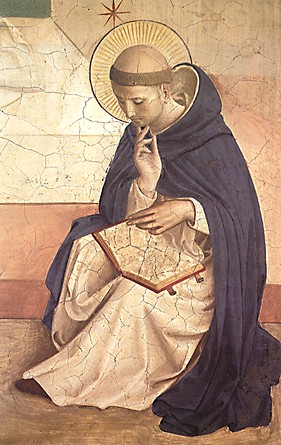
Paintings by Fra Angelico of St. Dominic

Alt of the above. Another. Higher-res version.


Source
The Meeting of Saints Dominic and Francis
Virgin with Child and Four Saints (detail of the predella)c. 1437Panel, 23 x 230cm (entire predella)Museo Diocesano, Cortona
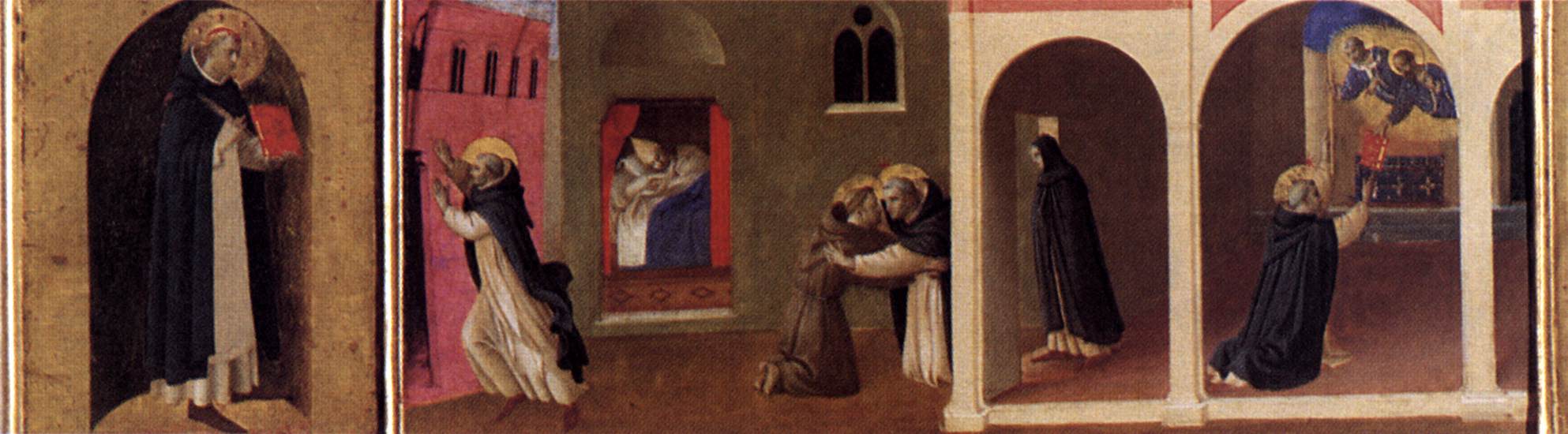
Description: The predella starts from the left with St Peter Martyr, followed by the scenes of Innocent III's dream of St Dominic holding up the falling church, the meeting of St Dominic and St Francis, then St Dominic receives the book and the stick by the Apostles Peter and Paul.
Icons

Not surprisingly, not so many icons of St. Dominic. Monastery Icons has one for sale, but I don't like the company's icons (at all).
More depictions here.
The Holy Inquisition: Dominic and Dominicans, by Guy Bedouelle, O.P.
St. Dominic and His Work, by Pierre Mandonnet, O.P.
Rule of Saint Dominic (adapted from the Rule of Saint Augustine)
O.P. Constitution; The Fundamental Constitution
The Dominicans [men] have only one college in the United States, Providence College. Fr. Shanley is president there now, and impressed many by his statement on the Vagina Monologues. (Ahem, tsk tsk Notre Dame.)
Dominican Spirituality
by William A. Hinnebusch, O.P.
by Isidore Clarke, O.P.
Dominican Principles of Spirituality by Pie Regamey, O.P.
http://www.domcentral.org/study/aumann/contpdim.htm, by Jordan Aumann, O.P.
Dominican Spirituality
some resources (warning, not all links are to orthodox materials)
Dominican martyrology
Fr. Chenu on the structure of the soul and mystical experience
(Fr. Schillebeeckx's essay -- warning, he's not orthodox, iirc)
(A little bit too much inculturation here!)
The New Wine of Dominican Spirituality (??? no idea if it's any good); review by a Dominican nun
Fr. Radcliffe's review of a book by Eric Borgman on Dominican Spirituality
Third Order Dominican Information
Third-order Dominicans
Tertiary spirituality
List of chapters
Immaculate Conception chapter (their links page)
St. Dominic's Church (in San Francisco)
My sister KK's liturgical haven while she was studying at the University of San Francisco.
St. Cecilia's in San Francisco; we went there once for an Opus Dei celebration.
Dominican Studia:
KK's Blackfriars
Dominican Studium Generale in the U.S.
Study Centers in Europe
Dominican rite
Dominican liturgy
Cnytr blog post
Dominican Rite Litany
Dominican Rite Liturgy Video
News about the Dominican Rite in Rome (links to this, which has a link to the old The Dominican Missal)
Dominican Sacramentary (supplement to the new Roman Missal)
Dominican Calendar
Supposedly there are pics of liturgy being celebrated at the Angelicum on this blog somewhere.
(Fortunately it's a young blog, so I was able to scan quickly--I think the photos are in the May archive. Thanks to the Dominicanus blog entry.)
Dominican-Jesuit controversies on grace
CE entry; Congregatio de Auxiliis
Prof. Freddoso's paper on Luis de Molina
History by James MacCaffrey, S.J.
Grace and Free Will, by Stephen S. Bilynskyj (I haven't read it, so I don't know about its orthodoxy)
Last night I couldn't sleep well because of an upset digestive system. Food poisoning again? Or too much fat in the system? Not sure. I need a doctor... hahaha. Does hot weather or humidity lead to weird things happening in the digestive system?
I ended up having a dream of a Soompi admin. She asked me to do some proof-reading of a paper or something. Weird. This is what happens when I look at someone's xanga before going to bed.
A note: Thomas Fleming on Mel Gibson (taken down from the Chronicles main page for some reason)



No comments:
Post a Comment