Yahoo movies:


moviephone photos
This afternoon I went to see Redbelt at the Century Capitol 16. Not many people at theater; I think there were only 3 of us watching Red Belt. (It was the 1:40 showing, and school isn't out yet.)
Since the movie involves Brazilian jiu-jitsu, there are Brazilian characters, and even better some Portuguese music. I was suprised to learn that Rebecca Pidgeon and David Mamet composed the Portuguese songs featured in the film. I haven't seen any cds with the soundtrack of the movie being sold. However, the songs are available on a cd by Rebecca Pidgeon, Behind the Velvet Curtain.
Dan Inosanto has a small cameo as "the Professor," teacher of Mike Terry, the main character, and Augusto Silva, his adversary at the end of the movie.

Some have complained that Mamet is misogynistic, or at least is not adept at writing female characters. At first Terry's wife, played by Alice Braga, seems like a woman who is just concerned with helping her husband manage financially, even if she does contnually nag him about it. She does seem to be more realistic about finances than he is. But she is revealed towards the end of the movie to be a "back-stabbing b****," more concerned about material comfort and "living the life" than supporting her husband and his adherence to principle. Nonetheless, Emily Mortimer's character, Laura, a lawyer who is "rescued" by Terry, ends up showing much strength and character in the movie.
*spoilers*
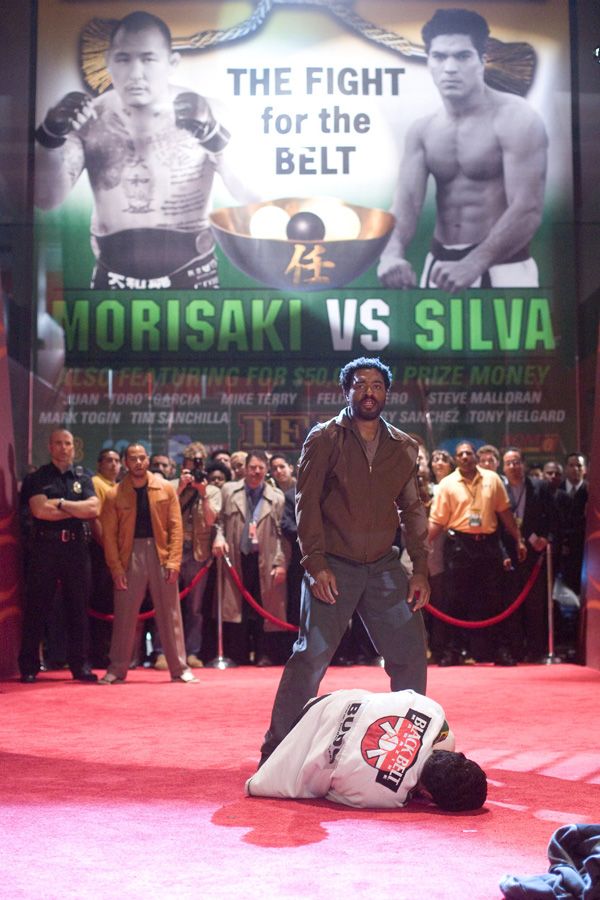
Mike Terry (Chiwetel Ejiofor) finds out that the MMA competition he has entered in order to help him honor his obligations to someone else has been fixed, and he confronts those who are responsible. He decides to leave the competition, rather than continue. He meets Laura outside, as she had to leave the arena in order to smoke. We see him talk to her, but we don't hear what he actually says. Anyway, she slaps him. At first I though perhaps she did that because she was being self-serving and thought he should have stayed in the competition. However, we next see him return to the ring, not to compete, but to blow the whistle on the competition, and he fights his way past private security and also his brother-in-law, who is participating in the headline fight.
Of course, the police officers we saw in the arena earlier are conveniently absent, so Terry is not arrested for trespassing and assault and battery. Did they go on a donut run?
Someone with an ideological axe to grind might think that the message of the movie, after all the talk about the philosophy behind BJJ, like avoiding or embracing a force rather than opposing it, is just BS--violence is the way to solving problems, as shown by Mike Terry's actions at the end of the movie.
But Terry didn't wasn't there to fight, though he was there to cause trouble--by revealing to the spectators and officials that the competition was a scam, and to show the bad guys what it is to have honor. He is forced to fight because they wish to stop him from telling the truth, including his brother-in-law, who is more concerned with furthering "the family business" than upholding honor. (After all, he made a deal with the bad organizers to throw the match, because the money that is to be made "is in the rematch.") We have corruption in Hollywood (embodied in the producer [Joe Mantegna] and the actor who never served in the military but plays a soldier [Tim Allen]) mixed up with corruption in organized fighting (the promoter, played by Ricki Jay, and Terry's other brother-in-law, who owns a club/bar), and Terry ultimately triumphs over it all, having coming close to being ruined by them after being caught in their "big con". (Which, unfortunately, does cost the life of one of his students.)
At the end, the other fighter in the headline fight gives to Terry his gold belt that was at stake, recognizing that Terry is the true champion who has not sacrificed his honor for the sake of fame and false honor. And the Professor, perhaps recognizing that he too has failed in stopping the heir to the school from corrupting the art, gives the red belt (there is only one red belt) to Terry.
Still, the objector that does raise an important question--is the 'philosophy' behind martial arts conducive to living well? Is it adequate for dealing with obstacles or adversaries outside the ring or a combat situation--business world, or just life in general? (The Art of War and The Five Rings are often marketed as manuals that will help one triumph in the business world.) What about the fancy rationale behind various moves and counters? Are they principles of living well? I do have my reservations about such grandiose claims being made of martial arts. After all, the use of martial arts is subordinate to ethics; it may be that the philosophy is not from the principles of the martial art, but from another source, and this is what gives the martial art its spirit. Hence, the best way to prevail in a fight is not to get into one in the first place. At least, that seems to be the point that Terry is making to Laura in her introductory lesson in BJJ--don't be within striking distance, be far away, and you won't get hit.
It's unfortunate the fight scenes weren't better filmed--John Machado was responsible for the MMA choreography. Perhaps the movie on the whole is one of Mamet's weaker efforts, because the action is not captured well, but one could argue that focusing on the action to much would detract from the point the movie is trying to make. It's not about fighting, but prevailing with honor. Some may say that Mamet's work is 'hypermasculine' while calling into question Mamet's integrity or character because of his own personal history. (He didn't serve in the military or fight in Vietnam, but reminds us in his recent Vogue interview that the great 20th century American writers, Hemingway and so on, actually had "a life" [including serving in the military and seeing action], from which they could draw inspiration for their writing.) But I think Mamet does have a vision of what a man is supposed to be like, and it's not the boys who go from month-to-month, drawing paychecks and indulging themselves at home with television or video games. Mamet wants to believe that the man who lives in accordance with personal integrity and honor will prevail over the various powers (the economic elites, Hollywood studios, what have you) that seek to control his life and destiny.
I believe Mamet was brought up Jewish--could it be that Redbelt is his Jewish spirituality seeking to express itself, even though there is no mention of God in the movie?
Psalm 5: 8-12
Lead me, O LORD, in thy righteousness because of mine enemies; make thy way straight before my face.
For there is no faithfulness in their mouth; their inward part is very wickedness; their throat is an open sepulchre; they flatter with their tongue.
Destroy thou them, O God; let them fall by their own counsels; cast them out in the multitude of their transgressions; for they have rebelled against thee.
But let all those that put their trust in thee rejoice: let them ever shout for joy, because thou defendest them: let them also that love thy name be joyful in thee.
For thou, LORD, wilt bless the righteous; with favour wilt thou compass him as with a shield.
David Mamet's Jewish Turn
Rebecca Pidgeon & David Mamet of Red Belt with Fanclubx.com
Rebecca Pidgeon has her own youtube account, which she uses to put clips of herself playing her music.
I don't know she was a singer and songstress before becoming an actress. (wiki)
MySpace
Alice Braga, RedBelt, Interview
REDBELT MOVIE Premiere 4/7/08 Los Angeles
Mamet Tackles Mixed Martial Arts in 'Redbelt'
Don't ask me why Redbelt is one word instead of two...

No comments:
Post a Comment