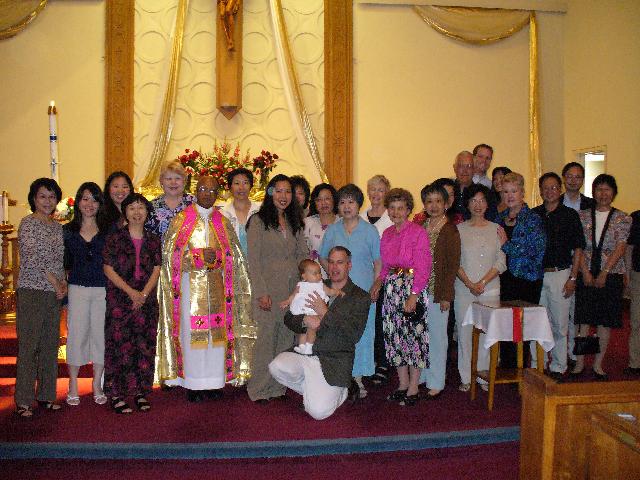
Imagine that, Benedictine roots. CE entry. A parish church turned into a family home. (???) Icon of him here (on an Antiochian Orthodox website!). Another short bio here.

Alternate site for pic.

A large exhibition is opening dedicated to gisaeng - female entertainers of the Chosun (Joseon) Dynasty who were known as "those possessing the body of the lower class but the mind of the aristocrat." From Jan. 13 to Feb. 13 at the Seoul Auction Center in Pyeongchang-dong, some 500 photographs and postcards with fascinating images of gisaeng from the late Chosun Dynasty and the Japanese colonial period will be put on display.The shirts, skirts and even underwear of the gisaeng, who were the fashion icons of their day, have been recreated after much research, and part of the exhibition hall has been decorated with the folding screens, musical instruments and cosmetic paraphernalia used by the entertainers.
History records the names of famous gisaeng such as Hwang Jin-i and Lee Mae-chang and calls them stylish and refined artists. "The gisaeng, who mixed with upper-class men, were accomplished women who could express themselves and accumulate knowledge," Seoul Auction's Kim Hyo-seon explained.
The highlights of the show are gisaeng postcards and photos from the collection of Lee Don-su. "During the colonial period, the artistic activities of the gisaeng gradually became constricted, but they also played the role of 'new women' spear-heading a new civilization," Lee said.
In colonial times, the Japanese Government-General energetically produced postcards to promote its colonization of the peninsula, and frequently inserted photos of gisaeng in tourist information or photo collections of Korean customs.
(englishnews@chosun.com )




Although it's set in Providence, ``Brotherhood'' bears more than a passing resemblance to the real-life saga of William ``Billy'' Bulger, once a powerful Massachusetts politician, and his brother James ``Whitey'' Bulger, a mob hit man, leader of Boston's notorious Winter Hill Gang and former FBI informant, who has been on the run from the law since 1995.











A little-known and unpublished work by Fr. Karol Wojtyla has touched off debate among experts across the globe about whether the future Pope John Paul II, as a young academic, had developed an appreciation of some aspects of Marxism as well as a strong critique of U.S.-style capitalism.
Aspects of Marxism? The negative aspects, or criticisms made by Marxists, but certainly not the 'positive' aspects, the Marxist philosophy and program?
The John Paul II Institute in Lublin, Poland, which is charged with Wojtyla’s pre-papal writings, has plans to publish the work in the near future. However, interpretations of the two-volume Katolicka Etyka Spoleczna (Catholic Social Ethics) have been bitterly contested, a debate touched off in Wojtyla’s homeland of Poland and beyond when the authors of this article first wrote about the unpublished volume in a cover story for the British Catholic weekly The Tablet last January.
The text contradicts views promoted by neoconservative thinkers who depict the pontiff as a lifelong fan of U.S.-style liberal capitalism. It also raises questions of why, when every detail of Wojtyla’s life has been combed over by researchers and biographers, mention of this 511-page work has apparently been avoided.
Yes, the Catholic neo-cons, trying to make the pope one of their own. Does anyone still believe them on this point?
Catholic Social Ethics originated as a series of lectures by Wojtyla in 1953-54, and was typed and bound for students and academics. It provides no evidence that the future pope had any direct political affiliation. However, it shows Wojtyla had acquired by his early 30s a sophisticated knowledge of Marxism and an empathy with its critique of capitalist injustices. It shows he had already rejected both “socialist totalism” and “individualistic liberalism” as prerequisites for a well-organized society.His social encyclicals do not deviate from his early thought, then.
Zycinski and his supporters will have trouble controlling public comment once Catholic Social Ethics is published. The bulk of the work is written as a response to Marxism. Wojtyla’s aim, he makes clear, isn’t to apply Marxism to Christianity, but to give Marxist concepts a Christian meaning, and win back the ideas of social justice that Marxism had expropriated.Wojtyla traces communism itself back to Christian tradition, even subtitling one section “The Objective Superiority of the Communist Ideal.” But he makes clear he is using the term generically to mean common ownership. The church believes “the private ownership principle” can be upheld while “enfranchising the proletariat.”
“In the contemporary communist movement, the church sees and acknowledges an expression of largely ethical goals,” the future pope concedes.
Ethical goals? If he is referring to certain ends or goods to be pursued, then perhaps Marxism isn't completely wrong. But what about the means to those ends? That is what matters in determining the usefulness or validity of a secular ideology.
“In line with patristic traditions and the centuries-old practice of monastic life, the church itself acknowledges the ideal of communism. But it believes, given the current state of human nature, that the general implementation of this ideal -- while protecting the human person’s complete freedom -- faces insurmountable difficulties.”The ideal of holding property in common. But it is difficult to implement this ideal while protecting freedom at the same time. Or is he saying more than this?
Catholicism cannot “agree with materialism” or the “primacy of economics,” Wojtyla writes. But it recognizes that “various facts and historical processes” are economically determined. “In a well organized society, orientated to the common good, class conflicts are solved peacefully through reforms. But states that base their order on individualistic liberalism are not such societies. So when an exploited class fails to receive in a peaceful way the share of the common good to which it has a right, it has to follow a different path.”Individualistic liberalism... a definition would be nice just for the sake of completeness. Let us see if one is offered in the book.
“Class struggle should gain strength in proportion to the resistance it faces from economically privileged classes, so the systemic social situation will mature under this pressure to the appropriate forms and transitions,” Wojtyla continues.Not sure what he is saying here--is he being naively optimistic? Mature? Does mature here have a positive connotation, similar to progress? Isn't it possible for class struggle to lead to greater fragmentation and possible civil unrest?
“Guided by a just evaluation of historical events, the church should view the cause of revolution with an awareness of the ethical evil in factors of the economic and social regime, and in the political system, that generates the need for a radical reaction. It can be accepted that the majority of people who took part in revolutions -- even bloody ones -- were acting on the basis of internal convictions, and thus in accordance with conscience.”So they were acting in accordance with conscience? What if their conscience was poorly formed to begin with? Is the tyrant acting in accordance with his conscience if he's warped it? Or are we saying that the revolutionaries had their hearts in the right place, even if the means they chose were wrong? Or perhaps the majority of the revolutionaries were duped by bad leaders--this does not contradict what is written.


Ha Ji-won will be taking on the title role in the upcoming KBS miniseries “Hwang Jin-I”, about a famous Chosun-era gisaeng or female entertainer. The first episode will be shown on Oct. 11.Wow, Song Hae-gyo in another movie, playing the same character as Ha Ji-won--I wonder who will do a more credible job? I didn't care much for Ha Ji-won's last movie, The Duelist, even though it attempted to be stylish. Since it is a 30-episode drama, it should be better. It will be interesting, though, to see if it has been sanitized in terms of content. (Unless Hwang Jin-I lead an innocent/pure life, despite her profession. But that would be surprising, wouldn't it? One does not hear of gisaengs or geishas getting married and remaining in their profession; one does hear of them becoming mistresses.)
"After looking at a lot of top stars for the role, we recently signed a contract with Ha Ji-won," the producers said Friday. The actress goes head-to-head with Song Hae-gyo, who also plays Hwang Jin-I in a movie of the same title that starts filming at the end of the month. Ha reportedly thought about turning down the part, citing the lack of time to practice the geomungo or six-stringed Korean zither and other skills of the accomplished all-round entertainer.
But she changed her mind when the first episode originally slated for September was postponed. Ha's agency Soft Land says Ha will study geomungo, dancing and even tightrope-walking starting this month, having said that she wants to do whatever she can herself instead of relying on a double. The drama depicts the life of Hwang Jin-I from her early years through when she became a famous gisaeng through the lens of a modern sensibility. Stories including her attempt to seduce great 16th century scholar Seo Gyeong-deok and their subsequent student-teacher relationship will be portrayed against beautiful scenic settings. The drama will air on Wednesdays and Thursdays in 30 episodes.
(englishnews@chosun.com )
The "sorrow of the world" disturbs the heart, plunges it into anxiety, stirs up unreasonable fears, disgusts it with prayer, overwhelms and stupefies the brain, deprives the soul of wisdom, judgment, resolution and courage, weakening all its powers; in a word, it is like a hard winter, blasting all the earth's beauty, and numbing all animal life; for it deprives the soul of sweetness and power in every faculty.

"How do I know if she's the one?"
I can't think of a question I encounter more often among single Christian men. The point of the question is clear enough. But a rich irony dwells beneath the question. In a culture that allows us to choose the person we're going to marry, no one wants to make the wrong choice. Especially if, as Christians, we understand that the choice we make is a choice for life.
The question is not merely ironic. If what you're after is a marriage that will glorify God and produce real joy for you and your bride, it's also the wrong question. That's because the unstated goal of the question is "How do I know if she's the one ... for me."
The question frames the entire decision-making process in fundamentally self-oriented — if not downright selfish — terms. And it puts the woman on an extended trial to determine whether or not she meets your needs, fits with your personality, and satisfies your desires. It places you at the center of the process, in the role of a window-shopper, or consumer at a buffet. In this scenario you remain unexamined, unquestioned, and unassailable — sovereign in your tastes and preferences and judgments.