offical site for Miss Korea
Video of the pageant: first part, second part
Chosun Ilbo article on Miss Honey Lee.
My guess is that the talent segment is in the first part, not the second--I believe the second starts off with the semi-finalists being selected? Or are they the finalists? Not sure, I didn't watch all the way through. I would like to see Miss Lee's singing, but I'll have to search for it when I have time.
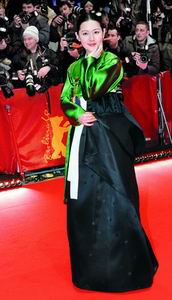
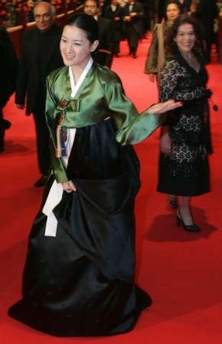
From the evening gown competition:
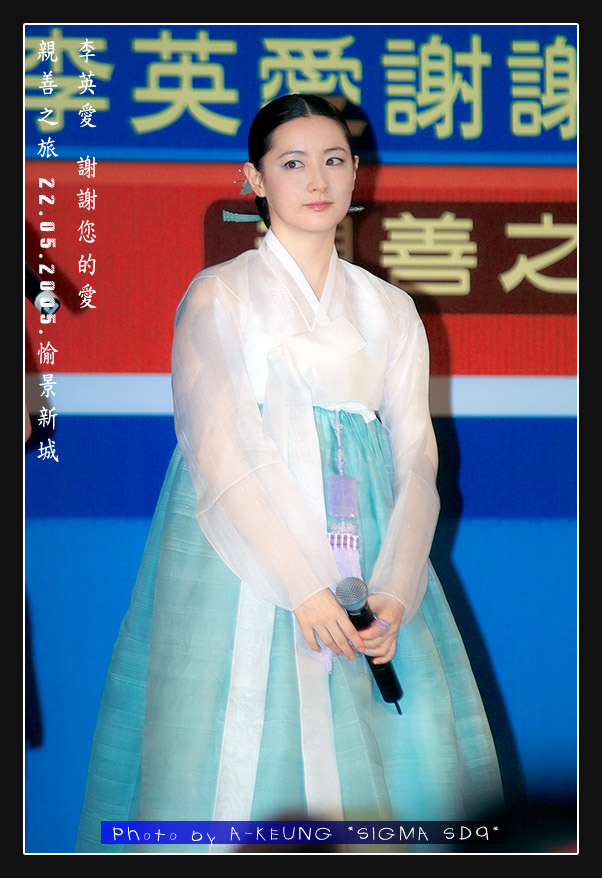
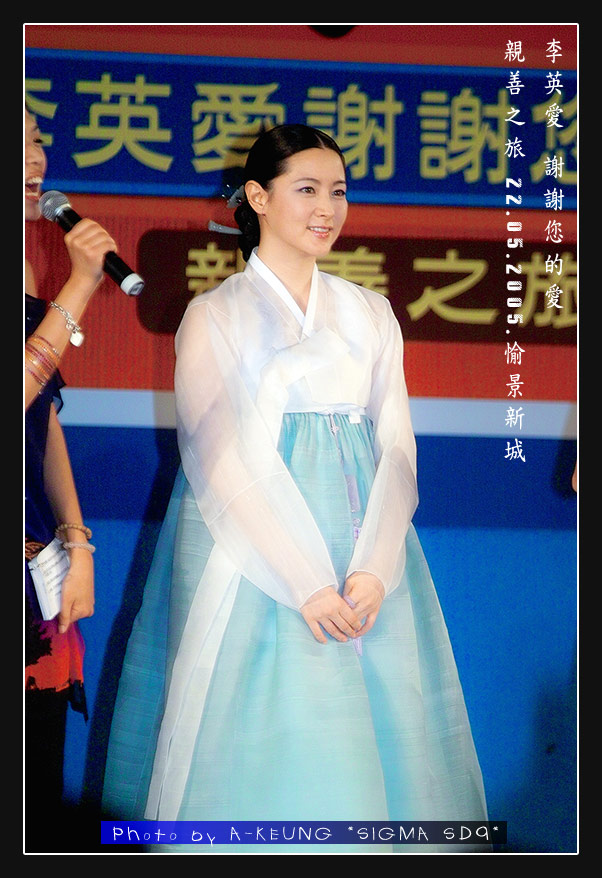
First, the winner, Miss Honey Lee:


Whatever what one might think of the style of Andre Kim, I think people must admit that his clothes are attention-getting. Sorry, I can't identify the other contestants because none is provided on the website for the above photos, and they weren't wearing their sashes--it was probably thought that they would distract from the gown or wouldn't fit. (Besides, even if I had the time to identify them, I can't read Korean.)
"Why Korean women?"
My sisters are puzzled by my interest in Korean women. Sarge asked if I really was interested in them; apparently he is enthusiastic to talk to his emo about finding a match for me down in NC. I still wonder if he has an ulterior motive. Haha.
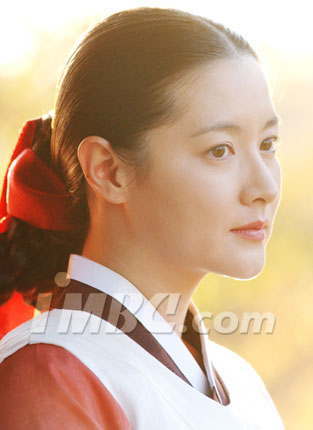
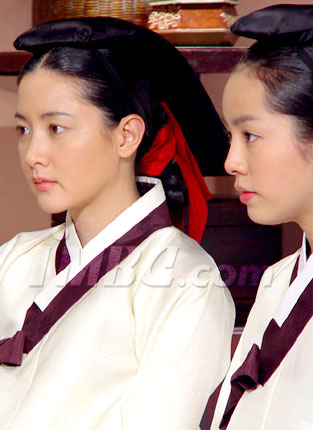
It is more accurate to say that I am attracted to, on a superficial level, to Korean celebrities because in public they show good manners and don't dress in blue jeans and t-shirts all of the time, and their characters they play in dramas and movies tend to fall within the bounds of decency and good morality. Having been introduced to Korean movies through actresses like Lee Young Ae, Kim Ha Neul, Shim Eun Ha, Choi Ji Woo, and Jang Jin Young, it would be difficult not to get some idea of what the ideal Korean lady is like from them.
Japanese female celebrities are physically attractive and usually polite (according to Japanese standards), but the stories of the movies and dramas are either overly romantic or questionable with respect to sexual morality, or most likely both, and one wonders about people who play such roles regularly. ALso, there are more Christians in the Korean entertainment industry in Korea than in the Japanese? (As far as I know--my guess that it is the case with respect to proportions, it may even be true with respect to absolute numbers). But does this mean Korean actresses are really better people than Japanese actresses. I don't have enough info for that, but with respect to their public image, Korean celebrities are a little bit more conservative--even if this image is carefully manufactured by them or their handlers, this is something that American celebrities don't care about--whatever they do is ok; it doesn't matter what the public thinks of their choices and behavior. They have to be "free" to be "themselves."
It is interesting to note that there is not so much of an obsession with youth fashion among Japanese women (and probably Korean women as well), even though they are staying single longer and have embraced the consumerist mentality. Indeed, women in their 30s and 40s have a fashion/style appropriate to them, as the fashion magazines devoted to their segment of the market appear to bear out. I can't remember seeing blue jeans in those magazines, but even if there were, my guess is that they would be appropriate only in casual situations and not the ideal. (However, I think I've seen older Japanese women wearing blue jeans and such while touring in Rome.) I am seeing more and more American mothers dressing like teenagers, and one cannot be but dismayed.
For most Hong Kong people (and let's not even cover their mainland cousins), it seems that there are either semi-formal clothes appropriate for the work place and some important occasions or casual wear--nothing in between, particularly for women. While it is true that one's wardrobe may be limited because of income restrictions, it's the casual wear that I object to, which at its worse is akin to the slobby, wear-it-on-the-streets-but-it-really-belongs-at-home look here in the U.S. But the differentiation among apparel in one's wardrobe really belongs in another post.
Anyways, very few Hong Kong female celebrities are attractive beyond the physical level--rarely does one see them wear anything besides blue jeans and t-shirts except for 'formal' occasions like awards ceremonies. Many of them can't speak Cantonese properly, and have rather poor table manners that would annoy my mother. I was disappointed when I found out Cecilia Cheung got a tattoo. (I think it is a permanent one. See Dalrymple's essay on tattoos.) The generation of actresses that came out in the late 70s and early 80s might be the last one with any sort of education in etiquette and maintaining an appearance (the kind of comportment that Frederica Mathewes-Green referred to when comparing old movies and their stars with what we have today).
Just some observations from a cultural observer, relying on data that might be questionable... but I do think pop culture gives some indication of the health of a society. I won't deny that I've been taken into celebrity-following, to a certain degree (and I was following hallyu, the Korean wave, before I knew what it was), but I don't have unrealistic plans to marry a celebrity, nor to marry someone who is as beautiful as a celebrity. Now if I were to get married, it would be ideal to find someone who is Asian, Catholic, traditional (Christianized Confucianist), and with good character. If God were to introduce me to someone who is Catholic, traditional, and good but not Asian, would I say no? I don't think I would. But cultural compatability is important, especially when it comes to domestic arrangements and raising of children and so on. More on compatability in another post.
Do I embrace the complete reservedness that some Asians think is proper? No--there needs to be a healthy balance, based on a proper understanding of social distinctions, one that finds among both the more traditional East Asians, but also among the more cultured of the Latins (at least Spanish speakers--I haven't really met Italians who have that balance, except maybe for clerics who have some measure of gravitas through training or otherwise; then again this is probably an unfair comparison based on biased samplings). While the British are known for their "stiff upper lip" (Theodore Dalrymple explains the rationale), I don't think the British nobility and elites are like that all the time, with everyone.
I do like the easy friendliness and openness that is to be found as well in Latin culture, but then again, affability is a virtue. *Latins have a reputation for being passionate and hot-blooded, at least when compared to Germanic peoples. But how much of this is acquired virtue and how much is due to natural disposition or temperament? After thinking about it some more, I wonder if the balance, the mean, is the same for all cultures. What may differ is how people express themselves through language (especially volume) and the body, and this is something that is passed on through one's family and culture. (One should note that bowing as a sign of respect was more common in the West once.)*
"Friendliness" crosses the line when it runs over social distinctions as if they don't exist. Such is the case here in the United States, where radical egalitarianism holds sway. While there are some who adhere to traditional mores, they are a very small minority. Calling someone who is a senior by their first name is just a no-no in my book, but it happens at BC, both in the philosophy and theology departments, with students addressing faculty by their first names. How bizarre and inappropriate, from a Confucian viewpoint, even if it is increasingly becoming the American way. When I recently was interviewed by the department chair of a certain university, she told me that I should call her by her first name, and since I was looking for a job, I wasn't going to make an issue of it, though it certainly put me in the difficult spot of doing something with which I disagree (and wrong, even if to a small degree). While one certainly is free to deny the respect that is due to them and which is of a benefit to them, one should not deny the benefit of the act to the one who is giving respect. I don't think I could marry a radical egalitarian.
Pageants and the Objectification of Women
While I do watch pageants, I must admit that as a practice they are bad and more likely to have a bad influence than good. What is especially irritating, besides the exaggerated importance given to physical beauty, is the attempt to make it balanced through the talent competition and the interview, along with 'charitable' activities. For example, the contestants of the Miss Korea pageant spent a day at a home for the mentally handicapped, and of course it was used as a photo-op by the pageant organizers. Now perhaps many or even all were genuinely interested in going there. But how can it not but seem a bit fake to the outside observer, especially if there are cameras to record the event, and it is touted as an official pageant event? How many of the contestants will return to that home in the future, or to charity work in general? I'm not passing judgment on them, because I don't know them, and this is a critique more of the organizers than of the contestants (though it would be nice to hear a contestant protest, "I'm not doing this because it's rather shameless, to seek attention in this way")--let's be honest, guys (and I say guys because most likely it is men who are in charge, and men who started and promoted these 'contests' to begin with)--this is mostly about physical beauty. If winners of pageants are used as models and spokespersons it is not because they have the character to serve as informed consciences (though they might), it is because the company(-ies) that sponsor the pageant are looking for a way to advertise with a pretty face, and seem like they are concerned with social issues at the same time.
The over-exposure to beauty in mass media can easily lead to shallowness and a focus on what pleases the self, in this case physical beauty. Without the proper education, such easy exposure can reinforce the objectification of women. While the danger of objectification that is associated with pornography is rather obvious...
(PornNoMore.com, Catholic Support Group, dads.org, Subtle Dangers of Pornography, The Centerfold Syndrome, Pornified)
the fashion and entertainment industries, audio and visual media, and beauty pageants do their own share of objectifying women and reducing their value to their physical appearance.
Is it surprising that models continue to have self-esteem issues even when they've become successful, or that they have eating disorders? (As if men don't know that the fashion industry does not promote a healthy ideal of feminine beauty.) Of course, some may have had bad childhoods and various issues with males and fathers, but can it really be said that earning a living off of one's appearance is a morally neutral act? And even if it were, what about the circumstances and the perhaps inevitable lifestyle that accompanies such a job? It is rare to see someone with a good [Christian] character enter into modelling, less likely than it is to see them in acting. (One wonders how much longer someone like Jim Caviezel will remain in the industry, even if he can find suitable projects that do not conflict with his Faith.)
The Decline of Modesty in Pop Music
Among singers, the problem of modesty is the worst, because much of pop music sales in Asia (and to a more limited degree in the U.S. and even less elsewhere) is generated on the creation and marketing of "idols," who often lack singing skills and only have a pretty face.
Most of the popular Korean singers and groups flaunt their sex appeal in their dances, TV performances and concerts. It's not clear to me that the Japanese pop music industry has gotten that bad, even though other aspects of Japanese pop culture and the entertainmenet industry might be questionable. While the Japanese companies market idols as well, it doesn't seem that there are any images beyond "young and innocent" and "mature woman"--certainly none of the "not a girl, not yet a woman" sex appeal as personified by Britney Spears. Perhaps it is an influence of ghetto culture on the Korean music industry? They seem to have taken the worst from the American (and Latin as well) music scene.
Gone are the days when Korean TV was very conservative and singers (and backup singers and dancers) would not be able to show any skin... and that was only 10 years ago.
I was skimming through some Korean music programs yesterday, and all of the popular acts were rather atrocious--the music was bad, and the singing barely tolerable. Which is why I hope Honey Lee will not disappoint with her talent act. It would be even better if she played the gayageum.
In other news...
There has been murmuring about Michelle Wie lately... another Jennifer Capriati in the works?
An oldie by Theodore Dalrymple on therapism.
"On Being Sacked as a Book Reviewer for Being Too Old"






















.jpg)


.jpg)
.jpg)
.jpg)
.jpg)
.jpg)


