Saturday, June 21, 2008

Sierra Hull vids
Just When I Needed You (Sierra Hull and Friends)
Rock Hearts
Sierra Hull and Highway 111 play "Virgil Calhoun"
"Molly" Bluegrass Parlor Band with Sierra Hull
Lonesome Pines JAKES BLUEGRASS BAND 2005
Ron Block - Sierra Hull - Clinch Mountain Backstep
Sierra Hull on her debut album "Secrets"
alt


Her website.
Friday, June 20, 2008
Laura Osnes Interview Grease Broadway After-Party
Max Crumm and Laura Osnes on Fox
more
I haven't heard anything about the musical since the reality show aired. How's it doing? Heh.
You're the One that I Want
Thursday, June 19, 2008
Coming up on EWTN
ST. THOMAS MORE: A HERO FOR OUR TIMES 0:30
Dr. Gerard Wegemer of the University of Dallas discusses the life and heroic virtues of St. Thomas More, who gave his life defending the Faith during the reign of Henry VIII.
Sun 06/22/08 6:30 AM 3:30 AM
DEFENDERS OF FAITH IN WORD AND DEED
St. John Fisher 0:30 A look at the life of St. John Fisher, the last Catholic Bishop of Rochester, martyred during the English Protestant Reformation.
Contra Dance Training
Contra Dance Training Ch 2 - Two Dancers
Contra Dance Training Ch 3 - Lessons for Four Dancers
Contra Dance Training Ch 4 - A Contra Line
Contra Dance Training Ch 5 - Come Dance With
Contra Dance Training Ch 6 - Called Dance I - Scott Russell
Contra Dance Training Ch 7 - Called Dance II - Scott Russell
Contra Dance Training Ch 8 - Contra Origins and the CCD
Contra Dance Training Ch 9 - Contra Credits
Chattahoochee Country Dancers, Atlanta, Georgia: website
ECD videos
Emerald City Regency Ball - Duke of Kent Waltz, 2, 3
Weekly English Country Dance Toronto Main
"Take a Dance" - ECD - Frolics in the Hey, Toronto
English Country Dance - Boatman (Toronto Frolics in the Hey)
Frolics in the Hey - "King of Poland" (danced)
Frolics in the Hey - Walk through - "Mad Robin"
Grand March English Country Dance Playford Ball
Arizona Contra Dance 2006 May Madness
Contra prom in Concord, part 1, 2, 3, 4, 5
Greenfield contra 5/24/08, part 1, 2, 3
Wednesday, June 18, 2008
UND Press publishes The Writings of Charles De Koninck, vol. 1
Volume One
Charles De Koninck
Edited and translated by Ralph McInerny
The Writings of Charles De Koninck, Volume 1, introduces a projected three-volume series that presents the first English edition of the collected works of the Catholic Thomist philosopher Charles De Koninck (1906–1965). Ralph McInerny is the project editor and has prepared the excellent translations.
The first volume contains writings ranging from De Koninck’s 1934 dissertation at the University of Louvain on the philosophy of Sir Arthur Eddington, to two remarkable early essays on indeterminism and the unpublished book “The Cosmos.” The short essay “Are the Experimental Sciences Distinct from the Philosophy of Nature?” is also included and demonstrates for the first time De Koninck’s distinctive view on the relation between philosophy of nature and the experimental sciences. A comprehensive introductory essay by Leslie Armour outlines the structure and themes of De Koninck’s philosophy. The volume begins with a biographical essay by De Koninck’s son, Thomas.
Charles De Koninck was on the faculty of Québec’s Université de Laval and was Director of Laval’s philosophy faculty from 1939 to 1956. He determined the course of philosophy at Laval and in much of French Canada through his publications and his connections with the Roman Catholic Church. He lectured frequently in the United States, as well as in Latin America, Europe, and Canada.
“Charles De Koninck, perhaps because of his untimely death, is not as well known to English-speaking readers as Etienne Gilson and Jacques Maritain, but his work belongs to that same world-class scholarship as his notable contemporaries. It is almost an understatement to say that his contribution to the philosophy of science remains timely. Readers are fortunate that his former student, Ralph McInerny, has seen fit to collect and to translate, where necessary, some of De Koninck’s most important work for this volume.” —Jude P. Dougherty, The Catholic University of America
Amazon
Chapter 3 of Dr. Médaille's book is out
Science, Normative and Positive
Let me suggest that the question is meaningless. Every science, insofar as it really is a science, is both positive and normative. Every science, insofar as it is a science, must be “normalized” to some criteria of truth. These truths will arise from two sources: an internal and an external source. The internal criteria involve a science’s proper subject matter and methodology. But these criteria are insufficient to found any science as a science. In addition, there must be external criteria of truth, and these truths can only come from one or more higher sciences. In the absence of such an external check, the science will merely be circular, dependent on nothing but itself and disconnected from the hierarchy of truth. Thus, for example, biology is responsible to chemistry, chemistry to physics, physics to metaphysics. No biologist can violate the laws of chemistry, and no chemist can reach a conclusion contrary to physics. Thus every science is responsible to its own methodology (and therefore “positive”) and to the higher sciences (and therefore “normative”). Every science has, therefore, both its own proper autonomy, based on its subject matter and methodology and its own proper connection to the near sciences, based on the hierarchy of truth. In speaking of the autonomy of a science, we should note that it is only a relative autonomy, not an absolute one. A scientist’s obligation to be faithful to his proper method does not relieve him of the obligation to higher truths. No science can provide its own criteria of truth without being merely circular. When a science attempts to do so, one of two things happens. The first possibility is that the science breaks up into mutually warring camps whose disputes can never be resolved because there are no accepted criteria of truth by which to resolve them. The second possibility is that the science becomes merely dogmatic, and no rational examination of its premises is permitted. In economics, both things have happened: the science is divided into warring factions with no arbiter of truth among them; the principles of the various factions have become dogmatic statements with little connection to reality.
I am puzzled by what is written here--if we were to use an Aristotelian-Thomistic account of scientific knowledge, the division would be between speculative and practical sciences, and one could make a correspondence to descriptive and normative sciences. I would deny that every science is both--theology is a science that would be both, but this does not seem to be the case with practical sciences like ethics or economics. These practical sciences may be founded upon "speculative truths," or principles that are grasped or intuited through the virtue of nous or understanding, but that does not mean that they are "speculative sciences," as St. Thomas understands the term.
Moreover, when we speak of something as normative, we are not talking about it adhering to criteria of truth. Rather, we mean that it is normative relative to us, it tells us what to do, it provides norms for our behavior.
wiki: normative science; positive science
Perhaps Dr. Médaille is trying to avoid problems associated with foundationalism, but his exposition of the criteria of truth has difficulties. What are the "criteria" for truth in scientia? Formal and material logic. (Which seem to have been combined by him into internal criteria.) I The only possible external check would be something Divinely Revealed--or Metaphysics with regards to first principles. But Metaphysics does not directly verify as "true" what we know about the physical world through nous or understanding. It can only show that an erroneous understanding of the material reality is false, and this by drawing upon what the opponent does know and concedes about the material universe. If the formal structure of the argument is valid, but an opponent does not assent to the conclusion or the premises, then our 'intuitive' knowledge of reality must be the arbiter.
Thus, for example, biology is responsible to chemistry, chemistry to physics, physics to metaphysics.
And while the dependence of the sciences that he outlines here may be laudable in so far as it accords a privileged place to metaphysics, ultimately I think it is incorrect, since there is no real distinction between the various "branches" of natural philosophy--this is not a case of subalternation. There are specialized areas of study within natural philosophy, or phusike, but they are all united in natural philosophy. Also, one needs to be careful not to be reductionistic, as if higher-level entities are completely comprehensible through lower-level entities. This would be to deny reality (the existence and behavior of higher-level entities cannot be completely explained by the lower-level entities which are their components), and thereby get rid of the formal cause. One can say that higher-level entities are partially explained by the natures of the lower-level entities (~virtual powers), but this is not all there is to them.
More thoughts later if I have time.
Foundationalist Theories of Epistemic Justification (Stanford ...
I have a post in the works that includes a discussion about 'conservatism'; one of these days I will finish it. Recently Helen Rittelmeyer and Dr. Gottfried have written responses to a definition of conservatism offered by Ross Douthat. Should we abandon that name in favor of something else? Christians should be acting as witnesses to Christ and evangelizing their neighbors. Traditional conservatives and paleoconservatives seek to uphold "Western" culture and tradition, especially its moral [and political] norms. They [should?] also wish to engage in dialogue and working with all of good will (and who acknowledge to some degree the Natural Law?). But who is a better guardian of the Natural Law than the Church? Can a conservatism that is not rooted in Christian vocation and grounded in the Christian Tradition, and lacks the authoritative witness of the Magisterium, be sustained?
More from Mr. Douthat: Conservatism, Defined and Debated, Burke and Conservatism
Photos: Prince William in the Royal Navy

In this May 9, 2008 photo, Britain's Prince William, looks on, in his Royal Navy uniform. It was announced Saturday May 31, 2008, that Prince William is expected to join Royal Navy patrols searching for drug runners in the Caribbean waters during an attachment with the service. The future King could also find himself helping to provide humanitarian relief if a hurricane strikes the region during his deployment on the Frigate HMS Iron Duke.
(AP Photo/John Stillwell, Pool)

(AP Photo/John Stillwell, Pool)

(AP Photo/John Stillwell, Pool)


Britain's Prince William looks out, as he controls a 15-meter twin-engine launch boat for teaching the principles of ship handling, during a training session, as he begins his two-month attachment with the Royal Navy. at Britannia Royal Naval college, in Dartmouth southwest England, Tuesday June 3, 2008. Sub-Lieutenant Wales, as he is known in the service, joined other naval recruits practicing maneuvers in the small vessel and will spend the next three weeks undergoing basic naval training, to learn core skills like navigation and sea safety. (AP Photo/Lefteris Pitarakis, pool)

Britain's Prince William laughs during a training session, as he begins his two-month attachment with the Royal Navy. at Britannia Royal Naval college, in Dartmouth southwest England, Tuesday June 3, 2008. Sub-Lieutenant Wales, as he is known in the service, joined other naval recruits practicing maneuvers in the small vessel and will spend the next three weeks undergoing basic naval training, to learn core skills like navigation and sea safety. (AP Photo/Lefteris Pitarakis, pool)


Britain's Prince William, centre, walks with other officers on the static training vessel Hindostan, during a training session, as he begins his two-month attachment with the Royal Navy at Britannia Royal Naval college, in Dartmouth southwest England, Tuesday June 3, 2008. Sub-Lieutenant Wales, as he is known in the service, joined other naval recruits practicing maneuvers in the small vessel and will spend the next three weeks undergoing basic naval training, to learn core skills like navigation and sea safety.
(AP Photo/Lefteris Pitarakis, pool)


Britain's Prince William, center, begins his two-month attachment with the Royal Navy at the Britannia Royal Naval College, Dartmouth, England Tuesday June 3, 2008. Prince William begins a two-month deployment in the Royal Navy on Tuesday and is scheduled to spend time in every department on the ship, including weapons engineering, logistics, operations, and the ship's helicopter flights. (AP Photos/Barry Batchelor, Pool)

Britain's Prince William, left, talks to other members of his crew after he controlled a 15-meter twin-engine launch during a training session on the principles of ship handling, as he begins his two-month attachment with the Royal Navy. at Britannia Royal Naval college, in Dartmouth southwest England, Tuesday June 3, 2008. Sub-Lieutenant Wales, as he is known in the service, joined other naval recruits practicing maneuvers in the small vessel and will spend the next three weeks undergoing basic naval training, to learn core skills like navigation and sea safety. (AP Photo/Lefteris Pitarakis, pool)

Britain's Prince William takes the helm of a 15-meter twin-engine launch for teaching the principles of ship handling, during a training session as he begins his two-month attachment with the Royal Navy. at Britannia Royal Naval college, in Dartmouth southwest England, Tuesday June 3, 2008. Sub-Lieutenant Wales, as he is known in the service, joined other naval recruits practicing maneuvers in the small vessel and will spend the next three weeks undergoing basic naval training, to learn core skills like navigation and sea safety.
(AP Photo/Ministry of Defence, ho)

Prince William is pictured during a training session at Britannia Royal Naval college, in Dartmouth. William donned the blue uniform of the Royal Navy as he started a two-month attachment which will see him serving on patrols searching for Caribbean drug runners.
(AFP/Pool/Chris Ison)

Britain's Prince William, left, asks a question during a training session, as he begins his two-month attachment with the Royal Navy. at Britannia Royal Naval college, in Dartmouth southwest England, Tuesday June. 3, 2008. Sub-Lieutenant Wales, as he is known in the service, joined other naval recruits practicing maneuvers in the small vessel and will spend the next three weeks undergoing basic naval training, to learn core skills like navigation and sea safety. (AP Photo/Lefteris Pitarakis, pool)


Britain's Prince William, left, sits with other officers during a training session, as he begins his two-month attachment with the Royal Navy. at Britannia Royal Naval college, in Dartmouth southwest England, Tuesday June 3, 2008. Sub-Lieutenant Wales, as he is known in the service, joined other naval recruits practicing maneuvers in the small vessel and will spend the next three weeks undergoing basic naval training, to learn core skills like navigation and sea safety. (AP Photo/Lefteris Pitarakis, pool)
Hayley Westenra, Summer Rain
Song with photos from that Japanese movie that P'lyn told me about (I can't remember the name at the moment.)
Hayley Westenra: never saw blue
Tuesday, June 17, 2008
Is the conservative narrative on fertility decline (which is, I think, secularization leads to fertility decline) correct? Does it give the primary cause at least? A transformation of culture, as people tainted by sin make use of tools to curtail child-bearing? (In the name of 'being responsible'?) Other than for "serious reasons," how could parents say one or two "is enough"? What has caused dropping fertility rates in developing countries? (Advocacy of contraception by both government organizations and NGOs?)
A problem with saying rights are "God-given"?
It isn't the case that these rights have been Divinely Revealed to us, not in the form of Christian Tradition at any rate. They must then be discoverable by human reason alone, but nonetheless connected to God in some way. That is, rights [may] have their origin in Divine Law, in the form of the Natural Law, if they can be said to be "God-given."
If rights correlate to duties, then we can say that "God-given" rights correspond to "God-given" duties incumbent upon the individual or the government. But what are these duties, and of which virtues are they precepts? It is not enough to say that they are in some way derived from human nature (like the Natural Law is derived in some way from human nature -- which can be a very questionable way to explain the Natural Law)--one must talk about what goods are involved.
If the precept that is involved is one of charity, love of God and neighbor, then how can one possibly legislate concerning God-given rights, when one cannot legislate charity, which requires grace and cannot be induced through human law? One the other hand, if the rights that are spoken of are connected to justice (and thus can be an object of human legislation), is it not a bit misleading to connect them directly with God? Do we need to have the virtue of charity in order to have the virtue of justice? Perfect justice, yes, but not imperfect justice.
It is true that both human nature and its goods are given by God. Man is made in the image of God, having a spiritual side that other animals lack. But as I have written before, this principle is insufficient to explain the foundation of rights as being in justice, rather than charity. One must show how they are derived from the precepts of particular justice and legal justice. Legal justice is especially important, since it is the virtue that directly pertains to the common good of a political community. In so far as rights can be derived from the precepts of justice, which are a part of the Natural Law (or an extension of it, in human law), then they can be said to be "God-given."
We must then ask, what conception of legal justice and the common good do we find in Jefferson? How about the Anglo-American political tradition in general? Does the Anglo-American political tradition accept a more traditional notion of the common good, or does it get it from the Enlightenment or liberalism? It does not matter so much if the Natural Law in itself is ignored or even denied in this tradition, so long as the precepts and the goods they involved can be reconciled with a proper understanding of the Natural Law.
Human Rights (Stanford Encyclopedia of Philosophy)
Rights (Stanford Encyclopedia of Philosophy)
Jefferson on Politics & Government: Inalienable Rights
John Locke Foundation | John Locke: His American and Carolinian Legacy
Principle 3. Unalienable Rights From God
wiki
Anthony Gregory, War vs. the Common Good
Anthony Gregory on the evil of militarism.
For Pete Takeshi and Seraphic Single. Oh, Pete Takeshi, remember the conversation we had about Two-Face? Here's the definitive answer.
Photos: Order of the Garter service

Britain's Prince William, left, and his father Prince Charles, walk together in the procession of The Order of the Garter in Windsor, England, Monday, June 16, 2008. The annual Order of the Garter Service which takes place at Windsor Castle is a ceremonial event involving Knights of the Garter who are appointed personally by the Sovereign. (AP Photo/Kirsty Wigglesworth, pool)


Britain's Queen Elizabeth II and her husband Prince Philip walk in the procession of The Order of the Garter in Windsor, England, Monday, June 16, 2008. The annual Order of the Garter Service which takes place at Windsor Castle is a ceremonial event involving Knights of the Garter who are appointed personally by the Sovereign. (AP Photo/Kirsty Wigglesworth, pool)

Kate Middleton arrives to watch Britain's Prince William installed as a Knight of the Garter, in a ceremony at Windsor, England, Monday June 16, 2008. Prince William was formally appointed to the most senior British order of chivalry by his grandmother Queen Elizabeth II, in a ceremony at St George's Chapel. William becomes a Royal Knight Companion - and the 1,000th knight in the register. The position reflects his position within the Royal family. (AP Photo/Steve Parsons, pool)

Prince William walks in the procession of The Order of the Garter in Windsor, in south-west England
(AFP/POOL/File/Kirsty Wigglesworth)

Britain's Prince William walks with his father Prince Charles, during the Garter ceremony at Windsor, England, Monday June 16, 2008. Prince William was formally appointed to the most senior British order of chivalry by his grandmother Queen Elizabeth II ,in a ceremony at St George's Chapel. William becomes a Royal Knight Companion - and the 1,000th knight in the register. The position reflects his position within the Royal family.
(AP Photo/Steve Parsons, pool)

Britain's Prince William arrives for the Order of the Garter Service at St George's Chape, in Windsor southern England on June 16, 2008. Britain's Queen Elizabeth appointed Prince William a Royal Knight of the Garter.
REUTERS/Luke MacGregor (BRITAIN)

Britain's Prince William arrives for the Order of the Garter Service, at Windsor in southern England on June 16, 2008. REUTERS/Luke MacGregor (BRITAIN)

Britain's Princes (L-R) William, Andrew, Charles and Edward arrive for the Order of the Garter Service at St George's Chapel, in Windsor southern England on June 16, 2008. Britain's Queen Elizabeth appointed Prince William a Royal Knight of the Garter. REUTERS/Luke MacGregor (BRITAIN)

Britain's Prince William (2R) arrives for the Order of the Garter Service with Prince Andrew (R) at St George's Chapel, in Windsor southern England June 16, 2008. Britain's Queen Elizabeth appointed Prince William a Royal Knight of the Garter. REUTERS/Luke MacGregor (BRITAIN)

Britain's Queen Elizabeth arrives for the Order of the Garter Service at St George's Chapel, in Windsor southern England on June 16, 2008. Britain's Queen Elizabeth appointed Prince William a Royal Knight of the Garter. REUTERS/Luke MacGregor (BRITAIN)

Britain's Queen Elizabeth II walks in the procession of The Order of the Garter in Windsor, England, Monday, June 16, 2008. The annual Order of the Garter Service which takes place at Windsor Castle is a ceremonial event involving Knights of the Garter who are appointed personally by the Sovereign. (AP Photo/Kirsty Wigglesworth, pool)

Britain's Prince William walks in the procession of The Order of the Garter in Windsor, England, Monday, June 16, 2008. The annual Order of the Garter Service which takes place at Windsor Castle, is a ceremonial event involving Knights of the Garter who are appointed personally by the Sovereign. (AP Photo/Kirsty Wigglesworth, pool)

Britain's Prince Harry and Kate Middleton attend the Order of the Garter Service at St George's Chapel, in Windsor southern England on June 16, 2008. REUTERS/Harry Page/Pool (BRITAIN)

Britain's Prince William (R) leaves the Order of the Garter Service with Prince Andrew at St George's Chapel, in Windsor southern England on June 16, 2008. Britain's Queen Elizabeth appointed Prince William a Royal Knight of the Garter. REUTERS/Luke MacGregor (BRITAIN)

Britain's Sophie Countess of Wessex and Princess Anne leave the Order of the Garter Service at St George's Chapel, in Windsor southern England on June 16, 2008. REUTERS/Luke MacGregor (BRITAIN)

Britain's former Prime Minister Margaret Thatcher leaves the Order of the Garter Service at St George's Chapel in Windsor southern England June 16, 2008. REUTERS/Luke MacGregor (BRITAIN)

Britain's Queen Elizabeth, and Prince Philip, leave the Order of the Garter Service at St George's Chapel, in Windsor, southern England on June 16, 2008. REUTERS/Luke MacGregor (BRITAIN)

Britain's Prince Charles and Camilla, Duchess of Cornwall leave the Order of the Garter Service held at St George's Chapel, in Windsor southern England on June 16, 2008. REUTERS/Luke MacGregor (BRITAIN)
Zenit: L.A. Bishops on Same-Sex Marriage
A summary: Marriage's Meaning "Given, Not Constructed"
The California Supreme Court did not respond to any of the appeals and homosexual couples started getting "married" yesterday afternoon, after 5:01 PM. The "progressive" will demonstrate their support and "enlightenment" as they take on conservative commentators and bloggers on the Internet. Ho hum. With them holding on to power in major urban areas, perhaps it is time for those who adhere to traditional morality to relocate away from major cities and entrench--it's not as if their political power could be diluted much more?
California is a mess.
Princeton Principles
iMAPP.org | Institute for Marriage and Public Policy
Tarek Saab on Catholic Answers
Gut Check
This blog entry has more info about him.
MountainCast: Tarek Saab
From 2006: Radio Interview with Tarek Saab ‘00 From NBC’s “The Apprentice ...
Sense and Sensibility fan-made videos
Sense and Sensibility 2008- The Person You Are
Someone Said Goodbye_Sense and Sensibility
Sense and Sensibility 2008: Some Way Back
You Are Loved
Reconciliation from 2008 BBC Sense and Sensibility
Zenit: On the Way of Peace
On the Way of Peace
"The Place Where We Find Ourselves Is Permeated With Symbolism"
BRINDISI, Italy, JUNE 15, 2008 (Zenit.org).- Here is a translation of the address Benedict XVI gave today in Brindisi before praying the midday Angelus.
The Pope was on a two-day pastoral visit to the coastal cities of Santa Maria di Leuca and Brindisi in the southwestern Italian region of Apulia.
* * *
Dear Brothers and Sisters,
Before concluding the celebration, I would like to express my gratitude to those who prepared it with such care and animated it with music and song. I thank those who organized my trip and continue to be of assistance so that it goes well: I think of the different local officials, the security, the volunteers and of you, dear citizens of Brindisi. I invite all of you, as I do every Sunday to join with me in praying the Angelus.
The place where we find ourselves -- the port -- is permeated with symbolism. Every port speaks of welcome, of rest, of security; it speaks of the shore that was longed for after the sea voyage that was perhaps long and difficult.
But it also speaks of departure, of projects and aspirations, of the future. The port of Brindisi especially plays an important role for communication with the Mediterranean Sea and the East; because of this, there is a base of the United Nations here that has a vital humanitarian purpose.
From this suggestive place, not far from Calimera -- the city known as Italy's "hello" -- I want therefore to renew the Christian message of cooperation and of peace between all peoples, especially between those nations who crown this sea, ancient cradle of civilization, and those of the Near and Middle East.
I would like to renew this message in the words that I used two months ago at the United Nations in New York: "The action of the international community and its institutions, provided that it respects the principles undergirding the international order, should never be interpreted as an unwarranted imposition or a limitation of sovereignty.
"On the contrary, it is indifference or failure to intervene that do the real damage. What is needed is a deeper search for ways of pre-empting and managing conflicts by exploring every possible diplomatic avenue, and giving attention and encouragement to even the faintest sign of dialogue or desire for reconciliation."
From this limb of Europe that stretches out into the Mediterranean, between East and West, we turn once again to Mary, Mother who "shows us the way" -- "Odegitria" -- giving us Jesus, the way of peace.
We invoke her with all the titles with which she is venerated in the shrines of Puglia, and especially here, in this ancient port, we pray to her as "port of salvation" for every man and for all of humanity.
May her maternal protection always defend your city and region, Italy, Europe and the whole world against the tempests that threaten the faith and true values; may she permit the young generations to take to the sea without fear, to face the voyage of life with Christian hope. Mary, port of salvation, pray for us!
[Translation by Joseph G. Trabbic]
Vids with Gabriel Suarez
Kalashnikov Rifle Gunfighting
Mr. Suarez is a youtube user.
Dog Brothers and Gabe Suarez
Dog Brothers Inc. Martial Arts
wiki
DBMA: DOG BROTHERS Martial Arts Munich
Dog Brothers UK
Dog Brothers Martial Arts promo
Dog Brothers Martial Arts
Dog Brothers on National Geographic
Kelly McCann's Tactical Carbine
A French court recognizes virginity—or lack thereof—as grounds for annulment.
plus, The Pains of Memory
Rhonda Vincent
Rhonda Vincent & The Rage - Hunter Berry & Sally Sandker
Rhonda Vincent & The Rage - Kentucky Borderline
Rhonda Vincent Good Thing Going
Rhonda Vincent Precious Jewel
Rhonda Vincent - I Gotta Start Somewhere
More from the Japanese album by Hayley Westenra
Hayley Westenra sings Japanese Songs 純 ~21歳の出会い
Hayley Westenra - ハナミズキ
hayley westenra in japan 2008 サイン会
Monday, June 16, 2008
CI: Global Cooling: Workplaces Discard the Necktie
Global Cooling: Workplaces Discard the Necktie
Shinhan Bank president Shin Sang-hoon doesn't wear a necktie these days, either on his way to the office or in it. He even loosened his top shirt button in a weekly executive meeting on Tuesday, and staff and employees are following suit.
Corporate Korea is shedding the necktie. Many executives, reeling from high oil prices and a slowing economy, consider the necktie a "cost factor" that adds to air conditioning expenses. And Korea isn't alone -- what was once the global symbol of a dignified businessman is now seen as an energy waster.
◆ No-tie becomes global fashion code
Neckties began disappearing at the start of the new millennium and the venture capital boom, when the no-tie look became the symbol of the cool new management style. The trend ebbed when the venture bubble burst, reviving the retro management style. But in these times of soaring fuel costs, the no-tie look is back.
By taking off your necktie your body temperature is said to fall by about two degrees Celsius. Simply removing your tie and raising the room temperature by two degrees can lead to savings of more than 6 percent in air conditioning costs.
A 'Cool-Biz' fashion show at the government complex in Sejongno, Seoul on June 2 promotes a no-tie/no-jacket summer dress code to help reduce energy costs.
The idea of saving money by taking off the necktie originated in Japan. The Japanese government and businesses began campaigning for the no-tie look in 2005 under the term "Cool-Biz". Then chief Cabinet secretary Yasuo Fukuda blasted the "sloppy" dress code but now he appears tieless at official functions in fanciful, colorful shirts.
About 50 big Korean firms have adopted the no-tie code, with Korean Air joining in on Tuesday. Financial firms including Kookmin Bank, Industrial Bank of Korea, Pusan Bank, Korea Life Insurance, LIG Insurance, Good Morning Shinhan Securities and Lotte Card also began taking off the tie this month. IT firms SK Telecom, KTF and Fuji Xerox Korea and Lotte and Hyundai Department Stores are doing the same.
Even more financial firms will likely discard their neckties as the Korea Federation of Banks and the Korean Financial Industry Union last week agreed to a simple dress code of no-tie and short sleeve shirts. Shinhan Bank employees can wear short sleeve t-shirts from Monday as can employees of the Industrial Bank of Korea from next month.
◆ Saves W300 billion a year
Besides saving money untying the tie can also save the environment, thanks to reduced carbon dioxide emissions. Japan estimates the cool biz campaign (no tie, short sleeves) from June to September last year resulted in 1.4 million tons less CO₂discharged into the atmosphere, equivalent to the monthly emissions of three million households.
According to the Korea Federation for Environmental Movements, the Korea Energy Management Corp. predicts the simpler dress code will save Korea some 2.9 billion kwh of electricity (worth W300 billion), which is the amount of energy generated by two atomic power plants.
But there's at least one group that's unhappy with the loose-collar movement -- tie makers. "Many American men stopped wearing neckties years ago," the Wall Street Journal wrote in a recent report. "Now, even tie guys are giving up on them. After 60 years, the Men's Dress Furnishings Association, the trade group that represents American tie makers, is expected to shut down Thursday." Tie sales in the U.S. have fallen nearly by half, from a peak of $1.3 billion in 1995 to $677 million last year.
◆ Jazz it up
But taking off your necktie doesn't mean you have to discard your fashion sense. The fashion industry has solutions in the so-called "untied look."
Shirts become extra important in this look. You can jazz them up with embroidery, showy stitching, patterns, broad collars or button-down collars. Or try wearing "cleric-style" shirts, which sport a white hem for the collar and sleeve. A more tight-fitting dress shirt or jacket and a slim silhouette suit will also do the trick.
Fashion companies are also showcasing premium "un-con", or unconstructed, suits, made of high-tech materials and no linings. Kim Seung-hyeon, a men's apparel buyer for Hyundai Department Store, says 80 percent of such suits put out were sold last year and sales should easily top 90 percent this year as their popularity has further picked up since May.
(englishnews@chosun.com )

AN: Over one million displaced, billions in damage from Guangdong flooding
Dozens killed in southern China, more than 10,000 factories closed in Guangdong, vegetable prices sky high. In the north, it is feared that the Yellow River will burst its banks. In Sichuan, heavy rain is falling, with the risk of landslides: tens of thousands of refugees have been evacuated.
Olivia Newton John, Don't Stop Believin'
A clarification on what Cardinal Castrillon Hoyos said
Some had wondered if the cardinal was talking about a juridical requirement or a pastoral ideal. It clearly appears, now, to have been the latter.
The Choir of New College, Oxford
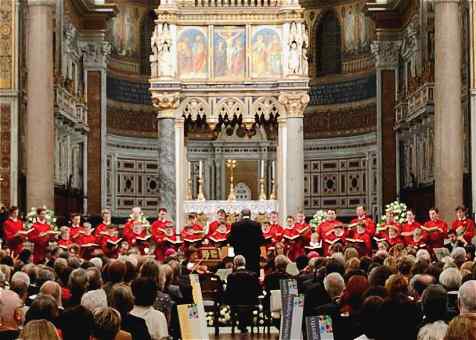
Choir of New College, Oxford - Art of the Chorister/2005/06
The Choir of New College Oxford
wiki
Choir of the New College Oxford (Choir) - Short History
BBC - Music Profiles - Choir of New College, Oxford
M.A.M. Arist List; Special Projects

The Luttrell Psalter
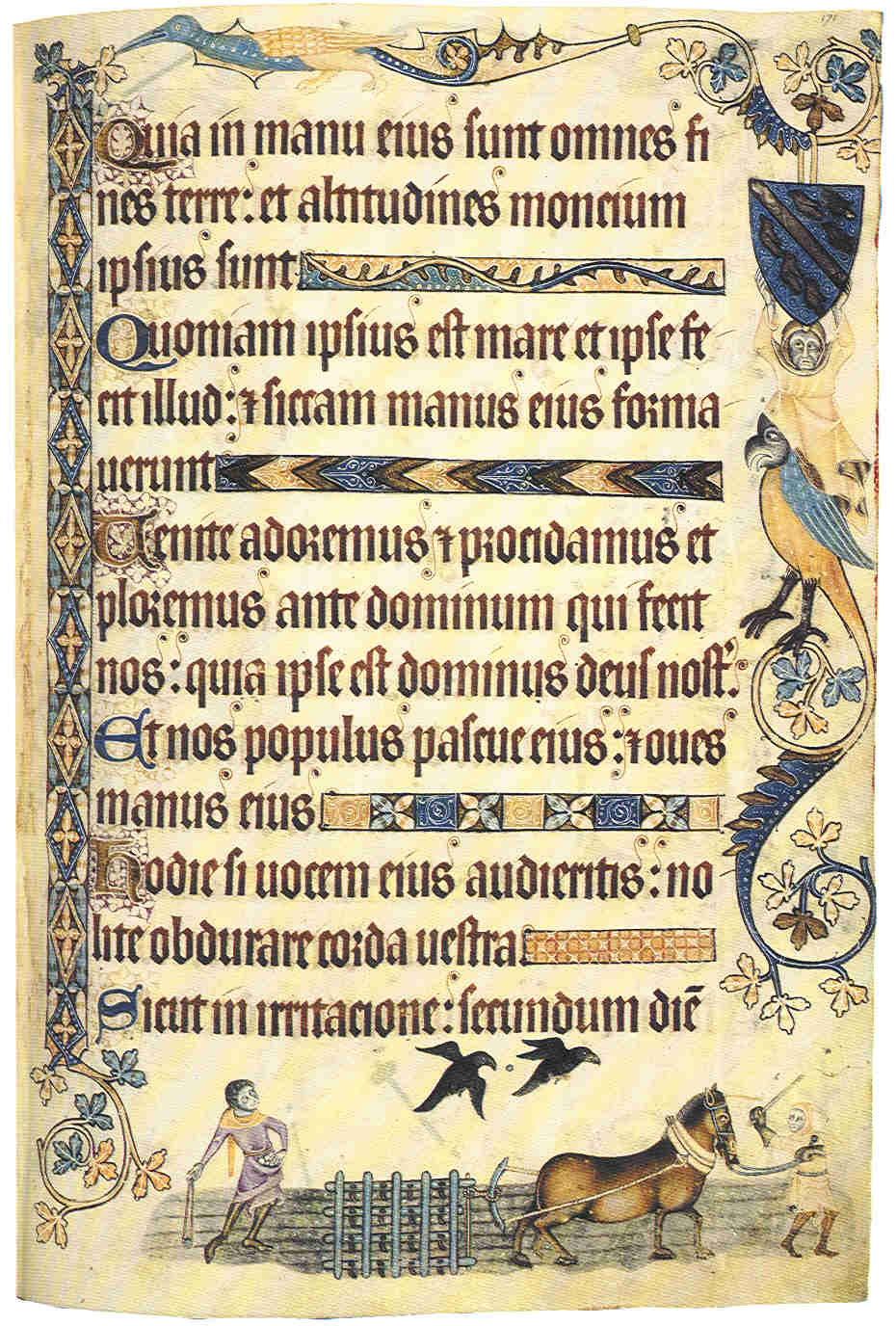


The Luttrell Psalter Film
Trailer
(Are the women's clothes perhaps a bit too clean?)
Luttrell Psalter (2nd trailer)
Luttrell Psalter plainchant (sneak peek)
More info:
Showcases :: Luttrell Psalter
Turning the Pages: High quality version of the Luttrell Psalter
wiki
Oxbow Books - The Luttrell Psalter: A Facsimile with an ...
Luttrell Psalter - illustrations of medieval life in the England ...
Google Books: Mirror in Parchment; Medieval Rural Life in the Luttrell Psalter
Michelle P. Brown, The World of the Luttrell Psalter
Time article
The Luttrells
The Orchard House Wardrobe: Luttrell Psalter Film
A couple of more Heiligenkreuz clips
CHANT MUSIC FOR PARADISE - Making of
chant - radio interview with Father Karl (english)
Or, practice your German!
Radio-Interview mit P. Karl (deutsch)
Caritas pater est (Plainchant by Chant Group Psallentes)
(link via NLM)
Negative attitudes towards the police
Should police officers wear some sort of a uniform? Or should they wear civilian clothing, along with a badge and their gear, maintaining a low-profile as much as possible? Is a uniform necessary for professionalism? (What would sheriffs and constables of the past have worn? Whatever was typical of the nobility?) Is a visible presence important for deterrence? Would deterrence be necessary in a small community? While police officers can effect some measure of deterrence in larger communities, doesn't this effect persist only while they are present? Hence, there is the problem of size and 'policing' by patrol car.
Some oppose the adoption of military-style BDUs by police officers, even though these are more comfortable and suited to the demands of police work (according to police officers who wear them), because this would make the police too 'militaristic' and be at odds with their actual function in society. Peter Hitchens holds on to the ideal attributed to Robert Peel in his creation of the Metropolitan Police Force, namely that the police officers should appear to be like an ordinary citizen as much as possible. Mr. Hitchens criticizes the replacement of the traditional bobby by the modern police officer accordingly. But what are the functions of the police, in addition to providing a defense of a community from criminals? The police are not merely referees and political life is more than a game--the stakes involved are much higher.
While they should appear like ordinary citizens as much as possible, they also have to be different, so that they are noticeable. Is it possible to balance being readily identifiable with blending in with the citizenry? Or are these two considerations so opposed, despite being seemingly necessary? What if it is the case that for the police to be truly effective, their presence should be concealed rather than be obvious? In order to determine what it is for the police to be effective, we must first know what its function is.
One detective for the Metropolitan Police has written that, "In 1829 the Metropolitan Police Act led to the introduction of the modern police force. The primary means of policing was conspicuous patrolling by uniformed police officers. The key objective was the prevention of crime." Is this ideal too unrealistic? Even though LEOs are said to enforce, that is compel observance or obedience of, the law, they cannot be a constant monitor everywhere, even in public areas--they cannot prevent a well-conceived crimed or one that is hidden from patrols or surveillance. In the U.S., because of the reliance on patrol cars, they usually only respond after a crime has been committed, and apprehend those who are guilty of crime and bring them to judgment and punishment. Though they serve the legal system and justice, they are not a tool of punishment, which is the coercive effect of law. They are also involved in the physical defense of a community, which function is assigned by Plato to the guardians in The Republic. And to an extent they act as referees who can mediate a dispute or de-escalate a situation before things turn ugly. Critics, in their zealous support of the deterrent function of police forget that the police must also defend the public and themselves from violent criminals, and therefore take the necessary precautions. (As the use of knives increases, is the time of the unarmed bobby coming to an end?)
Police officers are not meant to be social workers, though they should show a concern for their fellow citizens and do what they can to help because they are a citizen and in a position to do so. But these two roles should be kept separate, unless they are participating in the role of those who rule or of the magistrate? Otherwise, where the line be between showing proper concern for a fellow citizen and being a busybody?
Who should be entrusted with giving moral and spiritual direction to the members of the community, other than those who are virtuous and wise? And should they present themselves as sources of such aid, or should they rather wait until they are approached? In a fragmented community, perhaps only the police can be in such a position, but in a fragmented community, how can we be sure that the police themselves can be reliable moral guides? Being able to cite the laws of a community is not the same as being prudent or knowledgeable of (and conformed to) higher principles that should inform human law.
If it is proper to a republican constitution (or polity -- see Aristotle's Politics) for most to be citizens, would not the function of protecting a community from its internal enemies be a duty incumbent on everyone who is qualified to be a citizen as well? This seems to be in harmony with Peelian Principles. (Is it better to have a designated 'neutral' party apprehend those who have committed crimes, rather than relying upon the family of the victim(s)?) (Even in other constitutions, all the members of a community may be responsible for its defense, even though they might not hold office or have a share in ruling.)
The police are an instance of function being specialized within a community, and not of delegation or restriction of a function to certain persons, as in the case of legislating or ruling. If a true militia were to be established, how many people would lose interest in becoming a police officer, and look for another means of support while still feeling that they are engaged in the duties of a citizen? If citizens were more capable of defending themselves, or did not give the appearance of being passive sheep, would it be necessary to set the police apart in appearance in order to make their presence known and thus scare criminals off? And does having a uniformed police force (along with restrictions on firearms) serve to degrade the exercise of citizenship? If the citizenry cannot rely on the police to prevent crimes (which they cannot do to any great degree, at least here in the United States), would they not be somewhat justified in feeling angry that they have to support a group of people who seem useless?

Links:
Peelian Principles - Wikipedia, the free encyclopedia
The Peelers - The World's First Police Force.
A History of the Nine Principles of Policing
Blues And Twos - Police Officer's Blog (UK policing)
City of London Police (wiki)
Metropolitan Police History
The Metropolitan Police

Wiki: Metropolitan Police Service; Metropolitan Police Act 1829, 1839
The Metropolitan Police Act, 1829
Metropolitan Police Act 1829 (c.44)
Police authority and reform in Augustan Rome and nineteenth ...
Google Books: An Introduction to Policing and Police Powers, by Leonard Jason-Lloyd
Elaine Reynolds, Before the Bobbies: The Night Watch and Police Reform in Metropolitan London, 1720-1830 -- Google Books
| Book Review | The American Historical Review, 104.5 | The ...
To First U.S. Bobby, Unarmed Is Unsafe
Johnson, who used to stand ceremonial guard duty at the White House and other Washington sites as a member of the 3rd U.S. Infantry Regiment, said British police need far better training.
He said he had 36 weeks of academy training and supervised field work to become a police officer in Texas. But at Thames Valley he said he received less than half that, and most of the instruction involved how to fill out paperwork.
Johnson said British officers are instructed to retreat if they see a gun and call for backup from armed officers, but that can give suspects time to escape. He said he recently found himself in the same room with a man wanted for attempted murder and he could easily have taken the suspect by surprise and apprehended him.
But, Johnson said, because the man was believed to be armed, he was ordered not to approach him. The suspect walked away and was arrested by armed officers two days later.
"If he had gone out and committed more violent crimes in those two days," Johnson said, "I would have felt personally responsible."
BBC NEWS | UK | England | London | Armed police tackle gun murders
Another page for Sheriff Richard Mack. (Previously mentioned here.)
Constitutional Duties of a Sheriff
The Spiritual Politician: Sheriff Richard Mack: America's ...