Thursday, August 10, 2006

Varia for 2006 August 10


Army special forces soldiers, rear, salute during the funeral for Army 1st Sgt. Christopher Rafferty Friday, Aug. 4, 2006, at Arlington National Cemetery in Arlington, Va. (AP Photo/Haraz N. Ghanbari)

Army honor guard carry the remains of Army 1st Sgt. Christopher Rafferty during his burial ceremony at Arlington National Cemetery in Arlington, Va., Friday, Aug. 4, 2006, (AP Photo/Haraz N. Ghanbari)

All the News That Fits, by Thomas Fleming

‘Airlines terror plot’ disrupted
http://news.bbc.co.uk/2/hi/uk_news/4778575.stm
Find: Muslim Not Found
Find: Islam Not Found
Find: The Truth Not Found

In reading, seeing, or hearing news reports on the terrorist plot, hatched in the UK against the US, don’t bother to look for any description of the terrorists beyond the
phrase used by the government, “home-grown.”

Check JihadWatch for the latest on the plot to blow up commercial airliners travelling from the UK to the US.

Armed Port Authority Police Department officers keep watch inside the British Airways terminal of JFK Airport, Thursday, August 10, 2006 in New York. Passengers in the United States are facing heightened security at airports today after authorities in London uncovered a terror plot aimed at airlines traveling from Britain to the U.S. (AP Photo/Henny Ray Abrams)


An armed British police officer stands guard outside the Houses of Parliament in London, after Britain's national security threat level was raised to critical, Thursday Aug. 10, 2006. British authorities thwarted a terrorist plot to blow up several aircraft mid-flight between the United States and Britain using explosives smuggled in hand luggage, officials said Thursday. (AP Photo/Matt Dunham)
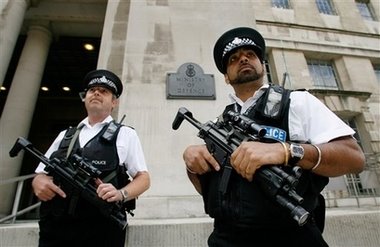
Armed British police officers stand outside the Ministry of Defence whilst patrolling the Westminster area of London, after Britain's national security threat level was raised to critical, Thursday Aug. 10, 2006. British authorities thwarted a terrorist plot to blow up several aircraft mid-flight between the United States and Britain using explosives smuggled in hand luggage, officials said Thursday. (AP Photo/Akira Suemori)


Armed police officers patrol Manchester Airport. Authorities in Britain have said they had thwarted a terrorist plot to wreak "mass murder" with the simultaneous mid-air bombings of planes to the United States, and ordered a maximum security alert that snarled air traffic around the world.(AFP/Paul Ellis)
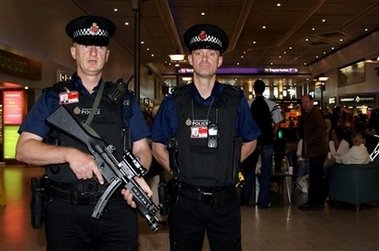
Policemen are seen on duty at Manchester Airport after a terrorist plot to blow up aircraft in mid-air has been foiled by British police and security services in England, Thursday Aug. 10, 2006. British authorities thwarted a terrorist plot to blow up several aircraft in flight between the United States and the United Kingdom using explosives smuggled in hand luggage, officials said Thursday. Britain's Home Secretary John Reid said the alleged plot was significant and that terrorists aimed to 'bring down a number of aircraft through mid-flight explosions, causing a considerable loss of life.' (AP Photo/Peter Bryne,PA)
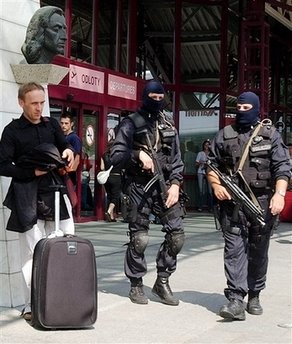
Members of the Polish Anti-terrorist Police unit guard Warsaw-Okecie international airport, Poland, Thursday, Aug. 10, 2006. Airlines across Europe canceled flights bound for London's Heathrow Airport Thursday, while some airports offered to take on diverted traffic after British authorities said they had thwarted a terror attack aimed at aircraft flying from Britain to the U.S. ( AP Photo/Czarek Sokolowski)

I find the next one amusing.

Massachusetts State police patrol with automatic weapons inside a terminal at Logan International Airport in Boston, Thursday, Aug. 10, 2006. The response to the terrorist threat announced Thursday produced long lines at airports as security officials scrambled to put new measures in place and passengers faced perplexing new restrictions _ including a ban on carrying liquids onto aircraft. (AP Photo/Michael Dwyer)

Joan Lunden did fire one for her "Behind Closed Doors" special on the FBI HRT...

Lots of MP-5s being used (still a favorite among counter-terrorist teams and police departments for CQB)... but then there's this:

Armed police patrol Gatwick international airport on the outskirts of London, following the introduction of heightened security measures August 10, 2006. British police said on Thursday they had thwarted a plot to blow up aircraft in mid-flight between Britain and the United States and arrested more than 20 people. (Kieran Doherty - BRITAIN/Reuters)
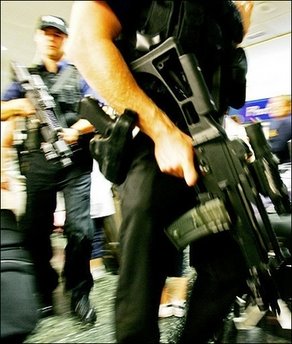

Armed British police walk in the check in area of the South terminal at Gatwick Airport, Sussex. US authorities issued their highest level "Red" terrorism alert for the first time after the discovery of a plot to bomb multiple US airliners flying home from Britain, an operation officials said bore the imprint of the Al-Qaeda movement.(AFP/Carl de Souza)

Looks like a G36K.

*edit* Looks like they're not the only ones.
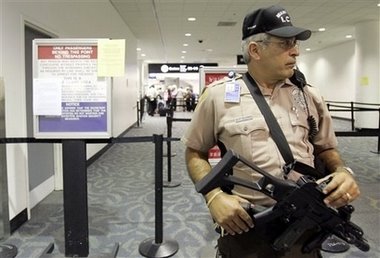
Miami-Dade County Police officer Mark Huetter watches the hallways at Miami International Airport Thursday, Aug. 10, 2006 in Miami. Airport lines stretched longer, security was increased and frustrated passengers across Florida emptied carry on bags of everything from lipstick to toothpaste as the U.S. issued a threat alert in response to what authorities called a thwarted terrorist attack. (AP Photo/Alan Diaz)

Miami-Dade County Police seargent Rudy Espinosa, right, performs security rounds at Miami International Airport Thursday, Aug. 10, 2006 in Miami. Airport lines stretched longer, security was increased and frustrated passengers across Florida emptied carry on bags of everything from lipstick to toothpaste as the U.S. issued a threat alert in response to what authorities called a thwarted terrorist attack. (Alan Diaz)

I wonder if the G36K is standard equipment for Miami-Dade--it had a prominent role in Miami Vice.
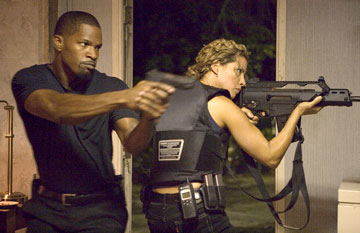
Heckler and Koch trying to get in on the carbine action--the HK416 System:


Something for Sarge:
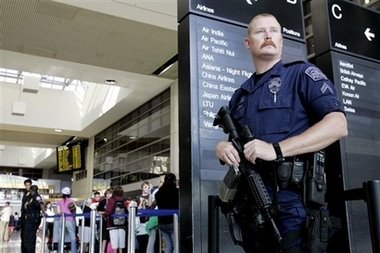
Los Angeles Airport Police officer James Adrian stands on watch at Los Angeles International Airport Thursday, August 10, 2006 in Los Angeles. The U.S. government issued its highest terrorism alert ever for commercial flights from Britain to the United States early Thursday after a terror plot was disrupted in London, with a specific concern for tourist-filled flights to major U.S. cities. (AP Photo/Nick Ut)

"You and your M4."

Sandro Magister: From Lebanon to Central Asia: The Rise of Shia Muslims

Korea Times review of Sugar: "Sugar" is Sweet but Not Delicious

'Kim Jong-il' Aphrodisiac Gang Busted

Living Korean Dance Legend Performs in New York

Korean traditional dance legend Kang Sun-young performs at the Lincoln Center in New York on Tuesday.
Front - August. 9, 2006

Monks climb stone steps after finishing their three-months summer retreat at the Sudeok Temple in South Chungcheong Province on Tuesday. The practice dates back some 2,400 years, when the Buddha encouraged his followers to spend the summer monsoon in contemplation lest they trample on budding grass or insects./Yonhap


Seoul Film Student Named New Asiana Model


Regarded as a gateway to stardom, the position of exclusive advertising model for Asiana Airlines has gone to a newcomer, Park Chae-kyung.

Asiana said Thursday it selected Park, who is studying film at the Seoul Institute of the Arts, and contracted her for two years of exclusive work. "To coincide with our new IC and improved service programs, we went looking for a new commercial model,” an Asiana staffer said. “Hundreds applied, but we determined that it was Park Chae-kyung who best lives up to the motto of our new service: 'Novelty, Earnestness, Softness, Quality.'” Stars who started out as Asiana models include Park Joo-mi, Han Ga-in, Lee Su-kyung and Lee Bo-young. Commercials featuring Park will hit the airwaves mid-month./Yonhap
(englishnews@chosun.com )


Ugh, but why would the Chosun Ilbo stoop to this level! How to Spot a Boob Job

Wednesday, August 09, 2006

News of Austen on BBC

From AustenBlog:
Masterpiece Theatre to Broadcast Jane Austen Festival in 2007

New productions of Northanger Abbey, Mansfield Park, Persuasion, and Sense and Sensibility...
nice.

Reappraisal of Syriana


Official site for the film

"Does the movie have something to do with Syria?" explanation of the name

Stephen Gaghan and Robert Baer:


Perhaps the reappraisal should wait until I re-watch the movie, but enough time has passed from the first viewing and I still remember the basic plot details. Is the movie a classic? I'm not sure--in 15 or 20 years I think it will seem outdated, if only because we may have a better sense of American entanglements in the Middle East by then, and the real role and influence oil companies have had.

I still think some movies could be made based on the actual life of Robert Baer. I believe originally the movie was going to be a straight adaptation of his book, but they decided to write a new script, and invent a character, Bob Barnes. Is Mr. Baer an opportunist, capitalizing on his experiences? A shameless self-promoter? An empty talking-head passing himself off as an expert on the Middle East, though one with a fascinating background? Or is he something more than that? (Similar charges have been made of those who have served the country, David Hackworth, Eric Haney...) I think that if it would have been possible for him to remain at the CIA while maintaining his integrity, he would have done so. When a man devotes his life to serving his country and he is prevented from doing so by the agency or military of which he is a part, one can only imagine the sadness he must feel.

What has the impact of the movie been? Virtually none, as far as I can tell. It didn't really enter into mainstream conversation among Americans. While reform of the CIA and the intelligence community remains a pressing concern, it is not clear to me if the 9/11 Commission, the changes that have been implemented and the various political appointments have amounted to any good. As it is, I don't think I would want to enter into Federal service. Unfortunately the movie, unlike the book See No Evil, did not really focus on the need of the CIA for reform, though it did show how politicized it was. One suspects that the agency's betrayal of Barnes reflects how officers and agents of a certain generation at the CIA perceived the changes within the agency during the 90s.

Instead, the movie focused on... oil. While Americans are aware that gas prices are going up and oil is coming from elsewhere, whom do they blame for the increase? The oil companies. Certainly not themselves. Just yesterday there was a story on NBC Nightly News about BP knowing for a while that they were having problems with corrision of their pipes in Alaska, and that it could have been mitigated had they not cut down on preventative measures in order to save on costs.

Does our dependency on oil influence our political decision-making and foreign policy? Undoubtedly. Could we really decide differently? Not if all of us agree with Vice President Dick Cheney in maintaining that "the American way of life is non-negotiable." This is what the movie attempts to portray, how all of the small cogs inside industry and government are caught up in something bigger than they can comprehend, and there is no easy solution to their difficulties. (Some have complained that the movie does not offer an easy solution--one wonders if they are being simpletons and completely missed the point of the movie.)

How are Muslim terrorist organizations weaved into the story of Syriana? Does the movie respect religious motivation, or does it attempt to reduce it to economics? While the movie does make the point that such groups can find recruits among those who have no economic opportunities, at the same time it portrays the recruiter as having sincere religious beliefs. It is not clear to me if those whom he recruits have an "authentic" conversion, or if they are merely seeking a way to lash out against their perceived oppressors.

Americans today remain as oblivious as before about Peak Oil and its potential consequences. Problems with infrastructure and conflict in oil-producing regions have obscured the basic assertion of Peak Oil messengers--there is a finite amount of oil on this planet, and sooner (or later) production will peak. If production peaks, while demand continues to increase (along with our dependency), leading to a point of no return for our economic arrangements, then the consequences will be dire. People don't realize that they depend on oil for more than fueling their cars and heating their homes.

At least Rep. Roscoe Bartlett is trying to do something about peak oil within Congress. (Interviews with Rep. Bartlett: audio files, transcripts)

That said, if one has to watch movies, Syriana is a movie worth watching (at least?) once. But it would be better use of time for people to read about Peak Oil and to see what they can do to forestall its consequences on their own lives. Maybe it will be not much, if they act in isolation. But if they realize this, perhaps they can meet and discuss with others and try to come up with an actionable plan for their local communities.

Books by Robert Baer:
See No Evil
Sleeping with the Devil
Blow the House Down (novel)

"The Fall of the House of Saud"
"Dangerous Liasons"

Interviews with Robert Baer:
Buzzflash; Frontline; BBC3; FrontPage; npr; Atlantic; CHUD (he discusses the movie); Harpers; Hoover; Foreign Correspondent; BBC; Washington ProFile; PBS interview; CNN transcript; Lateline; On the Media (020202, 060702); Bob Rivers; BORR; GreenCine;
; Public Ed Center; Eyeonbooks;

short bio

on intelligence reform and the CIA: Foreign Policy Association, How the CIA can be fixed;
Wanted: Spies Like Us; wmassociation; Hoover Institution: "I Spy"; "Flying Blind with the CIA"

chatroom transcript; another

Articles:
Durango Herald; Telegraph; Former Intelligence Officials Take To the Novel To Tell Their Stories; Intelligence Reform? Patience; Spy World; Top Former CIA Agent Condemns New Terror War; Salon; NRO; Online Journal; "Washington vs. Havana"

An analysis of current intelligence reform
a blogger's opinion

Anthony Sacramone on World Trade Center

over at First Things

Stephen Webb on "Men not Working"

I think the First Things group blogging is working. It is easier for there to be many entries about diverse but interesting topics if there are more than two people doing the blogging. As for the movie World Trade Center, I still don't think I will see it, though if Fujian Gal still wants to see it, I suppose I'll ask her when she comes back to Boston.

Unexpected Ozu reference

James Kushiner blogs on Yasujiro Ozu, commenting on his Tokyo Trilogy:

The films that I have seen--the trilogy--deal with the Japanese society as it faces changes under American occupation as it moves into the latter half of the 20th century. I do not know much about Japanese society (then or now), but in looking at the changes on a small scale, focused on one family, Ozu presents a
moving reminder of things that money cannot buy: loyalty, humility, generosity, love--all in the midst of change. The American occupation is simply background, just there, hardly depicted.

Traditional values and ways of life disappearing because of modernization and urbanization... one of my favorite themes. Ozu's work is on the top of my list of films to be collected...

Criterion Collection
Merchant Ivory filmography
The Merchant Ivory set was mentioned prominently at the old Criterion website (at least according to Google).

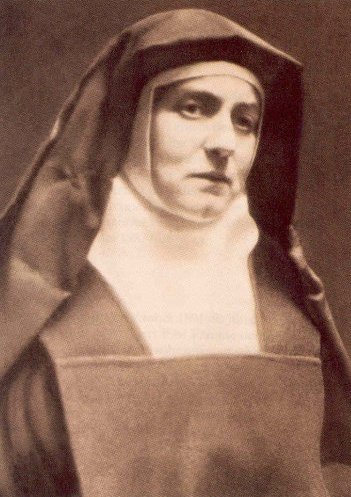
St. Teresa Benedicta of the Cross, August 9

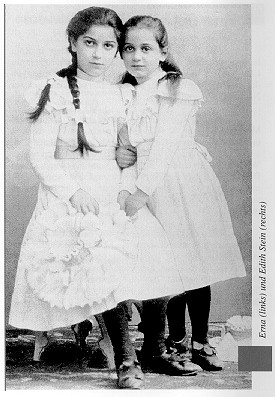
Known in her previous life as Edith Stein. With her sister Erna?:


"Canonization of Edith Stein and Homily"
A Vatican page.

carmelites.ie page
ourgradenofcarmel.org page
"Edith Stein--Convert, Nun, Martyr" by Laura Garcia
Second Exodus page
page on Edith Stein (more oriented towards philosophy)
a German site
German Carmel; French Carmel; carmelite.com; ocd.pcn.net

(larger version)
By Michael O'Brien:


Thomas Hibbs' review of Alasdair MacIntyre's Edith Stein: A Philosophical Prologue 1913-1922. (I first posted a copy here.)

ICS Publications

"Edith Stein's Contribution to a Phenomenology of Ethical (Self-) Revelation" by Michael Michau
Resources page at UND libraries

Heat

The book, not the movie. (Which incidentally appears to be almost universally touted by critics as being better than Miami Vice.)

Amy Welborn discusses the book here, and refers us to the review by Sara Dickerman. NYT review.

Bill Buford recounts his learning experiences in the kitchen of Babbo (Mario Batali's restaurant). Sounds very interesting, no?

Amazon listing. Mario Batali's webpage.

Tuesday, August 08, 2006

Nine Ways of Prayer of Saint Dominic

here (thanks to Tom Reagan); or here (from Georgette)

The niece is walking!

So fast!

My mom's IMs: "Baby is walking now. She said a lot of words, specially No No." "She is smart. I will tell you tomorrow on the phone. She knows birds and aeorplanes. I taught her and now whenever I say birds and planes, she will look up to sky and point to the sky. She learned how to clap now."

D---, I'm missing out.

Flag of Our Fathers coming Oct. 20


Military.com story; official site

No news as to when the movie about the campaign, told from the Japanese point of view, might be released or if it will be released here. (I was thinking it might be released only in Japan, but that doesn't seem likely.)

Another Dominican reference:
Giles Dimock, O.P. faculty page
His "Revisiting the Baroque"
some podcasts by him

After I dropped off the library books, I was headed back for the stairs by the Commonwealth Ave. garage when I saw a skunk on the lawn by the side of O'Neill, to the south of St. Mary's. The skunk had seen me and its tail was up; it was presumably ready to use its famed defense mechanism. As I slowly walked away it maintained its face-off until I was a safe distance away and it let its tail down. Evidently it was looking for food in the grass. When it scurried across the sidewalk towards the bushes at the side of O'Neill, its 4 feet looked like six. I had not seen a skunk so close up to this point, even though I could usually smell its presence around the house. Not a very ugly animal, all animals reflect the glory of God in their own way. I didn't imagine the white streak would be so prominent on the top of its body, but its tail was mostly or perhaps all white.

LG CFs: Lee Young Ae and Bae Yong Jun


Having watched the CFs, I can see why Japanese housewives would be infatuated with Yong-sama. His voice is deep and manly, and as P'lyn points out, he has the appearance of being "si man" -- polite or well-mannered. (Although she herself doesn't think he is that handsome, she prefers someone like Lee Byung Hyun.) I would have to agree, though "si man" is not necessarily fragile or wimpy, as is evidenced by his acting in Untold Scandal. (There I am not thinking of his character's womanizing but the fact that while he is a scholar he can also fight.)

Some websites for Bae Yong Jun.
http://www.kpopmusic.co.uk/Bae_Yong_Jun.htm
::: www BYJ site :::
http://baeyongjun.blogsome.com/
http://www.hancinema.net/korean_Bae_Yong-joon.php

Bolleeeeeeeewood...

Daniel Larison has made me aware that there are plenty of clips from Bollywood movies at YouTube, such as this one that he recommends.
Fans of Rani and Madhuri fight it out in the comments section.

An extended playlist. A site to visit if I get bored...

Only 4 clips under Aishawarya (who misspelled her name), 600 or so under Aishwarya, but 1464 under Rai. Woohoo!

Found some clips by a Greek singer, Anna Vissi. Her voice is not so strong.

The (college) education gap?

At First Things, Mary Angelita Ruiz comments on the NYT article, "Facing Middle Age with No Degree, and No Wife." She writes:

The authors examine at some length the possibility that many women now choose not to marry because the men they know are less educated than they are and are therefore chancy financial prospects. This is a narrow view of the situation. It is true that women now attend college in greater numbers than men, that the number of steady blue-collar jobs available to men without college degrees has decreased, and that women, let’s face it, like men with money. But Porter and O’Donnell do not examine the possibility—which, to be fair, was not examined in the census data they used—that educated women choose not to marry less-educated men because of a change in the way Americans view education.
Her alternative explanation:
Americans with university educations now look at a college diploma the way people fifty years ago, or even twenty-five years ago, looked at a high school diploma. A college diploma signals two things, correctly or incorrectly: that the diploma-holder is responsible and will strive to keep his family from needing to survive paycheck-to-paycheck, and that he has basic familiarity with American culture or some intellectual pursuit, and is thus potentially interesting and companionable. Whether he actually is responsible, interesting, or companionable is irrelevant, as is the certainty that many men who do not have university educations are more responsible, interesting, and companionable than many who do. What matters is the cultural assumption that a woman “marries down” in terms of maturity and intellect, not merely financially, if she marries a man who is not as educated as she is. I imagine that this assumption is
widespread enough to account for a statistically significant portion of the drop in marriages.
It has been reported that college-educated African-American women are not marrying men without the same background, and hence their poor of eligible mates has been limited, possibly impacting the crisis of the African-American family. I wonder if the same will happen with 'Euro-American' women, but my suspicion is that those who have money will tend to congregate in the same places (i.e. bars and clubs), even if the men they meet don't have a college education, and they will date (or sleep with) those men. Will they ultimately settle down with one? Are college-educated men just as likely or even more likely than blue-collar men to avoid marriage? Will the difference in education have a greater impact than obstacles to marriage and family due to character? Those looking for a "match" may take education into consideration. Those going on emotion or impulse may be looking for something else. But given that many men and women are marrying later to begin with, and the first place they look are probably those places they frequent (such as the workplace), there may be sufficient time for them to change their ideas about the importance of having a degree. (After all, one does not need a degree in order to be educated or reason well, and a degree is an indication of neither.) However, it may not be sufficient time for them to come to understand the purpose of marriage and the importance of character. (Enough men can find temporary shack-up honeys, without feeling the "need" to get married.) An analysis of "psychological preparedness" (really, just plain ol' maturity) needs to come into play. After all, what if people are avoiding marriage simply because they are self-centered.

Finally I found the post I was looking for, the one on this same topic that I had last read. It's over at Eunomia, which refers us to Steve Sailer's reaction.

Last week Range referred me to this post. Or was it this one? Definitely not this one. Fred Reed's main website.

Ugh.

Amy Welborn on Body Worlds exhibits and related stories.

Don't read, unless you can handle possibly vomit-inducing descriptions of how human bodies are treated and put on display.

St. Dominic, August 8

Founder of the Order of Preachers, Ordo Praedicatorum, one of my favorite religious orders, as you can tell from the links on the right. Originally I was very much attracted to the Jesuits, their spirituality and apostolate in education, but I've "regressed" since then. (Beyond Dominican spirituality, in many ways.) Can Ignatian spirituality supplement 'primitive' Christian spirituality? However, since I take St. Thomas Aquinas as an intellectual master and prefer the Dominican school (especially contemporary versions, like the River Forest school) to the others (like the old-school Jesuit school, Suarez and company). Then there is the old joke that ends with the punchline, "Seen any Albigensians lately?" (see the last one posted here)

There is another joke that I've heard, but I can't remember the first part--

There are three things that only God knows:

  1. ???
  2. How many Franciscan groups there are.
  3. What a Jesuit is thinking.


It's unfortunate that very few are willing to comment upon and revise Aristotle. While much of his data can be supplemented by what we have observed sine then, and hence many of his positions corrected, his basic philosophy of nature reminds valid, for the most part. I suspect that his analysis of alteration could be revised though, and his understanding of quantity, to take into account generation and corruption at all levels of natural being. But I really should read his work on Generation and Corruption.

(Dominican International Seminar, 2003: The Role of Philosophy in Dominican Formation and Apostolic Work. Fr. Benedict Ashley's "What Should be Done in the Future" -- text, pdf, abstract. Proposed Guide for Sharing Our Secular Resources. UND press should be publishing his The Way Toward Wisdom soon. His Health Care Ethics. Fifth edition already! Mark Latkovic's Natural Law in the Moral Thought of Benedict Ashley. Flyer.)

Enough about Aristotle and philosophy, though. Back to St. Dominic and the Dominicans. I have remarked elsewhere that the history of the Dominicans has been tied to the development of the medieval city and the university. If the medieval intellectual project is dead, and megapolises are in danger of sever reduction in size, will the Dominicans have a role to play in the future? At least the Jesuit serve as missionaries, even if their colleges and universities and schools are forced to shut down. Will scholasticism remain in some form, even if isolated to a few houses here and there, being replaced by so-called "monastic theology"?

One can view the debate over the New Theology in that light--however, renewal of the Church has always depends on a "return to the sources," and to concrete manifestations of Sacred Tradition, like the writings of the Church Fathers because of the very nature of the theological virtue of Faith, which is mediated by what is communicated to us by others. So while one should be securely anchored within Tradition before proceding to inquiry and speculation, it does not seem to me that the traditional Dominicans were wrong to emphasize that the roots and principles of St. Thomas (and other scholastics) were still valid. Though it may be the case that they did not take their inquiry in certain directions because there was no need for them to, or at worst, that their grasp of the Faith may not have been so deep on certain points--still I would not be so quick to judge the work of saints. Theology begins in and remains in Faith; otherwise, it is not theology.

If the human sciences of metaphysics and physics were abandoned, along with formal training in logic, we would be left with whatever talents an individual monk or theologian might possess, whether they be natural gifts or supernatural gifts. Theology inevitably makes use of our understanding of the world, and simply because one does not have training in the human sciences does not mean that one's theology will not be appropriating one's knowledge of reality.

(This seems to be the mistake certain Orthodox make, in appealing to a "theology" exclusively centered on Christ and one's experience of God. There is the "theology" which is identical to the spiritual life, the divine life, living in union or friendship with God. But there is also theology as rational activity which flows from the first. [This is the use of analogy.] I cannot see if they concede that Sacred Tradition is a proper foundation of theological inquiry, and it, through the activity of the Church's teaching authority, can serve to judge the results of inquiry as being proper or orthodox, then how they cannot recognize that the link between its "incarnate" nature and human language and understanding does not entail some sort of dependence on authentic human knowledge. Unless they appeal to some sort of supernatural experience being directly translatable into human language, without being mediated by our understanding of the natural world--which is what they may be getting at by their emphasis on the divine energies, and how they explain divinization or divine union.

Scholastics would also assert that their theological inquiry is rooted in their experience of the divine and in Faith--but they also acknowledge the role the human sciences have to play as tools for meditating upon the divine mysteries. Hence I wonder if the Orthodox focus on developing an ontology from Tradition alone is not somehow circular (leading to confusion rather than clarification, as is evident from what some have said on how Scripture is to be interpreted when it talks of light and other metaphors), or worse, actually depends upon presuppositions taken from outside of Tradition. This certainly leads credence to polemicists who charge them with an attitude of anti-rationalism; either they must deny that human reason alone can come to know anything about divine realities, or that if there is a conflict between what human reason knows and what their theological speculation states, then they must identify the latter with Tradition itself in order for the latter to triumph.)

Within an urban setting, perhaps the Dominicans, with their common life, have a role to play in liturgical renewal, more so than the Jesuits, who are more "free" with respect to liturgical duties as a direct result of St. Ignatius' intentions and legislation in the Constitutions of the Society of Jesus. (Perhaps too free [in a different sense], given the prevalence of liturgical dancing within Jesuit parishes and such.) In that respect the Dominican houses would be like monasteries and societies for apostolic life (most notably the Oratorians).

Unfortunately, it does not seem that a return to the old Dominican rite will take place any time soon, though I believe the Fraternity of St. Vincent Ferrer uses it exclusively. Nonetheless, among the younger Dominicans I have encountered there is a great interest in liturgical tradition and liturgical spirituality, and this is a good sign.

Now there may be concerns as to whether the Dominicans can support themselves financially, but mendicancy is not a human affair but a divine one, and one must ultimately trust in God to provide. On the other hand, if He does not provide, is it a sign of His will regarding the order?
A little bit more of the spirit of poverty would be good for everyone in the "Western" world, including the religious.

Finally, preaching. What this world needs are good preachers, as is evidenced by Fr. Corapi's fan following. It may be imprudent to preach in a crowded square here in the United States or Europe, but on the other hand if one has the special gift from God, one goes where the Spirit leads him. Solid, orthodox preaching (and catechesis) on divine things (including moral implications) is necessary for the renewal of the Church, and the Dominicans, by being faithful to their charism and traditions, can accomplish much here.

*As for basic or primtiive Christian spirituality, I am thinking of liturgical spirituality--see also Louis Bouyer's Introduction to Spirituality, or the three volume work on spirituality that includes Fr. Bouyer as an author. (I think Jacques LeClerq was also associated with that project.)

On St. Dominic and the Order
CE entries for St. Dominic, Order of Preachers (alternate site; entry was written by Pierre Mandonnet, O.P.); EWTN page; patron saints index page

Saint Dominic and the Order of Preachers, by J. B. O'Connor, O.P.
The Golden Legend: St. Dominic
History of the Dominican Order
The Dominicans, A Short History, by William A. Hinnebusch, O.P.
Saint Dominic and the Rosary; Article on him and the rosary by Robert Feeney; Paul Duffner;
Our Lady of Rosary Apparitions Art Gallery

(Odd-the thought that the spelling of Dominic was weird just struck me--this happens to me from time to time for various words; yesterday it was council.)

The current Master General is Carlos Alfonso Azpiroz Costa, O.P. (bio; "Proclaiming the Gospel in the Order of Preachers"; another bio, plus this)

Documents
alternate site for documents (not as many entries)
Provinces
Tradition page
Official website
OPcentral.org (their OP website links)

Wojciech Giertych, O.P. is the recently appointed theologian to the Papal Household.
Roamin' Roman's blog entry on his appointment; CWNews; Word from Rome
"Amoebas, crustaceans, and vertebrates"
His moral theology course (permanent link to the right).

Paintings by Fra Angelico of St. Dominic

Alt of the above. Another. Higher-res version.


Source

The Meeting of Saints Dominic and Francis

Virgin with Child and Four Saints (detail of the predella)c. 1437Panel, 23 x 230cm (entire predella)Museo Diocesano, Cortona

Description: The predella starts from the left with St Peter Martyr, followed by the scenes of Innocent III's dream of St Dominic holding up the falling church, the meeting of St Dominic and St Francis, then St Dominic receives the book and the stick by the Apostles Peter and Paul.

Icons

Not surprisingly, not so many icons of St. Dominic. Monastery Icons has one for sale, but I don't like the company's icons (at all).

More depictions here.

The Holy Inquisition: Dominic and Dominicans, by Guy Bedouelle, O.P.
St. Dominic and His Work, by Pierre Mandonnet, O.P.

Rule of Saint Dominic (adapted from the Rule of Saint Augustine)
O.P. Constitution; The Fundamental Constitution

The Dominicans [men] have only one college in the United States, Providence College. Fr. Shanley is president there now, and impressed many by his statement on the Vagina Monologues. (Ahem, tsk tsk Notre Dame.)

Dominican Spirituality
by William A. Hinnebusch, O.P.
by Isidore Clarke, O.P.
Dominican Principles of Spirituality by Pie Regamey, O.P.
http://www.domcentral.org/study/aumann/contpdim.htm, by Jordan Aumann, O.P.
Dominican Spirituality
some resources (warning, not all links are to orthodox materials)
Dominican martyrology

Fr. Chenu on the structure of the soul and mystical experience
(Fr. Schillebeeckx's essay -- warning, he's not orthodox, iirc)
(A little bit too much inculturation here!)

The New Wine of Dominican Spirituality (??? no idea if it's any good); review by a Dominican nun
Fr. Radcliffe's review of a book by Eric Borgman on Dominican Spirituality

Third Order Dominican Information
Third-order Dominicans
Tertiary spirituality
List of chapters
Immaculate Conception chapter (their links page)


St. Dominic's Church (in San Francisco)
My sister KK's liturgical haven while she was studying at the University of San Francisco.
St. Cecilia's in San Francisco; we went there once for an Opus Dei celebration.

Dominican Studia:
KK's Blackfriars
Dominican Studium Generale in the U.S.
Study Centers in Europe

Dominican rite
Dominican liturgy
Cnytr blog post
Dominican Rite Litany
Dominican Rite Liturgy Video
News about the Dominican Rite in Rome (links to this, which has a link to the old The Dominican Missal)
Dominican Sacramentary (supplement to the new Roman Missal)
Dominican Calendar
Supposedly there are pics of liturgy being celebrated at the Angelicum on this blog somewhere.
(Fortunately it's a young blog, so I was able to scan quickly--I think the photos are in the May archive. Thanks to the Dominicanus blog entry.)

Dominican-Jesuit controversies on grace
CE entry; Congregatio de Auxiliis
Prof. Freddoso's paper on Luis de Molina
History by James MacCaffrey, S.J.
Grace and Free Will, by Stephen S. Bilynskyj (I haven't read it, so I don't know about its orthodoxy)

Last night I couldn't sleep well because of an upset digestive system. Food poisoning again? Or too much fat in the system? Not sure. I need a doctor... hahaha. Does hot weather or humidity lead to weird things happening in the digestive system?

I ended up having a dream of a Soompi admin. She asked me to do some proof-reading of a paper or something. Weird. This is what happens when I look at someone's xanga before going to bed.

A note: Thomas Fleming on Mel Gibson (taken down from the Chronicles main page for some reason)

Monday, August 07, 2006

whoa...

The subletter's overnight guest came into the kitchen while I was there... didn't expect that to ever happen, him having a woman over. If I had known, I would have prepared and cleaned up the kitchen some more, plus some other things... I don't see him around the apartment much, but maybe I will ask him if that is his girlfriend next time we actually talk...

Cave-dwellers

The crawlers of Descent supposedly evolved from human beings who ventured into caves a long long time ago, and decided to stay there. (another pic--I think this is a production photo)
As I've mentioned before, they remind me of vampires (like the ones you see in Blade, or the ancient ones from the Buffyverse) or Remans from Star Trek Nemesis, or perhaps zombies in an advanced state of decay.

(Remans after all are Romulans who lived on the dark side of Remus and are sensitive to light, evolved, etc.)

Why should we regard living in cases as one, if not the primitive stage of living for human beings, rather than something temporary during an emergency or a stage of decay or even early camping. The wild and crazy imaginations of those with an ideological axe to grind... it's the same when they put forth stories about the ancestors of man living in trees, and so on.

iirc, Chesterton in The Everlasting Man makes a similar point, re-interpreting the evidence and coming to different conclusions, as well as reminding us of how ignorant we are of the past.

If Adam and Eve were given infused knowledge, would it have been taken away as the result of their sin? I doubt it--however this gift was probably not given to their descendants, and so they would have to pass on what they know to their children. It should not be surprising that the knowledge being handed down successive generations would diminish. How advanced were their tools? (And should we expect any traces of their existence? )

Without our power of imagination, the dogma of scientists would not gain as much acceptance as it has... hence, the power of narrative over reasoning. (One major and basic example is that of the notion of 'space'.) Another is the identification DNA as the formal cause of living things. While there may be a correlation between a set of genes with certain effects, mechanisms are rarely supplied, and the whole causal picture is usually incomplete. The uneducated are left with the understanding that a change in DNA is a sufficient cause unto itself, while in reality it may only be one condition.

Given the nonsense that is shown in TV and movies that trickles down, it shouldn't be surprising that many call for abstinence. Perhaps nothing kills learning more than established opinion rooted in pride or stubborness.

Mt. Athos, Greece: Of Monks and Men

Mt. Athos, Greece: Of Monks and Men

Thanks to Fr. Jim Tucker.

Water level of Amazon dropping

A disaster to take everyone's breath away

Why William Lind likes the Prussian monarchy

here

"Hezbollah wages new generation of warfare" by Matthew Stannard
"I think it's something new, in that a non-state organization has undertaken a major, sustained, broad-scale, and so far, the successful military offensive against a state," said William Lind, director of the Center for Cultural Conservatism at the Free Congress Foundation, a Washington, D.C., think tank. "What changes here ... is that non-state forces are able to challenge states militarily -- and win."

Some experts call it "modern warfare," some call it "unconventional conflict," others use technical terms such as "netwar" or "fourth-generation warfare."

The definitions differ, but all refer generally to conflict in which small, decentralized, non-state groups can turn the advantages of large national armies -- overwhelming firepower, high technology, a clear hierarchy of command -- into disadvantages, and in which winning political and public relations victories matters more than counting casualties and bombing sorties.

thanks to Global Guerillas

4GW theory is making its way to the MSM, perhaps it is time for some more fine-tuning of the theory that will take into consideration objections and purported historical counter-examples.

Another photo: 2006 Miss Koreas


2006 Miss Koreas: Winners of the 2006 Miss Korea awards accept certificates at Seoul Museum of Art, Monday. From left, Park Sung-min from Pusan, Park Hee-jeong from Pusan, Jang Yun-seo from North Chungchong Province, Lee Honey (reigning queen) from Seoul, Park Sharon from Inchon, Kim Yu-mi from Seoul and Kim Su-hyun from South Cholla Province. Korea Times


Slim TV phone: Pop singer Lee Hyo-ri demonstrates a 14.9-millimeter- thick digital multimedia broadcasting (DMB) phone from Samsung Electronics, SCHB540, Sunday. Samsung will market the thin TV phone today via SK Telecom at around 750,000 won. /Yonhap 08-06-2006 20:12


Fans Bet Kim Tae-hee's the Marrying Kind


Kim Tae-hee
Japanese
Marketers Bank on Gorgeous Korean ‘Villain’
Kim
Tae-hee Goes After Online Slanderers

As Kim Tae-hee’s demure image suggests, her fans feel the actress would take to married life like a duck to water. In a poll on the homepage of the Sports Chosun, a sister paper of the Chosun Ilbo, asking which celebrity was most likely to enjoy a model marriage, Kim took the overwhelming lead. The poll from July 30 until Sunday netted the actress 5,265 clicks of support or 48.8 percent of the 10,794 votes cast, making her the week's ideal wife. On the first day, she polled 50 percent. Fans appear to believe that the star will marry well and enjoy a happy marriage.

Two more Lees were next. K-pop star Lee Hyo-lee with her 2,390 votes (22.1 percent) pulled ahead of Lee Young-ae late in the race, leaving the actress in third with 2,300 (21.3 percent). But in Lee Young-ae's case, considering the fact that significant number of respondents were in or around their twenties, her rank wasn't all that bad. Meanwhile Jeon Ji-hyun managed a fourth place with 7.8 percent (839) of the votes.


From left: Lee Hyo-lee, Lee Young-ae and Jeon Ji-hyun
(englishnews@chosun.com )

Attention fans: they may be the marrying kind, but they may not want to get married to you!

If I go on retreat...

As much as I love the Byzantine liturgy and Holy Transfiguration monastery, the next time I go on retreat I may do it at Clear Creek, if it is possible. At Holy Transfiguration you are pretty much on your own, though you do meet with Father Abbot Joseph who inquires on your progress. One is encouraged to get away from busy-ness in order to be open to God, but I wonder if this is too much to expect from a beginner. When I was there, I had a lot of energy and couldn't spend much time doing NOTHING. So I think the incorporation of honest work into the schedule would help beginners such as myself, and may even help show those of us still in the world how we can integrate prayer (and even the divine office) into our daily living and live spiritually. But that is my guess. Apparently retreatants at Clear Creek do some work, but I will check and confirm when the time comes.

The journal of someone who went on retreat at Clear Creek. He reports being there when many priests are celebrating their (individual) Masses. I had witnessesed such a thing before, at San Gregorio del Muratori (Via Leccosa 54), which is the home of the Priestly Fraternity of St. Peter in Rome. While I don't know the ins and outs of the theology of Mass intentions and stipends and such, I prefer the Eastern view of the common celebration of one liturgy (and of concelebration), which prevents abuses of concelebration, as it is explained by Fr. Robert Taft, S.J. Something about having multiple Masses simultaneously celebrated in close proximity just strikes me as wrong, if only for the practical question that one does not know where to focus one's attention if one is sitting in the middle of the church. Perhaps this is not a real concern; but how is one to understand the implications of Eucharistic worship? Low Mass is listed on the horarium at Clear Creek; is there a daily communal eucharistic liturgy? If there isn't... maybe I wouldn't go to Clear Creek.

Fr. Taft's Eastern-Rite Catholicism: It's Heritage and Vocation
His Mass without Consecration?
The Evolution of the Byzantine Divine Liturgy

the journal Logos (not this one, associated with U. of St. Thomas)
Eastern Christian Publications (they publish Eastern Churches Journal)

"From Metaphysics to History"

Some Bishop John Zizioulas stuff:
Being as Communion
"Personhood and Being"
"The Ecclesiological Presuppositions of the Holy Eucharist" (bio)
"Communion and Otherness" (alt)

"Divine Energies of Divine Personhood: Vladimir Lossky and John Zizioulas on Conceiving the Transcendent and Immanent God" by Aristotle Papanikolaou (Papanikolaou's Being with God)
"Theo-Ontology" by Marilynn Lawrence

Sunday, August 06, 2006

At the End of an Age

Another post that I am now just getting around to finishing...

I started reading John Lukacs' At the End of the Age on the bus trip down to NYC earlier in July--it has plenty for reflection, though I think some of his analysis wasn't deep enough. I'm still mulling over the question of modernity and how dominant the intellectual mindset that goes with it really was. (I'm still thinking that "modern" ethics and political philosophy has affinities with, if not actual roots, with what came before, and can be better explained by the fallenness of human nature rather than by genealogy. On the other hand, the existence of groups like the Illuminati and the Freemasons and their idealogies must be admitted.)

While in many ways it is the most important chapter, it is also the weakest, the chapter dealing with science, Chapter Three: "The Question of Scientific Knowledge." Lukacs (mis-)appropriates contemporary science, especially the indeterminism of quantum mechanics, to argue for free will and against "spiritual determinism." While his intention is laudable, it doesn't really work, precisely because the indeterminism of quantum mechanics is due primarily not to the things, but in our measurement. (Measurement is not the same as sense perception, and in measuring quantum phenomena we act upon what is being measured.)

This Lukacs acknowledges. He writes: "The young German physicist Werner Heisenberg not only discovered but proved that in certain subatomic situations neither classical objectivity nor mechanical causality applied: that the act of the physicist's observation (more exactly: his attempts at measurement) interfered either with the movement or with the situation of his object--which mean, among other things, a big crack in the fundament of Descartes's and Newton's objectivism and determinism. In other words: the study of the 'reality' of matter was inseparable from the interference (and from the mind and the purpose) of the scientist." (96-7)

He then notes: "It is true that Heisenberg's discoveries involve only extreme and subatomic situations. Meanwhile, in the mechanical world, including all of its wonders such as space rockets or the Internet, the essential 'laws' and causalities of Newtonian physics continue to apply. But there are more and more evidences in the human world, where more and more of us recognize how observation may affect--indeed, it often does affect--the nature of the object, perhaps especially in the age of democracy."

Using quantum physics as an analogue for understanding interactions between human beings can be acceptable in so far as human beings can influence one another in ways that do not violate freedom, but make use of it. Still, the variations in how potentialities are actualized at the "quantum" level are due not to the ontological complexity of the things involved, but because of their simplicity, while human beings vary in their reactions and behavior because of their complexity--they are endowed with rational faculties, which makes them free and not determined .The elements of nature are determined, not free, but their behavior is not predictable because of the nature of our measurement techniques.

Lukacs rightly assails the attempt of certain physicists to come up with a "Theory of Everything" that is ultimately reductionistic, seeking an essential basic particle (108-110). "The earlier assumption--that the physical essence of the entire universe would be revealed in our discovery of its original and smaller particle--has now degenerated into the second assumption, the myth of the Unified Theory: that many physicists are now inclined to blieve that even fi we cannot find the smallest building block of the universe, we can find a mathematical formula that will explain the entire universe: a Theory of Everything." (112)

Determinism is dependent upon a certain understanding of causes and of natures. Lukacs traces its origin to Descartes:

The fundament (and the unavoidable component) of determinism, and of Objectivism, and of what Descartes established as "the scientific method," is mechanical causality. Mechanical causality means three things. First: that the same causes must--always and everywhere--have the same effects. Second, that there must be an equivalence between the force of cause and that of its effect. Third: that the cause must always and everywhere precede its effect. (113)


Lukacs then explains how this is inadequate to explain human action:

Neither wisdom nor profound philosophic disquisitions are needed to point out that this kind of causality does not always--indeed, not really--apply to human life (again: to the lives of the most complex organisms in the entire universe). The principal element, or instrument, that disrupts these causalities is the human mind. It intrudes into the structure (and also into the sequence) of events: because what happens is inseparable from what one thinks (or from what most people think) happens. (114)
With respect to history, instead of being an economic determinist, Lukacs sees it as a product of human choices, and pays due respect to the rational nature of man:


Many of the present 'schools' of social history depend on the concept of Economic Man, from the--at times veiled--'scientific' belief that the basic realities of human existence and of historic life and development are materal, whereof the mores and morals and thoughts and beliefs of most people are the superstructures. My belief, from an early time in my life, has been the opposite: that (perhaps especially in the democratic age and in democratic societies) the most important matter is what people think and believe--and that the entire materal organization of society, ranging from superficial fashions to their material acquisitions and to their institutions--are the consequences thereof. (66)

Thus, Lukacs reflects on his own writing of history: "I have consistently tried to apply my convictions about the hierarchy of historical factors (perhaps presumptuously: my perspective of human nature) in a successsive series of books. My conviction of the primacy of mind over matter--that what is important is what people think and believe and that the entire materal and institutional organization of the world is largely a superstructure of that--was suggested and, here and there stated, in my earliest books." (148)

Lukacs has been influenced by Modernity; he is probably aware of this, but is he aware of the limitations of the Modern way of seeing things? Though he is saved from grave errors, undoubtedly because of his Faith, still his thinking has not remained untouched, and points to the weakness of our intellects and our dependence upon others and culture. In describing human freedom, he writes "What mattered--surely in the long run, but often instantly, too--was their relationship to other people, which dependend on their ideas, rather than on their management of things... What mattered were the ideas they adopted or represented or wore--the ideas they had chosen and that they, on occasion, preferred to wear. In sum: the inclinations of their mind. After all, everything a man does depends on some kind of belief." [emphasis mine] (87-8) Who else but a Modern would explain human behavior in terms of ideas, instead of making use of desire or appetite or character? Or knowledge except in terms of ideas and beliefs?

Perhaps he would be sympathetic to those who would create a "virtue epistemology": "We are responsible for what we think--because we choose our thoughts. Consciousness includes intentionality. It contains intentionality... It is increasingly evident--again, especially because of the rapid increase of mental and not physical occupations--that large numbers of people nowadays demonstrate their failing ability to pay attention (including their failure to listen)." (124-5)

(A Thomist can concede that the act of judgment is dependent upon the will, and we chose to come to a judgment that turns out to be premature and false for various reasons. And ultimately, to be an excellent reasoner one needs the moral virtues. But he cannot accept an analytic epistemology which employs epistemic or moral virtue merely as a standard to distinguish and justify knowledge. As a rule-based epistemology it continues to suffer from the same defects that afflict any modern theory of epistemology.)

Despite these weaknesses, he seems to be an author worth reading, and is citied by many traditionalists and paleoconservatives. I look forward to reading his book on Hitler and Stalin. Some other extracts from At the End of the Age follow.

On the breakdown of the family

Women thought (or, rather, convinced themselves) that they were reacing against the age-old and often senseless categories and assertions of male authority; yet their dissatisfaction often arose not because of the oppressive strength but because of the weakness of males. The rising tide of divorces and abortions, the acceptance of sexual liberties, including pre-marital (and at times post-marital) habits of frequent copulation and other forms of cohabitation, the increasing numbers of unmarried women and single mothers, the dropping birth rate--thus the decline of the so-called 'nuclear' family--were, especially after 1955, grave symptoms suggesting vast social changes. They
included the perhaps seldom wholly conscious, but more and more evident, tendency of many young women to desire any kind of male companionship, even of a strong and brutal kind, if need be at the cost of their self-respect. In sum, the professional recognition as well as the legal protection of women had risen, while the respect for them had declined. Some of this was due to the twentieth-century cult of youth--which was especially widespread in America during the last phase of its urban and bourgeois period. However, it is not difficult to see that beneath the cult of youth there lurks the fear of death and even the fear of growing up: the fear of having to assume the responsibilities of maturity. The increasing 'freedoms' granted to young people in the twentieth century were, in some ways, a return to the practice before the Modern Age, the treatment (or non-treatment) of children as if they were smaller versions of adults. The education (in the original sense of the word) of children toward maturity was another bourgeois ideal fading away. (23-4)

1. "tendency of many young women to desire any kind of male companionship, even of a strong and brutal kind, if need be at the cost of their self-respect" -- but is it not the case with many that they do not have adequate self-respect to being with, not having a father or father figure in their lives, and so on?

2. Also, even when both parents are present, they may have failed to give the proper moral formation to female sexuality which is often enmeshed with Romantic notions of love. Consequently, women doing stupid things out of what they think is "love." Hence I would see this tendency as not only a sign but a result of the breakdown of community and families.

3. I wonder if Lukacs is asserting that "the tendency to protect and educate children (note the original meaning of 'educate': bring up, guide forth) was another new bourgeois habit" without sufficient support. While it may be true that "during the Middle Ages children were sent out to work, often for others" (22), might it not be more out of economic necessity than because the medievals didn't want to or know how to handle children? With growing prosperity in the Modern Age, there would be more opportunity to keep children home and to raise them. Also, one must differentiate between moral and intellectual formation here--intellectual formation can be delegated to a tutor or a school or to a master of a craft or skill without the responsibility for moral formation also being given.

On Education:

In the United States the principal and practical function fo the schools often became custodial (especially when both parents were working away from home), though this was seldom acknowledged. After 1960 at least one-fourth of the population fo the United States spent more than one-fourth of their entire lifetime in schools, from ages to twenty-two. As on so many other levels and ways of mass democracy, inflation had set in, diminishing drastically the content and the quality of learning: more and more young people, after twenty years in schools, could not read or write without difficulty. Schools were overcrowded, including colleges and universities. In this increasingly bureaucratized world little more than the possession of various diplomas mattered. Since admission to certain schools--rather than the consequently almost automatic acquisition of degrees--depended on increasingly competitive examinations, the word 'meritocracy' was coined, meaning that the rise and positions to be acquired in society depended on the category of the degree and on the category of the college or university wherefrom one graduated. In reality the term 'meritocracy' was misleading. As in so many other spheres of life, the rules that governed the practices and functions of schools and universities were bureaucratic rather than meritocratic. It is bureaucracy, not meritocracy, that categorizes the employment of people by their academic degrees. The number and the variation of degrees awarded by higher institutions grew to a fantastic, and nonsensical extent. Besides being custodial, the purpose of institutional education was now the granting of degrees to provide instant employment. (25-6)

On Confusion and Environmentalists:


...The confusion and the split-mindedness characteristic near or at the end of an age appears. Most 'conservatives,' votaries of what is still wrongly called 'capitalism' and of technical progress, deny the need to preserve or conserve. Most 'liberals' still cling to outdated dogmas of the so-called Enlightenment, unwilling to question the validity of 'Science.' This kind of schizophrenia is evident, too, among the Greens or environmentalists--otherwise an interesting and promising appearance of a movement that, for the first time in modern
history, prefers the conservation of Nature to the inroads of Finance and Science--since the same "Greens" who militate in favor of laws and authority to halt the ravages against nature at the same time militate against laws and authorities that still claim to protect families and forbid abortions. The very word 'environmentalism' is inaccurate and even misleading, as if mankind were on thing and its 'environment' another. Instead of recognizing their unavoidable coexistence, many environmentalists are also anti-humanists, wishing to exclude
all human traces from their cult of wilderness and wildness. (38)


I leave without discussing what Lukacs consideres to be the "most dramatic proposition of this book. Contrary to all accepted ideas we must now, at the end of an Age, recognize that we, and our earth, are at the center of our universe. We did not create the universe. But the universe is our invention; and, as are all human and mental inventions, time-bound, relative, and potentially fallible." (204)

Feast of the Transfiguration

Happy Feast of the Transfiguration!

Some icons!

caption:

Transfiguration of Our Lord (1998). Heiko Schlieper (1931-). Icon. © The Provincial Museum of Alberta. PMA:J99.1536. Jesus is flanked by the prophets Elijah and Moses.


From St. Catherine's Monastery:

From the chapel of the Sheptytsky Institute (click on link to see more icons from the chapel):

From Holy Transfiguration Greek Orthodox Monastery (Harvard, Illinois).


(Info: Icon of the Transfiguration 16th century
Egg tempera on panel, gesso ground, 55,5 x 43,5 cm
The Hermitage, St. Petersburg)

An icon by Aidan Hart.


(Caption: This Icon is by the hand of Nicholas Papas. It is from St. Philip's Antiochian Orthodox Church in Souderton, PA.)

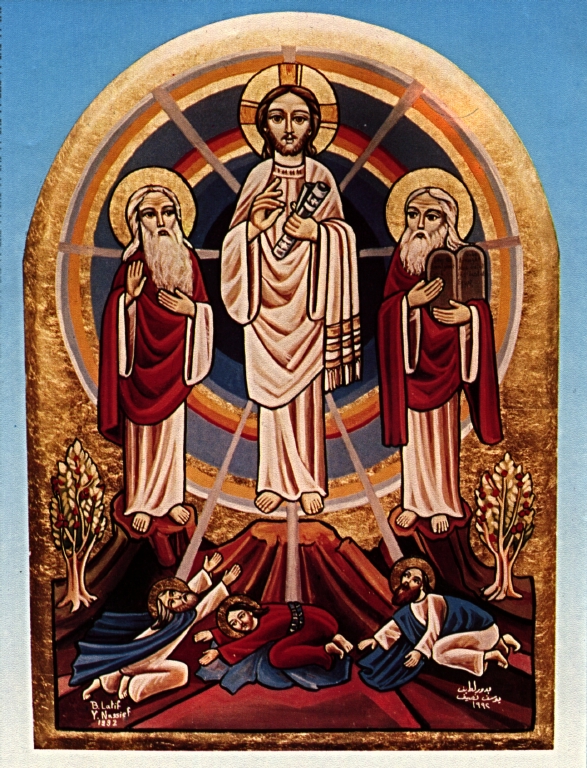
An Coptic icon:

(More Coptic icons.)

A page with Belarussian icons.

Holy Transfiguration Church (Greek Orthodox), Lowell, MA
Holy Transfiguration Church (Greek Orthodox), Marietta, GA (icons)
Holy Transfiguration Church (Greek Orthodox), Alakas
Holy Transfiguration Church (Orthodox), New Haven, CT
Holy Transfiguration Church (OCA), New Haven, CT -- icon work
Holy Transfiguration Church (OCA), Pearl River, NY
Holy Transfiguration Church (OCA), Raleigh, NC
Holy Transfiguration Church (OCA), Livonia, MI
Holy Transfiguration of Christ Cathedral (OCA), Denver, CO
Holy Transfiguration Church (Russian Orthodox), Baltimore, MD
Cathedral of the Transfiguration (Russian Orthodox), Brooklyn, NY
Holy Transfiguration Church (Antiochian Orthodox), IL
Holy Transfiguration Church (Antiochian Orthodox), Boise, ID
Holy Transfiguration Church (Malankara Orthodox Syrian Mission), WI
Holy Transfiguration Church (Melkite), McLean, VA
Holy Transfiguration Monastery (Byzantine Catholic), CA
Holy Transfiguration Skete (Byzantine Catholic), MI


Holy Transfiguration Monastery (Brookline, MA)
http://www.pokrov.org/controversial/hocna.html


Uncut Mountain Supply
University of Balamand

Last month I was in a discussion over at Pontifications over what the Apostles experienced on Mt. Tabor, and the nature of this Theophany. Some (most?) Orthodox (and many Eastern-rite Catholics) take Gregory of Palamas very seriously, and, from my point of view, make use of Church Fathers (such Maximos the Confessor) accordingly. (That is to say, read them as Gregory of Palamas read them.) It is claimed that his teachings were ratified by a council (the Council of Constantinople's ruling on hesychasm?), but the history was not given. Besides, would that council not be considered a local council and not an ecumenical council?
Apparently the Orthodox consider the fifth council of Constantinople to be an ecumenical one. (So what are the conditions for a council to be a legitimate one, and to be considered as having the status of 'ecumenical'?)


The Orthodox on that thread offered a different explanation of theophanies from Catholics. According to them, the Apostles actually preceived something uncreated and divine, the "Divine Light." What is especially of interest are their rules for interpreting Scripture when adducing proof texts.

For the sake of ecumenism this should be investigated from all angles...


Sermon on the Transfiguration by Gregory of Palamas
St. Gregory Palamas and the Tradition of the Fathers,
by Fr. George Florovsky
St. Gregory Palamas: An Historical Overview'; Knowledge, Prayer, Vision; historical appendices
Notes on the Palamite Controversy (OCIC version), John S. Romanides (homepage)
GP on the Relationship between Philosophy and Theology, by Nick Trakakis
"The Synodikon of Orthodoxy" at the Mind of the Orthodox Church
Melkite Information Center
Palamite Controversy blog
Paul Halsall on Hesychasm
St. Gregory Palamas Monastery (GOARCH)
CE entry on Hesychasm
St. Gregory Palamas Church

James Likoudis' reply to a lapsed Catholic (Mr. Likoudis' homepage)