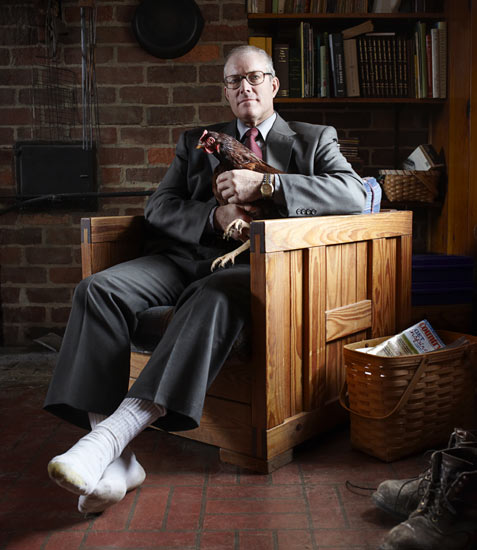
Interview with Matthew Simmons and James Howard Kunstler
A great sound bite:
KUNSTLER: It's only really been in the last ten years since a group of eminent elder statesman geologists retired from the industry and started to speak their minds, once they were established in their pensions. And started to essentially tell the truth about the world oil supply situation. And you know oddly enough even while that conversation has been going on for ten years most of the American people don't want to believe it and our leaders do not want to believe it. You know there is a question about why our leadership is so bad. My own opinion about it is that the dirty secret of the American economy is that it's mostly about the creation of suburban sprawl. We don't have that much of a manufacturing economy anymore. And if you subtract all the suburban sprawl activities like the housing bubble, the real estate industry, the mortgage mills, all of the accessories of the housing bubble like the strip mall building and all that stuff. If you subtract that from our economy there is not a lot left besides fried chicken and open-heart surgery. And you know neither John Kerry or George Bush or any people at the highest level want get up and say Americans we cannot have a suburban sprawl economy anymore because all it represents is an investment in stuff that we are not going to be able to use in 5 or 10 years.
Thanks also to
Energy Bulletin for the following:
Slow Food NationAlice Waters
It turns out that Jean Anthèlme Brillat-Savarin was right in 1825 when he wrote in his magnum opus, The Physiology of Taste, that "the destiny of nations depends on the manner in which they are fed." If you think this aphorism exaggerates the importance of food, consider that today almost 4 billion people worldwide depend on the agricultural sector for their livelihood. Food is destiny, all right; every decision we make about food has personal and global repercussions. By now it is generally conceded that the food we eat could actually be making us sick, but we still haven't acknowledged the full consequences--environmental, political, cultural, social and ethical--of our national diet. These consequences include soil depletion, water and air pollution, the loss of family farms and rural communities, and even global warming. (Inconveniently, Al Gore's otherwise invaluable documentary An Inconvenient Truth has disappointingly little to say about how industrial food contributes to climate change.) When we pledge our dietary allegiance to a fast-food nation, there are also grave consequences to the health of our civil society and our national character. When we eat fast-food meals alone in our cars, we swallow the values and assumptions of the corporations that manufacture them. According to these values, eating is no more important than fueling up, and should be done quickly and anonymously. Since food will always be cheap, and resources abundant, it's OK to waste. Feedlot beef, french fries and Coke are actually good for you. It doesn't matter where food comes from, or how fresh it is, because standardized consistency is more important than diversified quality. Finally, hard work--work that requires concentration, application and honesty, such as cooking for your family--is seen as drudgery, of no commercial value and to be avoided at all costs. There are more important things to do.
It's no wonder our national attention span is so short: We get hammered with the message that everything in our lives should be fast, cheap and easy--especially food. So conditioned are we to believe that food should be almost free that even the rich, who pay a tinier fraction of their incomes for food than has ever been paid before in human history, grumble at the price of an organic peach--a peach grown for flavor and picked, perfectly ripe, by a local farmer who is taking care of the land and paying his workers a fair wage! And yet, as the writer and farmer David Mas Masumoto recently pointed out, pound for pound, peaches that good still cost less than Twinkies. When we claim that eating well is an elitist preoccupation, we create a smokescreen that obscures the fundamental role our food decisions have in shaping the world. The reason that eating well in this country costs more than eating poorly is that we have a set of agricultural policies that subsidize fast food and make fresh, wholesome foods, which receive no government support, seem expensive. Organic foods seem elitist only because industrial food is artificially cheap, with its real costs being charged to the public purse, the public health and the environment.
The contributors to this forum have been asked to name just one thing that could be done to fix the food system. What they propose are solutions that arise out of what I think of as "slow food values," which run counter to the assumptions of fast-food marketing. To me, these are the values of the family meal, which teaches us, among other things, that the pleasures of the table are a social as well as a private good. At the table we learn moderation, conversation, tolerance, generosity and conviviality; these are civic virtues. The pleasures of the table also beget responsibilities--to one another, to the animals we eat, to the land and to the people who work it. It follows that food that is healthy in every way will cost us more, in time and money, than we pay now. But when we have learned what the real costs of food are, and relearned the real rewards of eating, we will have laid a foundation for not just a healthier food system but a healthier twenty-first-century democracy.
She makes the same points Wendell Berry has been making, especially in
The Unsettling of America.
One Thing to Do About Food: A ForumEric Schlosser, Marion Nestle, Michael Pollan, Wendell Berry, Troy Duster, Elizabeth Ransom, Winona LaDuke, Peter Singer, Dr. Vandana Shiva, Carlo Petrini, Eliot Coleman & Jim Hightower; in The Nation(Peter Singer? You gotta be kidding me.)
Wendell Berry:
Alice Waters has asked me if I will propose one thing that could change the way Americans think about food. I will nominate two: hunger and knowledge.
Hunger causes people to think about food, as everybody knows. But in the present world this thinking is shallow. If you wish to solve the problem of hunger, and if you have money, you buy whatever food you like. For many years there has always been an abundance of food to buy and of money to buy it with, and so we have learned to take it for granted. Few of us have considered the possibility that someday we might go with money to buy food and find little or none to buy. And yet most of our food is now produced by industrial agriculture, which has proved to be immensely productive, but at the cost of destroying the means of production. It is enormously destructive of farmland, farm communities and farmers. It wastes soil, water, energy and life. It is highly centralized, genetically impoverished and dependent on cheap fossil fuels, on long-distance hauling and on consumers' ignorance. Its characteristic byproducts are erosion, pollution and financial despair. This is an agriculture with a short future.
Knowledge, a lot more knowledge in the minds of a lot more people, will be required to secure a long future for agriculture. Knowing how to grow food leads to food. Knowing how to grow food in the best ways leads to a dependable supply of food for a long time. At present our society and economy do not encourage or respect the best ways of food production. This is owing to the ignorance that is endemic to our society and economy. Most of our people, who have become notorious for the bulk of their food consumption, in fact know little about food and nothing about agriculture. Despite this ignorance, in which our politicians and intellectuals participate fully, some urban consumers are venturing into an authentic knowledge of food and food production, and they are demanding better food and, necessarily, better farming. When this demand grows large enough, our use of agricultural lands will change for the better. Under the best conditions, our land and farm population being so depleted, this change cannot come quickly. Whether or not it can come soon enough to avert hunger proportionate to our present ignorance, I do not know.
Michael Pollan:
Every five years or so the President of the United States signs an obscure piece of legislation that determines what happens on a couple of hundred million acres of private land in America, what sort of food Americans eat (and how much it costs) and, as a result, the health of our population. In a nation consecrated to the idea of private property and free enterprise, you would not think any piece of legislation could have such far-reaching effects, especially one about which so few of us--even the most politically aware--know anything. But in fact the American food system is a game played according to a precise set of rules that are written by the federal government with virtually no input from anyone beyond a handful of farm-state legislators. Nothing could do more to reform America's food system--and by doing so improve the condition of America's environment and public health--than if the rest of us were suddenly to weigh in.
The farm bill determines what our kids eat for lunch in school every day. Right now, the school lunch program is designed not around the goal of children's health but to help dispose of surplus agricultural commodities, especially cheap feedlot beef and dairy products, both high in fat.
The farm bill writes the regulatory rules governing the production of meat in this country, determining whether the meat we eat comes from sprawling, brutal, polluting factory farms and the big four meatpackers (which control 80 percent of the market) or from local farms.
Most important, the farm bill determines what crops the government will support--and in turn what kinds of foods will be plentiful and cheap. Today that means, by and large, corn and soybeans. These two crops are the building blocks of the fast-food nation: A McDonald's meal (and most of the processed food in your supermarket) consists of clever arrangements of corn and soybeans--the corn providing the added sugars, the soy providing the added fat, and both providing the feed for the animals. These crop subsidies (which are designed to encourage overproduction rather than to help farmers by supporting prices) are the reason that the cheapest calories in an American supermarket are precisely the unhealthiest. An American shopping for food on a budget soon discovers that a dollar buys hundreds more calories in the snack food or soda aisle than it does in the produce section. Why? Because the farm bill supports the growing of corn but not the growing of fresh carrots. In the midst of a national epidemic of diabetes and obesity our government is, in effect, subsidizing the production of high-fructose corn syrup.
This absurdity would not persist if more voters realized that the farm bill is not a parochial piece of legislation concerning only the interests of farmers. Today, because so few of us realize we have a dog in this fight, our legislators feel free to leave deliberations over the farm bill to the farm states, very often trading away their votes on agricultural policy for votes on issues that matter more to their constituents. But what could matter more than the health of our children and the health of our land?
Perhaps the problem begins with the fact that this legislation is commonly called "the farm bill"--how many people these days even know a farmer or care about agriculture? Yet we all eat. So perhaps that's where we should start, now that the debate over the 2007 farm bill is about to be joined. This time around let's call it "the food bill" and put our legislators on notice that this is about us and we're paying attention.
The Shocking Truth about BreadFirst 4 paragraphs:
Flour, yeast, water and salt - a traditional loaf needs only four ingredients. So why are calcium propionate, amylase, chlorine dioxide and L-cysteine hydrochloride now crammed into our daily bread? Andrew Whitely, Britain's leading organic baker, reveals how our staple foodstuff was transformed into an industrial triumph, but a nutritional and culinary disaster. And, overleaf, he shares essential recipes for making your own slice of homemade heaven Back in the early 1960s, the national loaf was fundamentally redesigned. The flour and yeast were changed and a combination of intense energy and additives completely displaced time in the maturing of dough. Almost all our bread has been made this way for nearly half a century. It is white and light and stays soft for days. It is made largely with home-grown wheat and it is cheap. For increasing numbers of people, however, it is also inedible.
Now, as technology finds ever more ingenious ways to adulterate our bread, so science is revealing the havoc this may be causing to public health. As recent research suggests, we urgently need to rethink the way we make bread.
British industrial bread commands little respect. This isn't surprising when it is promoted with such mixed messages. Some loaves, described as having 'premium' qualities, seem barely distinguishable from others being sold at less than the price of a postage stamp. 'Healthy-eating' brands, adorned with images of nature and vitality, make detailed claims about the virtues of this or that added nutrient. But the big bakers keep quiet about nutrition when pushing their 'standard' loaves, which still account for over half of the market and are sold on price alone.
Article also includes some recipes! (
source)
The California Report Magazine For small and organic farmers, the San Francisco Bay Area is a pretty good place to be. There are lots of farmers' markets, restaurants that pride themselves on serving local and organic food, and plenty of people who think buying local produce makes sense. It's another story in the far-flung towns across rural Northern California, where it's harder for small farms to make it. But recently, groups of farmers and consumers have begun finding ways to fuel local economies with local food.
Click on the link to read more.
Carless in California: Living in California without owning a car (MP3 Audio)
Michael Krasny (host), KQED
Guests:
- Chris Balish, journalist and author of "How to Live Well Without Owning a Car: Save Money, Breathe Easier, and Get More Mileage Out of Life"
- James Corless, senior planner for the Metropolitan Transportation Commission
- Liz Elliott, co-director of Cyclists Inciting Change through Live Exchange (CICLE), an advocacy organization for bicyclists
(
source)
Finally, one more:
Permaculture - Permanent Agriculture (& a mini movie)
Short introduction to the origins of permaculture. Movie
here. (
source)