The French Catholic Bishops Conference held a briefing in the Vatican’s press Office on Friday to illustrate the figures of Louis and Zélie Martin, the parents of St. Therese of Lisieux.
Posted by Vatican Radio - English Section on Friday, October 16, 2015
Showing posts with label St. Thérèse of Lisieux. Show all posts
Showing posts with label St. Thérèse of Lisieux. Show all posts
Sunday, October 18, 2015
Definitely Western

Thursday, March 05, 2015
Wednesday, June 18, 2014
Thursday, October 29, 2009
Thérèse: The Story of Saint Thérèse of Lisieux - Trailer
I was actually looking for a trailer to the French movie about her...
Xenon Pictures
I was actually looking for a trailer to the French movie about her...
Xenon Pictures
Thursday, October 01, 2009

Saint Therese of Lisieux
Irish website
Gift shop: The Little Way
some photos
An icon. Another icon.

St. Thérèse of Lisieux - the visit of her relics to England and Wales 2009
Relics tour
St Therese relics on tour in UK
Wednesday, May 14, 2008
Zenit interview with editor of Dorothy Day's diaries
Dorothy Day's Duty of Delight
Interview With Editor of Diaries
By Annamarie Adkins
MARYKNOLL, New York, MAY 13, 2008 (Zenit.or g).- Seventy-five years after Dorothy Day co-founded the Catholic Worker Movement, and more than 25 years after she died, her diaries have been published for the first time.
The personal writings of the Catholic social activist, who was proclaimed a servant of God in 2000, begin in 1934 -- shortly after the Catholic Worker was founded -- and end days before her death in 1980.
Robert Ellsberg, publisher of Orbis Books, was asked to edit the diaries in 2005, and now has compiled the best of Day's writings in "The Duty of Delight: The Diaries of Dorothy Day."
Ellsberg shared with ZENIT what motivated Day as a Catholic and a social reformer, and what gifts her canonization could bring to the Church.
Q: Who was Dorothy Day? What led her to the Catholic Church?
Ellsberg: Dorothy Day was a radical journalist who converted to Catholicism and who found a way, in the Catholic Worker movement that she co-founded in 1933 and directed until her death in 1980, to combine her faith with her passion for social justice.
She had rejected Christianity in her youth, feeling that Christians were too complacent about the status quo. But a series of events -- culminating in her pregnancy and the birth of her daughter -- led her to a profound experience of God's love.
In return, she felt irresistibly drawn to enter the Church, even though this meant separating from her "common-law husband," the father of her child.
Q: Why have you chosen to title her diaries, "The Duty of Delight"?
Ellsberg: This was a line that recurred frequently in her diaries. She herself contemplated using it as the title for one of her books.
Often, after a recital of drudgery and disappointment, she would simply write, "The duty of delight."
I think it was a reminder to seek God in all things. That is really the theme of her diary, which is a chronicle of her efforts to perform all the chores and duties of her daily life with love and joy.
Q: What are the basic principles of the Catholic Worker Movement that Dorothy Day founded?
Ellsberg: The Catholic Worker is an effort to live out the radical social implications of the Gospel. Jesus said we cannot love God without loving our neighbor.
The Catholic Worker has been centered in "houses of hospitality" for the practice of the works of mercy: feeding the hungry, sheltering the homeless.
But Dorothy Day believed it was necessary not just to care for the poor; one must also protest and challenge the social structures that give rise to so much misery.
She was arrested many times in her life, particularly for her protests against preparations for war, but also, at the age of 75, for picketing with striking farm workers in California.
Q: Why was St. Thérèse of Lisieux Dorothy's favorite saint? Do you see the influence of St. Thérèse in Dorothy's diaries?
Ellsberg: Dorothy was profoundly attracted to St. Thérèse and even wrote a book about her. She embraced the "little way" and believed that the way to holiness was in the practice of all our everyday tasks in a spirit of love.
St. Thérèse wrote about her life in a convent as an arena for the practice of charity, patience, forgiveness.
Dorothy had the same experience in her life at the "Catholic Worker" surrounded by so many crazy, broken and often disagreeable people. Her spirituality was very much based on an effort to be more charitable and forgiving toward the people closest at hand.
And she believed these small efforts could have wide social impact -- like a pebble cast in a pond that sets forth ever-widening ripples.
Q: Although Dorothy Day chafed at the notion she was a saint, the cause for her canonization is under way. What is the status of her cause? What gifts could recognizing her sanctity bring to the universal church?
Ellsberg: Dorothy chafed at the idea of being put on a pedestal. She realized that most of us think of saints as perfect people. She felt completely unworthy of such idealization, and at the same time she didn't want to let people off the hook that easily: "Dorothy can do such things; after all, she's a saint!"
Dorothy had great reverence for the saints. Long before Vatican II, she spoke of the universal vocation to holiness, and she emphasized that we are all called to be saints. We are all called to put off the old person and put on Christ.
I think it will be plain to anyone reading her diaries that this was a woman who organized her daily life around her relationship with God, and I'm sure she will be eventually canonized.
In 2000 the Vatican accepted her cause and so she is officially a servant of God. A Dorothy Day Guild has been established in the Archdiocese of New York. But of course, these things move slowly.
I believe she brings many gifts to the Church.
First of all, unlike the vast majority of saints who were priests or religious, she was a layperson -- an unwed mother, at that -- who launched her movement without seeking any authorization from the Church.
She shows the great freedom in the Church and the responsibility we all have to listen to God's call and to respond in faith to the challenges of our time in history. She showed how to join the practice of charity with a passion for justice.
She helped the Church to rediscover the theme of Gospel nonviolence. And she serves as a great saint of "common ground," showing how it is possible to reconcile love for the Church with deep suffering over its failings.
In a culture that puts much emphasis on bigness, influence, and being noticed, she showed the power of simple faithfulness and being true to one's ideals and conscience.
Q: Many are unaware that Dorothy Day had an abortion early in life, before her conversion. Do you see her becoming the patron saint of women -- and men -- recovering from abortion?
Ellsberg: Although she did not ever write or speak about her abortion, this experience clearly helps to explain why her later pregnancy was such a momentous event; I think she experienced it as a sign of forgiveness and grace.
But I would be reluctant to single out this experience, which played no role in her public witness. I think it is more appropriate to call her the patron saint of the "seamless garment" or "consistent ethic of life" opposing abortion, but also capital punishment, war, torture, and all offenses against the sanctity of life.
Q: Almost every entry in the diary begins with Dorothy rising in the morning to attend Mass. What was the connection for her between the Mass and her work in pursuit of social justice?
Ellsberg: Dorothy believed in the real presence of Christ in the Eucharist, and she felt absolutely sustained by it. But she also believed in the real presence of Christ in the poor.
She believed that the purpose of the liturgy was to help us live in a more conscious confrontation with Christ. As she wrote, "The mystery of the poor is that they are Jesus and what we do for them we do for him."
--- --- ---
On the Net:
"The Duty of Delight: The Diaries of Dorothy Day": http://www.marquette.edu/mupress
Friday, March 07, 2008
Zenit: 3rd Lenten Sermon of Father Cantalamessa
3rd Lenten Sermon of Father Cantalamessa
"Be Doers of the Word and Not Hearers Only"
VATICAN CITY, MARCH 7, 2008 (Zenit.org).- Here is a translation of the Lenten meditation delivered today by Capuchin Father Rainero Cantalamessa, preacher of the Pontifical Household, to Benedict XVI and the Roman Curia, titled "Welcome the Word: The Word of God As a Way of Personal Sanctification."
This is the second in a series of Lenten meditations titled "The Word of God Is Living and Effective."
* * *
1. "Lectio Divina"
In this meditation we will reflect on the word of God as a way of personal sanctification. In the "lineamenta" that have been prepared for the Synod of Bishops in October 2008, this theme is taken up in Chapter 2, “The Word of God in the Life of the Believer.”
It is a theme that is very dear to the spiritual tradition of the Church. “The word of God,” St. Ambrose said, “is the vital substance of our soul; it nourishes, feeds, and governs the soul; there is nothing else that could give life to man’s soul apart from the word of God.”[1] “[T]he force and power in the word of God,” adds “Dei Verbum,” “is so great that it stands as the support and energy of the Church, the strength of faith for her sons, the food of the soul, the pure and everlasting source of spiritual life.”[2]
“It is especially necessary,” John Paul II wrote in “Novo millennio ineunte,” “that listening to the word of God should become a life-giving encounter, in the ancient and ever valid tradition of ‘lectio divina,’ which draws from the biblical text the living word which questions, directs and shapes our lives.”[3] The Holy Father Benedict XVI has also expressed himself on this theme on the occasion of the International Congress Sacred Scripture in the Life of the Church: “By assiduous reading, we listen to God who speaks and, in prayer, we respond to him with confident openness of heart.”[4]
With the reflections that follow I insert myself in this rich tradition, beginning with what the Scripture itself says on this point. We read in the letter of Saint James these lines on the word of God:
“He willed to give us birth by the word of truth that we may be a kind of first fruits of his creatures. Know this, my dear brothers: Everyone should be quick to hear, slow to speak, slow to wrath, [...] Therefore, put away all filth and evil excess and humbly welcome the word that has been planted in you and is able to save your souls. Be doers of the word and not hearers only, deluding yourselves. For if anyone is a hearer of the word and not a doer, he is like a man who looks at his own face in a mirror. He sees himself, then goes off and promptly forgets what he looked like. But the one who peers into the perfect law of freedom and perseveres, and is not a hearer who forgets but a doer who acts, such a one shall be blessed in what he does” (James 1:18-25).
2. Welcoming the Word
From James’ text we can draw out a schema of “lectio divina” that has three steps or successive actions: Welcoming the word, meditating on the word, putting the word into practice.
Thus the first step is listening to the word: “Welcome the word that has been planted in you.” This first step embraces all the forms and ways in which the Christian comes into contact with the word of God: Listening to the word in the liturgy, now facilitated by the use of the vernacular and by the wise choice of texts distributed throughout the year; then, Bible schools, written aids, and -- something that is irreplaceable -- personal reading of the Bible at home. For those who are called to teach others, to all of this there is added the systematic study of the Bible: exegesis, textual criticism, Biblical theology, study of the original languages.
In this phase it is necessary to beware of two dangers. The first is to stop at this first stage and to transform the personal reading of the word of God into an “impersonal” reading. This danger is quite real today, above all in academic institutions.
St. James compares the reading of the word of God with looking at oneself in the mirror; but for [Soren] Kierkegaard, those who limit themselves to studying the sources, the variants, the literary genres of the Bible, without doing anything else, is like someone who just looks at the mirror -- considering with exactness the form, the material, the style, the epoch -- without looking at oneself in the mirror. For Kierkegaard, the mirror does not perform its function on its own. The word of God has been given so that you put it into practice and not so that you exercise yourself in exegesis over its obscurities. There is a “hermeneutic inflation” and, what is worse, one believes that the most serious thing in regard to the Bible is hermeneutics, not practice.[5]
The critical study of the word of God is indispensible and one is never grateful enough to those who give their lives to smooth the way to an ever better understanding of the sacred text, but it does not by itself exhaust the meaning of the Scriptures; it is necessary but not sufficient.
The other danger is fundamentalism: Taking literally everything that one reads in the Bible, without any hermeneutic mediation. This second risk is much less innocuous than might seem to be the case at first glance and the current debate between creationism and evolutionism is the dramatic confirmation of this.
Those who defend the literal reading of Genesis -- the world was created some several thousand years ago, in six days, just as it is now -- cause immense damage to faith. "Young people brought up in homes and churches that insist on Creationism,” writes the scientist and Christian, Francis Collins, “sooner or later encounter the overwhelming scientific evidence in favor of an ancient universe and the relatedness of all living things through the process of evolution and natural selection. What a terrible and unnecessary choice they face! To adhere to the faith of their childhood, they are required to reject a broad and rigorous body of scientific data, effectively committing intellectual suicide. Presented with no other alternative than Creationism, is it any wonder that many of these young people turn away from faith, concluding that they simply cannot believe in a God who would ask them to reject what science has so compellingly taught us about the natural world?"[6]
The two excesses -- hyper-criticism and fundamentalism -- are only apparently opposed: What they have in common is the fact that both stop at the letter, neglecting the Spirit.
3. Contemplating the Word
The second step suggested by St. James consists in “fixing one’s gaze” on the word, in standing for a long time before the mirror, in sum, in meditating and contemplating the Word. In this connection the Fathers used the images of chewing and ruminating. “Reading,” says the 12th century prior of the Grand Chartreuse, Guigo II, the theorist of the “lectio divina,” “offers substantial food to the mouth, meditation chews on it and breaks it up.”[7] “When one recalls to memory things heard and sweetly thinks on them again in his heart, he becomes like a ruminator,” Augustine says.[8]
The soul that looks into the mirror of the word learns to know “how he is,” he learns to know himself, he sees his deformities in the image of God and in the image of Christ. “I do not seek my own glory,” Jesus says (John 8:50): well, the mirror is in front of you and immediately you see how far you are from Jesus. “Blessed are the poor in spirit”: The mirror is again in front of you and immediately you see that you are full of attachments and full of superfluous things. “Charity is patient”: You realize how impatient, envious and self-interested you are.
More than “searching the Scriptures” (cf. John 5:39), it is a matter of letting oneself be searched by the Scriptures. The word of God, the Letter to the Hebrews says, “penetrates even to the point of division of the soul and spirit, joints and marrow, and is able to discern sentiments and thoughts of the heart” (Hebrews 4:12-13). The best prayer for beginning the moment of contemplation is repeating with the Psalmist: “You search me, O God, and you know my hear, you probe me and know my thoughts: You see if I my way is crooked and you guide me along the way of life” (Psalm 139).
But in the mirror of the word, we do not only see ourselves; we see the face of God; better, we see the heart of God. Scripture, St. Gregory the Great says, is “is a letter of Almighty God to his creature; in it one learns to know the heart of God in the words of God.”[9] Jesus’ saying even holds for God: “From the fullness of the heart the mouth speaks” (Matthew 12:34); God has spoken to us, in Scripture, of that which fills his heart and that which fills his heart is love.
In this way the contemplation of the word procures the two pieces of knowledge that are the most important for advancing along the road of true wisdom: self-knowledge and knowledge of God. “That I might know myself and know you” -- “noverim me, noverim te” -- St. Augustine said to God. “That I might know myself to humble myself and that I might know you to love you.”
An extraordinary example of this twofold knowledge, of self and of God, that is obtained from the word of God is the letter to the Church of Laodicea in the Book of Revelation, which is worth meditating on every now and again, especially in this time of Lent (cf. Revelation 3:14-20). The Risen Christ lays bare the real situation of the typical member of this community: "I know your works; I know that you are neither cold nor hot. I wish you were either cold or hot. So, because you are lukewarm, neither hot nor cold, I will spit you out of my mouth.” The contrast between that which this person thinks about himself and that which God thinks of him is striking: “For you say, 'I am rich and affluent and have no need of anything,' and yet do not realize that you are wretched, pitiable, poor, blind and naked.”
A passage of unusual toughness, which, however, is immediately overturned by one of the most touching descriptions of the love of God: "Behold, I stand at the door and knock. If anyone hears my voice and opens the door, [then] I will enter his house and dine with him, and he with me.” It is an image that reveals its realistic and not only metaphorical significance if it is read, as the text suggests, with the Eucharistic banquet in mind.
Besides serving to verify the personal state of our soul, this passage of Revelation can help us to uncover the spiritual situation of the great part of modern society before God. It is like one of those infrared photographs taken by a satellite that reveals a panorama completely different from the one we are used to, the one observed by natural light.
Even in this world of ours, powerful on account of its scientific and technological conquests -- like the Laodiceans, who were commercially prosperous -- one feels satisfied, rich, without need of anyone, not even God. It is necessary that someone show it the true diagnosis of its state: “You do not know that you are unhappy, miserable, impoverished, blind and naked.” It is necessary that some one cry out to it, like the child in the Andersen fable: “The king is naked!” But through love and with love, like the Risen Christ with the Laodiceans.
To every soul that desires it, the word of God assures fundamental, and in itself infallible, spiritual direction. There is a spiritual direction that is, so to speak, ordinary and everyday, which consists in the discovering what God wants in the situations in which man usually finds himself. Such spiritual direction is assured by meditation on the word of God accompanied by the interior anointing of the Spirit, who translates the word into good “inspirations” and the good inspirations into practical resolutions. This is what is expressed by the verse of the Psalm that is so dear to lovers of the word: “Your word is a lamp for my steps, light on my way” (Psalm 119:105).
I was once preaching a mission in Australia. On the last day a man came to see me, an Italian immigrant who worked there. He said to me: “Father, I have a serious problem: I have a son who is 11 years old and who is not yet baptized. The fact is that my wife became a Jehovah’s Witness and does not want to hear about baptism in the Catholic Church. If I baptize him, there will be a crisis. If I do not baptize him I will not be at ease because when we got married we were both Catholic and we promised to raise our children in the faith.”
The next day the man came to see me and was visibly happier and he said to me: “Father, I found the solution. Last night, after I got home, I prayed a little bit, then I opened the Bible randomly. I read the passage where Abraham takes his son Isaac to sacrifice him and I saw that when Abraham took his son Isaac to be sacrificed it does not say anything about his wife.” It was an exegetically perfect discernment. I baptized the boy myself and it was a moment of great joy for all.
This practice of opening the Bible randomly is a delicate thing, which must be done with discretion, in a climate of faith and not without having prayed for a long time. Nevertheless, it cannot be ignored that, with these conditions, it has often born marvellous fruit and it has been practiced by the saints. One reads of St. Francis of Assisi, from the various stories about his life, that he discovered the type of life to which God was calling him by opening the Book of the Gospels three times at random “after having prayed a long time” and being “disposed to follow the first bit of advice that they offered to him.”[10] Augustine interpreted the words “Tolle lege” (“Take and read”), which he heard coming from a nearby house, as a divine order to open the book of Paul’s letters and to read the verse that presented itself to his glance.”[11]
There have been souls who have become holy with the word of God as their sole spiritual director. “In the Gospel,” wrote St. Thérèse of Lisieux, “I find everything necessary for my poor soul. I always find new light in it, hidden and mysterious meanings. I understand and know from experience that ‘the kingdom of God is within us’ (cf. Luke 17:21). Jesus does not need books or teachers to instruct souls; he is the teacher of teachers, he teaches without the noise of words.”[12] It was through a word of God, reading, one after the other, chapters 12 and 13 of 1 Corinthians that Thérèse discovered her profound vocation and jubilantly exclaimed: “In the mystical body of Christ I will be the heart that loves!”
The Bible offers a concrete image that sums up everything that has been said about meditating on the word: that of the book that is eaten, which we read about in Ezekiel:
“It was then I saw a hand stretched out to me, in which was a written scroll, which he unrolled before me. It was covered with writing front and back, and written on it was: Lamentation and wailing and woe! He said to me: ‘Son of man, eat what is before you; eat this scroll, then go, speak to the house of Israel.’ So I opened my mouth and he gave me the scroll to eat. Son of man, he then said to me, feed your belly and fill your stomach with this scroll I am giving you. I ate it, and it was as sweet as honey in my mouth. He said: ‘Son of man, go now to the house of Israel, and speak my words to them’ (Ezekiel 2:9-3:3; cf. also Revelation 12:10).
There is an enormous difference between the book that is simply read or studied and the book that is swallowed. In the latter case, the word truly becomes, as St. Ambrose said, “the substance of our soul,” that which informs our thoughts, forms language, determines actions, creates the “spiritual” man. The word that is swallowed is a Word that is “assimilated” by man, even if it is a passive assimilation -- as is the case with the Eucharist -- that is of a “being assimilated” by the Word, subjugated and defeated by that which is the most powerful of life principles.
In the contemplation of the word we have the sweetest example in Mary: She stored up all these things -- literally: “these words” -- meditating on them in her heart (Luke 2:19). In her the metaphor of the book that is swallowed has become reality, even a physical reality. The word has literally “filled her stomach.”
4. Doing the Word
We thus arrive at the third step along the way proposed by the Apostle James, the step on which the apostle most insists: “Be doers of the word and not hearers only, [...] for if anyone is a hearer of the word and not a doer, [...] a doer who acts, such a one shall be blessed in what he does.” This is also what Jesus has most at heart: “My mother and my brothers are those who hear the word of God and put it into practice” (Luke 8:21). Without this “doing the word,” everything is but an illusion, something built on sand. One cannot even say to have understood the word because, as St. Gregory the Great writes, the word of God is only truly understood when one begins to practice it.[13]
This third step consists in, in practice, obeying the word. The Greek term that is used in the New Testament to designate obedience -- “hypakouein” -- literally translated means “listening to,” in the sense of carrying out what one has heard. “My people have not listened to my voice, Israel has not obeyed me,” is God’s lament in the Bible (Psalm 81:12).
As soon as one begins to look through the New Testament to see in what the duty of obedience consists, one makes a surprising discovery, and that is, that obedience is almost always seen as obedience to the word of God. St. Paul speaks of obedience to teaching (Romans 6:17), of obedience to the Gospel (Romans 10:16; 2 Thessalonians 1:8), of obedience to truth (Galatians 5:7), of obedience to Christ (2 Corinthians 10:5). We also find the same language elsewhere: The Acts of the Apostles speaks of the obedience of faith (Acts 6:7), the first letter of Peter speaks of obedience to Christ (1 Peter 1:2) and of obedience to truth (1 Peter 1:22).
The obedience itself of Jesus is exercised above all through obedience to written words. In the episode of the temptations in the desert, Jesus’ obedience consists in recalling the words of God and of abiding by them: “It is written!”
His obedience is exercised, in a special way, to the words that are written of him and for him “in the law, the prophets, and the Psalms” and that he, as man, discovers progressively as he advances in the understanding and fulfilment of his mission.
When they want to prevent his being taken into custody, Jesus says: “But then how would the Scriptures be fulfilled which say that it must come to pass in this way?" (Matthew 26:54). Jesus’ life is as guided by a luminous wake that the others do not see and which is created by the words that were written for him; he gathers from the Scriptures the “it is necessary” -- “dei” in the Greek -- that governs his whole life.
The words of God, by the present action of the Spirit, become the expression of the living will of God for me in a given moment. A little example will help us to understand this. Once in community I discovered that someone had mistakenly taken something that I use. I was on my way to ask that it be returned when by chance -- or perhaps it was not really by chance -- I came up against the word of Jesus according to which you must “give to whoever asks of you; and whoever takes what is yours, do not ask for it back” (Luke 6:30). I understood that this word did not apply universally in all cases, but that certainly in that moment it did apply to me. It was a matter of obeying the word.
Obedience to the word of God is obedience we can always do. Obeying visible orders and authorities, is something that we do every so often, three or four times in a lifetime, if we are talking about serious obedience; but there can be obedience to God’s word in every moment. It is also the obedience that applies to all of us, inferiors and superiors, clerics and laity. The laity do not have a superior in the Church whom they must obey -- at least not in the sense that religious and clerics have a superior; but they do have, in compensation, a “Lord” to obey! They have his word!
Let us conclude this meditation of ours making our own the prayer that St. Augustine, in his “Confessions,” addresses to God to ask for the understanding of God’s word: “May your Scriptures be my chaste delight; may I not be deceived about them, nor deceive others with them. [...] Turn your gaze to my soul and hear the one who cries out from the depths. [...] Grant me time to meditate on the secrets of your law, do not close to the one who knocks. [...] Indeed, your voice is my joy, your voice is a pleasure superior to all others. Grant me what I love. [...] Do not abandon this parched blade of grass. [...] May the recesses of your word open to the one who knocks. [...] I beseech you through our Lord Jesus Christ, [...] in whom are hidden all the treasures of wisdom and knowledge (Colossians 2:3). These treasures I seek in your books.”[14]
* * *
[1] St. Ambrose, Exp. Ps. 118, 7,7 (PL 15, 1350).
[2] “Dei Verbum,” 21.
[3] John Paul II, "Novo Millennio Ineunte," 39.
[4] Benedict XVI, in AAS 97, 2005, p. 957.
[5] S. Kierkegaard, “Per l’esame di se stessi.” La Lattera di Giacomo, 1,22, in “Opere,” a cura di C. Fabro, Firenze 1972, pp. 909 ss.
[6] F. Collins, “The Language of God,” Free Press 2006, pp. 177 s.
[7] Guigo II, “Lettera sulla vita contemplativa” (Scala claustralium), 3, in Un itinerario di contemplazione. Antologia di autori certosini, Edizioni Paoline, 1986, p.22.
[8] St. Augustine, Enarr. in Ps. 46, 1 (CCL 38, 529).
[9] St. Gregory the Great, Registr. Epist. IV, 31 (PL 77, 706).
[10] Celano, "Vita Seconda," X, 15
[11] St. Augustine, “Confessions.” 8, 12.
[12] St. Thérèse of Lisieux, Manoscritto A, n. 236.
[13] St. Gregory the Great, Su Ezechiele, I, 10, 31 (CCL 142, p. 159).
[14] St. Augustine, “Confessions.” XI, 2, 3-4.
* * *
[Translation by Joseph G. Trabbic]
Sunday, October 01, 2006
St. Thérèse of Lisieux, October 1
A family favorite!
The Life of Saint Thérèse of Lisieux
John Paul II, Divini Amoris Scientia (proclamation of Saint Thérèse as a Doctor of the Church)


More photos here and here
Some icons:

source


more of Lynne Taggart's icons

source
Links:
Official website
The Society of the Little Flower
EWTN's Centenary of St. Therese
Some of her poems (pdf)
Carmelite.com
thelittleflower.org
Sanctuaire de Lisieux
National Shrine
ICS Publications (books by The Little Flower)
theresienwekre
The Little Way shop
something by Fr. Hardon
Random:
St. Gemma Galgani, EWTN, another
Looks like the website for St. Michael's has been updated. Same for Holy Transfiguration.
St. Therese of Carmel Church -- modern, but not so bad; not sure what the sanctuary will look like when done, but it probably wouldn't take much to improve the interior...
The Life of Saint Thérèse of Lisieux
John Paul II, Divini Amoris Scientia (proclamation of Saint Thérèse as a Doctor of the Church)

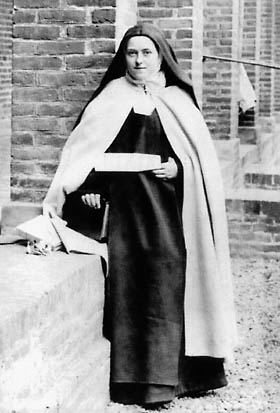


More photos here and here
Some icons:

source


more of Lynne Taggart's icons

source
St. Thérèse and her Little Way
Rev. John F. Russell, O.Carm.
Seton Hall University, South Orange, N.J. 07079
What is the meaning of “the little way” of St Therese? It is an image that tries to capture her understanding of being a disciple of Jesus Christ, of seeking holiness of life in the ordinary and the everyday. St Therese based “her little way” on two fundamental convictions: (1) God shows love by mercy and forgiveness, and (2) she could not be “perfect” in following the Lord. St Therese believed that the people of her time lived in too great a fear of God's judgment. The fear was stifling and did not allow people to experience the freedom of the children of God. St Therese knew from her life that God is merciful love; many scripture passages in the Old and New Testaments bore out that truth. She loved the maternal images for God in the Old Testament and the love of God for us in Jesus Christ. In fact, St Therese once wrote that she could not understand how anyone could be afraid of a God who became a child. She also knew that she would never be perfect. Therefore, she went to God as a child approaches a parent . . . with open arms and a profound trust.
St Therese translated “the little way” in terms of a commitment to the tasks and to the people we meet in our everyday lives. She took her assignments in the convent of Lisieux as ways of manifesting her love for God and for others. She worked as a sacristan by taking care of the altar and the chapel; she served in the refectory and in the laundry room; she wrote plays for the entertainment of the community. Above all, she tried to show a love for all the nuns in the community. She played no favourites; she gave of herself even to the difficult members. Her life sounds so routine and ordinary, but it was steeped in a loving commitment that knew no breakdown. It is called a “little way” precisely by being simple, direct, yet calling for amazing fortitude and commitment.
In living out her life of faith she sensed that everything that she was able to accomplish came from the generous love of God in her life. She was convinced that at the end of her life she would go to God with empty hands. Why? Because all was accomplished in union with God.
Catholics and other Christians have been attracted to St Therese's style. Her “little way” seems to put holiness of life within the reach of ordinary people. Live out your days with confidence in God's love for you. Recognize that each day is a gift in which your life can make a difference by the way you choose to live it. Put hope in a future in which God will be all and love will consume your spirit. Choose life, not the darkness of pettiness and greed. St Therese knew the difference love makes by allowing love to be the statement she made each day of her life.
Links:
Official website
The Society of the Little Flower
EWTN's Centenary of St. Therese
Some of her poems (pdf)
Carmelite.com
thelittleflower.org
Sanctuaire de Lisieux
National Shrine
ICS Publications (books by The Little Flower)
theresienwekre
The Little Way shop
something by Fr. Hardon
Random:
St. Gemma Galgani, EWTN, another
Looks like the website for St. Michael's has been updated. Same for Holy Transfiguration.
St. Therese of Carmel Church -- modern, but not so bad; not sure what the sanctuary will look like when done, but it probably wouldn't take much to improve the interior...
Subscribe to:
Posts (Atom)