Wednesday, July 02, 2008

I've been reading through Kirkpatrick Sale's The Human Scale. It's a dense book and the statistics and numbers can be overwhelming, so it can be difficult to judge how sound his arguments are. But I would recommend it to those who are interested in the problem of size for the science of politics. So far I have not read anything that would support the characterization of Mr. Sale as a leftist. Does he support a local version of socialism or the welfare state? Is he a libertine with respect to "social issues?"
His contribution to the American Conservative's "What is Left? What is Right?" issue.
Kirkpatrick Sale / Leopold Kohr
Kirkpatrick Sale
John Robb: JOURNAL: Governance of the Wilderness
His contribution to the American Conservative's "What is Left? What is Right?" issue.
Kirkpatrick Sale / Leopold Kohr
Kirkpatrick Sale
John Robb: JOURNAL: Governance of the Wilderness
The breathtaking run-up in oil prices is linked to the crisis of world financial institutions. What the U.S. Government should not do.
China has encouraged rapid export-led economic growth as a way of putting off dealing with its internal political and social problems. Economic growth requires energy, and China's energy comes overwhelmingly from coal. The nation's short-term survival strategy thus centers on producing enormous quantities of coal today, and far more in the future. (Excerpts)
More Hikaru Nishida
wiki
Welcome to Hikaru Nishida Home Page
Hikaru Nishida - IT'S SO EASY
Linda Ronstadt - It's So Easy (LIVE)
Hikaru Nishida - MOON RIVER
Hikaru Nishida - KISSIN' ON THE PHONE
Hikaru Nishida - THE CIRCLE GAME
Agnes Chan - THE CIRCLE GAME
RAINDROPS KEEP FALLIN' ON MY HEAD
Kumiko - RAINDROPS KEEP FALLIN' ON MY HEAD
Hikaru Nishida - VACATION
Hikaru Nishida - GOTTA PULL MYSELF TOGETHER
one boy,西田ひかる
♪ ボーイ・ハント
Hikaru Nishida - WHERE THE BOYS ARE
伊東ゆかり ボーイハント "Where The Boys Are",
ジョニーエンジェル 伊東ゆかり
西田ひかる Nishida hikaru「人生変えちゃう夏かもね」
Nishida Hikaru - Till the end of time
Nishida Hikaru - Miracle
西田ひかる 月夜の人魚
Hikaru Nishida - Natsu no prism
Miracle Hikaru @ Japan Festa in Bangkok
Hikaru Nishida - PHYSICAL
Olivia Newton -John "Physical"
Olivia Newton-John - Physical on Sold Gold 1981
Hikaru Nishida - SUKIYAKI
Kyu Sakamoto 坂本 九 - Sukiyaki (Covers Slide)
西田ひかる - 私のNo.1 ~You're the only one ~
西田ひかる
西田ひかる 涙 止まらない
西田ひかる Making of NH
Nishida Hikaru - Truth
Welcome to Hikaru Nishida Home Page
Hikaru Nishida - IT'S SO EASY
Linda Ronstadt - It's So Easy (LIVE)
Hikaru Nishida - MOON RIVER
Hikaru Nishida - KISSIN' ON THE PHONE
Hikaru Nishida - THE CIRCLE GAME
Agnes Chan - THE CIRCLE GAME
RAINDROPS KEEP FALLIN' ON MY HEAD
Kumiko - RAINDROPS KEEP FALLIN' ON MY HEAD
Hikaru Nishida - VACATION
Hikaru Nishida - GOTTA PULL MYSELF TOGETHER
one boy,西田ひかる
♪ ボーイ・ハント
Hikaru Nishida - WHERE THE BOYS ARE
伊東ゆかり ボーイハント "Where The Boys Are",
ジョニーエンジェル 伊東ゆかり
西田ひかる Nishida hikaru「人生変えちゃう夏かもね」
Nishida Hikaru - Till the end of time
Nishida Hikaru - Miracle
西田ひかる 月夜の人魚
Hikaru Nishida - Natsu no prism
Miracle Hikaru @ Japan Festa in Bangkok
Hikaru Nishida - PHYSICAL
Olivia Newton -John "Physical"
Olivia Newton-John - Physical on Sold Gold 1981
Hikaru Nishida - SUKIYAKI
Kyu Sakamoto 坂本 九 - Sukiyaki (Covers Slide)
西田ひかる - 私のNo.1 ~You're the only one ~
西田ひかる
西田ひかる 涙 止まらない
西田ひかる Making of NH
Nishida Hikaru - Truth
Tuesday, July 01, 2008
via Francis Beckwith, at WWWTW: Obama Supports Same-Sex Marriage, and If You Disagree You're a Bigot
Obama keeps reminding us why he is not really the herald of change (from the status quo) that he claims to be.
Srdja Trifkovic, Obama the “Patriot”
Thomas Fleming, One Nation Under Obama
Obama keeps reminding us why he is not really the herald of change (from the status quo) that he claims to be.
Srdja Trifkovic, Obama the “Patriot”
Thomas Fleming, One Nation Under Obama
Gene Logsdon, Pasture: the foundation of garden farm success
Pasture: the foundation of garden farm success
A sure way to tell the direction you should take in garden farming is to watch the trend in commercial farming and then do the opposite. Commercial farming has de-emphasized — and all but ignored in the corn belt — pasture and tree crop farming because these types of agriculture lack the ability to return quick and high-gross profits.
archived Jul 1 2008
original
original
NLM: Chant Release Date in US is Today
So... does Cistercian chant as it is sung now faithfully represent how chant was done in the Middle Ages?
So... does Cistercian chant as it is sung now faithfully represent how chant was done in the Middle Ages?
Videos: The Carpenters
The Carpenters - Rainy Days And Mondays
The Carpenters-Close To You
Carpenters - Yesterday Once More (Karaoke)
Carpenters - Yesterday Once More 1974
Carpenters - Thank you for the music (Tonight Show)
The Carpenters - Top Of The World
Top Of The World
カーペンターズ - Top of the World
Hikaru Nishida - TOP OF THE WORLD
Top of The World
The Carpenters-Close To You
Carpenters - Yesterday Once More (Karaoke)
Carpenters - Yesterday Once More 1974
Carpenters - Thank you for the music (Tonight Show)
The Carpenters - Top Of The World
Top Of The World
カーペンターズ - Top of the World
Hikaru Nishida - TOP OF THE WORLD
Top of The World
Monday, June 30, 2008
Etiquette, culture, and immigiration
Another post dealing with politesse.
It is commonly understood among Americans that one should expect poor service, by American standards, at a Chinese restaurant -- you can see this in the reviews of Chinese restaurants at Yelp. There are many Chinese restaurants that provide good service, both small ones (like Emperor Palace in SF) and those that have been inspired by the upper-scale restaurants in Hong Kong (Dynasty).
What are the origins of service industry in China as compared with England and Continental Europe? Did it have roots in, or at least tied to in some way, to the service of the nobility or the elites by members of the lower classes? Or even if it is linked to the rise of inns -- who could afford to travel and stay at such places? Would not innkeepers have to act as servants, either because of the class of the patrons? Can we compare English inns with those in China? When did the first commercial restaurants that were not a part of inn service appear in both areas? When do we see the beginnings of a service economy in imperial China? Was service etiquette always lacking in the cities of imperial China, with the transaction being more of an exchange of money for food and quality service not being expected? (Especially if the number of services was limited and the customers numerous.) What about pubs and restaurants in Europe? What are the origins of European standards hospitality within the "service industry"?
Immigrants should assimilate into their new society and adopt the native culture; but how is one to respond if they do not? Americans would be inclined to leave a small tip, or not one at all. But is there a point to complaining about it, when it is linked to a difference in cultures? Otherwise, are we not putting on ideological blinders by assuming that all cultures have the same standards of service and hospitality?
Certainly, there is a lack of emphasis on culture by the National Government -- a knowledge of history and of the government, basic lessons in "civics," are all one needs to gain citizenship in this country. I would argue that even with the limited political role of citizens, this is not enough to prepare people for citizenship. They should have a better knowledge of the laws, and a familiarity with the mores and customs of the community of which they are formally joining as citizens. There is something to be said for having a uniform set of rules of conduct within a community to foster unity and a common identity... solidarity. But it is unlikely the National Government will require any sort of education like this any time soon. It's opposed to the ideology of the proposition nation, and the National Government is one cause of the distingegration of local communities and cultures.
Besides, does one correct people for not adhering to standard "American" etiquette, by speaking with the manager or with the waiters? It seems that this would be out of place with respect to strangers, and more so with those who are one's superiors or seniors. (Even disrespectful.) One can also consider the likely outcome of such a repimand--they are not likely to change, especially because your lecturing lacks authority, and may even be offensive.
But maybe if it is instead presented as friendly business advice instead of criticism, the results might be different. One would need to be careful about one's emotions and attitudes in order to carry that off.
Up to now I have considered tipping to be more of a question of justice rather than liberality, since I heard that wait staff is paid the minimum wage or lower, as it is expected that this will be supplemented by the tips they receive. I don't know if in Japan if wait staff are paid better--but good service is expected there and given, not with the expectation that one will be paid extra because of it. As a result, the offering of a tip can be considered insulting. (It would be interesting to compare the development of hospitality standards in Europe with Japan's. The rest of East Asia seems to be imitating either Europe or Japan and not relying upon native customs.)
This does seem like a better solution--to pay wait staff a living wage, and to do away with tipping. But if that were to happen, how many restaurants could stay in business?
As for 'casual' dining... go into any fast-food restaurant or cafe, and you'll see that very often the employees are of a certain ethnicity. Americans have become accustomed to living with a certain kind of 'middle-class' luxury, without considering the consequences of the system they use. It's easy to talk about what the government should be doing for everyone, and what benefits we should receive when we don't have to think about the costs. Just as we don't need to worry about the person manning the cash register or flipping the burgers, so long as we get our food and it's not tainted. We pay lip service to social justice, but we don't look at our daily actions and see if they live up to its demands.
We may assume that everything is ok because "in the end, the market makes sure that this is the case"--after all, if the job were so bad, people would look for another one, right? But maybe we should be a bit more critical. As for the objection that if we don't patronize such places, goods will not be sold, businesses won't make money, and employees will be let go... do we not have a greater obligation to not support a system that exploits, and thus keep it in existence, rather than worrying about something that was always out of our control?
Are there universal standards of hospitality to be discovered by reason and therefore should be observed in all societies? How much 'pleasantness' and attentiveness should be required, beyond good 'personal skills'? Being pleasant and attentive are seen to be necessary for those working in customer service, but what can one reasonably expect or demand? Those who are born to serve (in a society where such class distinctions are made) may have no choice in the matter, but what about a persumably more 'egalitarian' society such as ours? Am I paying for someone to act the role of a servant (as opposed to a server, someone who brings the good that am I paying for)? By servant I do not mean someone who merely serves, but a human being who is only a tool or instrument for my satisfying my needs. A servant is an [social] inferior, and must therefore act accordingly.
In the more 'casual' restaurants in Hong Kong and Macau and China, good servers will bring you what you ask for, but they very likely will not anticipate your needs or take the initiative in asking you about what you might want. It really is more about providing food and drink than being a servant. (As for asking about the meal or the food... shouldn't that more about getting customer feedback about the food than 'service'?)
While a server should be friendly, why should I take it out on him financially if he is having a bad day? Being unfriendly is more of an offense against what is proper to living with others than justice. (Assuming that one is not paying for someone to be a 'servant'.) If a tech worker is having a bad day he doesn't risk losing his pay. Why should people in the 'service industry' be held to a different standard, unless we think of them as professional servants?
As for lack of attentiveness... if someone is busy (and not neglecting customers), one shouldn't reduce the amount of tip for that reason. (Though at least one inquiry into how things are going, if not once at each stage of the meal/transaction, would be appropriate.)
I would think that if people are to observe rules of courtesy and address, it is not because they are serving me, but because they are being good citizens. Too often we think of employees as serving customers. I don't see any reason not to think of this as a carry-over from a time when class distinctions and notions of superiority and inferiority went too far, to the deteriment of personal dignity. Rather, in any economy, all are working for mutual benefit, even if this is not at once apparent and if some jobs seem less necessary than others. (If they are less necessary, that does not mean they can be readily eliminated--we have to look at the underlying political economy and see why things are the way they are.) The necessary existence of authority and leadership does not require servility on the part of the subjects.
And so it seems to me that the standards of hospitality we demand are dependent upon our conception of service roles and acts. While we may be personally opposed to [chattel] slavery, how much of our day-to-day behavior with respect to service industry workers embodies the expectations of a master-servant relationship? While Aristotle's definition of a servant (or 'slave' as the Greek word is often translated) may not in itself entail these sorts of expectations, certainly there is room for the Christianization and transformation of the relationship--something that still needs to be completed today?
Begun on 6/5/08.
Last night we went to Oriental Restaurant on Noriega, between 32nd and 33rd. It is supposedly the sister restaurant of Emperor Palace. While the quality of the food at Emperor Palace the last time we had it (take-out) was worse than usual, it was, on the whole, better than the food at Oriental Restaurant. Though that is not to say I wouldn't go there again. But the food in general didn't have enough flavor. I did like the pickled vegetables though.
Tip - Wikipedia, the free encyclopedia
It is commonly understood among Americans that one should expect poor service, by American standards, at a Chinese restaurant -- you can see this in the reviews of Chinese restaurants at Yelp. There are many Chinese restaurants that provide good service, both small ones (like Emperor Palace in SF) and those that have been inspired by the upper-scale restaurants in Hong Kong (Dynasty).
What are the origins of service industry in China as compared with England and Continental Europe? Did it have roots in, or at least tied to in some way, to the service of the nobility or the elites by members of the lower classes? Or even if it is linked to the rise of inns -- who could afford to travel and stay at such places? Would not innkeepers have to act as servants, either because of the class of the patrons? Can we compare English inns with those in China? When did the first commercial restaurants that were not a part of inn service appear in both areas? When do we see the beginnings of a service economy in imperial China? Was service etiquette always lacking in the cities of imperial China, with the transaction being more of an exchange of money for food and quality service not being expected? (Especially if the number of services was limited and the customers numerous.) What about pubs and restaurants in Europe? What are the origins of European standards hospitality within the "service industry"?
Immigrants should assimilate into their new society and adopt the native culture; but how is one to respond if they do not? Americans would be inclined to leave a small tip, or not one at all. But is there a point to complaining about it, when it is linked to a difference in cultures? Otherwise, are we not putting on ideological blinders by assuming that all cultures have the same standards of service and hospitality?
Certainly, there is a lack of emphasis on culture by the National Government -- a knowledge of history and of the government, basic lessons in "civics," are all one needs to gain citizenship in this country. I would argue that even with the limited political role of citizens, this is not enough to prepare people for citizenship. They should have a better knowledge of the laws, and a familiarity with the mores and customs of the community of which they are formally joining as citizens. There is something to be said for having a uniform set of rules of conduct within a community to foster unity and a common identity... solidarity. But it is unlikely the National Government will require any sort of education like this any time soon. It's opposed to the ideology of the proposition nation, and the National Government is one cause of the distingegration of local communities and cultures.
Besides, does one correct people for not adhering to standard "American" etiquette, by speaking with the manager or with the waiters? It seems that this would be out of place with respect to strangers, and more so with those who are one's superiors or seniors. (Even disrespectful.) One can also consider the likely outcome of such a repimand--they are not likely to change, especially because your lecturing lacks authority, and may even be offensive.
But maybe if it is instead presented as friendly business advice instead of criticism, the results might be different. One would need to be careful about one's emotions and attitudes in order to carry that off.
Up to now I have considered tipping to be more of a question of justice rather than liberality, since I heard that wait staff is paid the minimum wage or lower, as it is expected that this will be supplemented by the tips they receive. I don't know if in Japan if wait staff are paid better--but good service is expected there and given, not with the expectation that one will be paid extra because of it. As a result, the offering of a tip can be considered insulting. (It would be interesting to compare the development of hospitality standards in Europe with Japan's. The rest of East Asia seems to be imitating either Europe or Japan and not relying upon native customs.)
This does seem like a better solution--to pay wait staff a living wage, and to do away with tipping. But if that were to happen, how many restaurants could stay in business?
As for 'casual' dining... go into any fast-food restaurant or cafe, and you'll see that very often the employees are of a certain ethnicity. Americans have become accustomed to living with a certain kind of 'middle-class' luxury, without considering the consequences of the system they use. It's easy to talk about what the government should be doing for everyone, and what benefits we should receive when we don't have to think about the costs. Just as we don't need to worry about the person manning the cash register or flipping the burgers, so long as we get our food and it's not tainted. We pay lip service to social justice, but we don't look at our daily actions and see if they live up to its demands.
We may assume that everything is ok because "in the end, the market makes sure that this is the case"--after all, if the job were so bad, people would look for another one, right? But maybe we should be a bit more critical. As for the objection that if we don't patronize such places, goods will not be sold, businesses won't make money, and employees will be let go... do we not have a greater obligation to not support a system that exploits, and thus keep it in existence, rather than worrying about something that was always out of our control?
Are there universal standards of hospitality to be discovered by reason and therefore should be observed in all societies? How much 'pleasantness' and attentiveness should be required, beyond good 'personal skills'? Being pleasant and attentive are seen to be necessary for those working in customer service, but what can one reasonably expect or demand? Those who are born to serve (in a society where such class distinctions are made) may have no choice in the matter, but what about a persumably more 'egalitarian' society such as ours? Am I paying for someone to act the role of a servant (as opposed to a server, someone who brings the good that am I paying for)? By servant I do not mean someone who merely serves, but a human being who is only a tool or instrument for my satisfying my needs. A servant is an [social] inferior, and must therefore act accordingly.
In the more 'casual' restaurants in Hong Kong and Macau and China, good servers will bring you what you ask for, but they very likely will not anticipate your needs or take the initiative in asking you about what you might want. It really is more about providing food and drink than being a servant. (As for asking about the meal or the food... shouldn't that more about getting customer feedback about the food than 'service'?)
While a server should be friendly, why should I take it out on him financially if he is having a bad day? Being unfriendly is more of an offense against what is proper to living with others than justice. (Assuming that one is not paying for someone to be a 'servant'.) If a tech worker is having a bad day he doesn't risk losing his pay. Why should people in the 'service industry' be held to a different standard, unless we think of them as professional servants?
As for lack of attentiveness... if someone is busy (and not neglecting customers), one shouldn't reduce the amount of tip for that reason. (Though at least one inquiry into how things are going, if not once at each stage of the meal/transaction, would be appropriate.)
I would think that if people are to observe rules of courtesy and address, it is not because they are serving me, but because they are being good citizens. Too often we think of employees as serving customers. I don't see any reason not to think of this as a carry-over from a time when class distinctions and notions of superiority and inferiority went too far, to the deteriment of personal dignity. Rather, in any economy, all are working for mutual benefit, even if this is not at once apparent and if some jobs seem less necessary than others. (If they are less necessary, that does not mean they can be readily eliminated--we have to look at the underlying political economy and see why things are the way they are.) The necessary existence of authority and leadership does not require servility on the part of the subjects.
And so it seems to me that the standards of hospitality we demand are dependent upon our conception of service roles and acts. While we may be personally opposed to [chattel] slavery, how much of our day-to-day behavior with respect to service industry workers embodies the expectations of a master-servant relationship? While Aristotle's definition of a servant (or 'slave' as the Greek word is often translated) may not in itself entail these sorts of expectations, certainly there is room for the Christianization and transformation of the relationship--something that still needs to be completed today?
Begun on 6/5/08.
Last night we went to Oriental Restaurant on Noriega, between 32nd and 33rd. It is supposedly the sister restaurant of Emperor Palace. While the quality of the food at Emperor Palace the last time we had it (take-out) was worse than usual, it was, on the whole, better than the food at Oriental Restaurant. Though that is not to say I wouldn't go there again. But the food in general didn't have enough flavor. I did like the pickled vegetables though.
Tip - Wikipedia, the free encyclopedia
Zenit: Patriarch's Homily for Feast of Sts. Peter and Paul
Patriarch's Homily for Feast of Sts. Peter and Paul
With Benedict XVI's Introduction
VATICAN CITY, JUNE 30, 2008 (Zenit.org).- Here is a translation of the homily from Orthodox Patriarch Bartholomew I for the Mass celebrated in St. Peter's Square on the feast of Sts. Peter and Paul, which was Sunday.
At vespers on Saturday, Benedict XVI inaugurated the Pauline Jubilee Year, which ends June 29, 2009.
* * *
The Holy Father's Introduction to the Patriarch's Homily
Brothers and Sisters,
The great feast of Saints Peter and Paul -- patrons of this Church of Rome and, together with the other apostles, pillars of the one, holy, Catholic and apostolic Church -- brings to us every year the welcome presence of a fraternal delegation of the Church of Constantinople which, this year, because of the opening of the "Pauline Year," is led by the Patriarch himself, His Holiness Bartholomew I. I address my cordial greeting to him as I express my joy of once again having the happy opportunity of exchanging the kiss of peace with him in the common hope of seeing the coming of the day of "unitatis redintegratio" -- the day of full communion between us.
I also greet the members of the patriarchal delegation, the representatives of the Churches and ecclesial communities, who honor us with their presence, offering with this presence a sign of the will to intensify the movement toward the full unity of the disciples of Christ. We dispose ourselves now to listen to the reflections of His Holiness the Ecumenical Patriarch, words that we desire to receive with an open heart because they come from our dearly beloved brother in the Lord.
* * *
Homily of the Ecumenical Patriarch Bartholomew I
Your Holiness,
Having again experienced, in November 2006, the joy and emotion of the personal and blessed participation of Your Holiness in the patronal feast of Constantinople, the commemoration of the St. Andrew the Apostle, the First Called, I set out "with a joyous step" from Fener in the New Rome, to come to you to participate in your joy in the patronal feast of Old Rome. And we have come to you "with the fullness of the blessing of the Gospel of Christ" (Romans 15:29), returning the honor and love, celebrating with our beloved brother in the land of the West, "the certain and inspired heralds, the coryphaei of the disciples of the Lord," the holy apostles Peter, brother of Andrew, and Paul -- these two great, central pillars of the whole Church stretched out toward heaven, which, in this historic city, also offered the ultimate shining confession of Christ and gave their souls to the Lord here through martyrdom, one on the cross and the other by the sword, and thus sanctified this city.
We greet, with the deepest and most devoted love, on the part of the Most Holy Church of Constantinople and her children throughout the world, You Holiness, desired brother, wishing from the heart "those who live in Rome beloved of God" (Romans 1:7), good health, peace, prosperity and progress day and night toward salvation "fervent in spirit, serving the Lord, joyful in hope, strong in tribulation, steadfast in prayer" (Romans 12:11-12).
In both Churches, Your Holiness, we duly honor and greatly venerate Peter -- he who made his salvific confession of the divinity of Christ, as much as Paul -- the vessel of election, who proclaimed this confession and faith to the ends of the universe in the midst of the most unimaginable difficulties and dangers. Since the year of salvation 258 we have celebrated their memory in the West and in the East on June 29. In the East we also prepare for this feast by a fast observed in their honor on the preceding days, following a tradition of the ancient Church. To strongly emphasize their equal importance, but also their weight in the Church and her regenerative and salvific work through the centuries, the East honors them in an icon in which they either hold a little ship in their hands, which symbolizes the Church, or they embrace and exchange the kiss in Christ.
It is indeed this kiss that we have come to exchange with you, Your Holiness, emphasizing the ardent desire and love in Christ, things which are closely related to each other.
The theological dialogue between our Churches "in faith, truth and love," thanks to divine help, goes forward despite the considerable difficulties that exist and the well-known problems. We truly desire and fervently pray that these difficulties will be overcome and that the problems will disappear as soon as possible so that we may reach the desired final goal for the glory of God.
We know well that this is your desire too, as we also are certain that Your Holiness will neglect nothing, personally working, together with your illustrious collaborators, through a perfect smoothing of the way, toward a positive fulfillment of the labors of dialogue, God willing.
Your Holiness, we too have proclaimed the year 2008 "Year of the Apostle Paul" on the 2,000 anniversary of the great apostle's birth. In regard to the events of the anniversary celebration, in which we have also venerated the precise place of the St. Paul's martyrdom, we are planning, among others things, a sacred pilgrimage to some of the monuments of the apostolic activity of the apostle in the East: Ephesus, Perge, and other cities in Asia Minor, but also Rhodes and Crete, the places called "good ports." Be assured, Your Holiness, that on this sacred journey, you too will be present, walking with us in spirit, and that in each place we will offer up an ardent prayer for you and our brothers of the venerable Roman Catholic Church, fervently asking the divine Paul's intercession with the Lord for you.
And now, venerating the sufferings and the cross of Peter and embracing Paul's chains and stigmata, honoring the confession and martyrdom and the venerable death of both for the name of the Lord, which truly leads to Life, we glorify the Thrice-Holy God and we supplicate him, so that through the intercession of Saints Peter and Paul, who are his protocoryphaei and apostles, he will, here below, grant us and all his children of the Orthodox and the Roman Catholic Church throughout the world "union of faith and communion in the Spirit" in the "bond of peace" and there above eternal life and great mercy. Amen.
[Translation by Joseph G. Trabbic]
Papal Homily for Feast of Sts. Peter and Paul
"Going to Rome Is for Paul the Expression of His Mission
VATICAN CITY, JUNE 30, 2008 (Zenit.org).- Here is a translation of Benedict XVI's homily for the Mass celebrated in St. Peter's Square on the feast of Sts. Peter and Paul, which was Sunday. Ecumenical Patriarch Bartholomew I was present at the ceremony.
At vespers on Saturday, the Pope inaugurated the Pauline Jubilee Year, which ends June 29, 2009.
* * *
Your Holiness and fraternal Delegates,
Lord Cardinals,
Venerable brothers in the episcopate and priesthood,
Dear brothers and sisters
From the earliest times, the Church of Rome has celebrated the solemnity of the great apostles Peter and Paul as a single feast on the same day, June 29. Through their martyrdom, they became brothers; together, they are the founders of the new Christian Rome. They are sung of as such in the hymn of the second vespers, which goes back to Paulinus of Aquileia (+806): "O Roma felix -- Oh happy Rome, adorned with the crimson of the precious blood of such great princes, you surpass every beauty of the world, not by your own merit, but trough the merit of the saints whom you have killed with bloody sword". The blood of martyrs does not call for revenge -- but reconciles. It does not present itself as an accusation but as a "golden light," according to the words of the hymn of the first vespers. It presents itself as the power of love which overcomes hate and violence, founding, in this way, a new city, a new community.
By their martyrdom, they -- Peter and Paul -- are now part of Rome. Through martyrdom, even Peter became a Roman citizen forever. Through their martyrdom, through their faith and their love, the two apostles show us where true hope lies, and are the founders of a new kind of city, which must again and again form itself in the midst of the old city of man, which continues to be threatened by the opposing forces of the sin and egotism of men.
By virtue of their martyrdom, Peter and Paul are in reciprocal relationship forever. A favorite image of Christian iconography is the embrace of the two apostles on the way to martyrdom. We can say that their martyrdom itself, in its deepest reality, is the realization of a fraternal embrace. They die for the one Christ and, in the witness for which they give their lives, they are one. In the writings of the New Testament, we can, so to speak, follow the development of their embrace, this unity in witness and in mission.
Everything starts when Paul, three years after his conversion, goes to Jerusalem "to consult Cephas" (Galatians 1:18). Fourteen years later, he again goes up to Jerusalem to explain "to the most esteemed persons" the Gospel that he preaches in order so that he might not run the risk of "running, or having run, in vain" (Galatians 2:1f). At the end of this meeting, James, Cephas and John give him their right hands, thus confirming the communion that unites them in the one Gospel of Jesus Christ (Gal 2:9). A beautiful sign of this growing interior embrace, which develops despite the difference in temperaments and in tasks, I find in the fact that the co-workers mentioned at the end of the First Letter of St. Peter -- Silvanus and Mark -- were equally close co-workers of St. Paul. This having of the same co-workers makes the communion of the one Church, the embrace of the great apostles, visible in a very concrete way.
Peter and Paul met each other at least twice in Jerusalem; at the end their paths take them to Rome. Why? Was this perhaps more than just pure chance? Is there perhaps a lasting message in it? Paul arrived in Rome as a prisoner, but at the same time as a Roman citizen who, after his arrest in Jerusalem, as a Roman citizen appealed to the emperor, to whose tribunal he was brought. But in a more profound sense, Paul came to Rome voluntarily. Through the most important of his letters, he had already drawn close to this city interiorly: to the Church in Rome, he had addressed the writing which, more than any other, is the synthesis of his whole proclamation and his faith. In the opening salutation of the letter, he says that the whole world speaks of the faith of the Christians of Rome and that this faith, therefore, was known everywhere as exemplary (Romans 1:8). And then he writes: "I do not want you to be unaware, brothers, that I often planned to come to you, though I was prevented until now" (1:13). At the end of the letter he comes back to this theme, now speaking of a plan to travel to Spain. "When I go to Spain I hope to see you when I pass through and to be helped by you on my way to that region, after having enjoyed your presence for a little while" (15:24). "And I know that, having come to you, I shall come in the fullness of Christ's blessing" (15:29). There are two things made evident here: Rome is for Paul a stage on the way to Spain, that is -- according to his conception of the world -- towards the extreme end of the earth. He considers his mission to be the fulfillment of the task received from Christ, the bringing of the Gospel to the very ends of the world. Rome is along this route. While Paul usually only goes to places where the Gospel had not yet been announced, Rome is an exception. There he finds a Church whose faith the world speaks about. Going to Rome is part of the universality of his mission as one sent to all peoples. The way to Rome, which, already before his external trip, he had traveled interiorly with his letter, is an integral part of his task of bringing the Gospel to all peoples -- of founding the Church, catholic and universal. Going to Rome is for him the expression of his mission's catholicity. Rome must make the faith visible to the whole world, it must be the meeting place in the one faith.
But why did Peter go to Rome? About this the New Testament does not say anything directly. But it gives us some indication. The Gospel of St. Mark, which we may consider a reflection of the preaching of St. Peter, is intimately oriented towards the moment when the Roman centurion, facing the death of Christ on the cross, says, "Truly this man was the Son of God!" (15:39). At the cross the mystery of Jesus Christ is revealed. Beneath the Cross the Church of the gentiles is born: the centurion of the Roman execution squad recognizes the Son of God in Christ. The Acts of the Apostles describe the episode of Cornelius, the centurion of the Italic cohort, as a decisive stage for the entrance of the Gospel into the pagan world. Following a command of God, he sends someone to get Peter, and Peter, also following a divine order, goes to the centurion's house and preaches. While he is speaking, the Holy Spirit descends on the gathered domestic community and Peter says: "Can anyone withhold the water for baptizing these people, who have received the holy Spirit even as we have?" (Acts 10:47).
Thus, in the Council of the Apostles, Peter becomes the intercessor for the Church of the pagans who do not need the Law because God "has purified their hearts with faith" (Acts 15:9). Certainly, in the Letter to the Galatians, Paul says that God gave strength to Peter for the apostolic ministry among the circumcised, and to Paul himself, the ministry among the pagans instead (Gal 2:8). But this assignment could be in force only as long as Peter remained with the 12 in Jerusalem in the hope that all of Israel would adhere to Christ. In the face of later developments, the 12 recognized the time in which they too must go forth into the world to announce the Gospel to it. Peter who, following divine order, had been the first to open the door to pagans, now leaves the leadership of the Christian-Jewish Church to James the Less, in order to dedicate himself to his true mission: to the ministry of the unity of the one Church of God made up of Jews as well as pagans. The desire of Paul to go to Rome highlights above all, as we have seen, the word "catholica" ["catholic"] among the characteristics of the Church.
St. Peter's journey to Rome, as representative of the peoples of the world, is above all associated with the word "una" ["one"]: he has the task of creating the "unity" of the "catholica," of the Church made up of Jews and pagans, the Church of all peoples. And this is the permanent mission of Peter: to make sure that the Church never identifies herself with any one nation, any one culture or any one state. That it may always be the Church of all. That it may unite mankind beyond every frontier and, amidst the divisions of this world, make God's peace present, the reconciling power of his love. Due to technology that is now the same everywhere, due to the global information network, and due also to the linking of common interests, there are new modes of unity in the world, which have caused the explosion of new oppositions and given new impetus to old ones. In the midst of this external unity, based on material things, we have all the more need of interior unity which comes from the peace of God - the unity of all those who, through Jesus Christ, have become brothers and sisters. This is the permanent mission of Peter, as well as the special task entrusted to the Church of Rome.
Dear confreres in the Episcopate! I wish now to address those of you who have come to Rome to receive the pallium as the symbol of your rank and your responsibility as archbishops in the Church of Jesus Christ. The pallium is woven from the wool of the sheep that the Bishop of Rome blesses every year on the Feast of Peter's Chair, thus setting them apart, so to speak, to be a symbol for the flock of Christ, over which you preside.
When we put the pallium on our shoulders, this gesture reminds us of the Shepherd who puts the lost sheep upon his shoulders -- the lost sheep who by himself can no longer find the way home -- and takes him back to the sheepfold. The Fathers of the Church saw in this sheep the image of all mankind, of human nature in its entirety, which is lost its and can no longer find the way home. The Shepherd who takes the sheep home can only be the Logos, the eternal Word of God himself. In the Incarnation, he placed us all -- the sheep who is man -- on his shoulders. He, the eternal Word, the true Shepherd of mankind, carries us; in his humanity he carries each of us on his shoulders. On the way of the Cross, he carried us home, he takes us home. But he also wants men who can "carry" together with him. Being a shepherd in the Church of Christ means taking part in this task, which the pallium commemorates. When we put it on, he asks us: "Will you also carry, together with me, those who belong to me? Will you bring them to me, to Jesus Christ?" What comes to mind next is the order Peter received from the Risen Christ, who links the command, "Feed my sheep" inseparably with the question, "Do you love me? Do you love me more than others do?" Every time we put on the pallium of the shepherd of Christ's flock, we should hear this question, "Do you love me?" and we must ask ourselves about that "more" of love that he expects from the shepherd.
Thus the pallium becomes a symbol of our love for the Shepherd Christ and our loving together with him -- it becomes the symbol of the calling to love men as he does, together with him: those who are searching, those who have questions, those who are self-assured and the humble, the simple and the great; it becomes the symbol of the calling to love all of them with the strength of Christ and in view of Christ, so that they may find him, and in him, find themselves. But the pallium which you will receive "from" the tomb of Peter has yet another meaning, inseparably connected with the first. To understand this, a word from the First Letter of St. Peter may help us. In his exhortation to priests to feed the flock in the correct way, St. Peter calls himself a "synpresbýteros" -- co-priest (5:1). This formula implicitly contains the affirmation of the principle of apostolic succession: the shepherds who follow are shepherds like him; together with him, they belong to the common ministry of the shepherds of the Church of Jesus Christ, a ministry that continues in them. But this "co-" (in co-priest) has still two other meanings. It also expresses the reality that we indicate today by what is said today about the "collegiality" of bishops. We are all "co-priests." No one is a shepherd by himself. We are in the succession of the apostles thanks only to being in the communion of the college in which the college of apostles finds its continuation. The communion -- the "we" -- of the shepherds is part of being shepherds, because there is only one flock, the one Church of Jesus Christ. Finally, this "co-" also refers to communion with Peter and his successor as a guarantee of unity. Thus, the pallium speaks to us of the catholicity of the Church, of the universal communion of shepherd and flock. And it refers us to apostolicity: to communion with the faith of the apostles on which the Church is founded. It speaks to us of the "ecclesia" that is "una," "catholica," "apostolic," and naturally, binding us to Christ, it speaks to us of the fact that the Church is "sancta" us that the Church is holy, and that our work is a service of this holiness.
This brings me back, finally, to St. Paul and his mission. He expressed the essence of his mission, as well as the most profound reason for his desire to go to Rome, in Chapter 15 of the Letter to the Romans, in an extraordinarily beautiful passage. He knows he has been called "to be a 'leitourgos' of Christ Jesus for the Gentiles, serving the Gospel of God as a priest, so that the pagans become an acceptable offering, sanctified by the holy Spirit" (15:16). Only in this passage does Paul use the word "hierourgein" -- serving as a priest -- together with "leitourgos" -- liturgist: he speaks of the cosmic liturgy, in which the world of men itself must become worship of God, an offering in the Holy Spirit. When the whole world will have become the liturgy of God, when in its reality it will have become adoration, then it will have reached its goal, then it will be whole and saved. And this is the ultimate objective of St. Paul's apostolic mission and of ours. It is to such a mystery that the Lord calls us. Let us pray in this hour that he may help us carry it out in the right way, to become true liturgists of Jesus Christ. Amen.
[Translation by Joseph G. Trabbic]
Christopher Roach on militias: Gun Rights, the Militia, and Community
From Dr. Gottfried: Thinking about white nationalists
From Dr. Gottfried: Thinking about white nationalists
Sunday, June 29, 2008
Internet Coverage of the Papal Mass for the Solemnity of Sts. Peter and Paul
NLM: Papal Mass for Saints Peter and Paul
Papal Mass for Saints Peter and Paul - the Homily
Via Fr. Z: Sts. Peter & Paul: Papal Mass - images and sermons
Benedict and Bartholomew recite the Creed in Greek
Vespers for the Opening of the Pauline Year
(Pallium points )
Wish I could have seen this on EWTN as well.
Misc: Music from the Toronto Oratory; the Splendour of Palestrina and William Byrd
Papal Mass for Saints Peter and Paul - the Homily
Via Fr. Z: Sts. Peter & Paul: Papal Mass - images and sermons
Benedict and Bartholomew recite the Creed in Greek
Vespers for the Opening of the Pauline Year
(Pallium points )
Wish I could have seen this on EWTN as well.
Misc: Music from the Toronto Oratory; the Splendour of Palestrina and William Byrd
This morning I attended Mass at OMPH Oratory, the first time in about 6 months. Unfortunately the only newsletter available was the newest one, for the month of July. It was a sung Mass, which was unexpected, since the sung Mass is usually at 5:30. I don't know if it was only for today, and the schola couldn't sing at 5:30 for some reason. I suppose I should drop by the St. Ann Choir's vespers some time.
Sarge there were a couple of vocation possibilities (i.e. feminae) for you in attendance this morning. I had not seen them before, but they appear to be regulars of some sort. (Are they also members of Opus Dei or some other movement? Because there were 3 of them together.) Maybe you'll find an uxor yet. (Although one may be too tall for you, but she was wearing heels, too...) I think they were all brunettes, but two out of three at least. Next time you're out here, I suppose you'll want to go and see for yourself.
As for me, I don't think I'll be returning any time soon, even though out of the three (STA and St. Basil being the other two), it is the closest. I would think that the rubrics are not absolutes for traditionalists, but I could be wrong.
Yesterday afternoon, I caught the last 5 minutes of The Journey Home on Immaculate Heart Radio--the show was being taped at Brompton Oratory--but I don't know who the guest was. I did a search through the EWTN archive, and I am guessing that it was Dr. William Oddie. (Date produced: 6/16/08.) Surely he must had had something to say about the current crisis affecting the Anglicans, and the search for a solution by traditional Anglicans.
de cura animarum
Sarge there were a couple of vocation possibilities (i.e. feminae) for you in attendance this morning. I had not seen them before, but they appear to be regulars of some sort. (Are they also members of Opus Dei or some other movement? Because there were 3 of them together.) Maybe you'll find an uxor yet. (Although one may be too tall for you, but she was wearing heels, too...) I think they were all brunettes, but two out of three at least. Next time you're out here, I suppose you'll want to go and see for yourself.
As for me, I don't think I'll be returning any time soon, even though out of the three (STA and St. Basil being the other two), it is the closest. I would think that the rubrics are not absolutes for traditionalists, but I could be wrong.
Yesterday afternoon, I caught the last 5 minutes of The Journey Home on Immaculate Heart Radio--the show was being taped at Brompton Oratory--but I don't know who the guest was. I did a search through the EWTN archive, and I am guessing that it was Dr. William Oddie. (Date produced: 6/16/08.) Surely he must had had something to say about the current crisis affecting the Anglicans, and the search for a solution by traditional Anglicans.
de cura animarum
Feast of Saints Peter and Paul
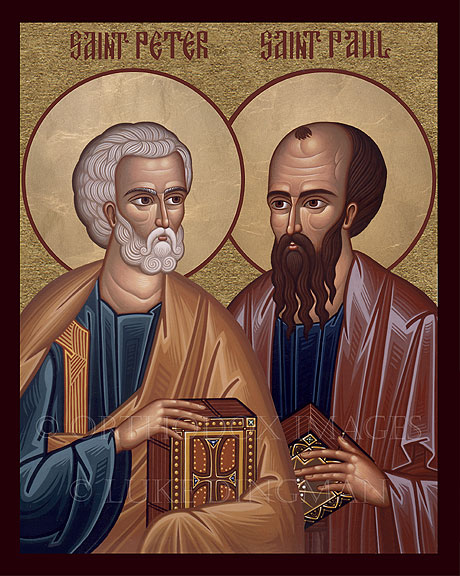


and this (source).

WFF: Saints Peter and Paul
Catholic Culture
CATHOLIC ENCYCLOPEDIA: St. Peter, Prince of the Apostles
Solemnity of Sts. Peter and Paul | St. Augustine on the Feast of ...
Unfortunately I am missing the papal vespers being celebrated at the Basilica of St. Paul in Rome, with the Patriarch of Constantinople in attendance... photos at NLM.
CNS STORY: Pope announces special year dedicated to St. Paul
ZENIT - Gearing Up for the Pauline Year
Catholic World News : Ecumenical Vespers service to open Pauline year
Orthodox Patriarch Will Help to Open Pauline Year - Catholic Online
The Vatican: The Papal Basilica - St. Paul Outside-the-Walls (official site for the basilica and the Pauline Year)
Fr. Z: Holy See’s Decree for Plenary Indulgences during Pauline Year (the decree itself)
Carmelite spirituality and the practice of mental prayer: Pauline ...
Saturday, June 28, 2008
Subscribe to:
Posts (Atom)