Thursday, May 17, 2007

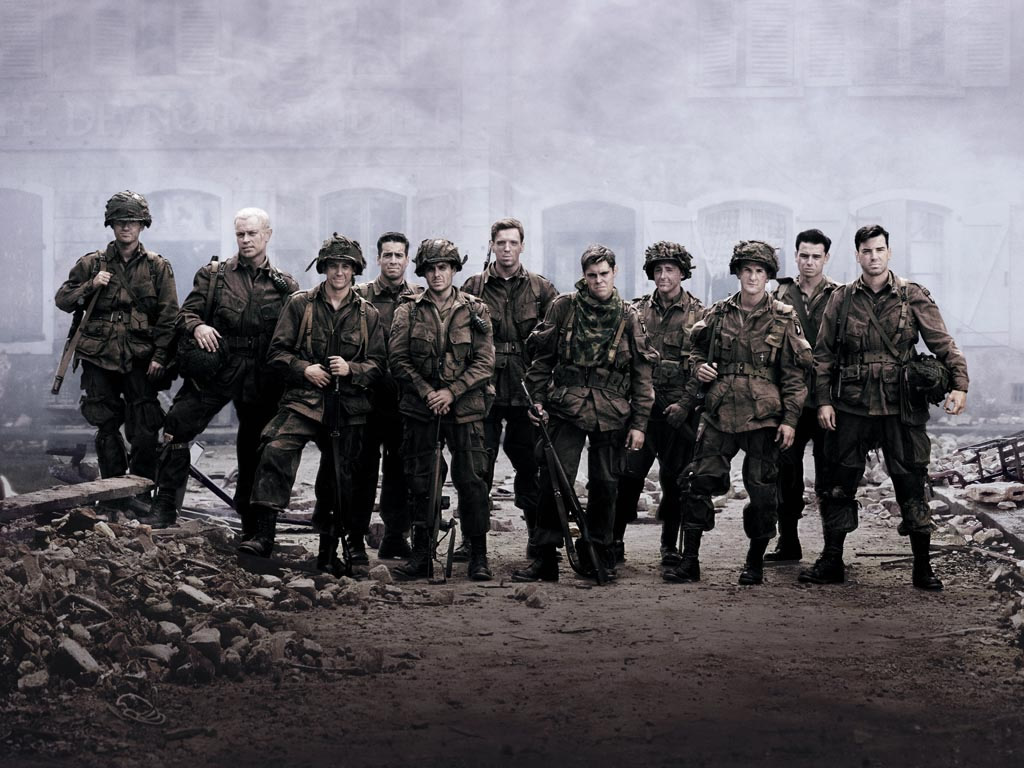
Major Dick Winters


Welcome to the Official CMOH Web Site of Major Richard Winters
Official website for Major Winters(?)


I learned of Major Winters through the Band of Brothers miniseries, which is based on the book of the same name written by Stephen Ambrose. He is a quiet American, the ideal representative of "the Greatest Generation," and even if not all American soldiers lived up to the name "the Greatest Generation," I believe Major Winters did. He is a true leader of men, concerned with their welfare, and a good soldier, though not as well known as some of our other American military heroes. He was nominated for a Congressional Medal of Honor for his actions on D-Day--leading his men to take out a German gun battery (depicted in episode 2 of Band of Brothers).

After the war, he was able to find the quiet life that he was looking for, on a small farm and Pennsylvania. (He was also a businessman.) An example of American Romanitas.

HBO: Band Of Brothers: Currahee (BBC)


Band of Brothers
History.com Band of Brothers


the book by Stephen Ambrose

Two books were recently published, one co-authored by Major Winters himself:


Beyond Band of Brothers: The War Memoirs of Major Dick Winters by Dick Winters and Cole C. Kingseed
Biggest Brother: The Life Of Major Dick Winters, The Man Who Led The Band of Brothers by Larry Alexander

Taki takes on Giuliani

at Taki's Top Drawer, of course

Paul Gottfried: When Republicans Debate; When Cousins Marry

NBC Nightly News does a story on Dragonskin

Finally, some national coverage.

Dateline will be continuing the story.

Amnesty for illegal immigrants in the works?

After I returned from grocery shopping, the Philosopher came out and expressed his worry about the Senate's new immigration bill. The Philosopher has been reading National Review, Thomas Sowell, and listening to Jay Severin.

A post to the VDare blog by Steve Sailer, 16 May 2007:
Senate Sell-Out Rolling Down the Tracks

Edit: Here is what the fuss is about (via Yahoo!)--

Bush, senators push immigration overhaul By JULIE HIRSCHFELD DAVIS, Associated Press Writer
12 minutes ago


WASHINGTON - The White House and key senators in both parties announced agreement Thursday on an immigration overhaul that would grant quick legal status to millions of illegal immigrants already in the U.S. It would also fortify the border.

President Bush said the proposal would "help enforce our borders but equally importantly, it'll treat people with respect."

"This is a bill where people who live here in our country will be treated without amnesty but without animosity," Bush said.

The compromise came after weeks of closed-door negotiations that brought the most liberal Democrats and the most conservative Republicans on immigration issues together with Bush's Cabinet officers to produce a highly complex measure that carries heavy political consequences. It still faces a long legislative struggle and its passage by the Senate or House is far from assured.

The plan would create a temporary worker program to bring new arrivals to the U.S and a separate program to cover agricultural workers. Skills and education level would for the first time be weighted more heavily than family connections in deciding whether immigrants should get permanent legal status. New high-tech employment verification measures would make sure that workers are here legally.

Sen. Edward M. Kennedy of Massachusetts, his party's lead negotiator on the deal, hailed it as "the best possible chance we will have in years to secure our borders and bring millions of people out of the shadows and into the sunshine of America."

Anticipating criticism from conservatives, Sen. Arlen Specter, R-Pa., said, "It is not amnesty. This will restore the rule of law."

The accord sets the stage for what promises to be a bruising battle next week in the Senate.

Senate Majority Leader Harry Reid,D-Nev., called the proposal a "starting point" for that debate and said the measure needs improvement.

"I have serious concerns about some aspects of this proposal, including the structure of the temporary worker program and undue limitations on family immigration," Reid said in a statement.

The breakthrough came when negotiators struck a bargain on a so-called "point system" that prioritizes immigrants' education and skill level over family connections in deciding how to award green cards.

The immigration issue also divides both parties in the House, which isn't expected to act unless the Senate passes a bill first.

The proposed agreement would allow illegal immigrants to come forward and obtain a "Z visa" and — after paying fees and a $5,000 fine — ultimately get on track for permanent residency, which could take between eight and 13 years. Heads of household would have to return to their home countries first.

They could come forward right away to claim a probationary card that would let them live and work legally in the U.S., but could not begin the path to permanent residency or citizenship until border security improvements and the high-tech worker identification program were completed.

A new temporary guest worker program would also have to wait until those so-called "triggers" had been activated.

Those workers would have to return home after work stints of two years, with little opportunity to gain permanent legal status or ever become U.S. citizens. They could renew their guest worker visas twice, but would be required to leave for a year in between each time.

Democrats had pressed instead for guest workers to be permitted to stay and work indefinitely in the U.S.

In perhaps the most hotly debated change, the proposed plan would shift from an immigration system primarily weighted toward family ties toward one with preferences for people with advanced degrees and sophisticated skills. Republicans have long sought such revisions, which they say are needed to end "chain migration" that harms the economy, while some Democrats and liberal groups say it's an unfair system that rips families apart.

Family connections alone would no longer be enough to qualify for a green card — except for spouses and minor children of U.S. citizens.

New limits would apply to U.S. citizens seeking to bring foreign-born parents into the country.

PCR, Giuliani Would Make a Worse President Than Bush

Giuliani Would Make a Worse President Than Bush
by Paul Craig Roberts

Ron Paul clarifies what he said during the debate

"Ron Paul Kicks Rudi's Neocon Ass with Truth & Logic"


Ron Paul with Sean Hannity

Politics makes strange bedfellows

This morning on the view, the women discussed the Republican debate again, as Joy Behar (who was absent yesterday and didn't get to participate in yesterday's discussion) wanted to talk about it. Rosie O'Donnell had the opportunity to watch the debate through the Fox website, as she had skipped it. Joy Behar was rather impressed by what Dr. Ron Paul said with regards to blowback and so on, and would consider voting for him on account of that. Rosie O'Donnell was sympathetic if not in agreement, while the Republican cheerleader, Elizabeth Hasselbeck, like many other Republican pundits, dismissed Paul's comments. iirc, Rosie O'Donnell even defended Paul from Giuliani's mischaracterization and other critiques. And this lead to another discussion about the use of terrorism as a bogeyman to scare the American people...

Reminder: Two experts on the efficacy of torture

Eric Haney:
Q: What do you make of the torture debate? Cheney ...

A: (Interrupting) That's Cheney's pursuit. The only reason anyone tortures is because they like to do it. It's about vengeance, it's about revenge, or it's about cover-up. You don't gain intelligence that way. Everyone in the world knows that. It's worse than small-minded, and look what it does.

I've argued this on Bill O'Reilly and other Fox News shows. I ask, who would you want to pay to be a torturer? Do you want someone that the American public pays to torture? He's an employee of yours. It's worse than ridiculous. It's criminal; it's utterly criminal. This administration has been masters of diverting attention away from real issues and debating the silly. Debating what constitutes torture: Mistreatment of helpless people in your power is torture, period. And (I'm saying this as) a man who has been involved in the most pointed of our activities. I know it, and all of my mates know it. You don't do it. It's an act of cowardice. I hear apologists for torture say, "Well, they do it to us." Which is a ludicrous argument. ... The Saddam Husseins of the world are not our teachers. Christ almighty, we wrote a Constitution saying what's legal and what we believed in. Now we're going to throw it away.


source

And Robert Baer:

The Israelis, Baer said, have learned that they can gain valuable information by establishing personal relationships with the inmates and gaining their trust.

"They found that torture, abusive tactics, made things overall worse for them politically," Baer said. "The Israelis are friendly with their prisoners. They play cards with them and allow them to contact their families. They are getting in their minds to determine what makes up a suicide bomber."


source

THE PRAGMATIC CASE AGAINST TORTURE....

old news: CorpWatch : US: Pentagon Spends Billions to Outsource Torture

United States: Trade in Torture

On Robert Baer: I was a cowboy for the CIA - Salon; "Baeriana: a chat with Robert Baer" by Ken Silverstein (Harper's ...; see also this previous post

New Catholic blog, Vox Nova

It deals with political and cultural questions from a Catholic perspective, with an emphasis on Catholic social doctrine: Vox Nova

Via Open Book

Photos: ROCOR-Russian Patriarch Reconciliation


Moscow Patriarch Alexy II, right, leader of the main Russian Orthodox Church, and Metropolitan Laurus, head of the Russian Orthodox Church Outside of Russia, seen during a ceremony marking the reunion at Christ the Savior Cathedral in Moscow, Thursday, May 17, 2007. Leaders of the Russian Orthodox faith signed a historic pact healing a schism between the church in Russia, which for decades cooperated with Soviet authorities, and an offshoot set up abroad after the 1917 Bolshevik Revolution. (AP Photo)

Russian President Vladimir Putin, right, and Metropolitan Laurus, head of the Russian Orthodox Church Outside of Russia, seen during a ceremony marking the reunion at Christ the Savior Cathedral in Moscow, Thursday, May 17, 2007. Leaders of the Russian Orthodox faith signed a historic pact healing a schism between the church in Russia, which for decades cooperated with Soviet authorities, and an offshoot set up abroad after the 1917 Bolshevik Revolution. (AP Photo/RIA-Novosti, Presidential Press Service, Dmitry Astakhov)

Russian President Vladimir Putin crosses himself during a religious service at Moscow's Christ the Saviour Cathedral Thursday, May 17, 2007. Church bells pealed in Moscow Thursday while leaders of the Russian Orthodox faith signed a historic pact healing a schism between the church in Russia, which for decades cooperated with Soviet authorities, and an offshoot set up abroad after the 1917 Bolshevik Revolution. (AP Photo/Misha Japaridze)

Russian President Vladimir Putin stands during a religious service at Moscow's Christ the Savior Cathedral Thursday, May 17, 2007. Church bells pealed in Moscow as leaders of the Russian Orthodox faith signed a pact on Thursday healing a historic schism between the church in Russia, which for decades cooperated with Soviet authorities, and an offshoot set up abroad after the 1917 Bolshevik Revolution. (AP Photo/Misha Japaridze)

(AFP/Maxim Marmur)
Russian President Vladimir Putin, left, attends a service with participation of Moscow Orthodox Patriarch Alexy II, right, during a ceremony marking the reunion at Christ the Savior Cathedral in Moscow, Thursday, May 17, 2007.

(AP Photo/RIA-Novosti, Presidential Press Service, Dmitry Astakhov)

(AP Photo)

(AP Photo)

Metropolitan Laurus, head of the Russian Orthodox Church Outside of Russia and Patriarch Alexy II, leader of the main Russian Orthodox Church conduct a religious ceremony at Moscow's Christ the Savior Cathedral Thursday, May 17, 2007. Church bells pealed in Moscow today while leaders of the Russian Orthodox faith signed a historic pact healing a schism between the church in Russia, which for decades cooperated with Soviet authorities, and an offshoot set up abroad after the 1917 Bolshevik Revolution. (AP Photo/Misha Japaridze)

Russian President Vladimir Putin, right, kisses an icon, presented to him by Patriarch Alexy II, leader of the main Russian Orthodox Church, left, during a religious service at Moscow's Christ the Saviour Cathedral Thursday, May 17, 2007. Church bells pealed in Moscow as leaders of the Russian Orthodox faith signed a pact on Thursday healing a historic schism between the church in Russia, which for decades cooperated with Soviet authorities, and an offshoot set up abroad after the 1917 Bolshevik Revolution. An unidentified clergyman stands at the background. (AP Photo/Misha Japaridze)

Russia's President Vladimir Putin (C) addresses the public as Patriarch Alexiy II (R), head of the Russian Orthodox Church and Metropolitan Laurus (L), the New York-based leader of the Orthodox Church Abroad stand next to him during a ceremony to sign a unification document in Moscow, May 17, 2007. The Russian Orthodox Church healed an 80-year rift on Thursday when a rival faction set up in the West by refugees fleeing the Soviet Union restored ties with the mother church in a lavish cathedral ceremony. REUTERS/Denis Sinyakov

Metropolitan Laurus, head of the Russian Orthodox Church Outside of Russia, left, and Patriarch Alexy II, leader of the main Russian Orthodox Church, right, listen to Russian President Vladfimir Putin at Moscow's Christ the Savior Cathedral Thursday, May 17, 2007. Church bells pealed in Moscow today while leaders of the Russian Orthodox faith signed a historic pact healing a schism between the church in Russia, which for decades cooperated with Soviet authorities, and an offshoot set up abroad after the 1917 Bolshevik Revolution.(AP Photo/ITAR-TASS, Presidential Press Service, Dmitry Astakhov)

(AP Photo/RIA- Novosti, Presidential Press Service, Dmitry Astakhov)

Patriarch Alexiy II (R), head of the Russian Orthodox Church and Metropolitan Laurus (L), the New York-based leader of the Orthodox Church Abroad, address the public after the ceremony of signing unification document in Moscow May 17, 2007. The Russian Orthodox Church healed an 80-year rift on Thursday when a rival faction set up in the West by refugees fleeing the Soviet Union restored ties with the mother church in a lavish cathedral ceremony. REUTERS/Denis Sinyakov (RUSSIA)

Metropolitan Laurus, head of the Russian Orthodox Church Outside of Russia, left, and Patriarch Alexy II, leader of the main Russian Orthodox Church exchange a signed reunion agreement at Moscow's Christ the Savior Cathedral Thursday, May 17, 2007. Church bells pealed in Moscow as leaders of the Russian Orthodox faith signed a pact on Thursday healing a historic schism between the church in Russia, which for decades cooperated with Soviet authorities, and an offshoot set up abroad after the 1917 Bolshevik Revolution. (AP Photo/Misha Japaridze)


Metropolitan Laurus, head of the Russian Orthodox Church Outside of Russia, left, and Patriarch Alexy II, leader of the main Russian Orthodox Church kiss after signing reunion agreement at Moscow's Christ the Saviour Cathedral Thursday, May 17, 2007. Leaders of the Russian Orthodox faith signed a historic pact Thursday healing a schism between the church in Russia, which for decades cooperated with Soviet authorities, and an offshoot set up abroad after the 1917 Bolshevik Revolution. (AP Photo/Misha Japaridze)

Metropolitan Laurus, head of the Russian Orthodox Church Outside of Russia, left, and Patriarch Alexy II, leader of the main Russian Orthodox Church sign reunion agreement at Moscow's Christ the Saviour Cathedral Thursday, May 17, 2007. After a choir sang sonorous hymns, Moscow Patriarch Alexy II, leader of the main Russian Orthodox Church, led the ceremony_which included leaders of church and state_with a sermon praising the ending the formal division. (AP Photo/Misha Japaridze)

(AP Photo/RIA- Novosti, Presidential Press Service, Dmitry Astakhov)

Russian Orthodox Patriarch Alexiy II (L) meets the head of the Russian Orthodx Church Abroad, Metropolitan Laurus, in the Danilov monastery in Moscow May 15, 2007. A branch of the Russian Orthodox Church whose members fled over 80 years ago to escape Bolshevik rule will rejoin the church in Moscow this week in a milestone on Russia's journey to heal the wounds of its Soviet past. REUTERS/Pool (RUSSIA)


Russian Orthodox Patriarch Alexiy II (3rd L) meets the head of the Russian Orthodx Church Abroad, Metropolitan Laurus (2nd R), and other church officials in the Danilov monastery in Moscow May 15, 2007. A branch of the Russian Orthodox Church whose members fled over 80 years ago to escape Bolshevik rule will rejoin the church in Moscow this week in a milestone on Russia's journey to heal the wounds of its Soviet past. REUTERS/Pool (RUSSIA)


Russian Orthodox Church's head of external relations, Metropolitan Kirill, right, and Metropolitan Laurus, left, the New York-based Leader of the Russian Orthodox Church Outside Russia, left, walk upon Metropolitan Laurus' arrival in Moscow, at Sheremetyevo airport, on Tuesday, May 15, 2007. A delegation of the Russian Orthodox Church Outside Russia arrived on Tuesday to take part in the final act of the latter's unification with Orthodox Church within Russia. Metropolitan Laurus is accompanied in his trip to Moscow by dozens of church leaders and clergymen. (AP Photo/Mikhail Metzel)


REUTERS/Hans Knopf (RUSSIA)

80 years on, Putin blesses the end of the schism within the Russian Orthodox Church

80 years on, Putin blesses the end of the schism within the Russian Orthodox Church
Patriarch Alexi II and the head of the Church abroad, metropolitan Laurus, today signed an act of canonical communion putting an end to the division between the two communities. Before a congregation of hundreds the first communal liturgy was celebrated today in Moscow’s Christ the Saviour cathedral, with Putin in the front row.


Moscow (AsiaNews) – The 80 year long schism within the Russian Orthodox Church was healed today with the celebration of the first communal liturgy in Moscow. President Putin, who addressed the congregation during the celebration, had long sought an end to the division, receiving words of praise from the ex separatists.

In Moscow's Christ the Saviour Cathedral Patriarch Alexi II with Metropolitan Laurus, who leads the Russian Orthodox Church Outside of Russia in New York, celebrated the historic event in which the clergy from the two Churches partook of communion from the same chalice. Before the solemn ceremony the two religious leaders signed the Canonical Communion Act, putting an end to nine decades of bitter division within the Russian Orthodox Church which began as Communist rule took hold after the Bolshevik Revolution in 1917. The schism became official in 1927, when Patriarch Sergiy declared loyalty to the communist regime.


This morning the Cathedral of Christ the Saviour, symbol of the current religious renewal, was packed with faithful from all over the world. At least 500 journalists were there to cover the historic event, which Russian press attributes to the intervention of President Vladimir Putin, in the front row at today’s celebration. In 2003 he delivered an invitation to metropolitan Laurus to visit Moscow on behalf of Alexi II. "Unity of the Orthodox Church - said Putin from the pulpit – is the necessary precondition for unity across the entire Russian world”.

With the signing of the canonical communion act, Patriarch Alexi II has become the leader of the reunified Church, the Church in exile however will maintain a certain autonomy: it will continue to appoint its own priests, it will maintain control of its properties and daily affairs and it will have the right to send representatives to the annual bishops conference in Moscow. The Patriarch of the Russian Capital will however have the right to approve nominations of new leaders to the outside Church. Moreover priests from the two Churches will be able to concelebrate the Eucharist.

According to official estimates, the outside Church counts over 480 thousand faithful in the US alone. According to the Moscow patriarchate two thirds of the 142 million Russian citizens are Orthodox, to whom a further million faithful in the ex soviet republics must be added.

Two underground priests from Wenzhou soon to be freed

Two underground priests from Wenzhou soon to be freed
Shao Zhoumin, vicar general of the diocese of Wenzhou, and Fr. Jiang Sunian are set to be freed this summer. The two were charged with having falsified their passports. The “Insieme per Prato” association mobilizes itself for their release.

and...
Pro-mainland lawmaker says Tiananmen crackdown was no massacre, no democracy till 2022

ROCOR to re-establish communion with the Russian Orthodox Church

Via KoreanCatholic: Russian Orthodox Church to end schism with formal reconciliation
Via Conservative Times: New York Times

Patriarchate of Moscow; news
ROCOR website (alt); another
Orthodox Church in America

wiki


St Nicholas Russian Orthodox Church, Dallas Texas

Wednesday, May 16, 2007

My Blueberry Nights trailer


Twitch coverage

The True Jesus of the Gospels, Part 3

The True Jesus of the Gospels (Part 3)

Commentary by Father Raniero Cantalamessa


VATICAN CITY, MAY 16, 2007 (Zenit.org).- Here is a translation of the Italian-language commentary by Capuchin Father Raniero Cantalamessa, preacher of the Pontifical Household, on the book "Inchiesta su Gesù" (An Investigation on Jesus) by Corrado Augias and Mauro Pesce.

Parts 1 and 2 appeared Monday and Tuesday, respectively.

* * *

5. Who is responsible for his death: the Sanhedrin, Pilate, or both?

The chapter of Corrado Augias' and Mauro Pesce's book on the trial and condemnation of Christ deserves a special discussion. The central thesis is not new; it began to be circulated after the tragedy of the Shoah and it was adopted by those who in the '60s and '70s proposed the thesis of Jesus who was a Zealot and a revolutionary.

On this view, the responsibility for Christ's death falls principally, indeed exclusively, on the shoulders of Pilate and the Roman administration, which indicates that the motive of Christ's condemnation was more political than religious. The Gospels acquitted Pilate and accused the Jewish leaders so as to pacify the Roman authorities in their regard and make friends with them.

This thesis was born from a just concern that today all of us share: To cut off at the root every pretext for anti-Semitism, which has procured for the Jewish people much evil at the hands of Christians. But the gravest mistake that can be made for the sake of a just cause is to defend it with erroneous arguments.

The struggle against anti-Semitism should be put on a firmer basis than that of a questionable (and questioned) interpretation of the Passion narratives. The innocence of the Jewish people, as such, of responsibility for the death of Christ rests on a biblical certainty that Christians have in common with Jews, but which, unfortunately, for many centuries has been strangely forgotten: "Only the one who sins shall die. The son shall not be charged with the guilt of his father, nor shall the father be charged with the guilt of his son" (Ezekiel 18:20). The doctrine of the Church knows only one sin that is transmitted by heredity from father to son, original sin, no other.

With this rejection of all anti-Semitism in place I would like to explain why the thesis about the complete innocence of the Jewish authorities of Christ's death and the essentially political nature of this death cannot be accepted. Paul, in the earliest of his letters, written around the year 50, gives the same fundamental account of Christ's death as the Gospels. He says that "the Jews have put Jesus to death" (1 Thessalonians 2:15), and he must have been better informed than we moderns about what took place in Jerusalem shortly before his arrival in the city, having once approved and "doggedly" defended the condemnation of the Nazarene.

During this earliest phase Christianity considered itself to be directed principally to Israel; converted Jews made up the majority membership in those communities in which the first oral traditions that came together later in the Gospels were formed; Matthew, as Augias and Pesce note, is concerned to show that Jesus came to fulfill, not abolish, the law. If there had been an apologetic worry, it would have been to present the condemnation of Jesus as the work of the pagans rather than the Jewish authorities with the scope of reassuring the Jews of Palestine and the Diaspora about the Christians.

On the other hand, when Mark, and certainly the other Evangelists, write their Gospel, Nero's persecution had already happened; this would have made Jesus appear to be the first victim of Roman power and the Christian martyrs as sharing in the fate of the Master.

We have a confirmation of this in the Book of Revelation, written after the persecution under Domitian, where Rome is the object of a ferocious invective ("Babylon," the "Beast," the "prostitute") because of the blood of the martyrs (cf. Revelations 13ff.). Pesce is right to perceive an "anti-Roman tendency" in John's Gospel (p. 156), but John is also the one who more accentuates the responsibility of the Sanhedrin and of the Jewish leaders in Christ's trial: How do we reconcile these things?

We cannot read the accounts of the Passion while ignoring everything that precedes them. The four Gospels attest, we can say on every page, to a growing religious contrast between Jesus and an influential group of Jews (Pharisees, doctors of the law, scribes) on the observance of the Sabbath, on the attitude toward sinners and publicans, on the clean and unclean.

Joachim Jeremias has shown the anti-Pharisaic motivation present in almost all of Jesus' parables. The Gospel data is just that much more credible insofar as the contrast with the Pharisees is not at all prejudicial or general. Jesus has friends among them (Nicodemus is one of them); we find him at dinner in one of their houses; they are willing at least to dispute with him and to take him seriously, unlike the Sadducees.

Without denying therefore that the later situation did something to further the contrast, it is impossible to eliminate every opposition between Jesus and an influential part of the Jewish leadership without completely unraveling the Gospels and making them historically incomprehensible. The ill will that the Pharisee Saul bore against the Christians did not come from nowhere and he did not bring it from Tarsus!

Once the existence of this contrast has been demonstrated, how can it be thought that it did not play any role at the moment of the final rendering of accounts and that the Jewish authorities, almost against their will, decided to denounce Jesus to Pilate only because of their fear of a Roman military intervention.

Of course Pilate was not so sensitive to the demands of justice to be worried about the fate of an unknown Jew; he was a hard and cruel type, ready to suppress with blood the tiniest hint of rebellion. All of that is true enough. However, he did not try to save Jesus out of compassion for the victim but only to score a point against his accusers with whom he had been in a cold war since his arrival in Judea. Naturally, this does not at all diminish Pilate's responsibility in Christ's condemnation. He was just as responsible as the Jewish leaders.

After all we should not aim at being "more Jewish than the Jews." From the accounts of Jesus' death present in the Talmud and in other Jewish sources (however late and historically contradictory they may be) one thing emerges: The Jewish tradition has never denied the participation of the religious leadership of the time in Christ's condemnation.

It has never defended itself by denying the fact but rather by denying that the fact constituted a crime and that it was an unjust condemnation: A version compatible with that of the New Testament sources which on the one hand highlight the participation of the Jewish authorities (of the Sadducees more than the Pharisees) in the Christ's condemnation, and on the other hand often excuse them, attributing their actions to ignorance (cf. Luke 23:34; Acts 3:17; 1 Corinthians 2:8). Raymond Brown also comes to this conclusion in his 1608 page book on "The Death of the Messiah."

A marginal note, but one that touches on a very delicate issue: According to Augias, Luke attributes to Jesus the following words: "And my enemies who did not want me to be king, bring them in and slaughter them before me" (Luke 19:27). Augias says of this line that "it is with such passages that the supporters of 'holy war' and armed struggle against unjust regimes seek to legitimate their actions."

It must be pointed out that Luke does not attribute these words to Jesus but to the king in the parable he is telling and we know that we cannot transfer the burden of the parable in all its details to reality, and in any case the parables must be transferred from the material plane to the spiritual plane. The metaphorical sense of those words is that accepting or rejecting Jesus has its consequences; it is a question of life or death, but spiritual life and death, not physical. Holy war has no place at all here.

6. A balance

It is time to end my critical reading with some concluding reflections. I do not share many of Pesce's views, but I respect them, recognizing their full right to citizenship in historical research. Many of them (on Jesus' attitude toward politics, the poor, children, the importance of prayer in his life) are indeed illuminating. Some of the problems raised -- Jesus' place of birth, the question of his brothers and sisters, the virgin birth -- are objective and are likewise discussed by some believing historians, but these are not problems with which the Christ of the Church stands or falls.

In regard to the place of birth, however, it seems strange to me to recognize that Mary constituted "for some early Christian writers, and Luke in particular, an important source of information" (p. 122) and then to deny Luke's report that Jesus was born in Bethlehem (p. 10). Mary should have known where her son was born!

Less justified it seems to me in a historical investigation of Jesus is the care with which Augias gathers all the insinuations about presumed homosexual relationships existing among the disciples, or between Jesus himself and "the disciple he loved" (was he not supposed to have been in love with Mary Magdalene?), and the detailed description of the scandalous incidents involving some of the women present in Christ's genealogy.

It seems we move sometimes from the investigation of Jesus to gossip about Jesus. However, there is an explanation for this phenomenon. There has always been the tendency to clothe Jesus in the garb of one's own epoch or ideology. In the past, though questionable, they were serious and relevant causes: Christ the idealist, socialist, revolutionary. ... Our time, obsessed with sex, cannot think of him except in connection with certain emotional problems.

I think that this putting together of a consciously alternative vision of a journalistic bent with a historical vision that is also radical and minimalist has led to a result that is on the whole unacceptable, not just for the man of faith but also for the historian. The claim according to which there is no relationship between the Jesus of the Gospels and the Jesus of the Church arises because of a failure to take account of the idea of development which should be familiar to the historian.

To confront the Christianity of the Gospels with that of later times and to conclude that they are two completely different things is to ignore that Christianity is life and that life is subject to growth. If we compare the photograph of an embryo in the maternal womb with the one of the ten-year-old child who has come from it, they will appear as two totally different realities, and yet everything that the person has become was contained and programmed in the embryo.

In the end one must ask the question: How did Jesus, who did not bring anything at all new to Judaism, who did not want to start any religion, who did not perform any miracle, and who is not risen save in the altered mind of his followers, how did he, I repeat, become "the man who changed the world," as the subtitle of the book defines him? A certain type of criticism begins with the intention of wiping away the veneer with which the ecclesiastical tradition has covered Jesus of Nazareth, but in the end the treatment reveals itself to be so corrosive as to dissolve the person beneath as well.

In trying to clear up the "mysteries" about Jesus to reduce him to an ordinary man, we end by creating a still more unexplainable mystery. A great English exegete, speaking of the resurrection of Christ, says: "The idea that the imposing edifice of the history of Christianity is like an enormous pyramid balanced upon an insignificant fact is certainly less credible than the assertion that the entire event -- that is, the event plus the meaning attributed to it -- really did occupy a place in history comparable to the one that the New Testament attributes to it" (C.H. Dodd).

Does faith condition historical research? Undeniably, at least to a certain extent. But I think that unbelief conditions it a great deal more. If one comes to the figure of Christ and to the Gospels as a non-believer (this is the case, as I understand it, of Augias at least) the essential is already decided: The virgin birth can only be a myth, the miracles are the result of suggestion, the resurrection is the product of an "altered state of consciousness," and so on.

One thing, nevertheless, consoles us and allows us to continue to respect each other and pursue dialogue: If the faith divides us, we are compensated by having "good faith" in common. Augias and Pesce claim to have written the book in good faith and I have certainly read and discussed it in good faith.

-----

Part 1 can be found here: http://www.zenit.org/english/visualizza.phtml?sid=107670

Part 2 can be found here: http://www.zenit.org/english/visualizza.phtml?sid=107740

One reason why I became disappointed with Tancredo

In response to Dr. Ron Paul, Rep. Tancredo said:

And although my dear friend Ron here -- I dearly love and really respect, but I'll tell you, I just have to disagree with you, Ron, about the issue of whether or not that -- whether Israel existed or didn't, whether or not we were in the Iraq war or not, they would be trying to kill us because it's a dictate of their religion, at least a part of it, and we have to defend ourselves.
Daniel Larison responds:

It is amusing to watch the gaggle of these other Republican candidates hold forth about the threat of Islam (Giuliani now claims to be some sort of expert), when they seem to have absolutely no historical perspective on any of this. Tancredo expressed this view most absolutely when he cut to the heart of the issue: “…whether Israel existed or didn’t, whether or not we were in the Iraq war or not, they would be trying to kill us because it’s a dictate of their religion, at least a part of it, and we have to defend ourselves.” Tancredo is sort of right, and yet also so horribly wrong that I cringed when I heard this.

Is jihad an integral part of Islam? Yes. Will there always be those who pursue jihad and try to subject non-Muslims to Islamic rule? Yes. Of course, where and under what circumstances jihadis will be doing this are all determined by any number of other factors. There are jihadis in Kashmir, but not terribly many in Gujarat–perhaps that has something to do with the political disputes over Kashmir? There are or have been jihadis in the Caucasus, Kosovo and Bosnia, but not terribly many in Indonesia, which may have something to do with violent contestation for power in the former. It seems plain that jihad comes to the fore when Muslims are caught up in conflict with non-Muslims, but otherwise the “dictate of their religion” remains more or less dormant. So, I put it to the majority of Republicans, why would you pursue policies that seem intent on provoking more conflicts with Muslims if you are interested in quelling jihadism and undermining its appeal? Either you have no idea what you are doing, in which case the rest of us should not heed your advice, or you are going about seeking the right goal in entirely the wrong way.

Jihad has existed in its fully formalised and elaborated form for approximately one thousand years, and yet jihadis (very broadly defined) took an interest in attacking Americans only in 1979. For some reason, Maghrebi Muslims were not gathering themselves into boats to raid the Jamestown settlement in a trans-Atlantic razzia. For some reason, the ruler of Morocco was among the first to recognise the independence of the United States; one of our earliest treaties was with the Moroccan monarchy. There was a war against Tripoli to secure our shipping in the Mediterranean, which was a war against piracy. From 1805 until 1979, it is exceedingly difficult to think of many episodes when the “dictate of their religion” so motivated zealous Muslims to attack Americans. As ties with Israel have deepened and our military profile in the region has increased, jihadi attacks have also increased. Now, as the old saying goes, correlation is not causation, but it is awfully curious that Muslims studiously overlooked a ”dictate of their religion” for most of our national history in our dealings with them and only happened to rediscover them at the moment that we embarked on policies that were not all together friendly to at least certain Muslim groups and states. Of course, we have enjoyed geographical distance from the Islamic world, and as inhabitants of this continent we have a certain luxury of distance that our cousins in Europe do not have, which is why it is so perplexing why anyone would actively promote a narrowing of this distance to bring us into ever-greater contact with people who are, in Mr. Tancredo’s estimation, out to kill us. The point is, surely, even if Tancredo were right (and he largely is not right), we would be far better advised to limit our points of contact with the Islamic world in every imaginable way than to expand them through ever-wider rounds of intervention, democratisation efforts and the like. Even by the standards of the wild Republican vision of the conflict with jihadis, the Republicans have been going about things in almost entirely the wrong way.

The history of Islam from the beginning has been one involving much strife, bloodshed and the invasions of non-Muslim lands, and anyone talking about this should harbour no illusions on this score (I certainly don’t), but as a result of political fragmentation of the Ottoman territories after WWI there has been no Islamic polity capable of projecting power or significantly threatening Europe or any of the countries bordering the Islamic world. The pathetic political and economic weakness and general geopolitical irrelevance of the Islamic world (Luttawak is right on this) has contributed to the eruption of mujihadeen on the borders of that world where there are relatively small-scale conflicts. Terrorism and even the pursuit of an “Islamic bomb” are the responses of a world desperately outclassed and outmatched in almost every measurable way by its neighbouring civilisations. Those who have been on the losing end of global cultural and economic transformations almost always grasp for the sword and try to redeem their losses through power–the American conservative movement can understand this response a little too well, I think–and thereby confirm their own lack of deeper reserves of strength.
Exactly.

I was also disappointed by this pop culture reference:


REP. TANCREDO: Well, let me just say that it's almost unbelievable to listen to this in a way. We're talking about -- we're talking about it in such a theoretical fashion. You say that -- that nuclear devices have gone off in the United States, more are planned, and we're wondering about whether waterboarding would be a -- a bad thing to do? I'm looking for "Jack Bauer" at that time, let me tell you. (Laughter, applause.)
A fictional character who uses torture and is willing to do anything to protect the country. Not exactly reassuring to those who believe in justice. Although I am a fan of 24, I don't think it should be taken as a moral guide for dealing with terrorism, and I don't think Federal agents should be emulating Jack Bauer in every way. So does Tancredo support the use of torture?

The Lady Downstairs says the show is anti-Catholic and immoral. Perhaps she can explain what she means by this. (After all, I could say the same of a certain show revolving around 4 single women in New York City.)

Marcus Aurelius, Meditations, Book V XXVII

XXVII. Within a very little while, thou wilt be either ashes, or a sceletum; and a name perchance; and perchance, not so much as a name. And what is that but an empty sound, and a rebounding echo? Those things which in this life are dearest unto us, and of most account, they are in themselves but vain, putrid, contemptible. The most weighty and serious, if rightly esteemed, but as puppies, biting one another: or untoward children, now laughing and then crying. As for faith, and modesty, and justice, and truth, they long since, as one of the poets hath it, have abandoned this spacious earth, and retired themselves unto heaven. What is it then that doth keep thee here, if things sensible be so mutable and unsettled? and the senses so obscure, and so fallible? and our souls nothing but an exhalation of blood? and to be in credit among such, be but vanity? What is it that thou dost stay for? an extinction, or a translation; either of them with a propitious and contented mind. But still that time come, what will content thee? what else, but to worship and praise the Gods; and to do good unto men. To bear with them, and to forbear to do them any wrong. And for all external things belonging either to this thy wretched body, or life, to remember that they are neither thine, nor in thy power.


From Project Gutenberg

Photos: Martina McBride


Country singer Martina McBride arrives at the 42nd Annual Academy of Country Music Awards on Tuesday, May 15, 2007, in Las Vegas. (AP Photo/Jae C. Hong)

Singer Martina Mcbride arrives for the 42nd annual Academy of Country Music Awards show at the MGM Grand Garden Arena in Las Vegas, Nevada May 15, 2007. REUTERS/Steve Marcus (UNITED STATES)

Country singers Martina McBride, left, Gretchen Wilson and Josh Turner get together before they perform on the NBC 'Today' television show kicking off program's summer concert series, in New York's Rockefeller Center, Friday May 11, 2007. (AP Photo/Richard Drew)


Country singer Martina McBride performs on the NBC 'Today' television show during program's summer concert series, in New York's Rockefeller Center, Friday May 11, 2007. (AP Photo/Richard Drew)

Her website. CMT.com page.
Martina McBride Guide


Anyway (I suspect this won't be available for long.) Another. American Idol. (Another.) God's Will. In My Daughter's Eyes. I Can't Stop Loving You.

Anyway MV


Martina Mcbride & Chieftains - I'll Be All Smiles Tonight


Where Would You Be


There You Are


Martina McBride & Clint Black - Still Holding On (LIVE)


Martina McBride & Bob Seger - Chances Are


Photos: Taylor Swift


Taylor Swift introduces herself to Tim McGraw after performing her song 'Tim McGraw' during the 42nd Annual Academy of Country Music Awards on Tuesday, May 15, 2007, in Las Vegas. (AP Photo/Mark J. Terrill)

Taylor Swift performs her song 'Tim McGraw' to the country star sitting in the audience during the 42nd Annual Academy of Country Music Awards on Tuesday, May 15, 2007, in Las Vegas. (AP Photo/Mark J. Terrill)

Singer Taylor Swift performs during the 42nd annual Academy of Country Music Awards show at the MGM Grand Garden Arena in Las Vegas, Nevada May 15, 2007. REUTERS/Steve Marcus (UNITED STATES)

Nominees Kellie Pickler, left, and Taylor Swift, both nominated for best new female vocalist, pose together as they arrive at the 42nd Annual Academy of Country Music Awards on Tuesday, May 15, 2007, in Las Vegas. (AP Photo/Jae C. Hong)


Taylor Swift, nominated for top new female vocalist, arrives at the 42nd Annual Academy of Country Music Awards on Tuesday, May 15, 2007, in Las Vegas. (AP Photo/Jae C. Hong)

official website; myspace; CMT.com page

fansite

Taylor Swift in studio with Bill Earley


Her song, "Tim McGraw":


"Teardrops on My Guitar":


I think she's probably too tall for you Sarge.