Saturday, February 20, 2010

An interesting post from Renegade Trads: St. Botulph, Pray For Us-- see the discussion regarding canonization.
Foreign Policy: China's High-Growth Ghost Towns by April Rabkin
Visiting the eerily vacant epicenter of unsustainable progress, far out in the grasslands of Inner Mongolia.
Visiting the eerily vacant epicenter of unsustainable progress, far out in the grasslands of Inner Mongolia.
As the country goes, so does the military.

(source)

WEST POINT, NY - MAY 23: Cadets in the graduating class of the United States Military Academy at West Point participate in commencement exercises on May 23, 2009 in West Point, New York. Secretary of Defense Robert Gates gave the commencement speech to the 970 graduates at the elite military academy. (Getty/Daylife)
Mr. Robert Hickson has an article in the March issue of Chronicles about West Point and the loss of traditions and decline of standards at the military academy and in the US Army at large: "Don Quixote at West Point."
When I contracted some of my trusted classmates from West Point and told them the entire story, I was told that the problem extends beyond the West Point Military Police. When cadets themselves are 'off duty,' it is often difficult to say who is a cadet and who is a vagrant or suspect gangster. Moreover, a dignified woman in the West Point Post Exchange had told me that the dress and conduct of the constable was representative. Cadets and other members of the military increasingly dress and act in this manner. 'This is not, by far, the way it used to be,' she said. 'But people don't seem to care anymore.' There is a pervading indifference, as if to say: 'I don't care, and you don't matter.'
My classmates informed me that the ethos at the academy is now so changed that a recent superintendent invited a very young, potential financial donor to stay overnight at his prestigious military quarters, while a decorated veteran general from World War II was put up at a nearby hotel. One of my other good classmates--not at all a curmudgeon, much less a pessimist or a fatalist--said, 'Robert, the Corps has, and the Army has'--cadet slang for 'the standards of the Corps and the Corps of Cadets itself have gone to hell, and the Army has, too.' I had not expected to hear these words from such a senior and distinguished man.
In any case, we shall not recover the flower of chivalry, much less its fuller fruits, unless we rediscover and are nourished by its roots, including its deeper religious roots. But as James Burnham writes, 'To be defeated after losing well does not always lose so much as not to have fought.' Don Quixote would agree. (And, along with his courage amid the surrounding mockery and cynicism, he further displayed 'the wisdom fo his naivete,' especially by his prompt and sustaining desire for 'chivalrous magnanimity' and for 'a new order of voluntary nobility.') As Chesterton once said, only a live thing can swim against the stream. Let us not be a drifter, nor a slothful tramp. As my Catholic Special Forces team sergeant once said to me: 'Sir, let us flame out, not rust out!'
Do the cadets still have an idea of what it means to be an officer and a gentleman? How can the admission of women to the academy not erode traditional ideals of what it is to be a gentleman?

WEST POINT, NY - MAY 23: Cadets in the graduating class of the United States Military Academy at West Point participate in commencement exercises on May 23, 2009 in West Point, New York. Secretary of Defense Robert Gates gave the commencement speech to the 970 graduates at the elite military academy. (Getty/Daylife)
Has the US Army relaxed of standards with regards to behavior and dress in the name of freedom and psychological comfort. Whatever the justification, if its high standards regarding appearance and demeanor are no longer enforced, and it draws its members from society at large, which is in decline, what should we expect except for soldiers and officers who behave no differently from their civilian counterparts when they are off duty?
The inevitable march to radical egalitarianism and the destruction of tradition -- it seems fitting that the Union Army, instrument for the eradication of traditional culture in the South, has fallen to the same disease that it has helped spread in the past. This is not to say that certain members, like the author of this piece, have not been heroic or virtuous, for whom I have much admiration and respect. But I am talking about the institution itself. After all, it serves the National Government.
*Slavery was just one aspect of the traditional culture of the South, and not a necessary part of it. If the South had ended slavery peacefully, we would have seen that this is the case, both in the result and in the originating impulse, which would have come from within the South. Instead the war and the occupation arguably created more animosity and resistance to change. Let us also remember that racism and racial discrimination was also present in the North.
On The Immorality of Illegal Immigration
On The Immorality of Illegal Immigration by Rev. Patrick J. Bascio
The book is advertised in Chronicles, so I took a look at the publisher's page. What's his relationship with his bishop like?
From VDARE: Father Pat Bascio: A Rare (?) Immigration Enforcement Voice In The Catholic Clergy
Who would say that illegal immigration isn't wrong? But the bigger question is of land, and whether it is a common good and if nation-states can make a claim to so much of it, putting up an obstacle to the (supposed) right to travel/migrate. Yet, how many immigrants would be willing to move in order to start from scratch, though, as a farmer, as opposed to being a wage slave in an industrialized economy? (Is that a significant enough consideration when it comes to defining the right to migration?)
The book is advertised in Chronicles, so I took a look at the publisher's page. What's his relationship with his bishop like?
From VDARE: Father Pat Bascio: A Rare (?) Immigration Enforcement Voice In The Catholic Clergy
Who would say that illegal immigration isn't wrong? But the bigger question is of land, and whether it is a common good and if nation-states can make a claim to so much of it, putting up an obstacle to the (supposed) right to travel/migrate. Yet, how many immigrants would be willing to move in order to start from scratch, though, as a farmer, as opposed to being a wage slave in an industrialized economy? (Is that a significant enough consideration when it comes to defining the right to migration?)
Last night I attempted some sprints, out on the middle of the road. (It was past midnight, so there were no cars on the road.) My back was bothering me, so my walk before the sprints was not so comfortable. Starting the first spring was not easy, but the second and third sprints didn't take as much willpower to commence. I felt a bit restricted in my abdominal region -- dinner? or excess fat? Still, this morning I felt rather energetic and was in the mood to sprint. I got enough sleep (a little less than 8 hours). And I did change my diet, to see if that would get rid of my sluggishness. Going primal seems to be working so far.
Tomgram: William Astore, The U.S. Military's German Fetish by William Astore
(via EB)
Once the United States started on the path of imperialism (and even before), when has its elites not been enamored with using the military for their imperial ventures? Given the successes of the Germany military, it's not surprising that the Americans would try to learn from them. The Germans are convenient scapegoat; whom did the American army emulate after World War I? Iirc, it was the French. Those with imperial ambitions or who seek to become a world power will want their military to be modelled after the best, not the worst.
3GW may have become popular in the "right" circles, but was it really ever adopted? (I think the Marines were more successful than the Army, according to William Lind.)
It seems to me that part of Patton's popularity was that he was one of the few who mastered 3GW and used it. But within military culture he may have been idolized for different reasons. Total situational awareness and full spectrum dominance though are relics of 2GW thinking, so how is this really linked to the German way of war?
3GW is a means, not an end in itself, and I think at the very least the more astute of the German military commanders realized this, even if the Nazi leadership did not. Should we attribute the mistakes made by Hitler to the German military? (As it is, many claim the German military should have resisted Hitler.) We should distinguish the learning of 3GW from thinking that war is the primary means of solving political conflict.
This smells like American exceptionalism and may be giving too much (or little) credit to American military leadership, depending on what one thinks of the Soviets and their role and bringing down the German war machine. I don't think the average German soldier was any less dedicated than the average American soldier. Comparing the average American citizen with the average German citizen with respect to virtues other than those needed for a warrior doesn't make sense to me, since the constitutional order had already been subverted by World War II, and the political power of an average American citizen was rather limited even then. Even the Germans could vote for their leaders under the Weimar Republic. Was the patriotism of a German soldier any less than that of an American? We seem to be repeating WW2 propaganda caricatures.
The author seems to overstretch in order to make his point, and does not appear to have adequate familiarity with 3GW, beyond certain principles. The historical illustrations do not match up. The snarky response is that the author is USAF -- what does he know about ground warfare? But maybe he knows more than this article seems to indicate. Still, the rest of the article serves as a warning to Americans about embracing militarism. Those who think 3GW will give them certain victory in the pursuit of imperial goals should be chastized. 3GW is just a tool; whether one should go to war in the first place is a question that needs to be answered based on justice and wisdom, not on the belief that victory can be achieved. (And in a 4GW world, 3GW may win a conflict against a nominal nation-state, but it will not help in occupation and nation-building, nor is it an adequate response to the use of 4GW by non-state actors after the defeat of the country.)
(via EB)
Once the United States started on the path of imperialism (and even before), when has its elites not been enamored with using the military for their imperial ventures? Given the successes of the Germany military, it's not surprising that the Americans would try to learn from them. The Germans are convenient scapegoat; whom did the American army emulate after World War I? Iirc, it was the French. Those with imperial ambitions or who seek to become a world power will want their military to be modelled after the best, not the worst.
A problem-solving leadership exercise, Project X consisted of several scenarios and associated tasks. Working in small groups, you were expected to solve these while working against the clock. What made the project exciting and more than busy-work, like the endless marching or shining of shoes or waxing of floors, was that it was based on German methods of developing and instilling small-unit leadership, teamwork, and adaptability. If it worked for the Germans, the “finest soldiers in the world” during World War II, it was good enough for us, or so most of us concluded (including me).
Project X was just one rather routine manifestation of the American military’s fascination with German methods and the German military mystique. As I began teaching military history to cadets at the Air Force Academy in 1990, I quickly became familiar with a flourishing “Cult of Clausewitz.” So ubiquitous was Carl von Clausewitz and his book On War that it seemed as if we Americans had never produced our own military theorists. I grew familiar with the way Auftragstaktik (the idea of maximizing flexibility and initiative at the lowest tactical levels) was regularly extolled. So prevalent did Clausewitz and Auftragstaktik become that, in the 1980s and 1990s, American military thinking seemed reducible to the idea that “war is a continuation of politics” and a belief that victory went to the side that empowered its “strategic corporals.”
3GW may have become popular in the "right" circles, but was it really ever adopted? (I think the Marines were more successful than the Army, according to William Lind.)
The American military’s fascination with German military methods and modes of thinking raises many questions. In retrospect, what disturbs me most is that the military swallowed the Clausewitzian/German notion of war as a dialectical or creative art, one in which well-trained and highly-motivated leaders can impose their will on events.In this notional construct, war became not destructive, but constructive. It became not the last resort of kings, but the preferred recourse of “creative” warlords who demonstrated their mastery of it by cultivating such qualities as flexibility, adaptability, and quickness. One aimed to get inside the enemy’s “decision cycle,” the so-called OODA loop -- the Air Force’s version of Auftragstaktik -- while at the same time cultivating a “warrior ethos” within a tight-knit professional army that was to stand above, and also separate from, ordinary citizens.
Is Clausewitz really the model for 3GW? Here he sounds more like a 2GW thinker.
This idolization of the German military was a telling manifestation of a growing militarism within an American society which remained remarkably oblivious to the slow strangulation of its citizen-soldier ideal. At the same time, the American military began to glorify a new generation of warrior-leaders by a selective reading of its past. Old “Blood and Guts” himself, the warrior-leader George S. Patton -- the commander as artist-creator-genius -- was celebrated; Omar N. Bradley -- the bespectacled GI general and reluctant soldier-citizen -- was neglected. Not coincidentally, a new vision of the battlefield emerged in which the U.S. military aimed, without the slightest sense of irony, for “total situational awareness” and “full spectrum dominance,” goals that, if attained, promised commanders the almost god-like ability to master the “storm of steel,” to calm the waves, to command the air.
It seems to me that part of Patton's popularity was that he was one of the few who mastered 3GW and used it. But within military culture he may have been idolized for different reasons. Total situational awareness and full spectrum dominance though are relics of 2GW thinking, so how is this really linked to the German way of war?
In the process, any sense of war as thoroughly unpredictable and enormously wasteful was lost. In this infatuation with German military prowess, which the political scientist John Mearsheimer memorably described as “Wehrmacht penis envy,” we celebrated our ability to Blitzkrieg our enemies -- which promised rapid, decisive victories that would be largely bloodless (at least for us). In 1991, a decisively quick victory in the Desert Storm campaign of the first Gulf War was the proof, or so it seemed then, that a successful “revolution in military affairs,” or RMA in military parlance, was underway.
Forgotten, however, was this: the German Blitzkrieg of World War II ended with Germany’s “third empire” thoroughly thrashed by opponents who continued to fight even when the odds seemed longest.
What a remarkable, not to say bizarre, turnabout! The army and country the U.S. had soundly beaten in two world wars (with a lot of help from allies, including, of course, those godless communists of the Soviet Union in the second one) had become a beacon for the U.S. military after Vietnam. To use a sports analogy, it was as if a Major League Baseball franchise, in seeking to win the World Series, decided to model itself not on the New York Yankees but rather on the Chicago Cubs.
3GW is a means, not an end in itself, and I think at the very least the more astute of the German military commanders realized this, even if the Nazi leadership did not. Should we attribute the mistakes made by Hitler to the German military? (As it is, many claim the German military should have resisted Hitler.) We should distinguish the learning of 3GW from thinking that war is the primary means of solving political conflict.
Precisely because that disaster did not befall us, precisely because we emerged triumphant from two world wars, we became both too enamored with the decisiveness of war, and too dismissive of our own unique strength. For our strength was not military élan or cutting-edge weaponry or tactical finesse (these were German “strengths”), but rather the dedication, the generosity, even the occasional ineptitude, of our citizen-soldiers. Their spirit was unbreakable precisely because they -- a truly democratic citizen army -- were dedicated to defeating a repellently evil empire that reveled fanatically in its own combat vigor.
This smells like American exceptionalism and may be giving too much (or little) credit to American military leadership, depending on what one thinks of the Soviets and their role and bringing down the German war machine. I don't think the average German soldier was any less dedicated than the average American soldier. Comparing the average American citizen with the average German citizen with respect to virtues other than those needed for a warrior doesn't make sense to me, since the constitutional order had already been subverted by World War II, and the political power of an average American citizen was rather limited even then. Even the Germans could vote for their leaders under the Weimar Republic. Was the patriotism of a German soldier any less than that of an American? We seem to be repeating WW2 propaganda caricatures.
The author seems to overstretch in order to make his point, and does not appear to have adequate familiarity with 3GW, beyond certain principles. The historical illustrations do not match up. The snarky response is that the author is USAF -- what does he know about ground warfare? But maybe he knows more than this article seems to indicate. Still, the rest of the article serves as a warning to Americans about embracing militarism. Those who think 3GW will give them certain victory in the pursuit of imperial goals should be chastized. 3GW is just a tool; whether one should go to war in the first place is a question that needs to be answered based on justice and wisdom, not on the belief that victory can be achieved. (And in a 4GW world, 3GW may win a conflict against a nominal nation-state, but it will not help in occupation and nation-building, nor is it an adequate response to the use of 4GW by non-state actors after the defeat of the country.)
Nevin Martell, The fantastic truth of Calvin and Hobbes (via FT)

(source)
What would happen if the misandrist teachers and principals of today got their hands on Calvin? Calvin on ritalin?
Related links:
Calvin and Hobbes Comic Strip on GoComics.com

(source)
What would happen if the misandrist teachers and principals of today got their hands on Calvin? Calvin on ritalin?
Related links:
Calvin and Hobbes Comic Strip on GoComics.com
Friday, February 19, 2010
공부의 신

This week I watched the first two episodes of the God of Study (공부의 신) on KBS America. While I may sympathize with students who have to endure the school system in E. Asia, especially secondary school, I have to say that the solution offered to them, to use the system in order to overthrow it, repels me. The alumnus who has become a lawyer tells the students that if they want to change the system and get rid of society's preferential treatment for those who go to the "right" schools and the power these fortunate few exercise over everyone else, they must first succeed academically and gain positions of influence and power. This may appeal to high school students who are currently suffering, but do the drama or the original manga look critically at the education system itself? Is this the sort of education that East Asians need, if industrialization is not the future? And what of a more liberal education?
John Gatto writes:
[I]ndustrial and institutional interest had seeded Russia, China, Japan, and the Pacific Islands with the doctrine of psychological schooling long ago, nearly at the beginning of the century, and in Japan’s case even before that.
We should probably add Korea to that list.
Because of the real crises that afflict education both here and in East Asia, I can't really enjoy the show, even if it tries to be inspiring. Would popular outrage in South Korea be sufficient for the education system to be reformed? What would it take to dethrone the education experts there? And would the corporations, forces of industrialization, and sadly, adherents to traditional Korean culture be fighting to preserve the status quo?
(How many Catholic secondary schools are there in South Korea? Do the successors of the Confucian scholars reject the current education system?)
Links for 공부의 신:
Han Cinema
D-addicts
Crunchy Roll
I am enjoying Slave Hunters though. (Also on KBS.)
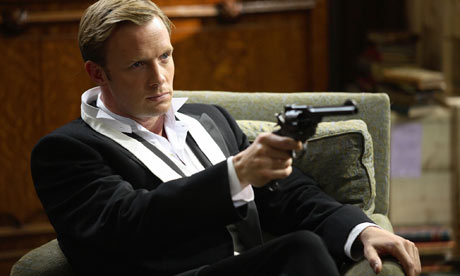
Next Sunday on Masterpiece Theater: The 39 Steps.
I will probably watch this adaptation of the novel because of Rupert Penry-Jones, but the other main character is a "feisty suffragette," Victoria Sinclair, played by Lydia Leonard. I haven't read the novel or watched the Hitchcock adaptation, so I don't know what sort of view is taken regarding the movement, if any.
BBC bungles showpiece drama remake The 39 Steps with a host of howlers... like the biplane with a machine gun ‘ahead of its time’
Apparently the character of Sinclair was invented for this adaptation. Something to make the story more palatable to the PC crowd?
Impious?
From Clash of the Titans Set Visit: IGN travels back to mythological ancient Greece.
Did Greek myths foster this sort of impiety? Not that I recall.
The legend of Perseus involves the hero, born of Zeus and a mortal woman, setting out on a quest to kill the snake-headed Gorgon Medusa (not played by Uma Thurman in the film, sorry Percy Jackson fans) and save the princess Andromeda from a sea monster -- known as the Kraken in the movie versions of the tale. The new film's story does deviate from the original's in many ways, though.
"In the original, Perseus is part man, part god, as you know," says Worthington. "And he accepts the gods' side pretty easily in the first one and accepts all the gifts the gods give him. And to me that wasn't a very good message to give to my nine-year-old nephew, or any kid, I think -- is that you have to be a god to achieve something. So one of the things I talked to Louis about was that … he wants to be a man and do this as a man. And do it with other men. Because I think that's a good message that anything is possible if you're banded together as men. So that's where it differs a lot. He's rejecting the gods a hell of a lot. And then the second thing is that [in] Greek mythology destiny is set for you, something I thought that was another crap message to give to my nephew. Because to say to him you're already going to be destined to do this, this and this, I believe you can make your own fate. So we kind of played against that. My Perseus is really a boisterous, belligerent kind of teenager. You tell him he can't do something, he'll run headlong into doing it. And that gets him into a lot of trouble. He's not the golden boy, he's the teenager who has to learn to grow up."
Did Greek myths foster this sort of impiety? Not that I recall.
Debra Medina

I think if I were living in Texas I'd be supporting her campaign. She seems to have Ron Paul's support, if not an official endorsement. How much will Glenn Beck's hit piece affect Texas voters? I think he's lost any respect he might have gained from paleos. Reactions of Republicans against her tell us what it means to be a "conservative" -- full acceptance of the National Government, the centralized nation-state, and slavish adoption of the official explanation coming out of D.C concerning 9/11. Her patriotism is called into question for her skepticism concerning the 9/11 report and she is called a traitor for talking about secession. If Texans are among those calling her a traitor, they've been brainwashed or they've moved in from elsewhere. Do they say the same thing about Ron Paul?
Sean Scallon, Some conspiracy theories are more equal than others
All You Need Is… A Slap by James Jackson
People are no longer told it is their fault, their actions that cause the effects. Their flaws and failings, their weakness and absurdity, even their criminality, can be excused and explained. The liberal-left and its psycho-twaddle franchise hold out the apparent answer. Everything is a condition or disorder, an illness or syndrome, an addiction or compulsion; everything can be blamed on someone or something else, on the system or situation, on society, on discrimination, on your vulnerabilities, on your not being breast-fed, on your mother preferring your sister, on your being undervalued and a third sibling or having attention-deficit or low self-esteem. Hell, it might even be ME. Blah, blah, blah. Grow a spine.
Our sense of wellbeing and our very souls—our capacity to accept reality and see the truth—are corrupted by this bullshit. Individual responsibility is abrogated and elsewhere, proportion and perspective are dropped.
Life After RC: Papal Action?
Giselle's reaction: "This would be very good, if true. (I used to think suppression was best, but Pete Vere showed me why that is actually not a good step.)"
For Pete Vere's explanation, see this and this.
Who would (or is qualified to) rewrite the constitution(s) and reform their seminaries?
Edit. Gisell updates with a translation of the Reforma piece. In the combox, someone asks how Miles Jesu is doing these days. (From Clerical Whispers in 2009: The Truth About Miles Jesu.)
[A]Mexican paper is indicating that the Pope has moved to refound the Legion of Christ, taking away the highest level of its hierarchy and placing all the schools under his immediate supervision. Obviously this is terribly unsubstantiated but I wanted to put a thread in place that will be corrected and updated when the information becomes available.
Giselle's reaction: "This would be very good, if true. (I used to think suppression was best, but Pete Vere showed me why that is actually not a good step.)"
For Pete Vere's explanation, see this and this.
Who would (or is qualified to) rewrite the constitution(s) and reform their seminaries?
Edit. Gisell updates with a translation of the Reforma piece. In the combox, someone asks how Miles Jesu is doing these days. (From Clerical Whispers in 2009: The Truth About Miles Jesu.)
In response to a comment on this post, I looked up a relevant passage from the Nicomachean Ethics. This is from Book VIII (Ross's translation):
See also Cicero's De Amicitia.
As in regard to the virtues some men are called good in respect of a state of character, others in respect of an activity, so too in the case of friendship; for those who live together delight in each other and confer benefits on each other, but those who are asleep or locally separated are not performing, but are disposed to perform, the activities of friendship; distance does not break off the friendship absolutely, but only the activity of it. But if the absence is lasting, it seems actually to make men forget their friendship; hence the saying 'out of sight, out of mind'. Neither old people nor sour people seem to make friends easily; for there is little that is pleasant in them, and no one can spend his days with one whose company is painful, or not pleasant, since nature seems above all to avoid the painful and to aim at the pleasant. Those, however, who approve of each other but do not live together seem to be well-disposed rather than actual friends. For there is nothing so characteristic of friends as living together (since while it people who are in need that desire benefits, even those who are supremely happy desire to spend their days together; for solitude suits such people least of all); but people cannot live together if they are not pleasant and do not enjoy the same things, as friends who are companions seem to do.
The truest friendship, then, is that of the good, as we have frequently said; for that which is without qualification good or pleasant seems to be lovable and desirable, and for each person that which is good or pleasant to him; and the good man is lovable and desirable to the good man for both these reasons. Now it looks as if love were a feeling, friendship a state of character; for love may be felt just as much towards lifeless things, but mutual love involves choice and choice springs from a state of character; and men wish well to those whom they love, for their sake, not as a result of feeling but as a result of a state of character. And in loving a friend men love what is good for themselves; for the good man in becoming a friend becomes a good to his friend. Each, then, both loves what is good for himself, and makes an equal return in goodwill and in pleasantness; for friendship is said to be equality, and both of these are found most in the friendship of the good.
Between sour and elderly people friendship arises less readily, inasmuch as they are less good-tempered and enjoy companionship less; for these are thou to be the greatest marks of friendship productive of it. This is why, while men become friends quickly, old men do not; it is because men do not become friends with those in whom they do not delight; and similarly sour people do not quickly make friends either. But such men may bear goodwill to each other; for they wish one another well and aid one another in need; but they are hardly friends because they do not spend their days together nor delight in each other, and these are thought the greatest marks of friendship.
One cannot be a friend to many people in the sense of having friendship of the perfect type with them, just as one cannot be in love with many people at once (for love is a sort of excess of feeling, and it is the nature of such only to be felt towards one person); and it is not easy for many people at the same time to please the same person very greatly, or perhaps even to be good in his eyes. One must, too, acquire some experience of the other person and become familiar with him, and that is very hard. But with a view to utility or pleasure it is possible that many people should please one; for many people are useful or pleasant, and these services take little time.
See also Cicero's De Amicitia.
J.D. Hayworth may be a bit better than John McCain, and I woudn't mind seeing McCain lose his the nomination, but does he offer enough solutions for the mess that is the political economy? I don't think he does. (I have relatives living in Arizona, but I don't know how many of them would vote for the Republican in November.)
Fred Thompson endorses John McCain
Yeah, Fred Thompson the great conservative hope of the Republican Party? What a joke.
Fred Thompson endorses John McCain
Yeah, Fred Thompson the great conservative hope of the Republican Party? What a joke.
The Defense Elephant in America's Living Room By SAUL LANDAU and NELSON P. VALDES
Pentagon Budget as Ponzi Scheme
Pentagon Budget as Ponzi Scheme
Daniel Larison seems to like Paul Ryan:

Related links:
Paul Ryan for U.S. Congress
Congressman Paul Ryan's Republican Healthcare Alternative
Republican poster boy Paul Ryan - Isthmus
The GOP's Alternative Budget - WSJ.com
Well, yes, my views are rooted in pessimism. After all, I am a pessimist. I’m all the more pessimistic because I see that there are figures such as Ron Paul and his son Rand, Paul Ryan and perhaps a few others, including our former governor Gary Johnson, who do offer the right sort of leadership, and I can also see that none of them can get a serious hearing from their own side.
What’s more, I see why these figures can’t get a serious hearing, and it certainly isn’t because they aren’t serious people. There is no large constituency on the right for the kind of deep and radical reforms they advocate. Whatever skepticism of the national security and warfare state there is, it is limited to a relative handful of libertarians and a few traditional conservatives, and even if there is theoretically more support for Paul Ryan’s proposals for domestic programs there is no political will to push for them.
Paul Ryan’s budget is a creditable effort to balance the budget and eliminate the long-term liabilities from entitlements. If the leadership had any convictions or spine, they would champion this is as the unpalatable but necessary reform that it is. That would mean embarking on a long uphill struggle against trends of public opinion, demographic changes and a national culture of entitlement, and it would probably be politically very dangerous for them to do this in the short to medium term. They couldn’t just sit back and wait to win back a couple dozen seats by default. They would have to risk what they have to do what is in the country’s best interest.
Of course, they remember how easily they were beaten back in ‘95-’96 when they proposed to do something with Medicare far less significant than what Ryan proposes, and they dare not go near it again. This is why we see their silly pose of being the saviors of Medicare in the health care debate. As their core constituents age and retire, the GOP is going to become the greatest obstacle to entitlement reform.

Related links:
Paul Ryan for U.S. Congress
Congressman Paul Ryan's Republican Healthcare Alternative
Republican poster boy Paul Ryan - Isthmus
The GOP's Alternative Budget - WSJ.com
Thursday, February 18, 2010
Zenit: Benedict XVI's Ash Wednesday Homily
"Lent Lengthens Our Horizon, It Orients Us to Eternal Life"
"Lent Lengthens Our Horizon, It Orients Us to Eternal Life"
Subscribe to:
Posts (Atom)