Showing posts with label San Jose. Show all posts
Showing posts with label San Jose. Show all posts
Friday, April 27, 2018

Saturday, November 09, 2013
Friday, August 30, 2013
Konjoe Burger Bar
Two Wednesdays ago I made my first visit to San Pedro Square Market in downtown San Jose to try Konjoe Burger Bar, which offers burgers made with grassfed beef. The chips that came with the burger were prepared well, and slightly spicy. The ketchup is made in the house, and has the texture of marinara sauce or tomato paste, but it is tasty. My konjoe burger (beef, fried egg, lettuce, pickled jalapeno, caramelized onions, cheese, konjoe sauce) was cooked medium rare/medium - can grass-fed ground beef be cooked more without becoming tough? I think the burgers at ROAM are better (and cooked longer). (I don't know which has better beef burgers, ROAM or Bareburger, but I think Bareburger may be slightly better on the whole.)
I also tried the steak sandwich from Phonomenal Noodle House - a Vietnamese version of a cheese steaksandwich? It was ok, but I liked my burger from konjoe much better.
San Pedro Square Market is a decent place for people to hang out in downtown San Jose, but I think that it closes relatively early, so that is a disadvantage. I think its clientele comprises mostly of SJSU students and local workers, and some of the SWPLs living in the area. Next time I will have to try the ribs at Bray?
Related:
Burger Bun Alternatives
I also tried the steak sandwich from Phonomenal Noodle House - a Vietnamese version of a cheese steaksandwich? It was ok, but I liked my burger from konjoe much better.
San Pedro Square Market is a decent place for people to hang out in downtown San Jose, but I think that it closes relatively early, so that is a disadvantage. I think its clientele comprises mostly of SJSU students and local workers, and some of the SWPLs living in the area. Next time I will have to try the ribs at Bray?
Related:
Burger Bun Alternatives
Monday, July 22, 2013
It's not just the European ethnic enclaves that are disappearing.
Made a stop in San Jose Japantown on Saturday afternoon, as someone wrote on her FB page that she would be appearing there for an event. It was a weekend afternoon, but there weren't many people on the streets. Not many toursts, as far as I could tell. (There was a cutie, next to whom I parked briefly until I decided to move the car since it was supposed to be in a tow-away zone for yesterday's event.)
The Buddhist Church on 5th St. is worth a look; I didn't go inside and I found out later from the people leaving that there was a Saturday service taking place at that time. Saturday vigil service so people don't have to go to temple on Sunday? How many families attending the temple have roots in area? Probably a significant number, but how many still live in immediate vicinity?
There are some new apartments in the area, but how many of the residents are Japanese-American? Most of the patrons for the Japanese restaurants seem to come from out of the area. It seems to me that SJ Japantown has lost its character as an ethnic neighborhood, as a living community - what ties to its past do those who frequent it or own businesses there have? Is it attractive as a tourist area? Will there be a demand that the city subsidize the neighborhood in some way if the businesses there begin to fail? While the neighborhood may be of historical interest, how many people other than your SWPLs care?
There are some markers and signs talking. bout the history of Japanese immigrants in America. One made mention of the ban on Japanese immigrants (among others) in the 1920s. I suppose that this is supposed to elicit the reaction that such a law was unfair or unjust, but there is no right to immigrate. I see no evidence that as the Japanese have assimilated, they have retained some set of "conservative" values.
SF Chinatown (old and new) are still around - but I suspect most of the immigrants are now from parts of China other than Hong Kong or Canton. Has anyone done a demographic survey on those areas? How many Cantonese-spearkers remain? Those Cantonese-speakers who have money probably choose to live elsewhere. It's been a while since I've walked by the neighborhood schools, are there many children left, or is Chinatown increasingly occupied by the elderly?
Made a stop in San Jose Japantown on Saturday afternoon, as someone wrote on her FB page that she would be appearing there for an event. It was a weekend afternoon, but there weren't many people on the streets. Not many toursts, as far as I could tell. (There was a cutie, next to whom I parked briefly until I decided to move the car since it was supposed to be in a tow-away zone for yesterday's event.)
The Buddhist Church on 5th St. is worth a look; I didn't go inside and I found out later from the people leaving that there was a Saturday service taking place at that time. Saturday vigil service so people don't have to go to temple on Sunday? How many families attending the temple have roots in area? Probably a significant number, but how many still live in immediate vicinity?
There are some new apartments in the area, but how many of the residents are Japanese-American? Most of the patrons for the Japanese restaurants seem to come from out of the area. It seems to me that SJ Japantown has lost its character as an ethnic neighborhood, as a living community - what ties to its past do those who frequent it or own businesses there have? Is it attractive as a tourist area? Will there be a demand that the city subsidize the neighborhood in some way if the businesses there begin to fail? While the neighborhood may be of historical interest, how many people other than your SWPLs care?
There are some markers and signs talking. bout the history of Japanese immigrants in America. One made mention of the ban on Japanese immigrants (among others) in the 1920s. I suppose that this is supposed to elicit the reaction that such a law was unfair or unjust, but there is no right to immigrate. I see no evidence that as the Japanese have assimilated, they have retained some set of "conservative" values.
SF Chinatown (old and new) are still around - but I suspect most of the immigrants are now from parts of China other than Hong Kong or Canton. Has anyone done a demographic survey on those areas? How many Cantonese-spearkers remain? Those Cantonese-speakers who have money probably choose to live elsewhere. It's been a while since I've walked by the neighborhood schools, are there many children left, or is Chinatown increasingly occupied by the elderly?
Wednesday, June 19, 2013
When I dropped by Kinokuniya SJ last week and found that it had moved out of the old building (where McWhorter's used to be) back into its last space at the Yaohan (now Mitsuwa) building. The floor space for the bookstore has been reduced even more now, as the stationary department has been added to the bookstore. (It used to occupy a separate space in the Yaohan building.) Where are all the other small shops that used to be there? They probably didn't generate enough sales to stay in business. Declining customer base? The toy store hasn't been around for some time.
Wednesday, August 08, 2012
Casino M8trix Opens
San Jose's Casino M8trix opens Tuesday after all
Apparently it is the replacement for Garden City. May of San Jose Chuck Reed was on the news talking about the casino as a source of revenue for the city. How long will it be the cash cow the city needs?
NYC Food and Beverage
Apparently it is the replacement for Garden City. May of San Jose Chuck Reed was on the news talking about the casino as a source of revenue for the city. How long will it be the cash cow the city needs?
NYC Food and Beverage
Saturday, June 30, 2012
Wednesday, April 25, 2012
I thought it was odd that there wasn't an In and Out near 85 in S. San Jose, but it turns out that there is one, and it's been there for a while (at least 4 years). I hadn't bothered to look it up on the internet until now, relying instead on my memories of driving through the area on the freeway. Now I know where to go for a late-night meal if I am in South San Jose. I was thinking of going to the one near the airport today after work, but instead I settled for the snacks offered in the staff lounge.
Friday, March 16, 2012
In the latest issue of The Valley Catholic...
coverage of the dedication of the newest parish of the Diocese of San Jose, which took place last month:
Diocese of San Jose creates new parish; dedicates Our Lady of Refuge Church
‘As we move into this church today… it is here that the Lord will be found…’
St. Joseph of Cupertino School reaches out to parishioners in Santee area
Our Lady of Refuge is patroness of Upper and Lower California, so the choosing of her as a patron saint of the church is a clear acknowledgement of the Spanish past of California and of the Mexican immigrants living in the area. Nonetheless, given the number of immigrants living in the area, both Hispanic and Vietnamese, it also seems to be an endorsement of a certain ideological claim about immigration as well.
More:
Photos of the Dedication
First Mass at Our Lady of Refuge packs in 1000 tri-cultural pilgrims
Our Lady of Refuge
Diocese of San Jose creates new parish; dedicates Our Lady of Refuge Church
‘As we move into this church today… it is here that the Lord will be found…’
St. Joseph of Cupertino School reaches out to parishioners in Santee area
Our Lady of Refuge is patroness of Upper and Lower California, so the choosing of her as a patron saint of the church is a clear acknowledgement of the Spanish past of California and of the Mexican immigrants living in the area. Nonetheless, given the number of immigrants living in the area, both Hispanic and Vietnamese, it also seems to be an endorsement of a certain ideological claim about immigration as well.
More:
Photos of the Dedication
First Mass at Our Lady of Refuge packs in 1000 tri-cultural pilgrims
Our Lady of Refuge
Sunday, February 26, 2012
A necessary first step, but not enough.
City Journal: San Jose and the Elephant in the Room by Steven Greenhut
I don't think many employees of San Jose will quit if the program is passed. Where else will they go, unless it is out of the state?
Something from Michael Shedlock: Bill to Destroy California Businesses Introduced in Senate; Bill Mandates Employers with 5 or More Employees to Create "Personal Defined Benefit Plan" Managed by CALPers
I don't think many employees of San Jose will quit if the program is passed. Where else will they go, unless it is out of the state?
Something from Michael Shedlock: Bill to Destroy California Businesses Introduced in Senate; Bill Mandates Employers with 5 or More Employees to Create "Personal Defined Benefit Plan" Managed by CALPers
Monday, July 11, 2011
Are they still charging for admission to the Sunday feria?
New website for the annual San Jose Mexican Heritage and Mariachi Festival.
Tuesday, August 03, 2010
What would LK think?
The problem with bicycles by Nathan Lewis (original)
I found out through EL that San Jose has its own version of Critical Mass: San José Bike Party (MySpace).
SFGate article on the San Jose Bike Party
San Francisco Bicycle Coalition
SF Critical Mass
Once people get into their heads that maybe the personal automobile is not really such a good idea -- in other words, after they have moved beyond the biodiesel/electric car phase, as if the only problem with the personal automobile is the fuel it uses -- they usually fixate on bicycles.
I say "fixate" because this often becomes an eco-fetish like so many other such things, as if more bicycles were better, and if you could just get enough bicycles in one place, you could "save the world."
The focus on bicycles is typically because, in the mind of this person,they still assume that they would be living in Suburban Hell, or perhaps some earlier variant of Suburban Hell (the 19th Century Hypertrophic Small Town America). Of course, if you are stuck in Suburban Hell, with its endless expanses of NoPlace and absurdly long distances between Places, then you would want a bicycle at the very least.
I found out through EL that San Jose has its own version of Critical Mass: San José Bike Party (MySpace).
SFGate article on the San Jose Bike Party
San Francisco Bicycle Coalition
SF Critical Mass
Sunday, May 02, 2010
Sunday, March 21, 2010
Tonight I walked by Kentwood Place -- who is buying the homes here? Rich immigrant families trying to buy a home within the boundaries of the local school districts? Young professionals moving from into that part of San Jose from elsewhere? What is the starting price? The shopping center that used to occupy the spot may not have been much to look at, but it was a part of my personal history...
Sunday, December 06, 2009
A Christian nation?
Can San Jose be called a Christian city?

This week's bulletin from the Oratory mentioned the statue of Quetzalcoatl in downtown San Jose again. (I thought I had blogged about this last time I saw this in the bulletin, but I can't find the post. Oh wait, I found it. I don't know why a search with "Quetzalcoatl" didn't yield the proper result.)
How many of the city's Mexican(-American) (Chicano?) residents really identify with the statue? Perhaps those who favor their indigenous American (Aztec? Nahua?) heritage over their Spanish heritage--how many of those are really descended from the Aztecs, rather than from one the other peoples conquered, subjugated, or threatened by the Aztecs? Can we say that the majority of San Jose's residents are Christian, at least nominally--they self-identify as Christians, even if they do not practice? Is the same true of Cupertino? The San Francisco Bay Area as a whole? How about California? Or the United States?
In some parts of the United States, the Christian identity of the people may be rather strong. But what of the urban coastal areas? Or the big cities in the Midwest? In such areas, do the inhabitants identify Christmas more with Christ or with the secular, commercial holiday?
If "nation" in "Christian nation" means the country possesses only one people with a single culture and identity, then I would argue that it is misleading to talk about the United States as a Christian nation.
Does the exaggerated notion on the part of Christians that they live in a Christian "nation," when in fact their locale is anything but Christian, hinder their self-understanding and their mission to evangelize? In a locale where Christians are a minority, should they seek official recognition of Christianity and Christian symbols just because they wrongly think of the United States as being a single nation-state with one dominant Christian identity that permeates the whole country?
Is it proper for Christians to vote for a Christian to be president? Daniel Larison has argued that this kind of identity politics is inevitable, even if it is deemed to be 'illegitimate' by those who advocate a secular rationalist approach to politics. But even if a Christian is voted into the White House, is everything he does at the White House of symbolic value for the rest of the country? Even if the United States were properly a federation of republics, would there be an uneasy tension between some sort of Federal identity and one's local identity? If the Federal Government is just the servant of the States, should we care so much how representative their residences are of the "Christian" character of the United States? Or would we be more concerned with their character and whether they live up to the Christianity they espouse?
What is the proper context of "See how these Christians love one another?" Does this mean that they loved their non-Christian neighbors less? Perhaps, in the sense that they may have associated with their non-Christian neighbors less, in so far as those non-Christians were deeply mired in sin and idolatry. Similarly, they have concentrated on building up their friendships with Christians (and maybe non-Christians who were still men of good will). If this is the witness that they offered in the early Church, it seems to be an example we should re-learn today. But if society at large (that is to say the local community) is hostile to Christianity, how should we who live in a supposed democracy deal with it? (It seems such political concerns may not have been relevant to Christians who lived in the Roman Empire before Christianity gained official toleration?)
Even if Christians live in a community with a strong Christian culture and identity, this is not something to be for granted. Rather that needs to be reappropriated each day, as each Christian, no matter what his station in life, seeks to unite himself to Christ more and more, and expressed.
This does not mean that there isn't a place for organizations and movement that focus on "national" issues -- some anti-Christian forces can only and must be combated at that level. But average Christians must relearn to devote their energies to their place and the people who live there. While we can do what we can to avoid the crass commercialism of the secular holiday season, we can strive to bring the Good News, of which Christmas is one moment and a strong symbol, to those around us.
Related links:
San Jose's Mysterious Monuments
Robert Graham Artist
Blanca Alvarado Quetzalcóatl
Official National MEChA Website
National Council of La Raza

This week's bulletin from the Oratory mentioned the statue of Quetzalcoatl in downtown San Jose again. (I thought I had blogged about this last time I saw this in the bulletin, but I can't find the post. Oh wait, I found it. I don't know why a search with "Quetzalcoatl" didn't yield the proper result.)
How many of the city's Mexican(-American) (Chicano?) residents really identify with the statue? Perhaps those who favor their indigenous American (Aztec? Nahua?) heritage over their Spanish heritage--how many of those are really descended from the Aztecs, rather than from one the other peoples conquered, subjugated, or threatened by the Aztecs? Can we say that the majority of San Jose's residents are Christian, at least nominally--they self-identify as Christians, even if they do not practice? Is the same true of Cupertino? The San Francisco Bay Area as a whole? How about California? Or the United States?
In some parts of the United States, the Christian identity of the people may be rather strong. But what of the urban coastal areas? Or the big cities in the Midwest? In such areas, do the inhabitants identify Christmas more with Christ or with the secular, commercial holiday?
If "nation" in "Christian nation" means the country possesses only one people with a single culture and identity, then I would argue that it is misleading to talk about the United States as a Christian nation.
Does the exaggerated notion on the part of Christians that they live in a Christian "nation," when in fact their locale is anything but Christian, hinder their self-understanding and their mission to evangelize? In a locale where Christians are a minority, should they seek official recognition of Christianity and Christian symbols just because they wrongly think of the United States as being a single nation-state with one dominant Christian identity that permeates the whole country?
Is it proper for Christians to vote for a Christian to be president? Daniel Larison has argued that this kind of identity politics is inevitable, even if it is deemed to be 'illegitimate' by those who advocate a secular rationalist approach to politics. But even if a Christian is voted into the White House, is everything he does at the White House of symbolic value for the rest of the country? Even if the United States were properly a federation of republics, would there be an uneasy tension between some sort of Federal identity and one's local identity? If the Federal Government is just the servant of the States, should we care so much how representative their residences are of the "Christian" character of the United States? Or would we be more concerned with their character and whether they live up to the Christianity they espouse?
What is the proper context of "See how these Christians love one another?" Does this mean that they loved their non-Christian neighbors less? Perhaps, in the sense that they may have associated with their non-Christian neighbors less, in so far as those non-Christians were deeply mired in sin and idolatry. Similarly, they have concentrated on building up their friendships with Christians (and maybe non-Christians who were still men of good will). If this is the witness that they offered in the early Church, it seems to be an example we should re-learn today. But if society at large (that is to say the local community) is hostile to Christianity, how should we who live in a supposed democracy deal with it? (It seems such political concerns may not have been relevant to Christians who lived in the Roman Empire before Christianity gained official toleration?)
Even if Christians live in a community with a strong Christian culture and identity, this is not something to be for granted. Rather that needs to be reappropriated each day, as each Christian, no matter what his station in life, seeks to unite himself to Christ more and more, and expressed.
This does not mean that there isn't a place for organizations and movement that focus on "national" issues -- some anti-Christian forces can only and must be combated at that level. But average Christians must relearn to devote their energies to their place and the people who live there. While we can do what we can to avoid the crass commercialism of the secular holiday season, we can strive to bring the Good News, of which Christmas is one moment and a strong symbol, to those around us.
Related links:
San Jose's Mysterious Monuments
Robert Graham Artist
Blanca Alvarado Quetzalcóatl
Official National MEChA Website
National Council of La Raza
Tuesday, September 08, 2009
SJ Mercury: San Jose cops checking whether garage killing was linked to Dub Show Tour
20th homicide of the year.
20th homicide of the year.
Monday, December 15, 2008
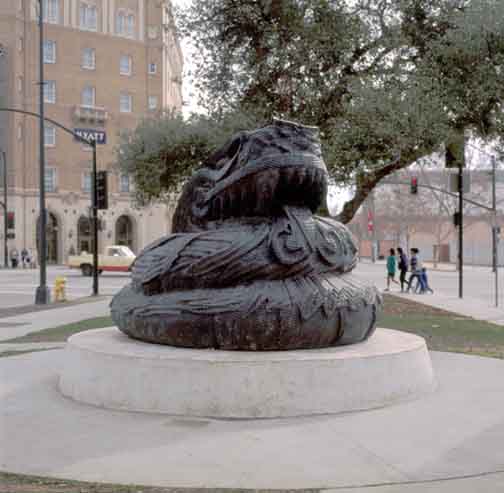
I was reminded by this week's bulletin from the oratory of that the city of San Jose commissioned and put on display a statue by Robert Graham (wiki) of the Aztec god Quetzalcoatl "in a park just adjacent to St. Joseph's Cathedral"; this reminder was occasioned by the feast of Our Lady of Guadalupe.
How many of the city's Mexican[-American] residents identify with Quetzalcoatl instead of la Guadalupana? Sure there are some, perhaps a growing number of Mexican-Americans radicals who reject Christianity as an imperialist import, identifying with their Aztec (or other) roots instead. But before comissioning the statute did the city of San Jose take a poll asking its Mexican[-American]s whether they wanted a statue of Quetzalcoatl or some sort of public display of la Virgen de Guadalupe? I don't recall one being done.
Another sign of the [public] rebellion against Christianity by the elites? (Somewhat akin to Julian the Apostate's reversion to paganism, but at least he believed in something, not like the secular atheists who now have power and are just interested in symbolic actions that show their rejection of Christianity.)
As a side note, there are some Mexicans who have undoubtedly embraced some form of Protestantism who reject la Guadalupana, or at least devotion to her... one student was forced to throw a picture of Nuestra Señora away by her mother. Is the diocese doing enough to reach out to them? How can it, when it is not getting enough vocations? (And whose fault is that?)
Links:
Aztlan pride sites? La Voz de Aztlan and In Search of Atzlan
SanJose.com on the statue of Quetzalcoatl
Subscribe to:
Posts (Atom)